Friday, March 6, 2015

The Second Best Exotic Marigold Hotel: Second-rate

The Second Best Exotic Marigold Hotel (2015) • View trailer 
Three stars. Rated PG, for mild profanity and sensuality

By Derrick Bang • Originally published in The Davis Enterprise, 3.6.15

In this particular case, “second best” is ... merely OK.

It’s like visiting a friend you haven’t seen for a few years, only to discover that the friend has changed. And not for the better.

Able — if only for a moment — to forget the various issues plaguing his personal and
professional life, Sonny (Dev Patel, center) reflects on the warm bond he has established
with Muriel (Maggie Smith, at his immediate right).
The set-up is familiar, and therefore offers less of the first film’s delightful sense of discovery; the subplots are more contrived, giving a sense, at times, that all concerned are trying too hard; and Maggie Smith doesn’t get nearly as many of her deliciously piquant one-liners (echoing those she also flings so readily on TV’s Downton Abbey).

At 122 minutes, this sequel also is a bit long, and drags in spots.

Fortunately, familiarity isn’t an entirely bad thing. The entire cast has returned for this second outing, as have writer/director John Madden and co-scripter Ol Parker. They’re all seasoned pros, and while the ground on which they tread may be worn, they nonetheless step with alacrity.

There’s no question that the first Hotel’s success owes much to aging baby-boomers who tire of comic-book movies; we also can point to similarly delightful “aging relic” characters in recent films such as Quartet, Philomena, Pride and even the aforementioned Downton Abbey. Frankly, it’s refreshing to spend time with people who weren’t in diapers a mere decade ago.

That said, Madden and Parker shrewdly hedge their bets by including the much younger Dev Patel, even more familiar now, in the wake of his three-season run on HBO’s The Newsroom His Sonny Kapoor continues to be the hilariously over-enthusiastic glue that binds the residents of his Jaipur-based Exotic Marigold Hotel.

Patel also knows his way around a well-timed line delivery, and Sonny remains much like the dinner guest who invariably embarrasses himself, no matter what the conversational circumstances, by going one ill-advised sentence over the edge.

But poor Sonny endures more than his share of flustered setbacks in the second outing, and Patel struggles gamely to navigate these abnormal waters. That he mostly succeeds has more to do with his skill as an actor, than with the material with which he’s forced to work.

And “forced” seems the operative term. Much of the first film’s dynamic revolved around fish-out-of-water tension: the need for ex-pat Brits to navigate this exotic and wholly alien territory. Well, the territory has become comfortable, which means that Madden and Parker have to pull new narrative tricks out of their hats ... and the strain is noticeable.

Chappie: Too many nuts, not enough bolts

Chappie (2015) • View trailer 
Three stars. Rated R, for violence, gore and constant profanity

By Derrick Bang

The best part about Chappie is the title character: not the robot per se, but the marvelous motion-control “performance” given by Sharlto Copley, which was built into a CGI character by the film’s video effects wizards.

Once Chappie falls in with rather evil companions, his "maker" Deon (Dev Patel) tries to
share some important moral imperatives ... such as Thou Shalt Not Kill. But while this
suddenly sentient robot understands the notion of conscience, his "monkey see, monkey do"
tendencies often yield less than ideal results.
We never see Copley on screen, of course, and there’s certainly no way that he could be concealed within this robot’s streamlined mechanical form ... but the actor grants this character a personality, awareness and sense of presence that evoke the similarly brilliant manner in which Andy Serkis brought Gollum to life, in Peter Jackson’s Lord of the Rings and Hobbit films.

I only wish that director Neill Blomkamp’s film were the equal of its star.

The South African-born Blomkamp burst on the cinematic scene with 2009’s stunning District 9, a thoughtful sci-fi parable that explored racism, class divides and political skullduggery, while simultaneously building to a rip-roaring climax: a neat trick in all respects.

But Blomkamp has recycled many of the same story elements in subsequent projects, to diminishing returns. Its much bigger budget notwithstanding, 2013’s Elysium played the same narrative card: the violent efforts of an oppressed underclass to rebel against a harsh and long-established social order, with the catalyst being a lone individual who undergoes a spiritual and even physical transformation.

And here we are at Chappie, Blomkamp’s third sci-fi epic, and — as in District 9 — our central character once again is an innocent forced to adapt to horrific circumstances, while unwittingly becoming the face of social upheaval.

This time, though, Blomkamp and co-scripter Terri Tatchell have compounded the sense of déjà vu by borrowing heavily from previous cinema sci-fi. The result too frequently feels like a clumsy blend of Robocop (the 1987 original) and Australian director George Miller’s savage, post-apocalyptic Mad Max series, stitched together like Frankenstein’s monster.

Along with elements that have become Blomkamp clichés after only three films, most particularly the testosterone-enraged, alpha-male villain who comes after our hero with bigger, badder hardware: David James’ Koobus, in District 9; Copley’s Kruger, in Elysium; and now Hugh Jackman’s Vincent Moore, in Chappie. They’re all the same character: unhinged psychopathic thugs. Been there, grimaced at that.

Friday, February 27, 2015

Focus: A sharply conceived caper

Focus (2015) • View trailer 
3.5 stars. Rated R, for profanity, sensuality and brief violence

By Derrick Bang • Originally published in The Davis Enterprise, 2.27.15

Heist flicks rely on two essential ingredients: a tight, logical script that holds together even as the narrative veers in unexpectedly twisty directions; and — just as important — a sharply constructed cast of characters, played by actors who approach this material with sincerity and conviction.

Having pulled off yet another successful con, Nicky (Will Smith) and Jess (Margot Robbie)
realize that they make a pretty good team. But their increasing fondness for each other, on
a personal level, threatens the objectivity that's essential in their nefarious line of work...
In other words, actors who don’t preen from one scene to the next, undercutting the tension and suspense we desire from the genre.

Ideal scripts, in turn, need to be clever on three levels: the core storyline — in other words, the actual caper(s) — which should be intriguing, unusual and introduced with zest; the inevitable “unexpected” glitch that complicates matters, and which the filmmakers usually expect us viewers to anticipate; and, finally, the genuinely surprising second twist, which nobody sees coming, and which leaves us nodding with admiration.

Hats off to the writing/directing team of Glenn Ficarra and John Requa, then, because Focus delivers on all counts. Heist thrillers are one of my favorite genres; I’ve seen scores of good ones, and therefore usually anticipate all manner of revelations, hiccups and gotchas.

And yet Ficarra and Requa startled me, with their devious, eleventh-hour eyebrow-raiser. Well done.

On top of which, they’ve assembled ideal talent, starting with smooth-as-silk Will Smith, whose every word, deed, gesture and wary expression denote career larceny. He’s perfectly cast as the sophisticated Nicky Spurgeon, a seasoned master of misdirection, who deploys and unerringly supervises a veritable squadron of sharps, pick-pockets and thieves at crowded, high-profile events such as conventions and parades.

Smith is well matched by Margot Robbie’s Jess Barrett, a frisky blonde with a sensual wiggle, who worms her way into Nicky’s crew with the sort of breathy admiration and flirty innocence that Marilyn Monroe perfected, back in the day. Robbie will be remembered as Leonaro DiCaprio’s seductively controlling wife in 2013’s The Wolf of Wall Street, and let’s just say that she’s equally alluring here.

And just as unpredictable. Indeed, Jess wears “devious” like the slinky, skin-tight dresses into which Robbie gets poured; we can’t help wondering about her end game, from the moment she catches Nicky’s attention.

But, then, we also don’t expect him to be candid with her, so the question revolves around who’s likely to get played, and how quickly.

Meanwhile, Smith and Robbie — both dripping with sensual savoir-faire — circle each other with a playfully erotic grace that wholly eluded the characters in Fifty Shades of Grey.

The Lazarus Effect: Dead on arrival

The Lazarus Effect (2015) • View trailer 
One star. Rated PG-13, for dramatic intensity, horror violence and mild sensuality

By Derrick Bang

This is what passes for scary these days?

This laughable, ludicrous swill?

Modern audiences are getting very short-changed.

With his suddenly homicidal fiancée prowling the darkened corridors outside their lab,
Frank (Mark Duplass) cautions Eva (Sarah Bolger) to stay quiet, while he concocts a
silly plan to save the day.
This flaccid rubbish is bad in so many ways, one scarcely knows where to begin. Luke Dawson and Jeremy Slater’s irrationally asinine script? David Gelb’s artless, hammer-handed directing? The cast of blithering idiots who couldn’t inject credibility into their dialogue if their lives depended on it?

In fairness, bad line readings aren’t entirely the fault of the cast; nobody could have made this clumsy nonsense sound persuasive. That said, the performances also don’t deserve placement on anybody’s résumé.

At its core, this is just another sloppy re-tread of the hoary Frankenstein saga, with bioengineered chemicals taking the place of good ol’ lightning. This, too, is part of the problem; Dawson and Slater haven’t an original thought between them, and seem content to blatantly rip off vastly superior predecessors.

And they can’t even do that well.

Frank (Mark Duplass) and his fiancée Zoe (Olivia Wilde), running a research lab at a fictitious, Berkeley-based university, are being assisted by graduate students Niko (Donald Glover) and Clay (Evan Peters). The team recently has hired an undergraduate videographer, Eva (Sarah Bolger), to record their progress.

(One cliché of bad writing, by the way, is the affectation of granting people no more than first names: Nothing calls faster attention to wafer-thin, one-dimensional characters.)

Although Eva’s presence gives Gelb an excuse to dabble in “found footage”-style video inserts, this affectation — mercifully — quickly is replaced by Michael Fimognari’s conventional cinematography. Which, to be fair, is a point in Gelb’s favor.

Anyway...

Frank and Zoe apparently obtained their original grant to develop a chemical “boost” that would help revive patients who code on an operating table: something akin to adrenalin or defibrillation. Somewhere along the way, though, they began attempting to resurrect deceased animals with their gloppy white formula; they finally succeed with a dog named Rocky.

Champagne all around.

But Rocky has come back ... ah ... different: warier, stronger and more aggressive. (Cue strong memories of Stephen King’s vastly superior Pet Sematary ... and I mean the book, not the lousy 1989 film adaptation.) Clay spouts the pseudo-scientific gibberish that “explains” this transformation: Thanks to the injected glop, Rocky’s brain is building massive neural networks, moving well past the usual limits of his species. Or some such nonsense.

Not sure why that would make him so violent, but hey, I’m no brain surgeon. (Neither is anybody in this movie. Obviously.)

Friday, February 20, 2015

McFarland USA: A genuine heart-warmer

McFarland USA (2015) • View trailer 
Four stars. Rated PG, for mild dramatic intensity

By Derrick Bang • Originally published in The Davis Enterprise, 2.20.15

For crowd-pleasing cinema, it’s hard to beat an inspirational underdog sports saga.

Particularly one that’s true. (Well, mostly.)

After yet another frustrating argument at home, the forlorn Thomas (Carlos Pratts, right)
briefly contemplates an extremely foolish way out of his miserable life. Cue the well-timed
arrival of Coach Jim White (Kevin Costner), whose calm and inspirational pep talk is the
stuff of which great underdog sports flicks are made.
Director Niki Caro and the team behind McFarland USA have the formula down cold, with an engaging blend of character drama, cross-cultural tension and stirring competition. Caro is blessed with an eye and ear for the plight of disenfranchised people who sometimes feel like strangers in their own country; she’s the New Zealand-based filmmaker who came to our attention with 2002’s stirring Whale Rider, and followed up with the equally compelling North Country.

Both those films concerned women stymied in their efforts to succeed on their own terms, and forced to battle long-established conventions steeped in predominantly male cultures.

McFarland USA trades gender wars for a gentle analysis of the class structure that exists in this country, and the cynical hopelessness endured by those who live on the wrong side of that divide. Caro and her writers — Christopher Cleveland, Bettina Gilois and Grant Thompson — are smart enough to eschew strident sermons, recognizing that the lessons here will go down more smoothly in an environment of optimism and compassion.

On top of which, the story cleverly rotates the social barrier, by making its central character and his family — products of so-called privileged society — the “outsiders” in an environment that feels completely alien, and has its own longstanding rules of behavior and attitude.

High school football coach Jim White (Kevin Costner) has a history of anger-management issues. Bounced from one school to another, acquiring a dismal reputation along the way, in the autumn of 1987 he bottoms out in California’s San Joaquin Valley agricultural community of McFarland. As he and his family — wife Cheryl (Maria Bello) and daughters Julie (Morgan Saylor) and Jamie (Elsie Fisher) — drive slowly through town, searching for their new home, the latter curiously asks, “Are we in Mexico?”

It’s a brave opening gambit, because the movie succeeds or fails right there: The slightest whiff of censure, disapproval or arrogance, and the story slides into uncomfortably racist territory. But Caro understands the peril involved, and she draws just the right line reading from young Fisher.

The moment passes safely, but is followed by several more; we still unconsciously hold our breath. The living room of the Whites’ new home is dominated by an overpowering image painted directly onto the wall. The elderly woman next door presents them with a “new neighbor” gift: a chicken. The local car culture roars past the house late into each night; roosters blast them out of bed each dawn.

Tuesday, February 17, 2015

One Chance: Quite endearing, if slightly flawed

One Chance (2013) • View trailer 
3.5 stars. Rated PG-13, and needlessly, for brief profanity and mild sexual candor

By Derrick Bang


[Note: I’ve given up on waiting for this film to be granted wide release in the States; it obviously ain’t gonna happen. The Weinstein Company initially promised us this British import in late 2013, and then delayed it to last spring, and then granted it limited release in October. Apparently, that’s all we’ll get ... and yet there’s also no word yet of home video release, despite its DVD availability across the pond for at least a year now. Such are the idiosyncrasies of U.S. film distribution ... and, regardless, I’m not letting this review go to waste!]

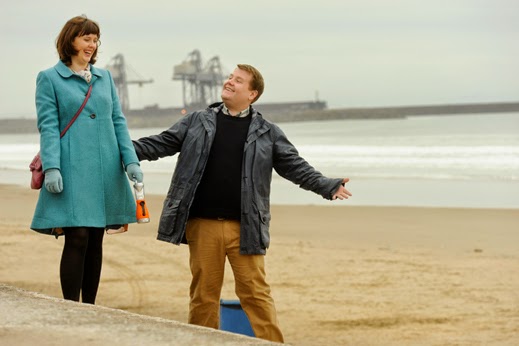
During a courtship that's frequently too cute for words, Paul (James Corden) never misses
an opportunity to serenade Julz (Alexandra Roach) with one of his favorite opera arias.
Some people are blessed and cursed in equal measure, and that’s certainly the case with Britain’s Paul Potts. Although graced with a lovely voice and a childhood fondness for opera and choir singing, these interests made him a frequent target for contemptuous peers in the Bristol-based, former quarry hamlet of Fishponds, where he grew up.

The rather unusual arc of Potts’ subsequent life is the subject of this whimsical, sometimes melancholy biographical drama from David Frankel, who previously charmed us with gentle character-clash comedies such as The Devil Wears Prada and the under-appreciated The Big Year.

Frankel is a good choice for this material; I’m less certain about scripter Justin Zackham, thus far known only for The Bucket List and The Big Wedding, both broad-strokes comedies fronted by A-list casts. One Chance is his first feature-length stab at factual material; while retaining many elements crucial to Potts’ life, Zackham plays fast and loose with other important details, for no apparent reason.

The real Potts has two brothers and a sister, all of whom are MIA in this film. Their father was a bus driver, not a steelworker. Most crucially, Potts wasn’t nearly as socially inept as this film suggests; he was elected the youngest member of the Bristol City Council as a Liberal Democrat in 1996, a position he held for seven years. That far-from-minor detail also remains MIA.

It could be argued that none of this matters, in the telling of a real-life Cinderella story, and that’s true ... to a point. But Potts’ actual experiences are sufficiently compelling to warrant a more accurate account of his ups and downs; heightening his misfit qualities, to make him even more of an underdog, feels like gilding the lily.

Even so, Frankel and Zackham skillfully work our emotions, building us to what should be a joyfully shared triumph ... and then they pull the rug out from under us. I’ve rarely seen a feel-good film so badly miscalculate its finale, employing a hasty voice-over to replace what should have been, at the very least, an ecstatic montage.

It’s an atrocious use of said-bookism: We don’t want to be told what happens during the climax, we want to watch it happen. Good grief, that’s basic Storytelling 1A.

Sigh.

Friday, February 13, 2015

Fifty Shades of Grey: Colorless

Fifty Shades of Grey (2015) • View trailer 
One star. Rated R, for strong sexual content, profanity and considerable nudity

By Derrick Bang • Originally published in The Davis Enterprise, 2.13.15

While it’s certainly true that this film is better than the atrociously written book on which it’s based, that’s damning with very faint praise.

Because this film still is a stinker.

Hunky gazillionaire Christian Grey (Jamie Dornan) makes Anastasia (Dakota Johnson) an
offer she absolutely should refuse: to become his "submissive" during a brief "relationship"
that he promises won't include love. Hey, it's every girl's dream, right?
Dakota Johnson is reasonably persuasive as Anastasia Steele, the naïve, freshly minted college graduate who enters a web of sexual sin with a blend of curiosity, wariness and endearing, flirty innocence. Kelly Marcel’s screenplay also makes Ana smarter and spunkier than the dim-bulb imbecile of E.L. James’ so-called novel, who constantly talked and behaved as if she were 21 going on 12.

But Jamie Dornan is a total joke as billionaire, super-stud businessman Christian Grey. Dornan couldn’t act his way out of a snowball in hell; he actually makes Keanu Reeves look talented. Dornan is as uncomfortable in this role as his Grey is in his impeccably tailored clothes: stiff, awkward and wholly unconvincing.

Dornan’s line readings are the stuff of acting workshop nightmares ... although, in fairness, I’m not sure anybody could breathe credible life into this wooden dialogue.

Director Sam Taylor-Johnson has precisely two tricks up her sleeve, and she uses both to wretched excess: constant tight-tight-tight close-ups on her two stars, and instructions that they deliver every word with breathy, clipped, arched-eyebrow hesitation. Both affectations are the stuff of turgid afternoon TV soap operas, a level to which this film constantly sinks.

An over-reliance on tight close-ups minimizes a story’s sense of time and place; it’s also boring. Most significantly, it denotes a director who doesn’t trust her cast, the theory being that (for example) it’s easier for Dornan to emote if cinematographer Seamus McGarvey moves his camera close enough for us to count the pores on Christian Grey’s cheeks.

That’s the trouble with theories: Not all of them turn out to be true.

Taylor-Johnson has only one previous feature film to her credit: Nowhere Boy, 2009’s thoughtful biography of John Lennon’s early years. It’s leagues better than this dull, turgid, over-hyped and under-delivering mess.