3.5 stars. Rated PG-13, and needlessly, for brief profanity and mild sexual candor
By Derrick Bang
[Note: I’ve given up on waiting for this film to be granted wide release
in the States; it obviously ain’t gonna happen. The Weinstein Company initially
promised us this British import in late 2013, and then delayed it to last
spring, and then granted it limited release in October. Apparently, that’s all
we’ll get ... and yet there’s also no word yet of home video release, despite
its DVD availability across the pond for at least a year now. Such are the idiosyncrasies
of U.S. film distribution ... and, regardless, I’m not letting this review go
to waste!]
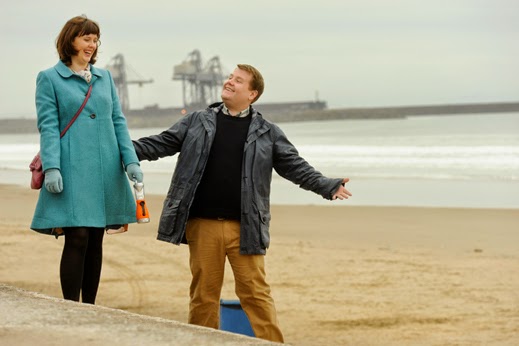 |
| During a courtship that's frequently too cute for words, Paul (James Corden) never misses an opportunity to serenade Julz (Alexandra Roach) with one of his favorite opera arias. |
Some people are blessed and
cursed in equal measure, and that’s certainly the case with Britain’s Paul
Potts. Although graced with a lovely voice and a childhood fondness for opera
and choir singing, these interests made him a frequent target for contemptuous
peers in the Bristol-based, former quarry hamlet of Fishponds, where he grew
up.
The rather unusual arc of Potts’
subsequent life is the subject of this whimsical, sometimes melancholy
biographical drama from David Frankel, who previously charmed us with gentle
character-clash comedies such as The
Devil Wears Prada and the under-appreciated The Big Year.
Frankel is a good choice for this
material; I’m less certain about scripter Justin Zackham, thus far known only
for The Bucket List and The Big Wedding, both broad-strokes
comedies fronted by A-list casts. One
Chance is his first feature-length stab at factual material; while
retaining many elements crucial to Potts’ life, Zackham plays fast and loose
with other important details, for no apparent reason.
The real Potts has two brothers
and a sister, all of whom are MIA in this film. Their father was a bus driver,
not a steelworker. Most crucially, Potts wasn’t nearly as socially inept as
this film suggests; he was elected the youngest member of the Bristol City
Council as a Liberal Democrat in 1996, a position he held for seven years. That
far-from-minor detail also remains MIA.
It could be argued that none of
this matters, in the telling of a real-life Cinderella story, and that’s true
... to a point. But Potts’ actual experiences are sufficiently compelling to
warrant a more accurate account of his ups and downs; heightening his misfit qualities,
to make him even more of an underdog, feels like gilding the lily.
Even so, Frankel and Zackham
skillfully work our emotions, building us to what should be a joyfully shared
triumph ... and then they pull the rug out from under us. I’ve rarely seen a
feel-good film so badly miscalculate its finale, employing a hasty voice-over
to replace what should have been, at the very least, an ecstatic montage.
It’s an atrocious use of
said-bookism: We don’t want to be told
what happens during the climax, we want to watch
it happen. Good grief, that’s basic Storytelling 1A.
Sigh.

