Showing posts with label Judi Dench. Show all posts

Friday, March 4, 2022

Belfast: Deeply moving snapshot of a nation in crisis

Belfast (2021) • View trailer
Five stars (out of five). Rated PG-13, for violence and profanity
Available via: Movie theaters, Amazon Prime and other streaming services

Armed with an impressive seven Academy Award nominations, Kenneth Branagh’s riveting, semi-autobiographical drama has just become available via streaming services.


This is must-see cinema.


Buddy (Jude Hill, his back to camera) listens quietly while his mother (Caitriona Balfe),
grandmother (Judi Dench) and grandfather (CiarĂ¡n Hinds) explain what has been
happening in their neighborhood.


It isn’t easy to layer an era of chaos, tumult and danger with warmth and humor, and Branagh — who wrote the script, as well as directing — has done so sublimely. He wisely followed John Boorman’s lead, who in 1987’s Hope and Glory similarly depicted the horrors he experienced as a child in London during World War II.

In this case, Branagh’s quasi-surrogate self is 9-year-old Buddy, played with beguiling innocence and impishness by Jude Hill, in a stunning feature film debut. Because this story is viewed through Buddy’s experiences and imagination, Hill is in practically every scene, and he capably carries the film; he’s beyond adorable. 


Branagh extracts an amazingly accomplished and nuanced performance from this young lad. It’s a crime that he didn’t secure a Best Actor nod to accompany all the other well-earned nominations.


Cinematographer Haris Zambarloukos opens with an imposing, full-color overview of today’s Belfast. We then slide into a crowded, working-class pocket neighborhood; the image turns monochromatic as we’re whisked back to the summer of 1969. Children play merrily in the sun-dappled streets; adults chat amiably while walking to and from the little shops nestled in between row houses.


Everybody knows everybody else. When Buddy’s Ma (Caitriona Balfe) calls him in for tea, the message is passed along via children and adults until it finally reaches him. 


Then, suddenly, anarchy: An angry mob rounds a street corner like a swarm of maddened bees, laying waste to homes, shop windows, vehicles and anything else in their path … with a focus on Catholic families. It’s the opening salvo of the five-day political and sectarian violence that quickly spread through Ireland and led to the 30-year conflict dubbed “The Troubles.”


Buddy, terrified, stands frozen like a deer caught in headlights. We see the disconnect in his gaze; the boy cannot begin to comprehend the savage reality of what’s happening.


In that instant, his life — and that of his family, and everybody else — is altered. Forever. The calm of sociable neighborliness has been shattered, never to return; Catholic and Protestant families, once close friends, now eye each other warily. (Buddy and his family are Protestants.)


In the aftermath, streets are barricaded; watchers are posted 24/7. Buddy’s universe — this tiny portion of Northern Belfast — has become an artificial island.


Friday, July 3, 2020

Artemis Fowl: Quite foul

Artemis Fowl (2020) • View trailer 
Two stars. Rated PG, for fantasy action and mild rude humor

By Derrick Bang • Originally published in The Davis Enterprise, 7.3.20

When fantasy goes bad, it goes really bad.

I’m not surprised Disney abandoned theatrical release for this fiasco, in favor of a debut on its Disney+ streaming service.

Things are about to get much worse: Our heroes — from left, Domovoi (Nonso Anozie),
Holly (Lara McDonnell), Mulch (Josh Gad) and Artemis (Ferdia Shaw) — react with
horror as a massive troll prepares to ... well ... eat them.
But I’m frankly astonished that director Kenneth Branagh kept his name on it, because this misbegotten adventure clearly endured post-production tampering that left major chunks of key plot details on the cutting-room floor. What remains makes no sense whatsoever.

You’ll spend half the film — if you’re foolish enough to waste time with it — muttering, “But what about…?”

Matters also aren’t helped by the fact that the title character is an arrogant, thoroughly obnoxious little snot. He’s played by first-time actor Ferdia Shaw, and boy, the inexperience shows. His so-called performance is stiff as a board, and he’s constantly upstaged by everybody else in the cast … not a good thing, for the designated star.

(Seriously, Kenneth? This was the best you could get out of the boy?)

I can’t imagine fans of Eoin Colfer’s popular young adult series liking anything about this film. Scripters Conor McPherson and Hamish McColl extracted bits and bobs from the first two books — 2001’s Artemis Fowl and 2002’s Artemis Fowl and the Arctic Incident — but largely fabricated their own original story; calling the result a disappointment is gross understatement.

Perhaps the biggest sin is that Artemis, Colfer’s feisty “13-year-old criminal mastermind,” has been bowdlerized — in typical Disney fashion — into a “12-year-old devil-may-care genius.” Ergo, this film’s Artemis doesn’t do any thieving; indeed, he’d accomplish very little, were it not for the far more heroic efforts of his colleagues.

He has been sanitized to the point of utter blandness.

Sad, sad, sad.

Branagh opens his film with a ludicrous media throng gathered outside Northern Ireland’s imposing Fowl Manor (actually Antrim’s Dunluce Castle), in the aftermath of some Cataclysmic Event. An imposing figure — we soon learn he’s Mulch Diggums (Josh Gad) — is spirited away to a remote interrogation facility, where he reveals what occurred via flashback.

Enter Artemis, who prefers surfing to the humdrum routine of school work that doesn’t begin to tax his massive intellect. (Not that the surfing has anything to do with what follows, but it did keep the six members of this film’s “Surf Unit” occupied.)

Friday, December 20, 2019

Cats: Purr-vasively strange

Cats (2019) • View trailer 
Three stars. Rated PG, for some suggestive humor

By Derrick Bang


From the opening moments and without interruption throughout, director Tom Hooper’s big-screen adaptation of Cats is visually breathtaking: a mesmerizing display of cinematic razzle-dazzle dominated by Paco Delgado’s stunning costume design, Sharon Martin’s equally impressive hair and makeup design, and Andy Blankenbuehler’s inventive choreography.

Having unwisely followed the larcenous Rumpleteazer (Naoimh Morgan, left) and
Mungojerrie (Danny Collins, right) into a human house, in order to steal anything that
catches their fancy, Victoria (Francesca Hayward) is dazzled and distracted by
all the finery.
Theater fans who delight in ostentatious production numbers will be blown away. That’s the only possible reaction.

Those seeking a story to go along with all the visual excess, however, will find this many kibbles short of a full bowl.

In fairness, that shortcoming is equally true of the play. Andrew Lloyd Webber’s staging of T.S. Eliot’s poems in Old Possum’s Book of Practical Cats was audaciously far-fetched to begin with, and it definitely didn’t resonate in the manner of Phantom of the Opera or Les MisĂ©rablesCats plays more like an opulent cabaret show, with individual production numbers linked by the barest trace of plot.

And a very weird plot, at that.

The film opens ominously, as a car stops in a Soho alley; the driver gets out only long enough to discard a sack with something inside. The car departs; the sack is surrounded by dozens of cats (all actors), who help the young feline inside free herself. This is Victoria (Francesca Hayward, principal ballerina at The Royal Ballet), abandoned by unseen owners. (Human beings never appear in this saga. Nor do dogs, although one is heard.)

Victoria discovers that she has been embraced by a tribe of cats known as the Jellicles, on the very night that matriarch Old Deuteronomy (Judi Dench) will make the “Jellicle choice” that determines which cat will be reborn into a new life, by ascending to the Heaviside Layer.

(One simply must run with this.)

The rest of the film is dominated by the contenders for this honor, each granted a descriptive song and dance that reveals characteristics and talents. In that respect, Cats is somewhat akin to A Chorus Line, building to the triumphant “choosing moment.” But Cats is more full-blown opera, with each lengthy song weaving into the next; very few lines are spoken in dramatic fashion, absent musical accompaniment.

Friday, November 10, 2017

Murder on the Orient Express: A misdemeanor offense

Murder on the Orient Express (2017) • View trailer 
Three stars. Rated PG-13, and rather harshly, for brief violence and mild dramatic intensity

By Derrick Bang

Many actors long to play Hamlet.

Others look forward to taking a crack at Hercule Poirot.

When an avalanche delays the London-bound Orient Express, Hercule Poirot (Kenneth
Branagh) is in the perfect position to solve a heinous murder ... because the killer still
must be somewhere on the train.
Kenneth Branagh is a marvelous Poirot. He nails Agatha Christie’s famous Belgian private detective: from the meticulous OCD tendencies — stroking his perfectly coifed mustache, sizing up the comparative height of his twin breakfast soft-boiled eggs — to the narrowed gaze and waspish tone that indicate crime scene analysis undertaken by his “little grey cells.”

Branagh definitely deserves placement alongside David Suchet and Albert Finney, as cinema’s greatest Poirots.

Alas, the same cannot be said for the vehicle in which Branagh’s Poirot inhabits. Screenwriter Michael Green’s attempt to turn Christie’s Murder on the Orient Express “relevant” for modern viewers makes a shambles of her ingeniously plotted 1934 novel. His adaptation commits the cardinal sin of telegraphing the twist so early, that he gives away the game before we’re even halfway through the film.

Green was an odd choice for this assignment. He’s into excess and exploitation: a sci-fi/horror guy whose credits include Green Lantern, Logan, Alien: Covenant and television’s Gotham and American Gods. He obviously lacks the subtlety and sly British wit required of a Christie mystery, which demands the touch of somebody like Peter Morgan (The Queen, television’s The Crown) or Julian Fellowes (Downton Abbey and his own marvelous Christie pastiche, 2001’s Gosford Park).

Green struggles mightily to transform this story into an action-oriented adventure akin to director Guy Ritchie’s recent re-boots of Sherlock Holmes, and it simply doesn’t work. Murder on the Orient Express is a mostly tranquil drawing-room mystery ... except that it takes place aboard a train.

Branagh also directs, and succumbs overmuch to long tracking shots and other visual flourishes, which further diminish the story at hand. One sequence, inexplicably shot from above the characters’ heads as they enter a train compartment, is incredibly distracting.

Branagh seems to love the camera trickery made possible by contemporary CGI effects, and misses no opportunity for stunning vistas of the eponymous train, as it navigates the mountainous regions from Here to There: undeniably gorgeous, as is Haris Zambarloukos’ cinematography ... but rather beside the point.

The story takes place in 1934. Green opens the film with a droll prologue that hasn’t a thing to do with Christie, but nonetheless deftly establishes everything we need to know about Poirot. A last-minute change of plans interrupts an intended vacation in Istanbul, and prompts him to board the lavish Orient Express en route to London via Italy, Switzerland and France.

Friday, September 29, 2017

Victoria and Abdul: A revealing friendship

Victoria and Abdul (2017) • View trailer 
3.5 stars. Rated PG-13, and too harshly, for dramatic elements and mild profanity

By Derrick Bang

History is laden with fascinating incidents and anecdotes, and — here’s the amazing thing — more pop up all the time.

Having been granted the privilege of serving "the jelly" — at the request of Queen Victoria
(Judi Dency) — Abdul (Ali Fazal, center) does his best to maneuver the wobbly dessert,
while Sir Henry Ponsonby (Tim Pigott-Smith) watches nervously.
You’d think, given the tireless methodology of modern research, that we’d have uncovered pretty much everything by now. Chances are, not even close.

Case in point: The unlikely, all but unknown — and (deliberately) mostly concealed — camaraderie that bonded Britain’s Queen Victoria and a former Muslim Indian clerk named Abdul Karim. The saga came to light in 2010, with the publication of research journalist Shrabani Basu’s Victoria & Abdul: The True Story of the Queen’s Closest Confidant; the details were assembled from the hitherto undiscovered journals of both Abdul and Victoria, the latter written in Hindustani Urdu (!).

The narrative immediately demanded even wider exposure, and this thoughtful big-screen translation comes courtesy of director Stephen Frears: an apt choice, given the similar sensitivity he brought to the depiction of Elizabeth II, in 2006’s The Queen. Scripter Lee Hall has adapted Basu’s book with grace and the sly wit at which the British excel, particularly when they’re poking gentle fun at themselves.

The thoroughly captivating result is anchored by the venerable Judi Dench, taking a second crack at the role she first played in 1997’s Mrs. Brown (which, rather intriguingly, details a similarly “imprudent” incident in Queen Victoria’s life). But while Dench dominates this new film — how could she not? — Ali Fazal also deserves credit for the elegance with which he has brought an equally compelling character to life.

This is late during Queen Victoria’s reign, when she has become — in her own words — fat, lame, cantankerous and impotent (along with several other marvelous pejoratives that I couldn’t jot down quickly enough). The regal routine, and life itself, have become tedious things to be endured, rarely enjoyed. She suffers fools not at all, let alone gladly; each day begins with chiding admonitions about diet and “movement” from the royal physician, Dr. Reid (Paul Higgins).

Dench always has excelled at withering glances, and they get plenty of exercise here. Victoria is well aware of the obsequious jockeying that takes place behind closed doors, as her many children — led by heir apparent Bertie (Eddie Izzard) — and court hangers-on curry favor and snipe at each other. No conversation comes close to actual candor; she can’t trust anybody to be sincere, and she’s well aware that everybody is waiting for her to die.

Friday, September 30, 2016

Miss Peregrine's Home for Peculiar Children: Enchanting fantasy

Miss Peregrine's Home for Peculiar Children (2016) • View trailer 
Four stars. Rated PG-13, for dramatic intensity and quite scary fantasy violence

By Derrick Bang

It would be difficult to imagine a more perfect marriage of imaginative picto-fiction and eccentric filmmaking sensibilities.

All dressed up and ready for ... we know not what: from left, Olive (Lauren McCrostie),
Claire (Raffiella Chapman), the invisible Millard (Cameron King), the Twins (Thomas and
Joseph Odwell) and Emma (Ella Purnell).
Author Ransom Riggs’ neo-gothic Miss Peregrine’s Home for Peculiar Children was released to acclaim in the summer of 2011, spending well over a year on The New York Times’ Children’s Best Sellers list. It occupies a niche that blossomed with the 2007 arrival of Brian Selznick’s The Invention of Hugo Cabret, brought to the big screen with panache by director Martin Scorsese.

Tim Burton has just done the same with Miss Peregrine, and if the results aren’t quite as impressive, it’s a beguiling near-miss. This new film also plays to one of Burton’s career themes: the importance of responding with kindness and grace to the misfits in our world, as opposed to shunning or fearing them.

Scripter Jane Goldman — boasting oodles of fan cred for her handling of Kingsman, Neil Gaiman’s Stardust and two of the X-Men films — has faithfully retained both the core plot of Riggs’ unusual narrative, as well as its mythical, off-kilter and slightly morbid atmosphere.

That’s no small feat: As with The Invention of Hugo Cabret, much of Miss Peregrine’s appeal lies in the manner in which the story unfolds, and how Riggs chooses to tell it.

Both books also cleverly exploit actual world history, transporting readers to pivotal eras that are both simpler and more dangerous.

And, perhaps best of all, both books evoke the imaginative blend of words and images that was much more common in the late 19th and early 20th centuries, led by fantasists such as Lewis Carroll, H.G. Wells and Jules Verne. It would be nice if modern readers — of all ages — grew more tolerant of books with pictures.

Rather drolly, both film adaptations share the same young star.

Miss Peregrine begins in present-day Tampa, Florida, as teenage Jake (Asa Butterfield) discovers that his beloved grandfather, Abraham (Terence Stamp), has died — or been killed — under sinister circumstances. Jake finds the body in the woods near Abraham’s house, and is horrified to discover that his grandfather’s eyes are missing. Worse yet, Jake briefly glimpses a huge something lurking nearby, in the mist.

Friday, March 6, 2015

The Second Best Exotic Marigold Hotel: Second-rate

The Second Best Exotic Marigold Hotel (2015) • View trailer 
Three stars. Rated PG, for mild profanity and sensuality

By Derrick Bang • Originally published in The Davis Enterprise, 3.6.15

In this particular case, “second best” is ... merely OK.

It’s like visiting a friend you haven’t seen for a few years, only to discover that the friend has changed. And not for the better.

Able — if only for a moment — to forget the various issues plaguing his personal and
professional life, Sonny (Dev Patel, center) reflects on the warm bond he has established
with Muriel (Maggie Smith, at his immediate right).
The set-up is familiar, and therefore offers less of the first film’s delightful sense of discovery; the subplots are more contrived, giving a sense, at times, that all concerned are trying too hard; and Maggie Smith doesn’t get nearly as many of her deliciously piquant one-liners (echoing those she also flings so readily on TV’s Downton Abbey).

At 122 minutes, this sequel also is a bit long, and drags in spots.

Fortunately, familiarity isn’t an entirely bad thing. The entire cast has returned for this second outing, as have writer/director John Madden and co-scripter Ol Parker. They’re all seasoned pros, and while the ground on which they tread may be worn, they nonetheless step with alacrity.

There’s no question that the first Hotel’s success owes much to aging baby-boomers who tire of comic-book movies; we also can point to similarly delightful “aging relic” characters in recent films such as Quartet, Philomena, Pride and even the aforementioned Downton Abbey. Frankly, it’s refreshing to spend time with people who weren’t in diapers a mere decade ago.

That said, Madden and Parker shrewdly hedge their bets by including the much younger Dev Patel, even more familiar now, in the wake of his three-season run on HBO’s The Newsroom His Sonny Kapoor continues to be the hilariously over-enthusiastic glue that binds the residents of his Jaipur-based Exotic Marigold Hotel.

Patel also knows his way around a well-timed line delivery, and Sonny remains much like the dinner guest who invariably embarrasses himself, no matter what the conversational circumstances, by going one ill-advised sentence over the edge.

But poor Sonny endures more than his share of flustered setbacks in the second outing, and Patel struggles gamely to navigate these abnormal waters. That he mostly succeeds has more to do with his skill as an actor, than with the material with which he’s forced to work.

And “forced” seems the operative term. Much of the first film’s dynamic revolved around fish-out-of-water tension: the need for ex-pat Brits to navigate this exotic and wholly alien territory. Well, the territory has become comfortable, which means that Madden and Parker have to pull new narrative tricks out of their hats ... and the strain is noticeable.

Friday, November 29, 2013

Philomena: Grace and forgiveness

Philomena (2013) • View trailer 
Four stars. Rating: PG-13, and quite needlessly, for fleeting profanity

By Derrick Bang • Originally published in The Davis Enterprise, 11.29.13

Some of them sneak up on us.

At first, journalist Martin Sixsmith (Steve Coogan) agrees to investigate the intriguing
tale related by Philomena Lee (Judi Dench) because he smells a potentially great
story. As time passes, however, her refined behavior — and generosity of spirit —
awaken a reaction that he never expected: He begins to care.
At first blush, Philomena seems the sort of mildly detached, urbane dramedy that the Brits deliver so well: a “two-hander” that places a prim, proper and deeply spiritual old woman in a car with a cynical younger journalist. It’s a road trip, a genre with which we’re quite familiar: These two disparate characters will get to know each other, achieving mutual respect and trust as the journey continues. Cue the inevitable happy conclusion.

Except that Philomena isn’t like that at all.

Director Stephen Frears’ new film is an acting showcase for star Judi Dench, who delivers yet another mesmerizing performance. Co-star Steve Coogan is a revelation in a dramatic role: a quite impressive change of pace for a confrontational British comic actor who has been nothing short of irritating in gawdawful projects such as Hamlet 2 and Tristram Shandy: A Cock and Bull Story.

They’re marvelous together, displaying an oil-and-vinegar dynamic that leaves us wondering, as the story proceeds, which one will get fed up first, and tell the other to sod off. Now, that's dramatic tension.

And, oh my goodness, the story. Shattering, unforgettable, deeply moving and laced with surprises, right up to the final scenes that deliver a truly unexpected — and frankly heart-stopping — portrait of vicious, unrepentant evil.

If that didn’t pique your curiosity, nothing will.

Coogan doesn’t merely play a featured acting role; he also co-produced and co-wrote (with Jeff Pope) the film, having been deeply touched by the book on which this factual story is based: Martin Sixsmith’s The Lost Child of Philomena Lee. Up to this moment, Coogan’s writing oeuvre has been similarly comic, often of the shrieking variety; with Pope’s help, he nonetheless delivers a sensitive, restrained and genuinely touching script.

Clearly, Coogan recognized that he need not oversell the material with florid dialogue or acting histrionics; the story’s core facts deliver their own emotional wallop. Besides which, Frears (Dirty Pretty Things, The Queen and many others) is too accomplished a director to allow that sort of nonsense. He guided Helen Mirren to an Academy Award; he may well have done the same for Dench here.

Friday, November 9, 2012

Skyfall: Shaken and stirred!

Skyfall (2012) • View trailer
Four stars. Rating: PG-13, for intense action sequences, sensuality and fleeting profanity
By Derrick Bang • Originally published in The Davis Enterprise, 11.9.12


Daniel Craig’s stint as James Bond has been about rebirth and re-invention, and Skyfall is no different, albeit with an intriguing twist: It feels more like John Le Carre than Ian Fleming.

Somehow, Daniel Craig's James Bond, left, always seems to wind up tied to a chair,
and forced to listen as the villain — in this case, Javier Bardem's Silva — shares his
nasty plans. But this is no ordinary villain, and Silva has no intention of destroying the
world's economy, or igniting a war with Russia or China. This maniac's mission is much
more personal, and it'll cut to the very core of Britain's venerable intelligence agency.
As also was the case with Casino Royale, things get personal.

The formula seems the same at the outset, with an audacious, action-laced pre-credits teaser set in Istanbul, which finds Bond and a fellow field agent (plucky Naomie Harris, as Eve) in hot pursuit of a baddie who has ambushed some MI6 colleagues and stolen a vitally important computer hard drive. First on foot, then in cars and motorcycles, and finally atop a moving train, Bond relentlessly pursues this fellow, ultimately with the assistance of a backhoe (!), all to an exhilarating orchestral score from composer Thomas Newman.

Then, at the climactic moment ... things take an unexpected turn.

And not just in terms of plot, as the scripting trio — returning scribes Neal Purvis and Robert Wade (their fifth 007 epic), allied with Oscar-nominated playwright John Logan (The Aviator, Hugo) — moves the narrative into increasingly un-Bondian waters. Director Sam Mendes gradually shifts the tone as well, utilizing the obligatory exotic locals as a means of moving the action from London to Scotland — the long way around — for a stripped-down third act very much akin to his masterful 2002 adaptation of The Road to Perdition.

An unusual approach, for our big-screen imbiber of cocktails shaken, not stirred? Indeed. But there’s a reason for the madness concocted by Mendes and his writing team: an artistic flourish that suitably honors this 50th anniversary outing in cinema’s longest-running continuous franchise. (Dr. No opened in London on Oct. 5, 1962.)

There’s also plenty of madness elsewhere, in the form of Silva: an adversary who stands among the most memorable of Bondian megalomaniacs, and is brought to chilling life by Javier Bardem. And if we see a bit of his horrific Anton Chigurh, from No Country for Old Men, that’s probably no accident.

Bond villains too frequently have felt like pretend scoundrels with fancy dress and fancier accents — particularly during the spoof-laden Roger Moore years — but Bardem’s Silva is the real deal. His introductory soliloquy on the feral nature of trapped rats probably is the best scene-stealing debut ever granted any Bond baddie, and Bardem sells the moment masterfully.

And this fellow isn’t out to rule the world; he merely wants revenge.

For what, precisely? Ah, therein lies the tale.

Friday, May 11, 2012

The Best Exotic Marigold Hotel: Make a reservation

The Best Exotic Marigold Hotel (2011) • View trailer
Four stars. Rating: PG-13, for sexual candor and fleeting profanity 
By Derrick Bang 


Change can be difficult — sometimes heartbreaking — even when embraced willingly.

It becomes considerably worse when change is forced upon us.

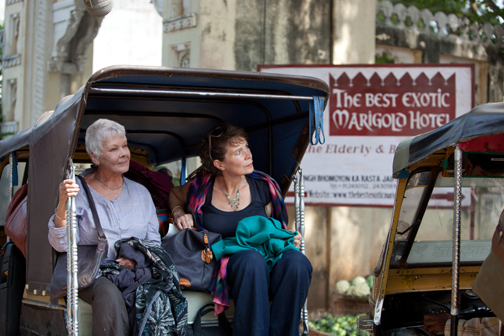
Evelyn (Judi Dench, left) and Madge (Celia Imrie) bravely embrace the hustle
and bustle of Jaipur, the city where they've elected to spend their "golden years."
Some of their companions, back at the self-professed Best Exotic Marigold
Hotel, lack this adventurous spirit ... which, obviously, is their loss.
During the prologue to director John Madden’s thoroughly charming The Best Exotic Marigold Hotel, we meet seven individuals who fear they’ve reached that point in their lives — “of a certain age,” as the fashionably polite suggest — when society deems them irrelevant. Worse yet, all these folks are further burdened by their own personal baggage, in some cases a soul-crushing weight that has dragged them down for decades.

Recently widowed Evelyn (Judi Dench) has just learned, to her humiliation, that her husband left her financially stranded and — by relegating her to the role of “companion” — unable to fend for herself. Graham (Tom Wilkinson), a High Court judge, finally has let cynicism overrule compassionate objectivity. Muriel (Maggie Smith), a fearful, reflexive xenophobe, needs hip replacement surgery.

Singletons Madge (Celia Imrie) and Norman (Ronald Pickup), refusing to gracefully accept their advanced years, continue to seek sexual thrills like thirtysomething sybarites. Tragically, marital bliss died long ago for Jean (Penelope Wilton) and Douglas (Bill Nighy); now she only snipes at him, while he patiently endures.

Fans of British cinema already realize they need read no further; with a cast like this, how could Madden’s adaptation of Deborah Moggach’s These Foolish Things — screenplay by Ol Parker — miss?

It doesn’t, of course. The Best Exotic Marigold Hotel is a gentle reminder that life doesn’t stop at 60; that new experiences are to be embraced, not avoided; that fate truly does reward the brave; and that it’s never too late to make new friends or find new lovers.

Through chance, serendipity and design — and, in Muriel’s case, medical necessity (no waiting time for her surgery) — all these retirees find themselves on the same plane to India, responding to the skillfully worded promise of colorful brochures and come-hither Internet sites extolling the luxurious accommodations of Jaipur’s Best Exotic Marigold Hotel.

Thursday, March 24, 2011

Jane Eyre: Deliciously swooning melodrama

Jane Eyre (2011) • View trailer for Jane Eyre
Four stars (out of five). Rating: PG-13, and quite stupidly, for dramatic intensity and a fleeting nude image
By Derrick Bang


Folks who love their romances brooding and gothic will adore director Cary Fukunaga's new take on Charlotte Bronte's Jane Eyre. I haven't seen so much angst and despair — nor so many dismal moors and long-suffering stares — since Merle Oberon chased Laurence Olivier in 1939's Wuthering Heights.

That was sister Emily Bronte's novel, of course, but Charlotte certainly penned an equally memorable saga of tortured love.
Jane (Mia Wasikowska) can't help being attracted to Rochester (Michael
Fassbender), even though she knows the very thought of embarking in a
relationship with the man is impossible, given the divide of their social
stations. But what is love, if not an emotion determined to surmount any
potential obstacle?

I'm frankly surprised, at a time when Jane Austen's books have enjoyed such renewed popularity, that we've not sooner re-visited either or both of the Bronte sisters. To be sure, a typical Austen heroine has more dash and sharp-tongued wit than an average Bronte heroine, but the latter should not be dismissed as silent wallflowers. This new Jane Eyre offers plenty of spirited feminine pluck, thanks both to Mia Wasikowska's sensitive performance and Moira Buffini's impressively nuanced script. The book runs roughly 400 pages, and capturing all that depth in a two-hour film is no small accomplishment; Buffini — who also scripted the charming Tamara Drewe — does a fine job.

Then, too, Michael Fassbender's Edward Rochester just might get swooning female viewers to forget Colin Firth's Mr. Darcy, in 1995's Pride and Prejudice. Fassbender's tempestuous Rochester is a haunted soul for the ages.

Fukunaga's one irritating misstep is the decision to open his film at the story's first climax — the conclusion of the third of this saga's five major acts — and then reveal what came before through a series of lengthy flashbacks. This sort of structural conceit, if employed unnecessarily, bespeaks a director who fears that his audience demands a splashy first scene, in order to settle into the story. That's utter nonsense, particularly given the drama at hand as Bronte's book begins.

Then, too, Fukunaga compounds the error later on, by showing us those opening scenes again, when Buffini's screenplay catches up to them. What, did they think we had forgotten so quickly?

That pesky annoyance aside, we quickly settle into the unhappy tale of poor Jane, orphaned as a child and initially raised by her Aunt Sarah (the hissably waspish Sally Hawkins, who recently starred in Made in Dagenham), who despises the girl. As soon as decorum permits, Jane — a heartbreaking performance, at this early age, by Amelia Clarkson — is shipped off to the foreboding Lowood School for Girls.

Additionally, Aunt Sarah makes it clear that "it" — not "she" — will remain at Lowood during all holidays. Needless to say, this is the sort of institution where the staff appears to live quite well on the tuition fees, while the scores of young girls must make do with cold rooms, minimal clothing and meager meals.

We generally associate this sort of hard-luck orphan with Charles Dickens ... and, in truth, Oliver Twist didn't have it any harder.

Friday, November 14, 2008

Quantum of Solace: Quantum thrills

Quantum of Solace (2008) • View trailer for Quantum of Solace
Four stars (out of five). Rating: PG-13, for action violence and sensuality
By Derrick Bang • Originally published in The Davis Enterprise, 11.14.08
Buy DVD: Quantum of Solace • Buy Blu-Ray: Quantum of Solace [Blu-ray]

One expects many things from a James Bond film — furious action scenes, mordant one-liners, compliant female companions — but political topicality isn't high on the list.

And yet Quantum of Solace boasts a central plotline ripped from today's headlines: a subject so serious that a grim documentary, Flow, has been making the rounds even as this newest Bond adventure explodes on screens across the world.
Somewhat worse for the wear, James Bond (Daniel Craig) and Camille (Olga
Kurylenko) manage to escape from one tight spot, only to find themselves in
the midst of an even worse predicament. Truly, though, what else would we
expect of an 007 adventure?

Daniel Craig once again cuts an impressive figure as both the most physically imposing and vulnerable 007 the 22-film series has delivered, and he also fills the stylish Tom Ford suits with considerable aplomb.

As was the case with Casino Royale, though, the much-welcomed series reboot isn't limited merely to the actor whom naysayers once foolishly dismissed as "the blond Bond"; scripters Paul Haggis, Neal Purvis and Robert Wade have built another ground-level thriller as far removed from the cartoon megalomania of (for example) Moonraker and Tomorrow Never Dies as could be imagined.

Clearly, the re-booted Bond formula has been influenced heavily by the success of Matt Damon's Bourne entries, but that's just fine; we need to remember that Bond was there first anyway, when the series debuted back in the 1960s, with the more realistic From Russia with Love and On Her Majesty's Secret Service.

Both those earlier films also had an emotional undercurrent that vanished as Bond moved into the 1970s and '80s; watching Craig resurrect that aspect of our not-so-secret agent is a welcome sight.

Quantum of Solace begins minutes after the adrenalin-pumping finale of Casino Royale, as Bond bundles the injured Mr. White (Jesper Christensen) into the trunk of his car — you'll recall that 007 shot White, having deduced that this shadowy figure had something to do with Vesper's death in the previous film — and attempts to deliver this baddie to an interrogation session with M (Judi Dench).

First, though, we're treated to a literally smashing car chase — Aston Martin vs. Alfa Romeo — taking place on a crowded, enclosed mountainside highway along Northern Italy's Lake Garda: a novelty because of the bumper-to-bumper traffic which you'd think would make such an action sequence impossible.

The subsequent session with White also hits an unexpected snag, which leads to the film's second breathtaking action sequence: a footchase that manages to outdo the "free-running" sequence that so stylishly kicked off Casino Royale. Second unit director Dan Bradley and stunt coordinator Gary Powell do astonishing things with this hell-for-leather pursuit; the result is a visceral thrill-ride that'll literally catch your breath.