Showing posts with label Julie Walters. Show all posts

Friday, December 14, 2018

Mary Poppins Returns: Plenty of magic

Mary Poppins Returns (2018) • View trailer 
Four stars. Rated PG, for no particular reason

By Derrick Bang • Originally published in The Davis Enterprise, 12.14.18

Even in a Hollywood environment driven by short-term greed, some films have managed to remain revered, thou-shalt-not-remake-or-sequelize classics (although that hasn’t stopped people from thinking about it).

Having magically entered the world painted on the outside of a Royal Doulton china
bowl, Mary Poppins (Emily Blunt, center) encourages her companions — from left,
Georgie (Joel Dawson), Anabel (Pixie Davis), Jack (Lin-Manuel Miranda) and
John (Nathanael Saleh) — to join her for what surely will be a remarkable ride.
Gone With the WindCasablancaSome Like It HotLawrence of Arabia and The Godfather come to mind. (The latter was OK, because Francis Ford Coppola handled the trilogy himself.)

It’s not merely a function of great cinema; such films also are a product of their time — where we were, as a country and as a people — which further complicates efforts to re-visit them.

Mary Poppins made that list, and deservedly so, for more than half a century … although Disney’s failure to capitalize on their 1964 hit likely had less to do with leaving well enough alone, and more to do with the fact that author P.L. Travers loathed the film, and — since she lived until 1996 — likely blocked any efforts to draw additional water from the well.

But tempus fugit, and a couple of decades further down the line, Disney decided to attempt the impossible — no doubt with fingers crossed and breath held — and thus we have Mary Poppins Returns.

The studio certainly took pains to assure success. Director Rob Marshall, a veteran of opulent stage-to-film translations of Chicago and Into the Woods, is an excellent choice as guiding hand. He shares scripting credit with David Magee (Finding NeverlandLife of Pi and the under-appreciated Miss Pettigrew Lives for a Day) and John DeLuca. Truth be told, their shared vision hews much closer to the subversive edge present in Travers’ eight books, and which was missing from the 1964 film’s cotton candy tone.

The casting is equally choice. Emily Blunt steps primly, saucily and posture-perfectly into Julie Andrews’ immaculately polished shoes, and this saga’s three children — Anabel (Pixie Davies), John (Nathanael Saleh) and Georgie (Joel Dawson) — are every bit as precociously adorable, and talented, as the original’s Karen Dotrice and Matthew Garber.

Most crucially, Broadway phenom Lin-Manuel Miranda is bloomin’ terrific as Jack, the amiably optimistic lamplighter who stands in for Dick Van Dyke’s chimney sweep. The enthusiastic and athletic Miranda steals the show, and that’s no small feat; there’s much to admire in this ambitious and opulent musical fantasy. 

Marshall & Co. deliver a fresh, richly entertaining bit of razzle-dazzle, while honoring — and slyly referencing — the original.

Friday, July 20, 2018

Mamma Mia: Here We Go Again — Another treat for ABBA fans

Mamma Mia: Here We Go Again (2018) • View trailer 
3.5 stars. Rated PG-13, for playful sensuality

By Derrick Bang

Playful summer sensuality couldn’t possibly look more enticing than it does in this delightful musical.

When Donna (Lily James, right) asks if she can get a job singing at a Greek café/bar, she's
challenged to prove her vocal chops, much to the delight of best friends Rosie (Alexa
Davies, left) and Tanya (Jessica Keenan Wynn).
The entire gang returns for another romantic roundelay in this sparkling sequel, which adds a few casting surprises to an ensemble already rich with tuneful joie de vivre. The story is typical “musical lite” — just enough plot on which to hang a bunch of song and dance numbers — but writers Ol Parker, Richard Curtis and Catherine Johnson add enough flirty banter and droll double entendres to keep everybody amused.

And yet, since we’re dealing with a finite songbook, one can’t help feeling that all the “good stuff” was used up during the first film. Reprises of the title song and “Dancing Queen” are inevitable, but many of the other tunes here — no matter how cleverly placed — are less familiar, and therefore don’t resonate nearly as much.

This sequel definitely suffers the comparative lack of power ballads that gave its predecessor so much effervescent momentum. No doubt recognizing this, the writers have shaped a more emotional story better suited to the quieter, more poignant songs at work here.

Even so, the first act is rather slow, and we get a sense that Parker — who also directs — is having trouble warming up.

Fortunately, things improve as the film proceeds.

Many years have passed, during which Sophie (Amanda Seyfried) and her maybe-father Sam (Pierce Brosnan), happily ensconced on the magical Greek island of Kalokairi, have worked hard to renovate the taverna that her mother Donna (Meryl Streep) always wished to transform into a luxury hotel. The grand opening is set for the following day: an occasion that has brought Donna’s lifelong friends Tanya (Christine Baranski) and Rosie (Julie Walters) to the island.

Alas, Sophie’s other maybe-dads — Harry (Colin Firth) and Bill (Stellan Skarsgård) — are tied up elsewhere in the world, and boyfriend Sky (Dominic Cooper) is in New York, learning the ins and outs of the hotel trade.

Worse yet — and there’s simply no getting around this, since the bomb drops almost immediately — Donna is absent, having died a year earlier. (What? I hear you scream. No kidding.) Not having her mother on hand to share this moment, is almost more than Sophie can bear.

This melancholia prompts Sophie to reflect on the circumstances that brought her mother to Kalokairi, so long ago: our entry to the extended flashback subsequently intercut with the present-day activities.

Friday, November 20, 2015

Brooklyn: Endearing coming-of-age drama

Brooklyn (2015) • View trailer 
Four stars. Rated PG-13, and rather harshly, for brief sensuality

By Derrick Bang

There’s a moment in this film when Eilis Lacey (Saoirse Ronan) pauses at the top of the stairs in her home in tiny Enniscorthy, Ireland.

Director John Crowley holds on this hushed and wordless tableau, as Eilis thoroughly scans her bedroom, and the room immediately adjoining. Ronan’s expression is intent and focused, her carefully composed gaze a blend of determination and regret.

Eilis (Saoirse Ronan, second from right) listens warily as Mrs. Kehoe (Julie Walters, center
rear) responds to some thinly veiled gibes from Patty (Emily Bett Rickards, far left) and
Diana (Eve Macklin, second from left). Given half a chance, Eilis knows, Patty and Diana
will make fun of her.
And we understand that she’s memorizing these rooms — this childhood haven where she grew up — certain in the knowledge that she’ll never return. The realization is heartbreaking: one of the most poignant leave-takings I’ve ever seen on the big screen.

Brooklyn is filled with emotionally powerful moments, most given additional heft by Ronan’s exquisitely sensitive performance. She has the added benefit of excellent material; Colm Tóibín’s acclaimed 2009 novel of the same title has been deftly adapted by Nick Hornby, an excellent novelist and screenwriter (About a Boy, An Education) with a strong sense of dialogue and interpersonal dynamics.

This is a gentle, simple tale: also an ironically timely one, given the current national — and international — furor regarding immigrants. Crowley and Hornby couldn’t have anticipated such real-world turbulence during production, and therefore cannot be credited (or blamed) for deliberately creating subtle advocacy cinema.

At the same time, it’s nice to be reminded of the American values that have made our “land of the free, home of the brave” such a cherished destination for so many people from throughout the world, and for so long.

Occasional cultural references pinpoint this story in 1952 and ’53. Eilis has spent her entire life in Enniscorthy; we meet her during a final shift at a local all-purpose shop run by Miss “Nettles” Kelly (Brid Brennan), a condescending harridan who clearly enjoys embarrassing her less refined customers.

Work is scarce throughout Ireland, and under ordinary circumstances Eilis’ prospects would be extremely limited. But she’s lucky; her older sister Rose (Fiona Glascott), with assistance from Catholic priests on both sides of the Atlantic, has arranged for Eilis to emigrate to Brooklyn, New York.

Departure is bittersweet at best; although Eilis is excited, the bond with her sister is strong, as is a shared concern for their somewhat frail and lonely mother (Jane Brennan), who never fully recovered from her husband’s death.

The ocean journey, though not without incident, is cleverly condensed by Hornby; it also sets up a “passing it forward” encounter that comes to fruition, quite poignantly, toward the end of the film.

Tuesday, February 17, 2015

One Chance: Quite endearing, if slightly flawed

One Chance (2013) • View trailer 
3.5 stars. Rated PG-13, and needlessly, for brief profanity and mild sexual candor

By Derrick Bang


[Note: I’ve given up on waiting for this film to be granted wide release in the States; it obviously ain’t gonna happen. The Weinstein Company initially promised us this British import in late 2013, and then delayed it to last spring, and then granted it limited release in October. Apparently, that’s all we’ll get ... and yet there’s also no word yet of home video release, despite its DVD availability across the pond for at least a year now. Such are the idiosyncrasies of U.S. film distribution ... and, regardless, I’m not letting this review go to waste!]

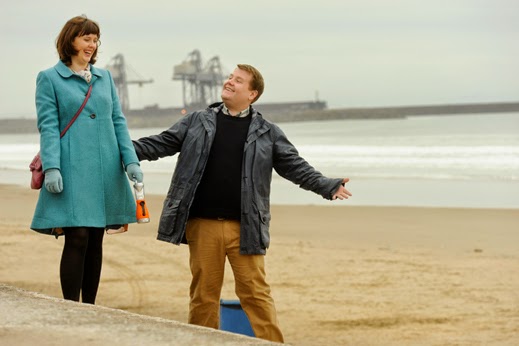
During a courtship that's frequently too cute for words, Paul (James Corden) never misses
an opportunity to serenade Julz (Alexandra Roach) with one of his favorite opera arias.
Some people are blessed and cursed in equal measure, and that’s certainly the case with Britain’s Paul Potts. Although graced with a lovely voice and a childhood fondness for opera and choir singing, these interests made him a frequent target for contemptuous peers in the Bristol-based, former quarry hamlet of Fishponds, where he grew up.

The rather unusual arc of Potts’ subsequent life is the subject of this whimsical, sometimes melancholy biographical drama from David Frankel, who previously charmed us with gentle character-clash comedies such as The Devil Wears Prada and the under-appreciated The Big Year.

Frankel is a good choice for this material; I’m less certain about scripter Justin Zackham, thus far known only for The Bucket List and The Big Wedding, both broad-strokes comedies fronted by A-list casts. One Chance is his first feature-length stab at factual material; while retaining many elements crucial to Potts’ life, Zackham plays fast and loose with other important details, for no apparent reason.

The real Potts has two brothers and a sister, all of whom are MIA in this film. Their father was a bus driver, not a steelworker. Most crucially, Potts wasn’t nearly as socially inept as this film suggests; he was elected the youngest member of the Bristol City Council as a Liberal Democrat in 1996, a position he held for seven years. That far-from-minor detail also remains MIA.

It could be argued that none of this matters, in the telling of a real-life Cinderella story, and that’s true ... to a point. But Potts’ actual experiences are sufficiently compelling to warrant a more accurate account of his ups and downs; heightening his misfit qualities, to make him even more of an underdog, feels like gilding the lily.

Even so, Frankel and Zackham skillfully work our emotions, building us to what should be a joyfully shared triumph ... and then they pull the rug out from under us. I’ve rarely seen a feel-good film so badly miscalculate its finale, employing a hasty voice-over to replace what should have been, at the very least, an ecstatic montage.

It’s an atrocious use of said-bookism: We don’t want to be told what happens during the climax, we want to watch it happen. Good grief, that’s basic Storytelling 1A.

Sigh.

Friday, June 22, 2012

Brave: Loses its way

Brave (2012) • View trailer
3.5 stars. Rating: PG, and somewhat generously, for rude humor and considerable scary action
By Derrick Bang • Originally published in The Davis Enterprise, 6.22.12


All Pixar animated films are lush, impeccably mounted productions — every backdrop fine-tuned to the height of available imaging technology, every scene timed to comic perfection — and Brave is no different.

With her disapproving mother and doting father looking on, far right,
Merida demonstrates archery skills that are far superior to all the other
clan lords and their sons: from left, Lord Macintosh and Young
Macintosh, Wee Dingwall and Lord Dingwall, and Lord MacGuffin
and Young MacGuffin.
The long, long ago and far, far away Scottish Highlands setting has a verdant ambiance granted even greater verisimilitude by the careful application of 3D cinematography; the resulting full-immersion sensation is as breathtaking to us, in these early years of the 21st century, as William Garity’s ground-breaking multi-plane camera work was for audiences of Disney’s early 1930s and ’40s animated classics.

The characters here are fun and feisty, often exaggerated for comic relief, and led by Merida, a resourceful and headstrong heroine who is voiced fabulously by Kelly Macdonald. Merida’s pluck, determination and stubborn defiance of tradition are matched only by her flaming, flowing red tresses: as much a part of her presence and personality as her oh-so-familiar teenage angst.

All the elements are in place ... except one.

The most important one.

However well Brenda Chapman’s original story may have flowed, as first conceived, it has become something of a mess in the hands of screenwriters Mark Andrews, Steve Purcell, Irene Mecchi and Chapman herself, along with (no doubt) the uncredited participation of many, many more Pixar staffers. The result plays less like a cohesive, thematically consistent narrative and more like a committee effort calculated to hit all the essential demographic targets.

In the mid-1970s, before attempting his first thriller, physician Robin Cook thoroughly analyzed then-best-selling novels to determine what they had in common; he then sat down and wrote Coma, which incorporated what he had learned. Despite reading like a soulless product, it became a smash hit and kick-started Cook’s second career as a successful author.

Brave has that same sense of having been crafted from a laundry list of “what works” ... which is a shame. Pixar’s best films are truly original creations that establish their own trends; Brave, in contrast, too often echoes bits and pieces from other sources.

Thursday, July 17, 2008

Mamma Mia: Irresistible

Mamma Mia (2008) • View trailer for Mamma Mia
3.5 stars (out of five). Rating: PG-13, for playfully smutty dialogue
By Derrick Bang • Originally published in The Davis Enterprise, 7.17.08
Buy DVD: Mamma Mia • Buy Blu-Ray: Mamma Mia! The Movie [Blu-ray]


As musicals come and go, Mamma Mia is perhaps the most deliberately frivolous ever concocted, its postage-stamp plot no more than a tissue-thin excuse to deliver a few dozen classic ABBA hits.
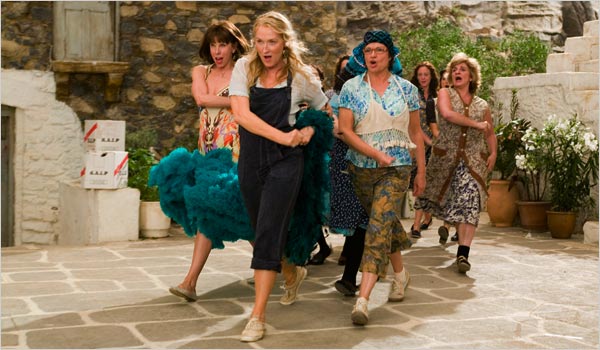
While leading her friends — Tanya (Christine Baranski, left) and Rosie (Julie
Walters, right) — on a tour of her villa, Donna (Meryl Streep, center) uncorks
the song "Money, Money, Money" to explain  her precarious finances ... and,
of course, the entire Greek island community joins in the ever-expanding
production number, merely one of many in this energetic musical.

Nine years, 20 productions and 30 million tickets later, the fans obviously don't care, and with good reason: The show is a high-spirited, colorful hoot. Even now, more than 17,000 people see one of the nine current productions (worldwide) every night, generating $8 million per week in ticket sales. The word "phenomenon" would not be out of place.

Mamma Mia demands strong singers, reasonably agile dancers and very little else. The narrative does not include — indeed, actively ignores — sweeping dramatic arcs.

Naturally, then, this film adaptation is filled with actors. Whose singing abilities are uneven, at best.

Sigh.

In fairness, star Meryl Streep throws herself into the central role of Donna with every irrepressible atom in her energized body, and she makes the part her own through sheer force of will. And, yes, Streep sings reasonably well, as proven a few years ago with the film adaptation of A Prairie Home Companion.

Co-star Julie Walters is equally memorable as the feisty, wisecracking Rosie, one of Donna's two best friends. Walters handles her one dynamic song with reasonably aplomb, substituting similar passion — and, by the time this particular number arrives, plenty of audience good will — for actual vocal chops.

Colin Firth gets off lucky; his character, Harry, need only navigate his way through a ballad, which arrives with its wistful tone more or less intact. Stellan Skarsgård's Bill, thankfully, isn't required to sing. Much.

But Pierce Brosnan?

Oh, dear.

Brosnan's Sam has two key numbers, both typical ABBA power ballads, and the picture grinds to an uncomfortable halt when he rasps his way through his first song's prologue. I haven't been this embarrassed for an actor-turned-reluctant-singer since Clint Eastwood talked to the trees back in the 1969 adaptation of Paint Your Wagon.

Mind you, I've always — always — liked Brosnan, and in all other respects he makes a great Sam. But Brosnan can't sing a lick, and Tuesday's preview audience breathed an audible sigh of relief when the backing orchestra became loud enough to better camouflage the actor's wincingly limited range.

What was everybody thinking?