Showing posts with label 1990s. Show all posts

Friday, February 23, 2024

Ordinary Angels: Sweet and heavenly

Ordinary Angels (2024) • View trailer
3.5 stars (out of five). Rated PG, for dramatic intensity
Available via: Movie theaters
By Derrick Bang • Published in The Davis Enterprise, 2.23.24

Given how polarized our country has become, it’s refreshing to see a story that involves community members selflessly coming together for a common purpose.


Faced with stacks of overdue notices, Sharon (Hilary Swank) helps Ed (Alan Ritchson)
separate them into three piles, from "it can wait" to "extremely urgent."


The fact that director Jon Gunn’s heartwarming film is based on actual events — astonishing actual events, at that — is icing on the cake.

Scripters Kelly Fremon Craig and Meg Tilly haven’t strayed far from what went down in Louisville, KY, in late 1993 and early ’94: a winter still remembered for a massive storm that dumped almost 16 inches of snow in a single night, killed at least five people, and left much of the city without power.


Ed Schmitt remembers it for an entirely different reason ... but that’s getting ahead of things.


Gunn opens his film on tragedy, as Ed (Alan Ritchson) loses his wife Theresa (Amy Acker, seen only fleetingly) to Wegener’s disease, a rare and horrific condition that leads to organ failure. He’s left to function as a single parent to young daughters Ashley (Skywalker Hughes) and Michelle (Emily Mitchell).


His wife’s loss isn’t the end of Ed’s anguish; Michelle was born with liver disease, which has worsened to the point that the little girl desperately needs a transplant. But that’s expensive, and dealing with Theresa’s illness and death left Ed with nothing but bills and overdue notices; he’s a blue-collar roofer with no means of quickly raising the necessary cash.


Elsewhere in the city, hard-living hairdresser Sharon Stevens (Hilary Swank) is on the fast track to alcoholic extinction. Her adult son wants nothing to do with her, and best friend Rose (Tamala Jones) can’t get her to acknowledge the drinking problem.


Then — proving anew that sometimes the best way to help yourself, is to help somebody else — Sharon spots a newspaper article that describes the Schmitt family’s plight, and appeals for help.


She impulsively decides to provide some.


But that’s an uphill sell, particularly after she crashes Theresa’s funeral service (a teeth-grindingly embarrassing sequence that’s almost impossible to endure, due to Swank’s performance). Even so, Sharon’s self-destructive tendencies are matched by an equally strong stubborn streak; she’s not one to take “no” for an answer.


She therefore turns into a ferociously persistent, one-woman public relations machine ... albeit after a rocky start. (Political campaign managers should be so doggedly tenacious.)

Friday, August 11, 2023

The Beanie Bubble: Bursts with fun

The Beanie Bubble (2023) • View trailer
3.5 stars (out of five). Rated R, for profanity
Available via: Apple TV+
By Derrick Bang • Published in The Davis Enterprise, 8.11.23

On June 3, 1999, a massive truck was side-swiped and overturned on Atlanta’s I-285 during rush hour, spilling its contents onto the freeway.


The payload: a massive shipment of “Stretchy the Ostrich” Teenie Beanie Babies, bound for a McDonald’s outlet.


"Success," insists Ty Warner (Zack Galifianakis), "is 1 percent inspiration, and 99 perecent
presentation." New business partner Robbie (Elizabeth Banks) plays along, when the
two prepare to make a splash at their first collaborative toy fair.


Rather than stop to determine if the driver was all right, or call 911, numerous motorists — according to an Associated Press wire story — “leaned from their cars to scoop up the Beanie Babies with one hand, while they kept rolling with the other hand on the wheel.”

Co-directors Kristin Gore and Damian Kulash open their engaging film with a re-enactment of that chaotic scene, albeit with a bit of dramatic license: full-size Beanies, a wide variety of styles, and drivers exiting their cars to grab an armful.


The Beanie Bubble — scripted by Gore, from Zac Bissonnette’s 2015 non-fiction book, The Great Beanie Baby Bubble: Mass Delusion and the Dark Side of Cute — is a dramatized account of the toy craze that captivated folks during the latter years of the 20th century, and early 21st. It’s a deliciously scathing indictment of both speculative greed — on par with the 17th century Dutch tulip craze — and the Svengali-like sway an entrepreneur held over three key women in his professional and personal life.


Although there’s no doubt Ty Warner was an incredibly gifted businessman with acute market sense, he also exploited and subsequently abandoned talented colleagues who deserved equal credit for his company’s success. Given that two also became lovers, Gore and Kulash’s entertaining film shines a well-deserved light on the fact that success, in this case, required a village of four.


Much of this saga’s depiction here is accurate; other key details are — shall we say — massaged. Gore and Kulash are up front about this, opening with a cheeky text block that reads “There are parts of the truth you just can’t make up. The rest, we did.”


Their film unfolds in a non-linear fashion, bouncing between multiple timelines that depict how Warner (played here by Zack Galifianakis) meets and soon relies upon Robbie (Elizabeth Banks), Sheila (Sarah Snook) and Maya (Geraldine Viswanathan).


Robbie — at loose ends, stuck in an unhappy marriage — enters Warner’s life in 1983, just as his fledgling toy company achieves its first breakthrough: plush cats that are deliberately under-stuffed, to make them more cuddly and lifelike. The two become lovers and partners, with Robbie’s sharp business acumen quite instrumental in building the Ty brand.


Banks deftly captures the nuanced thrill of a woman given an opportunity to emerge from an unhappy shell, to become a mover and shaker. Robbie becomes dynamic, playful and (so she believes) firmly in control of what blossoms into an exciting career. She’s also the only person who can stand up to the often imperious Warner; Banks’ steely sideways glance gets plenty of action.


Monday, November 29, 2021

King Richard: Game, set and match!

King Richard (2021) • View trailer
Five stars (out of five). Rated PG-13, for violence, brief profanity, sexual candor and fleeting drug references
Available via: Movie theaters and (until December 19) HBO Max

Truth isn’t merely stranger than fiction; sometimes it’s also more inspiring.


Director Reinaldo Marcus Green’s King Richard is many things: an amazing underdog story, a touching family drama, a gently powerful indictment of institutional racism, and — most of all — the inspiring study of one man’s determination to doggedly persevere, despite being repeatedly knocked down … in some cases, literally.


Serena (Demi Singleton, left) and Venus (Saniyya Sidney) listen intently as their father,
Richard (Will Smith) emphasizes the need to give equal weight to training body,
mind and soul.


In a stunning screenwriter debut, Zach Baylin’s sensitivity to this true-life saga is sublime; he has a keen ear for husband/wife and parent/child dynamics, and an acute awareness of how to play us viewers. At various moments, we laugh, cry, wince or hold our breath in nervous anticipation.

Given that Serena and Venus Williams serve as co-executive producers, there’s no doubt they’ve intended this film as a valentine to their father, and an acknowledgment of the miracle that he wrought. That said, there’s no false sentimentality here; the emotions are credible and authentic, the journey never contrived or sensationalized.


Actually, there’s no need; the truth is astonishing enough on its own.


Nor is this a hearts-and-flowers depiction of the man who molded two of the world’s greatest tennis stars. Will Smith’s starring performance — certain to earn an Oscar nomination — is prickly at times: frequently admirable, but often unlikable. By all accounts (including his own), Richard Williams was very difficult to live or work with: stubborn, demanding and often unreasonable, answering solely to his own (frequently bewildering) logic and carefully crafted vision.


He’s the epitome of “my way or the highway.” As it happens, though, his way usually proves successful.


Smith’s portrayal is all these things, along with nobler aspects: devotion to his wife and daughters; fierce protectiveness, to the point of personal peril; a stickler for family values and a solid work ethic; a shrewd judge of character; and a pragmatic awareness of the limitations society places on its Black citizens … along with a feisty desire to circumvent such restrictions, whenever possible.


He’s also the man of a thousand maxims. The film’s best running gag is the relish with which Smith delivers these pearls of wisdom, with a slight, totally endearing mangling of the King’s English: dead-on accurate to the actual Richard’s cadence … as is the unhurried, gently swaying manner with which he walks.


The performance is fascinating … as is the man himself.

Friday, December 13, 2019

Dark Waters: Deadly serious

Dark Waters (2019) • View trailer 
Four stars. Rated PG-13, for dramatic intensity, disturbing images and brief profanity

By Derrick Bang • Originally published in The Davis Enterprise, 12.13.19

Mark Ruffalo has become this generation’s Henry Fonda. Or Jimmy Stewart.

When corporate attorney Robert Bilott (Mark Ruffalo, right) reluctantly visits the cattle
ranch that has been in Wilbur Tennant's (Bill Camp) family for generations, they're
startled by the sudden apperance of a heifer that appears to be viciously rabid.
Ruffalo’s performances radiate the same intelligence and integrity. The same resolute dedication to a cause. The same anguish at the realization that greed and cowardice too frequently trump benevolence and compassion. The same disbelief over the ease with which people in power feel no remorse over lying, cheating and ill-treating those less equipped to fight back.

The primary difference is that Fonda and Stewart mostly played fictional characters in their iconic films, such as The Grapes of Wrath and Mr. Smith Goes to Washington. Ruffalo takes it a step further, tackling actual individuals in an expanding roster of fact-based sagas that qualify as searing advocacy cinema.

He earned his third Academy Award nomination for 2015’s Spotlight, while portraying Pulitzer Prize-winning Boston Globe reporter Mike Rezendes, who led the investigative charge that exposed the local Catholic Archdiocese’s cover-up of child molestation cases. The film deservedly won that year’s Best Picture Oscar, and the viewing experience is jaw-dropping, as Rezendes and his fellow reporters uncover proof of the church’s ever-more-heinous behavior.

Dark Waters is even harder to watch.

Much harder.

This new film, also lifted from headlines, depicts defense attorney Robert Bilott’s heroic determination — over the course of two decades — to force DuPont to reveal that it had knowingly poisoned people for even longer. And not only had concealed such monstrous behavior, but defiantly maintained that it had done nothing “legally wrong,” and therefore could not be “blamed” for anything.

That last little detail comes well into a saga that already has become grim viewing. Director Todd Haynes’ approach is methodical and relentless, carefully fueled by the strong character dynamics that he delivered in Far from Heaven, Carol and other previous films. 

The information dump is considerable but not insurmountable. In effect, we gradually learn the degrees of DuPont’s perfidy along with Bilott, while he becomes a reluctant investigator in the mold of Rezendes and — reaching further back — Bob Woodward and Carl Bernstein, in All the President’s Men.

Or, more closely linked, Erin Brockovich, in the 2000 drama named for that similarly righteous crusader. That case also started with water.

Richard Jewell: Grim slaughter of innocents

Richard Jewell (2019) • View trailer 
Four stars. Rated R, for profanity and dramatic intensity

By Derrick Bang

Perhaps the most reprehensible lingering disgrace in the ordeal suffered by Richard Jewell — during a lengthy nightmare laden with hourly indignities — is the fact that, to this day, the Atlanta Journal-Constitution maintains that it behaved responsibly.

Centennial Park security officer Richard Jewell (Paul Walter Hauser, center) points law
enforcement officers to a suspicious-looking backpack that has been abandoned
beneath a bench near the sound-and-light tower adjacent to the performance stage,
where Jack Mack and the Heart Attack are entertaining thousands of fans.
To borrow a phrase from the younger generation, I call BS.

Jewell deserves to be remembered solely as the hero who, while working as a security guard at the 1996 Summer Olympics in Atlanta, Georgia, discovered a bomb-laden backpack and helped evacuate the crowded area before it exploded. He undoubtedly saved many, many lives.

Instead, he’s more likely remembered as the hapless individual who, three days later, was identified as the probable suspect who planted the bomb, thanks to an overzealous FBI investigation, inflammatory “reporting” by the Atlanta Journal-Constitution, and the hundreds of media outlets that subsequently fanned the flames. 

Despite being cleared after an 88-day siege by media and all manner of law enforcement, Jewell undoubtedly remained a question mark in the minds of many, particularly since nobody initially was arrested for the heinous crime. It’s easy to imagine the rumor-mongering: “Maybe he did do it, but the FBI just didn’t have enough evidence…”

Even when Eric Rudolph confessed to being the bomber after being arrested in 2003, there was no way to wholly eradicate the avalanche of accusatory publicity that had buried Jewell and his equally hapless mother for 88 days. Retractions and “fresh truth” rarely have the impact of three months’ worth of screaming headlines.

Director Clint Eastwood and scripter Billy Ray — adapting Marie Brenner’s mesmerizing profile of Jewell, in the February 1997 Vanity Fair — have done their best to restore his honor, in a compelling drama fueled by powerhouse performances from Paul Walter Hauser and Kathy Bates, as Richard and his mother, Bobi. The result is a terrifying cautionary tale about the fragility of one’s place in society, and the ease with which an ordinary life can be ruined by authority and bad publicity.

Jewell’s ordeal truly is straight out of Kafka.

Tuesday, November 13, 2018

Can You Ever Forgive Me? — Fascinating character study

Can You Ever Forgive Me? (2018) • View trailer 
Four stars. Rated R, for profanity and brief drug use

By Derrick Bang

New York-based freelance journalist/author Lee Israel published three biographies between 1972 and ’85, about actress Tallulah Bankhead, game show contestant Dorothy Kilgallen, and cosmetics maven Estée Lauder. The Kilgallen book earned considerable praise and hit The New York Times Best Sellers list; the Lauder tell-all was an ill-advised money grab that badly damaged Israel’s career, and sent her into an emotional tail-spin.

And so it begins: Having realized that a carefully "embellished" letter by a noted literary
celebrity is worth more to collectors, Lee (Melissa McCarthy, right) offers just such a
doctored document to antiquarian bookseller Anna (Dolly Wells), who reads it delightedly.
By 1992, 53-year-old Israel was a withdrawn, embittered alcoholic enduring a savage case of writer’s block, with no means of support; she faced eviction from a decaying apartment laden with hundreds (thousands?) of musty books, along with the paper debris and correspondence from a three-decade career.

Her “solution” — the impulsive means by which she kept a roof over her head — remains notorious and controversial to this day.

Director Marielle Heller’s Can You Ever Forgive Me? is an unflinching account of this later chapter in Israel’s life: an often excruciating depiction of the depths to which self-pity can drive somebody. The grimly mesmerizing saga is fueled by two phenomenal performances, starting with Melissa McCarthy’s fearless portrayal of Israel.

Your raised eyebrows, gentle reader, are unwarranted. McCarthy demonstrated a solid talent for straight drama with her memorable supporting role in 2014’s St. Vincent, and her work here makes good — and then some — on that promise. Frankly, it’s a shame she continues to toil so far beneath her abilities, with low-brow comedy trash such as Tammy, Spy, Heat and pretty much everything else she has done since 2011’s Bridesmaids jump-started her big-screen career.

Actually, comedic stars-turned-serious actors aren’t that uncommon in Hollywood; the roster includes Bill Murray, Emma Thompson, Whoopi Goldberg, Robin Williams, Steve Carell and quite a few others. No less than Jackie Gleason earned an Oscar nomination for his supporting role as Minnesota Fats, in 1961’s The Hustler.

Unforgettable dramatic characters often are driven by anguish and disappointment: a desperate state of mind that comedians know all too well. McCarthy is no different, and her persuasive work here frequently transcends the artifice of acting; it’s easy to believe that we’ve somehow stumbled into a means of time-shift voyeurism, and become privy to the actual Lee’s day-by-day exploits.

That’s not merely sensitive direction and accomplished acting, of course; credit also goes to scripters Nicole Holofcener and Jeff Whitty, and their note-perfect adaptation of Israel’s fourth and final book, written just six years before her death in 2014. (That memoir’s title shall remain unshared for the moment, since it’s a total spoiler.)

At first blush, there’s nothing sympathetic or appealing about McCarthy’s depiction of Lee. She’s slovenly, unkempt and aggressively rude to strangers and colleagues alike. She has no friends, and it’s frankly amazing that her agent (Jane Curtain, as Marjorie) continues to tolerate the abuse.

It’s difficult to determine whether Lee is clinically depressed or “merely” misanthropic, although the distinction could be telling; the former option might justify a semblance of pity. But McCarthy doesn’t yield; even Lee’s one apparently redeeming quality — a steady devotion to her 12-year-old cat, Jersey — is offset by the squalor in which they exist (the specifics of which, when fully revealed, are a stomach-churning experience).

Friday, September 18, 2015

Everest: Grim, heroic tragedy

Everest (2015) • View trailer 
3.5 stars. Rated PG-13, for dramatic intensity

By Derrick Bang


Human grit and determination know no bounds, even to the point of neglecting experienced judgment and common sense, in pursuit of ... what, precisely? Bragging rights?

Seems a pretty thin return for risking one’s life.

Granted clear skies and ideal climbing conditions, the members of two teams — from left,
Scott Fischer (Jake Gyllenhaal), Jon Krakauer (Michael Kelly) and Beck Weathers (Josh
Brolin) — begin their final assault on Everest's summit. Alas, conditions won't remain
mild for long...
Icelandic director Baltasar Kormákur’s Everest persuasively conveys the jovial, devil-may-care resolve and physical grit that characterize those bent on conquering Earth’s highest and most dangerous summit. The international cast is convincing, particularly while depicting the 24/7 adrenaline rush that fuels such folks during the weeks of preparation leading up to an ascent.

But this isn’t action-oriented melodrama, in the mold of (for example) Sylvester Stallone’s laughably improbable Cliffhanger. Scripters William Nicholson and Simon Beaufoy have based this film’s narrative on the ill-fated 1996 Everest expeditions that turned tragic with the arrival of a particularly nasty blizzard. Allowing for modest artistic license — and with Nicholson and Beaufoy doing their best to adapt sometimes conflicting accounts from the five (!) books written between 1997 and 2014 — the resulting story feels both authentic and even-handed.

But if some of this film looks familiar, there’s good reason: We’ve been here before. The 1998 IMAX documentary of the same title, the giant-screen format’s biggest hit to date, devoted a chunk of its 45-minute running time to this catastrophe; indeed, Kormákur’s new film references the presence of the IMAX production team.

More recently, documentarian David Breashears’ Storm Over Everest focused exclusively on this 1996 climb.

But even the most successful documentaries never achieve the mainstream penetration of a big-budget, Hollywood-type production, and there’s no denying that these events cried for just such treatment. Kormákur’s heartfelt drama likely will be the final word on this subject, and it’s a worthy historical document.

More than once, in fact, I was reminded of British director Charles Frend’s superlative 1948 drama, Scott of the Antarctic, with John Mills starring as the British explorer whose team tried to become the first to reach the South Pole. Kormákur’s new film is in worthy company.

Sunday, May 24, 2015

Spike Island: Sweet rock 'n' roll

Spike Island (2012) • View trailer 
Four stars. Not rated, with profanity, sensuality and plenty of recreational drug use

By Derrick Bang

Director Mat Whitecross’ exhilarating indie, released three years ago but only now making its way on our side of the Atlantic, is a valentine to music fans of all ages, but particularly for those of us who — as teenagers — fell madly, passionately and hopelessly in love with One Special Album that ruled our lives, awake or asleep.

With the concert grounds tantalizingly close — but still unapproachable, thanks to high
fences and numerous guards — the situation seems hopeless for, from left, Little Gaz
(Adam Long), Zippy (Jordan Murphy), Tits (Elliot Tittensor) and Sally (Emilia Clarke).
It became a personal soundtrack to eating, studying and falling in love: the songs that we discussed and dissected endlessly and enthusiastically to like-minded friends.

Whitecross and scripter Chris Coghill haven’t merely depicted the obsessive zeal of such devotion; their film is constructed with an inventive, vibrant bounce that spills youthful bliss from every frame. In that context, Spike Island belongs in the company of like-minded, music-laden predecessors such as The Commitments, That Thing You Do and, more recently, Begin Again.

All that said, American viewers are warned to anticipate accents so thick that subtitles wouldn’t have been amiss. I know, intellectually, that all these characters are speaking English in this British production, but the working-class Manchester accent is thick enough to give the most impenetrable Irish brogue a run for its money.

Which is to say, much as I enjoyed this first exposure, the eventual home-viewing experience will be even more satisfying, when I can turn on the DVD’s closed captions.

Coghill’s story, set in Manchester during the spring of 1990, follows five rough ’n’ tumble teenage lads who — like many of their fellow “Madchesterians” — have succumbed to the eponymous debut album by The Stone Roses, released the summer before and still ruling the charts. Beloved in great part because the band members were Manchester natives themselves, the album touched a nerve in rock and punk fans already marginalized by recession, mass unemployment, class wars and the recent poll tax riots.

Rock-inflected movements come in many sizes. Although lacking the massive historical shift signaled by the 1960s British invasion, The Stone Roses definitely fueled a Manchester-based mini-revolution that brought a shimmering, jangling illusion of hope to a subset of Briton that felt helpless and beaten down.

Mind you, at first blush this story’s young heroes — Gary “Tits” Titchfield (Elliot Tittensor), Darren “Dodge” Howard (Nico Mirallegro), Chris “Zippy” Weeks (Jordan Murphy), “Little Gaz” Duffy (Adam Long) and “Penfold” Andrew Peach (Oliver Heald) — seem little more than hooligans. They’re introduced while laying waste to their school with multiple cans of paint: a shrill anarchic act inspired by The Stone Roses themselves. (Check the LP cover of the aforementioned album.)

Tuesday, February 17, 2015

One Chance: Quite endearing, if slightly flawed

One Chance (2013) • View trailer 
3.5 stars. Rated PG-13, and needlessly, for brief profanity and mild sexual candor

By Derrick Bang


[Note: I’ve given up on waiting for this film to be granted wide release in the States; it obviously ain’t gonna happen. The Weinstein Company initially promised us this British import in late 2013, and then delayed it to last spring, and then granted it limited release in October. Apparently, that’s all we’ll get ... and yet there’s also no word yet of home video release, despite its DVD availability across the pond for at least a year now. Such are the idiosyncrasies of U.S. film distribution ... and, regardless, I’m not letting this review go to waste!]

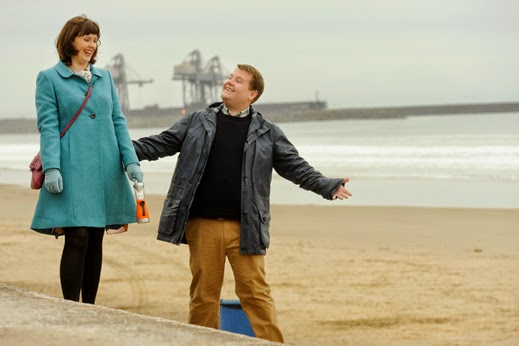
During a courtship that's frequently too cute for words, Paul (James Corden) never misses
an opportunity to serenade Julz (Alexandra Roach) with one of his favorite opera arias.
Some people are blessed and cursed in equal measure, and that’s certainly the case with Britain’s Paul Potts. Although graced with a lovely voice and a childhood fondness for opera and choir singing, these interests made him a frequent target for contemptuous peers in the Bristol-based, former quarry hamlet of Fishponds, where he grew up.

The rather unusual arc of Potts’ subsequent life is the subject of this whimsical, sometimes melancholy biographical drama from David Frankel, who previously charmed us with gentle character-clash comedies such as The Devil Wears Prada and the under-appreciated The Big Year.

Frankel is a good choice for this material; I’m less certain about scripter Justin Zackham, thus far known only for The Bucket List and The Big Wedding, both broad-strokes comedies fronted by A-list casts. One Chance is his first feature-length stab at factual material; while retaining many elements crucial to Potts’ life, Zackham plays fast and loose with other important details, for no apparent reason.

The real Potts has two brothers and a sister, all of whom are MIA in this film. Their father was a bus driver, not a steelworker. Most crucially, Potts wasn’t nearly as socially inept as this film suggests; he was elected the youngest member of the Bristol City Council as a Liberal Democrat in 1996, a position he held for seven years. That far-from-minor detail also remains MIA.

It could be argued that none of this matters, in the telling of a real-life Cinderella story, and that’s true ... to a point. But Potts’ actual experiences are sufficiently compelling to warrant a more accurate account of his ups and downs; heightening his misfit qualities, to make him even more of an underdog, feels like gilding the lily.

Even so, Frankel and Zackham skillfully work our emotions, building us to what should be a joyfully shared triumph ... and then they pull the rug out from under us. I’ve rarely seen a feel-good film so badly miscalculate its finale, employing a hasty voice-over to replace what should have been, at the very least, an ecstatic montage.

It’s an atrocious use of said-bookism: We don’t want to be told what happens during the climax, we want to watch it happen. Good grief, that’s basic Storytelling 1A.

Sigh.

Friday, September 28, 2012

The Perks of Being a Wallflower: Enchanting coming-of-age drama

The Perks of Being a Wallflower (2012) • View trailer
4.5 stars. Rating: PG-13, for drug and alcohol use, sexual candor and brief violence
By Derrick Bang


Judging by the number of perceptive, achingly poignant high school misfit dramas produced over the years, being unpopular must’ve been a whole lot more popular than it seemed at the time.

After unknowingly devouring some marijuana-laced brownies, Charlie (Logan Lerman,
center) unintentionally becomes the hilarious star of his first party. But new friends
Sam (Emma Watson) and Patrick (Ezra Miller) ignore this opportunity to humiliate him,
instead taking care to ensure that Charlie survives the experience with his dignity
(mostly) intact.
Stephen Chbosky’s The Perks of Being a Wallflower, published in 1999, has sold more than a million copies and become something of a modern Catcher in the Rye (an earlier classic, perhaps not coincidentally, said to be a favorite of Chbosky’s young protagonist). Perks also has the distinction of being one of the top entries in the American Library Association’s list of most frequently challenged and banned books, in 2004 and from ’06 through ’09 (where it peaked, at No. 3) ... which, in my mind, merely proves that Chbosky did an excellent job.

Hollywood naturally came calling, but Chbosky held onto his baby, mindful of the many horror stories revolving around successful authors who had seen their popular works destroyed by other hands. Meanwhile, he nurtured his varied talents by scripting the 2005 film adaptation of Rent and creating, writing and producing the 2006-08 TV series Jericho. A decade earlier, he also wrote, directed and produced The Four Corners of Nowhere, a little-seen 1995 indie film which I suspect is about to be rescued from obscurity.

Point being, Chbosky earned the right to script and direct Perks, and has done a commendable job. His angst-ridden saga of emotional isolation is well cast, impeccably acted, sensitively directed and — no surprise here — impressively faithful to the book. The film will be embraced both by young readers who devoured the epistolary novel, and by older movie fans who remember seeing themselves in John Hughes’ equally insightful teen dramas of the late 1980s (Pretty in Pink, The Breakfast Club and others).

Perks is, in short, destined to become one of the defining teen dramas of the early 21st century.

The year is 1991, as the precocious but socially awkward Charlie (Logan Lerman) begins his first morning as a freshman at Pittsburgh’s Mill Grove High School. He arrives in quiet terror, already counting down the days until he can flee as a graduating senior.

He’s smart and perceptive, easily able to answer his English teacher’s introductory questions ... but only privately, in his opened notebook, rather than risking peer censure by raising his hand and branding himself a teacher’s pet. But the instructor, Mr. Anderson (Paul Rudd), notices; a tentative bond is formed.