Showing posts with label James Corden. Show all posts

Friday, August 28, 2026

The Christophers: A work of art

The Christophers (2025) • View trailer
Four stars (out of five); rated R, for profanity
Available via: Hulu
By Derrick Bang • Published in The Davis Enterprise, 8.30.26

Once upon a time, this thoughtful character study would have arrived with a visible splash, and enjoyed a modest but well-deserved run at arthouse theaters.


Instead, it landed directly in streaming purgatory, likely never to be found by the potential audience that mainstream release would have attracted.


Understandably suspicious about the actual reasons for her having entered his life,
Julian (Ian McKellen) tantalizes Lori (Michaela Coel) by showing her where he has 
stashed a long-unfinished series of paintings.

More’s the pity, because considerable talent is on display here.

Ed Solomon’s intriguing original script is essentially a two-hander that would have made a crackling stage play. Director Steven Soderbergh opens up the tableau a bit, granting us a sense of London’s bohemian Fitzrovia district, but our attention is held throughout by the enthralling performances from stars Ian McKellen and Michaela Coel.


McKellen effortlessly slides into the role of waspish, once-famous painter Julian Sklar, his glory years long behind him, all but forgotten and holed up in a pair of adjacent townhouses connected via their basements. (A droll running gag: Whenever anybody rings one buzzer, the intercom invariably responds with a testy “Other door!”)


Julian is best known to the current generation for his long run as the dismissive star of a cruel, long-running TV show, “Art Fight,” during which would-be artists submitted works live, on camera, hoping for praise and promise. More often than not, Julian instead delighted in cruel jokes and humiliating take-downs.


“A cry for help from the paint itself!” is just one example of his scornful assessments. 


TV viewers apparently ate it up. (And they would, right? One can but shudder.)


Coel plays Lori Butler, an impressively educated art critic familiar with that world in general, painting and painters in particular, and — most pointedly — Sklar, who has been the focus of her withering published commentary for quite some time. She seems to have taken particular delight in detailing his progressive decline.


She’s also a part-time forger, which bespeaks considerable talent of her own.


We meet Lori first, when she’s approached by Sklar’s children, Barnaby and Sallie (James Corden and Jessica Gunning). The latter knows Lori from their days in art college, and somehow also is aware of her clandestine activities. They want Lori to take a job as Julian’s assistant, so that she’ll have access to a series of unfinished, long-abandoned canvases ... in order to complete them, so that Barnaby and Sallie will have a substantial inheritance when their father dies.


The canvases in question are the long-rumored third “Christopher Series,” which — if “suddenly” discovered stashed in Sklar’s townhouse, following his death — would be worth a fortune.


With just a few deft strokes, via dialogue and body language, Corden and Gunning establish Barnaby and Sallie as venal, grasping and thoroughly despicable clods.

Friday, December 18, 2020

The Prom: Gotta sing! Gotta dance!

The Prom (2020) • View trailer
3.5 stars. Rated PG-13, for thematic elements and suggestive/sexual candor
By Derrick Bang • Published in The Davis Enterprise, 1.22.21

It’s easy to see why director Ryan Murphy was attracted to this Tony-nominated stage musical; it’s basically a double-length episode of his hit TV series, Glee.


On steroids. With an A-list cast.


Having decided to save a small Indiana town from itself, our four Broadway stars — from
left, Trent (Andrew Rannells), Barry (James Corden), Dee Dee (Meryl Streep) and
Angie (Nicole Kidman) — salute themselves in song.


The Prom — a Netflix original — boldly blends serious social commentary with frivolous Broadway razzmatazz, and gets away with it because the Bob Martin/Chad Beuelin script cheekily acknowledges as much.


“This is how actors intervene,” proclaim the lyrics in one of the many patter tunes, “through fiery songs and dance breaks!”


Indeed, Beguilin’s lyrics — he co-created the stage musical, with Martin’s book and Matthew Sklar’s music — are wickedly clever, with snarky messaging, insider jokes and tongue-twistingly inventive rhymes that even Tom Lehrer would admire.


Assign this material to scene-stealing talents such as Meryl Streep, James Corden, Nicole Kidman and Andrew Rannells, and the result — while a bit bloated, at 130 minutes — is a lot of fun.


The story kicks off during the opening night production of Eleanor!: The Eleanor Roosevelt Story, a wildly expensive and thematically ill-advised musical featuring New York stage stars Dee Dee Allen (Streep) and Barry Glickman (Corden). The post-opening party turns into a disaster when reviews crucify the show, effectively flat-lining their careers.


While commiserating with career chorus girl Angie Dickinson (Kidman) — who has just quit her 20-year job in the musical Chicago, after once again losing the plum role of Roxie Hart, this time to Tina-Louise (very late of Gilligan’s Island, and still with us) — they decide that salvation lies is attaching their star status to some sort of noble cause, thereby reaping the benefit of flattering publicity.


Trouble is, Dee Dee and Barry are unapologetic narcissists — and even admit as much, in song — and therefore embrace this notion for all the wrong reasons.

Friday, December 20, 2019

Cats: Purr-vasively strange

Cats (2019) • View trailer 
Three stars. Rated PG, for some suggestive humor

By Derrick Bang


From the opening moments and without interruption throughout, director Tom Hooper’s big-screen adaptation of Cats is visually breathtaking: a mesmerizing display of cinematic razzle-dazzle dominated by Paco Delgado’s stunning costume design, Sharon Martin’s equally impressive hair and makeup design, and Andy Blankenbuehler’s inventive choreography.

Having unwisely followed the larcenous Rumpleteazer (Naoimh Morgan, left) and
Mungojerrie (Danny Collins, right) into a human house, in order to steal anything that
catches their fancy, Victoria (Francesca Hayward) is dazzled and distracted by
all the finery.
Theater fans who delight in ostentatious production numbers will be blown away. That’s the only possible reaction.

Those seeking a story to go along with all the visual excess, however, will find this many kibbles short of a full bowl.

In fairness, that shortcoming is equally true of the play. Andrew Lloyd Webber’s staging of T.S. Eliot’s poems in Old Possum’s Book of Practical Cats was audaciously far-fetched to begin with, and it definitely didn’t resonate in the manner of Phantom of the Opera or Les Misérables. Cats plays more like an opulent cabaret show, with individual production numbers linked by the barest trace of plot.

And a very weird plot, at that.

The film opens ominously, as a car stops in a Soho alley; the driver gets out only long enough to discard a sack with something inside. The car departs; the sack is surrounded by dozens of cats (all actors), who help the young feline inside free herself. This is Victoria (Francesca Hayward, principal ballerina at The Royal Ballet), abandoned by unseen owners. (Human beings never appear in this saga. Nor do dogs, although one is heard.)

Victoria discovers that she has been embraced by a tribe of cats known as the Jellicles, on the very night that matriarch Old Deuteronomy (Judi Dench) will make the “Jellicle choice” that determines which cat will be reborn into a new life, by ascending to the Heaviside Layer.

(One simply must run with this.)

The rest of the film is dominated by the contenders for this honor, each granted a descriptive song and dance that reveals characteristics and talents. In that respect, Cats is somewhat akin to A Chorus Line, building to the triumphant “choosing moment.” But Cats is more full-blown opera, with each lengthy song weaving into the next; very few lines are spoken in dramatic fashion, absent musical accompaniment.

Friday, June 8, 2018

Ocean's 8: Larkish ladies of larceny

Ocean's 8 (2018) • View trailer 
3.5 stars. Rated PG-13, and too harshly, for brief profanity, fleeting drug use and mild suggestive content

By Derrick Bang • Originally published in The Davis Enterprise, 6.8.18

As long as reasonable care is taken — sharp script, skilled direction, a competent cast — light-hearted caper thrillers can’t miss.

That’s definitely the case with Ocean’s 8.

With their compatriots "on assignment" at Cartier headquarters, the bulk of the team —
from left, Debbie (Sandra Bullock), Tammy (Sarah Paulson), Nine Ball (Rihanna),
Lou (Cate Blancett) and Constance (Awkwafina) — tracks progress via a computer monitor.
If this new film pales slightly when compared to 2001’s sparkling remake of Ocean’s Eleven, it’s mostly because the formula has lost some luster via repetition. Still, the well-designed gender switch compensates for such familiarity, and there’s no question that director Gary Ross — who also scripted this re-boot, with Olivia Milch — assembles the pieces with élan, and then guides them through a devious chess game laden with twists ... at least one of which likely will be a surprise.

Mostly, Ross delivers the necessary level of fun, which was so crucial to the 2001 predecessor’s success. We always had a sense that George Clooney & Co. were playing themselves, as much as their characters — which was absolutely true of the 1960 Frank Sinatra/Dean Martin original — and that added effervescent bonhomie to the action. These were guys with whom we wanted to share war stories over cocktails; the same is true of this Girls Just Want To Have Fun reworking.

And yes — just to be clear — this gender switch is far better, in every possible way, than 2016’s conceptually similar but otherwise misguided remake of Ghostbusters.

We meet Debbie Ocean (Sandra Bullock) — the equally larcenous sister of Clooney’s Danny Ocean — immediately following a prison stretch of five years, eight months and 12 days. Rather than accept this sentence as a lesson learned, Debbie spent the entire time devising, refining and perfecting what she now believes will be the perfect crime: the theft of the Toussaint, a unique diamond necklace valued at $150 million, which stays locked in an impenetrable vault in the bowels of the Cartier mansion.

All she needs is a crew.

Bullock’s Debbie is perky, poised and polished: utterly unflappable, and generally sporting a mildly self-confident smirk that potential marks immediately find disarming. This contrasts nicely with the wary and somewhat hardened Lou (Cate Blanchett), Debbie’s former partner in crime, who is less than enthusiastic when given the opportunity to resume their illicit ways.

Debbie mocks; Lou challenges. Bullock and Blanchett make an excellent team, and the script teases us with the possibility that their relationship might run deeper than mere professional camaraderie.

Friday, November 4, 2016

Trolls: Hair today, gone tomorrow

Trolls (2016) • View trailer 
Three stars. Rated PG, and needlessly

By Derrick Bang

Occasional successes such as The Lego Movie notwithstanding, Hollywood’s track record with respect to designing films from toys has been spotty, at best.

After several of their friends are kidnapped by the evil, Troll-chomping Bergen chef, the
eternally cheerful Poppy, left, tries to persuade the eternally gloomy Branch to join her
on a rescue mission.
Anybody out there remember GoBots: Battle of the Rock Lords? Or Bratz: The Movie? Kit Kittredge: An American Girl? Clue? Battleship? Jem and the Holograms? Or — God help us all — The Garbage Pail Kids?

Contrary to what is assumed by far too many of today’s Tinseltown deal makers, good movies rarely spring from 15-word concept pitches, regardless of the source material. At the beginning, middle and end of the day, it always comes down to story, story, story.

Which is the ingredient most sorely lacking in DreamWorks Animation’s Trolls.

To be sure, the film’s “fuzzy immersion” look is fabulous, with everything given a luxurious, yarn-like quality. The color palette is equally pleasing: bright pastel hues that favor rich blues, greens, pinks and purples. No question: It’s a razzle-dazzle delight, populated by adorable animated characters that are certain to please very young viewers.

Anybody over the age of 6 or 7 ... not so much.

Adults ... not at all.

The derivative, threadbare script aside — Erica Rivinoja, Glenn Berger and Jonathan Aibel couldn’t have spent much time on it — this film’s insufferable, gooey-sweet tone is guaranteed to send diabetics into sugar shock. It’s syrupy overkill on par with the slushy, mushy movies based on the Care Bears, Rainbow Brite and My Little Pony.

Ya gotta worry about a movie that promises to help viewers Find Their Happy Place.

So. This vividly multihued realm is inhabited by fuzzy, barefooted Trolls of various shades (and a few unusual sizes). All possess the ability to expand and manipulate their hair, with the skill of Spider-Man and his web-shooters. By and large, though, the forever cheerful Trolls are much too busy with “hug attacks” every 30 minutes, and their tendency to burst into song at random moments.

Alas, the Trolls share this kingdom with the much larger, uglier and nastier Bergens: dour, pessimistic creatures who look much more like the actual trolls of ancient myth, than the little Trolls themselves. The Bergens yearn to be happy, and learned long ago that the only way to achieve such bliss ... was by devouring Trolls. Baked, fried, sautéed, fricasseed or simply popped into the mouth and chomped, like a gumball.

Even if the Troll is still alive and protesting.

(Like, seriously? That’s a rather grim concept for such a family-friendly endeavor.)

Friday, February 19, 2016

The Lady in the Van: Driven to delightful distraction

The Lady in the Van (2015) • View trailer 
Four stars. Rated PG-13, and too harshly, for a fleeting unsettling image

By Derrick Bang • Originally published in The Davis Enterprise, 2.19.16


Some plays make awkward films, the very nature of their enclosed stage universe rendered claustrophobic on the big screen.

When Alan (Alex Jennings) cautiously worries about his new "permanent interloper's"
ability to drive — let alone whether she even possesses a license — the feisty Miss
Shepherd (Maggie Smith) shrugs him off with one of her imperious displays of
dignified entitlement.
That absolutely isn’t the case with The Lady in the Van, which opens up quite cleverly under the guidance of director Nicholas Hytner and scripter Alan Bennett. The latter has adapted this charming little drama from his own play, which debuted in 1999 in London’s West End, and which in turn was based on actual events recorded in his exhaustive memoirs.

Maggie Smith starred in the stage production, and also played the same role in a BBC Radio adaptation. No surprise, then, that she delivers a crisp, saucy and richly memorable performance in this cinematic version.

She plays Mary Shepherd, an elderly homeless woman who lives in a dilapidated van that she has trundled about a bucolic North London street called Gloucester Crescent, a neighborhood which — in this late 1960s setting — hosts various British stage and literary luminaries. As introduced in Hytner’s film, we get the vague sense that “Miss Shepherd” has made a habit of parking in front of a given house until her sloppy ways prove too distressing, at which point she fires up the van and moves elsewhere along the lane.

Her eccentric behavior comes to the attention of playwright, screenwriter, actor and author Alan Bennett (Alex Jennings) when he moves into the neighborhood, taking the house at No. 23. She’s rather hard to miss — given the combination of street rubbish and feisty imprecations that trail in her wake — and Bennett’s new neighbors are only too happy to supply details and rumors.

They’ve all kinda/sorta tolerated Miss Shepherd, out of a sense of liberal guilt that prompts them into occasional deliveries of food, reading material and any other small items they assume she might find useful. Parents cluck when their children, passing too close to Miss Shepherd, wrinkle their noses and complain that “she smells bad.”

Here, too, Bennett’s descriptive prose paints marvelous word pictures, when (for example) his running commentary describes her aromatic miasma as an “odoriferous concerto ... with urine only a minor component.”

Tuesday, February 17, 2015

One Chance: Quite endearing, if slightly flawed

One Chance (2013) • View trailer 
3.5 stars. Rated PG-13, and needlessly, for brief profanity and mild sexual candor

By Derrick Bang


[Note: I’ve given up on waiting for this film to be granted wide release in the States; it obviously ain’t gonna happen. The Weinstein Company initially promised us this British import in late 2013, and then delayed it to last spring, and then granted it limited release in October. Apparently, that’s all we’ll get ... and yet there’s also no word yet of home video release, despite its DVD availability across the pond for at least a year now. Such are the idiosyncrasies of U.S. film distribution ... and, regardless, I’m not letting this review go to waste!]

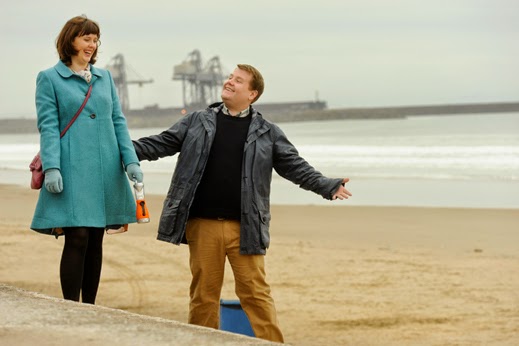
During a courtship that's frequently too cute for words, Paul (James Corden) never misses
an opportunity to serenade Julz (Alexandra Roach) with one of his favorite opera arias.
Some people are blessed and cursed in equal measure, and that’s certainly the case with Britain’s Paul Potts. Although graced with a lovely voice and a childhood fondness for opera and choir singing, these interests made him a frequent target for contemptuous peers in the Bristol-based, former quarry hamlet of Fishponds, where he grew up.

The rather unusual arc of Potts’ subsequent life is the subject of this whimsical, sometimes melancholy biographical drama from David Frankel, who previously charmed us with gentle character-clash comedies such as The Devil Wears Prada and the under-appreciated The Big Year.

Frankel is a good choice for this material; I’m less certain about scripter Justin Zackham, thus far known only for The Bucket List and The Big Wedding, both broad-strokes comedies fronted by A-list casts. One Chance is his first feature-length stab at factual material; while retaining many elements crucial to Potts’ life, Zackham plays fast and loose with other important details, for no apparent reason.

The real Potts has two brothers and a sister, all of whom are MIA in this film. Their father was a bus driver, not a steelworker. Most crucially, Potts wasn’t nearly as socially inept as this film suggests; he was elected the youngest member of the Bristol City Council as a Liberal Democrat in 1996, a position he held for seven years. That far-from-minor detail also remains MIA.

It could be argued that none of this matters, in the telling of a real-life Cinderella story, and that’s true ... to a point. But Potts’ actual experiences are sufficiently compelling to warrant a more accurate account of his ups and downs; heightening his misfit qualities, to make him even more of an underdog, feels like gilding the lily.

Even so, Frankel and Zackham skillfully work our emotions, building us to what should be a joyfully shared triumph ... and then they pull the rug out from under us. I’ve rarely seen a feel-good film so badly miscalculate its finale, employing a hasty voice-over to replace what should have been, at the very least, an ecstatic montage.

It’s an atrocious use of said-bookism: We don’t want to be told what happens during the climax, we want to watch it happen. Good grief, that’s basic Storytelling 1A.

Sigh.

Tuesday, December 30, 2014

Into the Woods: Doesn't go far enough

Into the Woods (2014) • View trailer 
3.5 stars. Rated PG, for thematic elements, fantasy peril and some suggestive material

By Derrick Bang


I never cease being delighted by Stephen Sondheim’s wordcraft wizardry.

His music and lyrics are as ferociously clever as anything concocted by Ira Gershwin or Cole Porter, and as sharply sardonic as the best of mathematician-turned-satirical-tunesmith Tom Lehrer.

The witch (Meryl Streep, right) explains that the Baker (James Corden) and his wife (Emily
Blunt) will need to find four items in order to reverse the curse that has left them unable
to start a family. Naturally, we cannot help feeling that the witch isn't being entirely honest
about why she actually wants these items...
Almost three decades have passed since Sondheim and collaborator James Lapine unleashed Into the Woods, a frothy, thoroughly enchanting what-if musical that takes an unexpectedly mature approach to several classic Grimm fairy tales. Mostly, Sondheim and Lapine imagine what happened next, following the obligatory “happily ever after” fade-out that concludes such stories.

Nothing good, as it turns out.

Broadway classics don’t always transition well to the big screen, in great part because we lose the intimacy that comes from being in a theater with the actors who can bring fire and passion even to material this whimsical. No doubt many have contemplated this particular challenge, since Into the Woods debuted in 1987, but Rob Marshall eventually won the battle.

Certainly he seems a worthy choice, having watched his cinematic adaptation of Chicago take six of its 13 Academy Award nominations, including Best Picture.

His handling of Into the Woods is unlikely to garner such stellar praise, but not for lack of quality; this simply isn’t as visually dynamic a production, its delights limited chiefly to the way in which the cast brings fresh brio to Sondheim’s lyrics and patter-songs. Production designer Dennis Gassner spends a lot of time with various forest settings that look rather similar; the scenery magic derives more from sfx supervisor Matt Johnson’s various touches, most notably the giant beanstalk that sprouts next to a certain home.

That said, there’s no denying the spectacular splash with which this film opens, cross-cutting between the various sets of characters within the intermingled saga to follow, their desires explicated in the lengthy “Prologue,” the first of Sondheim’s many ingenious songs. Marshall and editor Wyatt Smith have a field day with this stylish production number, a bravura 10 minutes that sets a most impressive stage.

The story is fueled by seemingly reasonable but ultimately ill-advised wishes. In short order, we meet Cinderella (Anna Kendrick), who wishes to attend the palace festival; Jack (Daniel Huttlestone), a naïve but kind-hearted boy who wishes that his cow, Milky White, didn’t have to be sold; and the Baker (James Corden) and his wife (Emily Blunt), who wish they could become parents.

Friday, July 4, 2014

Begin Again: A melody-laden charmer

Begin Again (2013) • View trailer 
Four stars. Rated R, for profanity

By Derrick Bang • Originally published in The Davis Enterprise, 7.4.14

It’s a bit rough around the edges at first, the approach uncertain, the artist perhaps nervous and worried about looking foolish.

A needless concern.

With Dan (Mark Ruffalo, far right) acting as an on-the-fly director, Greta (Keira Knightley)
performs one of her songs in a New York City alley, accompanied by several talented
instrumentalists, and watched by a gaggle of neighborhood children.
I could be discussing the first song we see performed by Greta (Keira Knightley), reluctantly and a bit shyly, in front of an indifferent bar crowd. But I’m actually talking about this film itself: Perhaps writer/director John Carney is that clever, to have mirrored Greta’s stumbling debut before the public eye, with our reaction to the manner in which her story unfolds.

Because, in both cases, the talent involved can’t help but win us over.

Begin Again is the newest offering from the Irish filmmaker who charmed us so thoroughly with the saga of a Dublin busker in 2006’s Once, a film cherished just as much for its music — and that marvelous, Academy Award-winning song, “Falling Slowly” —  as for the gently romantic manner in which its story unfolded.

Carney’s new film once again revolves around music, but the setting and tone are both different and somewhat grittier. This narrative has a villain, but it’s an entity rather than an individual: the music industry, depicted as the instrument by which pure expression is quashed, either benignly or overtly. Remaining true to one’s dreams, passions and (reasonable) expectations is the ideal here: a goal too easily corrupted, as we shall see, by outside forces conscious only of the bottom line.

Those who adore New York for its cornucopia of emotions and experiences will delight in Carney’s rapturous depiction: a Big Apple we’ve not seen idolized so passionately since Woody Allen’s Manhattan, back in 1979. This is a New York of joyous romance, much like the Paris of Jean-Pierre Jeunet’s Amélie: the city as we imagine it, based on cinematic valentines like this one.

The story opens in the aforementioned East Village bar, as the unwilling Greta is dragged to the stage for one song: a brief musical interlude noticed by nobody except Dan (Mark Ruffalo), whose presence — in that bar, at that moment — is explained during the first of Carney’s clever flashbacks. Dan, once a lauded record label exec, has fallen on hard times prompted by a crisis in his personal life; the result is growing friction with his longtime partner, Saul (Mos Def), which climaxes in yet another humiliation.

Dan also drinks too much, and has been doing so for too long. But his radar remains unimpaired: He’s drawn, moth to flame, by this hesitant performance by a British singer/songwriter who’d rather be anywhere else.