Showing posts with label Will Smith. Show all posts

Monday, November 29, 2021

King Richard: Game, set and match!

King Richard (2021) • View trailer
Five stars (out of five). Rated PG-13, for violence, brief profanity, sexual candor and fleeting drug references
Available via: Movie theaters and (until December 19) HBO Max

Truth isn’t merely stranger than fiction; sometimes it’s also more inspiring.


Director Reinaldo Marcus Green’s King Richard is many things: an amazing underdog story, a touching family drama, a gently powerful indictment of institutional racism, and — most of all — the inspiring study of one man’s determination to doggedly persevere, despite being repeatedly knocked down … in some cases, literally.


Serena (Demi Singleton, left) and Venus (Saniyya Sidney) listen intently as their father,
Richard (Will Smith) emphasizes the need to give equal weight to training body,
mind and soul.


In a stunning screenwriter debut, Zach Baylin’s sensitivity to this true-life saga is sublime; he has a keen ear for husband/wife and parent/child dynamics, and an acute awareness of how to play us viewers. At various moments, we laugh, cry, wince or hold our breath in nervous anticipation.

Given that Serena and Venus Williams serve as co-executive producers, there’s no doubt they’ve intended this film as a valentine to their father, and an acknowledgment of the miracle that he wrought. That said, there’s no false sentimentality here; the emotions are credible and authentic, the journey never contrived or sensationalized.


Actually, there’s no need; the truth is astonishing enough on its own.


Nor is this a hearts-and-flowers depiction of the man who molded two of the world’s greatest tennis stars. Will Smith’s starring performance — certain to earn an Oscar nomination — is prickly at times: frequently admirable, but often unlikable. By all accounts (including his own), Richard Williams was very difficult to live or work with: stubborn, demanding and often unreasonable, answering solely to his own (frequently bewildering) logic and carefully crafted vision.


He’s the epitome of “my way or the highway.” As it happens, though, his way usually proves successful.


Smith’s portrayal is all these things, along with nobler aspects: devotion to his wife and daughters; fierce protectiveness, to the point of personal peril; a stickler for family values and a solid work ethic; a shrewd judge of character; and a pragmatic awareness of the limitations society places on its Black citizens … along with a feisty desire to circumvent such restrictions, whenever possible.


He’s also the man of a thousand maxims. The film’s best running gag is the relish with which Smith delivers these pearls of wisdom, with a slight, totally endearing mangling of the King’s English: dead-on accurate to the actual Richard’s cadence … as is the unhurried, gently swaying manner with which he walks.


The performance is fascinating … as is the man himself.

Friday, January 17, 2020

Bad Boys for Life: An excessive final (?) rodeo

Bad Boys for Life (2020) • View trailer 
Three stars. Rated R, for strong bloody violence, relentless profanity, sexual candor and brief drug use

By Derrick Bang


Too long, too loud and too laughably ludicrous.

Too profane, as well. Along with deplorably violent.

In characteristic fashion, Marcus (Martin Lawrence, left) wants to reason with a highly
agitated suspect, whereas Mike (Will Smith) prefers the more direct,
confrontational approach.
Par for the course, in a film co-scripted by Joe Carnahan (who previously brought us NarcSmokin’ Aces and 2018’s remake of Death Wish, among others).

Carnahan got an assist from co-writers Peter Craig and Chris Bremner, and the result — the very late-arriving threequel to 1995’s Bad Boys — delivers precisely what this series’ fans expect. I’ve no doubt they’ll all go home satisfied.

That said, this bloated cop thriller would be a slog without the mirthful banter between Will Smith and Martin Lawrence, returning as forever bickering “bad boys” Mike Lowrey and Marcus Burnett. Except that they’re no longer “boys, as their much younger colleagues frequently point out. They’ve become the cop equivalent of creaky old-timers, and the story has fun with this dynamic.

Marcus, a newly minted grandfather, is more than ready to call it a day. Mike, lacking his partner’s family ties, stubbornly hangs onto his bad-ass rep … while clandestinely dying his signature goatee, in order to conceal the grey. He believes the rep is all he has, despite Marcus’ insistence to the contrary.

Bad Boys for Life — something of a surprise, given the space between it and 2003’s Bad Boys II — is fueled by a classic “one last rodeo” plot. It’s laden with nonstop mayhem: gun battles; sniper assassinations; landscape-pummeling vehicular pursuits in cars, motorcycles, sidecars and helicopters; and several gratuitously gory deaths. Scores of assault gun-wielding thugs are dispatched bloodily, like swatted flies.

It’s all quite over the top; at a self-indulgent 123 minutes, this film definitely wears out its welcome. It also stretches credibility way past the breaking point, starting when Mike unexpectedly takes four to the chest from a semi-automatic assault weapon. And survives.

Seriously?

Catching one bullet would be sufficient for story purposes; four is an early indication of the absurd excess favored by Moroccan-born co-directors Adil El Arbi and Bilall Fallah (who built their résumé with the Belgian crime dramas ImageBlack and Gangsta). 

And no; that’s not really a spoiler, since this intended assassination takes place scant minutes into the film. 

Friday, October 11, 2019

Gemini Man: Double trouble

Gemini Man (2019) • View trailer 
Four stars. Rated PG-13, for considerable action violence and brief profanity

By Derrick Bang • Originally published in The Davis Enterprise, 10.11.19

Nature … or nurture?

That provocative question is at the heart of Gemini Man, thanks to an unexpectedly thoughtful script from David Benioff, Darren Lemke and Billy Ray. 

No matter where our heroes go — from left, Danny (Mary Elizabeth Winstead), Brogan
(Will Smith) and Baron (Benedict Wong) — the bad guys always catch up with them ...
and quickly. How is that possible?
“Unexpected” in the sense that — during the lengthy initial act — nothing about this high-octane thriller suggests that it’ll become so philosophical.

Considerable credit also goes to director Ang Lee — an Academy Award winner for Brokeback Mountain and Life of Pi — who, at first blush, seems an unusual choice for such pell-mell spyjinks. But Lee has long been fascinated by angst-laden decisions thrust upon characters forced to confront long-dormant facets of themselves.

(On top of which, Lee isn’t adverse to the occasional action-laden blockbuster, having also helmed Crouching Tiger, Hidden Dragon and Hulk.)

This updated Gemini Man has virtually nothing to do with the bone-stupid 1976 TV show of the same name, wherein Ben Murphy’s secret agent Sam Casey had the power to turn invisible, but only for 15 minutes at a time, lest his radiation-induced talent kill him. The series deservedly perished after only five episodes, leaving behind nothing but the intriguing title that Lee and his scripters have developed into a far superior premise.

We meet Will Smith’s Henry Brogan — an ex-Special Forces sniper turned assassin for a clandestine U.S. government agency — as he calmly prepares for his current mission: an assignment he completes successfully. Back at home in rural Savannah, Ga., Brogan tells his long-trusted handler, Del Patterson (Ralph Brown), that he’s had enough. 

Too many kills have left Brogan unable to face his own reflection in a mirror. He simply wants to build bird houses and fish the local waterways from his tiny boat.

We’ve seen this preamble many times before; we know full well that black-ops agents — particularly assassins — never are allowed to go quietly into that good night. And that’s true here as well.

But not in the usual manner. 

Friday, May 24, 2019

Aladdin: Lost its luster

Aladdin (2019) • View trailer 
Three stars. Rated PG, for no particular reason

By Derrick Bang • Originally published in The Davis Enterprise, 5.24.19


Too many Hollywood types ignore the universal maxim:

If it ain’t broke, don’t fix it.

When arrogant soldiers thunder through the marketplace on horseback, Aladdin
(Mena Massoud) acts quickly enough to prevent two children from being trampled
beneath the hooves.
1992’s Aladdin was just right as a 90-minute animated fantasy. This “enhanced” live-action remake, at 128 minutes, is a textbook case of bloated overkill.

Disney obviously didn’t learn from the identical mistake made with 2017’s live-action Beauty and the Beast, similarly overblown at 129 minutes (as opposed to the 1991 animated version’s 84 minutes). More is not better, most particularly when the original’s sublime musical component gets saddled with new songs that aren’t merely inferior, but are noticeably out of synch with the rest.

Scripter/director Guy Ritchie — who shares writing chores with John August — has completely altered this fable’s heart and moral. Instead of a cautionary tale on the importance of recognizing that grandiose wishes are a hollow illusion, this Aladdin has been transformed, and quite clumsily, into a female empowerment saga.

This new subtext doesn’t integrate well with the existing storyline; indeed, it’s clearly a contrived sop to the #MeToo movement, complete with a (new) power ballad that Princess Jasmine (Naomi Scott) belts out at a climactic moment. But here’s the irony: Immediately after she sings that song, Aladdin is the one who saves the day.

And why shouldn’t he? Disney animated films are laden with powerful female characters: Ariel, Belle, Pocahontas, Mulan, Merida, Tiana, Rapunzel, Lilo, Moana and — needless to say — Anna and Elsa. Is there anything wrong with leaving Aladdin guy story?

It’s also blatantly obvious that Jasmine’s aforementioned mantra — “Speechless” — was crafted to sound as much as possible like “Let It Go,” the Academy Award-winning anthem from Frozen. That “coincidence” aside, this new tune doesn’t belong with the others.

The original film’s Alan Menken/Howard Ashman/Tim Rice songs boast the witty lyrics and clever melodic counterpoint of masterful musical theater numbers. And while Menken still wrote the music for “Speechless,” the lyrics — by Benj Pasek and Justin Paul — are unimaginative and redundant. It’s not a song; it’s a diatribe.

Sigh.

Friday, December 16, 2016

Collateral Beauty: Only mildly appealing

Collateral Beauty (2016) • View trailer 
Three stars. Rated PG-13, for thematic elements and fleeting profanity

By Derrick Bang

Overt sentimentality is a tough sell in this cynical era, so director David Frankel is to be congratulated: For the most part, his film manages to be sincerely poignant, without sliding too much into eye-rolling schmaltz.

While trying to finish a quiet, isolated dinner, Howard (Will Smith) is surprised — and
quickly annoyed — to be confronted by the personification of Love (Keira Knightley),
unaware that she's actually an actress hired to deceive him.
Allan Loeb’s original script is an audacious blend of It’s a Wonderful Life and Charles Dickens’ A Christmas Carol, reconfigured for modern times. That’s risky for all sorts of reasons, most notably because “borrowing” from such beloved classics invites comparisons that make most such endeavors fall short. Whether this update succeeds will be up to each viewer’s tolerance for Frank Capra-style melodrama (known as “Capra-corn,” back in the day).

This also is an unusual effort from a writer best known for slapstick moron comedies such as The Switch, The Dilemma and (God help us) Here Comes the Boom. But Loeb apparently has a more serious side, and he wrestles with some fairly weighty concepts here. It’s easy to see why the result piqued the interest of star Will Smith, who has demonstrated a fondness for holiday-timed melodramas such as The Pursuit of Happyness and Seven Pounds.

Smith is very good at morose angst; he suffers persuasively, radiating anguish with an intensity that can be painful to watch. We definitely feel for the guy, in such storylines, and — as a given narrative progresses — we become invested in his search for salvation, closure, relief or whatever else seems just beyond his reach.

He stars here as Howard, a charismatic New York advertising executive with a flair for inspiring both clients and staff. We meet him giving a warm pep talk to the employees of his successful firm: a moment enjoyed equally by his longtime business partners — and friends — Whit (Edward Norton), Claire (Kate Winslet) and Simon (Michael Peña).

But that was then. Flash-forward a few years later, as the story actually begins, and personal tragedy — the death of his young daughter — has reduced Howard to a disheveled, morose and perpetually silent shadow of his former self. He shows up to work each day solely to build elaborate domino mazes, ultimately knocking down each creation, then starting another. The business, left without its captain, has been sliding into oblivion.

Whit, Claire and Simon don’t know what to do. Every means of engaging Howard has been ignored or rebuffed, and — because he owns controlling shares of their company — they can’t even act on a friendly takeover offer. (We assume it’s friendly. Loeb’s script is a bit sketchy on certain important details: a failing that becomes more noticeable as the story proceeds.)

Friday, August 5, 2016

Suicide Squad: Great premise, uneven execution

Suicide Squad (2016) • View trailer 
3.5 stars. Rated PG-13, for violence, dramatic intensity, disturbing behavior, suggestive content and brief profanity

By Derrick Bang • Originally published in The Davis Enterprise, 8.5.16


E.M. Nathanson deserves the credit, and nobody has the faintest idea who he is.

He wrote the best-selling 1965 WWII thriller, The Dirty Dozen, which director Robert Aldrich turned into a crackling action film two years later. With the template firmly established — that of disgraced convict soldiers sent on a suicide mission, with the promise of commuted sentences for any survivors — numerous books and films have “borrowed” the premise, often to crowd-pleasing results.

Col. Rick Flag (Joel Kinnaman, center top) has his hands full, trying to control the behavior
of his misfit squad: clockwise from upper right, Deadshot (Will Smith), Captain Boomerang
(Jai Courtney), Katana (Karen Fukuhara), Harley Quinn (Margot Robbie) and Killer Croc
(Adewale Akinnuoye-Agbaje)
Those crowds include comic book readers, particularly with the 2007 re-boot of this concept in DC’s Superman universe.

And why not? Bad guys always get the best lines, and there’s no questioning the vicarious thrill of watching villains allowed to behave reprehensibly.

As one of this new film’s characters impertinently explains, following a minor transgression: “We’re bad guys. It’s what we do.”

The audaciously irreverent big-screen adaptation of Suicide Squad has plenty of snarky allure, in great part thanks to Margot Robbie’s captivating star turn as the sexy, salacious and gleefully homicidal Harley Quinn. As any longtime comic book fan will attest, Robbie nails the character, with all of her cherubic, psychopathic charisma. Harley revels in her over-the-top awfulness, and Robbie embraces the role with lustful fury.

Comic book movies very rarely get remembered by Academy voters, but this one should; Robbie’s performance here makes the movie.

She gets a strong assist from Will Smith, doing an equally fine job with the more difficult role of Floyd Lawton, better known as ace assassin Deadshot. Most of the time, Lawton has no problem with killing at the behest of the highest bidder, but he hates being viewed in a negative light by his estranged but still devoted adolescent daughter, Zoe (Shailyn Pierre-Dixon, touching in a brief performance).

Smith, as a result, must navigate the more delicate waters of a conflicted soul: a bad guy who might possess a shred of nobility.

But we’re getting ahead of things. To the plot:

As the next installment in DC movie continuity, Suicide Squad — directed and scripted by David Ayer — takes place in the aftermath of early spring’s Batman V Superman: Dawn of Justice, which concluded as Big Blue was dealt a mortal blow by a Kryptonite spear. The U.S. government, in something of a panic, worries how a world without Superman could defeat the next hyper-powered adversary.

Friday, December 25, 2015

Concussion: Grim reality check

Concussion (2015) • View trailer 
3.5 stars. Rated PG-13, for dramatic intensity and occasional profanity

By Derrick Bang • Originally published in The Davis Enterprise, 12.24.15

Great movie entrances are pure magic.

Consider George C. Scott’s eyebrow-raising pep talk, at the opening of Patton. John Travolta, strutting down the street, in Saturday Night  Fever. Or, more recently, Christian Bale’s meticulous “suiting up” and comb-over, in American Hustle. Everything you need to know about each of these characters, in one quick scene.

When renowned neurosurgeon Dr. Julian Bailes (Alec Baldwin, center) finally gains an
audience with veteran NFL doctor Joseph Maroon (Arliss Howard, right), Dr. Bennet
Omalu (Will Smith) is enraged to hear that his meticulous research into brain injuries
is being dismissed. With prejudice.
Writer/director Peter Landesman grants Will Smith’s Dr. Bennet Omalu a similarly illuminating entrance, as Concussion begins. It’s a courtroom confrontation; Omalu has taken the stand to testify; his credentials have been challenged. In a bravura display of gentle chiding, unassuming pride and a droll insistence on full disclosure — leavened with an oh-so-slightly-mocking sense of humor — Omalu takes complete control of the room.

It’s a brilliant display of acting chops by Smith, who — from this moment onward — firmly has our hearts and minds. We’ve learned everything essential about this doctor, mostly crucially that he is a good and honorable man. That he respects the dignity of others, and insists — in turn — that they respect him.

The scene is marvelous: destined to become a much-viewed YouTube hit.

And, of course, the perfect way for Landesman to start his film.

Concussion, based on journalist Jeanne Marie Laskas’ exhaustive September 2009 exposé in GQ Magazine, charts Omalu’s initially lonely and Sisyphean struggle to get the National Football League to acknowledge that grown men bashing their heads together, even when wearing the (minimal) protection afforded by a helmet, likely isn’t good for their grey matter.

Indeed, far from “not good.” Potentially life-altering, even deadly.

Sensible people, confronted with such a suggestion, would nod and say, “Well, of course; what else would you expect?”

But the NFL circled the wagons, sent out the lawyers, and — possibly — pulled strings in Washington, D.C., to thoroughly discredit anybody daft enough to suggest such a thing. We’re talking football, folks: the one thing in Amuuurica capable of generating more foolish passion than the right for each citizen to own 437 guns.

But that’s getting ahead of things.

Friday, February 27, 2015

Focus: A sharply conceived caper

Focus (2015) • View trailer 
3.5 stars. Rated R, for profanity, sensuality and brief violence

By Derrick Bang • Originally published in The Davis Enterprise, 2.27.15

Heist flicks rely on two essential ingredients: a tight, logical script that holds together even as the narrative veers in unexpectedly twisty directions; and — just as important — a sharply constructed cast of characters, played by actors who approach this material with sincerity and conviction.

Having pulled off yet another successful con, Nicky (Will Smith) and Jess (Margot Robbie)
realize that they make a pretty good team. But their increasing fondness for each other, on
a personal level, threatens the objectivity that's essential in their nefarious line of work...
In other words, actors who don’t preen from one scene to the next, undercutting the tension and suspense we desire from the genre.

Ideal scripts, in turn, need to be clever on three levels: the core storyline — in other words, the actual caper(s) — which should be intriguing, unusual and introduced with zest; the inevitable “unexpected” glitch that complicates matters, and which the filmmakers usually expect us viewers to anticipate; and, finally, the genuinely surprising second twist, which nobody sees coming, and which leaves us nodding with admiration.

Hats off to the writing/directing team of Glenn Ficarra and John Requa, then, because Focus delivers on all counts. Heist thrillers are one of my favorite genres; I’ve seen scores of good ones, and therefore usually anticipate all manner of revelations, hiccups and gotchas.

And yet Ficarra and Requa startled me, with their devious, eleventh-hour eyebrow-raiser. Well done.

On top of which, they’ve assembled ideal talent, starting with smooth-as-silk Will Smith, whose every word, deed, gesture and wary expression denote career larceny. He’s perfectly cast as the sophisticated Nicky Spurgeon, a seasoned master of misdirection, who deploys and unerringly supervises a veritable squadron of sharps, pick-pockets and thieves at crowded, high-profile events such as conventions and parades.

Smith is well matched by Margot Robbie’s Jess Barrett, a frisky blonde with a sensual wiggle, who worms her way into Nicky’s crew with the sort of breathy admiration and flirty innocence that Marilyn Monroe perfected, back in the day. Robbie will be remembered as Leonaro DiCaprio’s seductively controlling wife in 2013’s The Wolf of Wall Street, and let’s just say that she’s equally alluring here.

And just as unpredictable. Indeed, Jess wears “devious” like the slinky, skin-tight dresses into which Robbie gets poured; we can’t help wondering about her end game, from the moment she catches Nicky’s attention.

But, then, we also don’t expect him to be candid with her, so the question revolves around who’s likely to get played, and how quickly.

Meanwhile, Smith and Robbie — both dripping with sensual savoir-faire — circle each other with a playfully erotic grace that wholly eluded the characters in Fifty Shades of Grey.

Friday, February 14, 2014

Winter's Tale: A crisp, sparkling fantasy

Winter's Tale (2014) • View trailer 
Four stars. Rating: PG-13, for violence and sensuality

By Derrick Bang • Originally published in The Davis Enterprise, 2.14.14

Fans of Neil Gaiman’s novels, particularly Neverwhere and Stardust, will adore this film.

Director/scripter Akiva Goldsman’s luxuriously romantic fantasy offers the same mythic qualities: a setting that’s familiar yet not quite of this world; an incandescent yet oddly witty love story; and mortal characters — of a sort — caught within a timeless duel between agents of good and evil.

Despite having broken into her home with the intent of stealing its valuables, Peter
(Colin Farrell) finds his plans thwarted after meeting Beverly (Jessica Brown Findlay).
Her response, to this uninvited stranger? Why, to offer him a cup of tea, of course!
It’s such an odd concoction that one false move — a single line of dialogue too precious, delivered with perhaps too much smug arrogance — and the entire narrative would collapse under the weight of its own contrivance. And yet Goldsman unerringly walks that fine line, delivering a warm, gently humorous and richly poignant adaptation of Mark Helprin’s massive 1983 novel.

Indeed, the first miracle is that Goldsman has captured this huge book’s essence in a film that runs a mere 118 minutes. But perhaps we shouldn’t be surprised, given his Academy Award victory for adapting A Beautiful Mind, and his obvious fondness for historical dramas (Cinderella Man) and speculative fiction (The Da Vinci Code, I Am Legend).

Even so, this film’s mere existence represents a second miracle: a most unexpected roll of the dice by Warner Bros. Helprin’s captivating epic is the sort of story that rarely works on the big screen.

The American public is notoriously reluctant to embrace intelligent, adult-oriented fantasy, preferring instead the empty calories of popcorn sci-fi action flicks. Granted, Gaiman is doing his best to help reverse that trend, and Goldsman’s captivating work here could help a great deal.

I frankly hesitate to describe this plot to even a minor degree, because while not a mystery per se, Winter’s Tale derives much of its charm from the many revelations — major and minor — that emerge along the way. Indeed, even the casting offers surprises, all of them pleasant.

Our most unusual protagonist is Peter Lake (Colin Farrell), an orphan with an unusual origin, having arrived in late 19th century New York under quite unlikely circumstances. This is, in fact, the film’s core test: One must accept this startling, almost biblical introduction as a foreshadowing of the storytelling style to come. Having allowed this near-impossible weave of otherworldly thread, the resulting tapestry will be much easier to snuggle into.

Peter grows up poor and uneducated — a skilled thief who also possesses “a way with machines” — and lives on the streets until taken under the wing of a Fagin-like protector, Pearly Soames (Russell Crowe). We catch up with these two in 1916, with Peter on the run after some sort of falling out; the furious Soames and his men are hell-bent on cornering and then killing their prey ... slowly and painfully.

Friday, May 25, 2012

Men in Black III: Still well-suited

Men in Black III (2012) • View trailer
Four stars. Rating: PG-13, for sci-fi action violence and some disgustingly unpleasant monsters
By Derrick Bang • Originally published in The Davis Enterprise, 5.25.12


Ten years may have passed, but nothing has changed: same gonzo hardware; same outrageous — and dangerous — aliens; same giddy Danny Elfman score; same stoic, sourpuss expression on Tommy Lee Jones’ face.


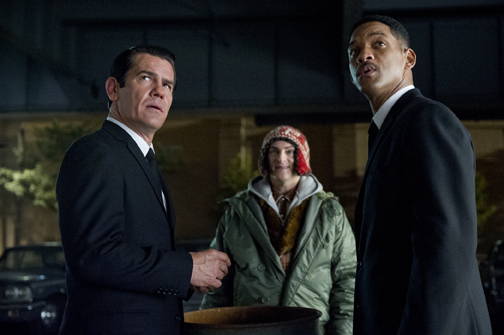
Having time-jumped back to 1969, Agent J (Will Smith, right) finds it hard
enough to persuade his partner Agent K's younger self (James Brolin, left) of the
severity of their mission. Things get even more complicated with the arrival of
Griffin (Michael Stuhlbarg), a hyper-dimensional alien with the ability to see
all outcomes — good and bad — of every possible reality.
Come to think of it, Jones hasn’t changed a jot in a decade. Perhaps he’s actually an alien in disguise?

Men in Black III is a hoot ’n’ a holler, and a welcome return to form after this series’ somewhat disappointing sophomore installment, back in 2002. And while it’s still not possible to recapture the 1997 original’s gleefully warped freshness, this third entry’s writers — Etan Cohen, David Koepp, Jeff Nathanson and Michael Soccio — have done a nifty job with an ingenious premise that stimulates plenty of snarky one-liners.

On top of which, Will Smith’s comic timing remains every bit as reliably droll as Jones’ slow, impassive takes.

The narrative kicks off with a slick jailbreak engineered by Boris The Animal (Jemaine Clement), a truly nasty baddie with a morphology that gets ickier as the film proceeds. Boris — a Boglodite who gets enraged when people add “The Animal” to his name — has been incarcerated on the Moon for the past 40-plus years, where Agent K (Jones) put him after a particularly nasty skirmish at Cape Canaveral, back on July 16, 1969.

If you don’t immediately register the significance of that date, surrender your geek cred card at the door.

With Boris seeking vengeance, Agent J (Smith) tries to pull the file on that old MIB case. Unfortunately, he finds the information restricted: rather mysterious, given his usual security clearance. Attempts to gain access get him nowhere; the new head of MIB, Agent O (Emma Thompson), leaves him with an enigmatic warning: “Don’t ask questions you don’t want the answers to.”

Funny thing, J reflects; that’s precisely what K has said, on numerous occasions.

(Thompson’s Agent O has taken over for Rip Torn’s Agent Zed, from the previous two films. For some reason, Torn opted out of this installment.)

Wednesday, December 24, 2008

Seven Pounds: Heavy lifting

Seven Pounds (2008) • View trailer for Seven Pounds
Three stars (out of five). Rating: PG-13, for sensuality and dramatic intensity
By Derrick Bang • Originally published in The Davis Enterprise, 12.24.08
Buy DVD: Seven Pounds • Buy Blu-Ray: Seven Pounds [Blu-ray]


What price penance?

Soulless monsters walk away from their self-inflicted carnage without a single backward glance, apparently believing themselves above the weaknesses of guilt or morality.
Emily (Rosario Dawson) grows ever more curious about Ben (Will Smith), the
solicitous stranger who has become such an important part of her life, but he
refuses to answer personal questions. This emotional wall becomes increasingly
troublesome, as do the great lengths to which the filmmakers go to preserve
the "big mystery" at the heart of this film.

Not so Ben Thomas, who hemorrhages guilt to a degree that seems life-threatening. Even without knowing its cause, we wonder how any human being can endure the weight of so much anguish.

Seven Pounds finds star Will Smith once again in a more serious mode, shooting for the tragic arcs he has carried now for three consecutive holiday seasons, starting with The Pursuit of Happyness (2006) and I Am Legend (2007). Indeed, this new film re-unites Smith with director Gabriele Muccino, with whom the impressively bankable star made Happyness.

Without question, Smith is the Teflon box-office champ; no matter how unusual, downbeat or just plain dreadful the project, he still comes out smelling like a rose ... and pleases studios by making buckets of money in the process. Honestly, anybody able to transform a dog like last summer's Hancock into even a modest hit isn't a mere mortal; he's a cinematic force of nature.

But I can't help wondering if Seven Pounds — the title of which, while appropriate, is deliberately vague — will end Smith's invincible streak. Unlike the fact-based Happyness, which concluded on a triumphant note, this new film is relentlessly, grindingly and at times insufferably grim.

It feels like one of those dour 1970s Swedish tragedies, with Smith and co-star Rosario Dawson standing in for Max von Sydow and Liv Ullman. And I don't intend that as a compliment.

Muccino goes out of his way to turn Seven Pounds into a challenging experience, starting with the multiple flashbacks and fractured chronology that director Alejandro González Iñárritu made such a calling-card in 2003's 21 Grams. Properly employed, this sort of technique can drive and shape an already intriguing storyline ... but Grant Nieporte's script for Seven Pounds lacks the density necessary for so much narrative trickery.

Eventually, it feels as if Muccino and Nieporte are just messing with us, and that becomes annoying.

Which is a shame, because the moral imperative at the heart of their film is fascinating, particularly in our era of reflexively diminished responsibility. We live in a nation populated by too many cretins who never, ever acknowledge their own stupid or destructive behavior; they always seek to blame somebody else.

Such people would benefit from the serious study of Will Smith's Ben Thomas ... that is, were it not for the fact that the film itself is such a difficult slog.

Thursday, July 3, 2008

Hancock: Identity crisis

Hancock (2008) • View trailer for Hancock
Three stars (out of five). Rating: PG-13, for vulgarity and action violence
By Derrick Bang • Originally published in The Davis Enterprise, 7.3.08
Buy DVD: Hancock • Buy Blu-Ray: Hellboy II: The Golden Army [Blu-ray]

Movies don't surprise me very often — and I mean really surprise me — but Hancock isn't at all what I expected.
When it looks as if Ray (Jason Bateman, up in the air) and his car are about to
get squashed by an approaching train, Los Angeles' randomly helpful superhero,
Hancock (Will Smith), does a good deed but still destroys too much public
property in the process. Ray's challenge, which he subsequently embraces, is to
get the city to like its resident champion ... despite his flaws.

We can be forgiven for believing, thanks to the misleading publicity campaign, that Will Smith's summer entry is a lowbrow comedy about a homeless, disenfranchised superhero with a bad attitude and no concern for his public image. It's a reasonably clever concept; nowhere is it written that all superheroes should (or will) possess Superman's moral integrity and flag-waving belief in truth, justice and the American way.

But the previews made this flick look like a monumentally unfunny echo of My Super Ex-Girlfriend, the 2006 debacle that did nothing to assist Uma Thurman's already sagging career. It appeared as though even Smith's considerable charm — and box-office clout — might not be up to the challenge of selling Hancock.

Now that the film has arrived ... well, I'm still not sure.

During its first act, director Peter Berg's film is every bit as clumsy and forced as the coming attractions suggested. But something unexpected happens about halfway in, at which point Vincent Ngo and Vince Gilligan's script veers into territory that I can't discuss here, at the risk of giving too much away.

And the film, up to this point an uneasy blend of low comedy and social conscience, becomes a poignant drama.

This shift, alas, creates fresh problems.

At an economical 95 minutes, Hancock would have been a zippy little summer comedy with so-so special effects and a modestly engaging premise. We approach such films with minimal expectations and are willing to forgive lapses in continuity or plot logic.

But when the mood turns serious, and the details regarding the title character's backstory finally emerge, it's a whole new ballgame ... and one that must withstand the numerous new questions that erupt. Ngo and Gilligan's script — which apparently kicked around Hollywood for quite a few years — isn't up to the challenge.

Or Berg wasn't.

Either way, Hancock emerges as a compromised product. It feels as if some studio wonk, bothered by the tonal shift, came along with a chainsaw and hacked away chunks of exposition. This story apparently has some key villains, aside from the criminal riff-raff Hancock dispatches without breaking into a sweat; we definitely need to know more about these major baddies, but answers there are none.

It's an intriguing paradox: Just as Hancock becomes much more interesting, it also becomes more frustrating.