Showing posts with label Cate Blanchett. Show all posts

Friday, March 21, 2025

Black Bag: Deliciously crafty

Black Bag (2025) • View trailer
Four stars (out of five). Rated R, for profanity, sexual candor and violence
Available via: Movie theaters
By Derrick Bang • Published in The Davis Enterprise, 3.23.25

Spy flicks don’t come much sleeker, sexier or smarter than this one.


Director Steven Soderbergh and writer David Koepp have concocted a tightly plotted, British-based thriller that unfolds over the course of a single week. The execution is mesmerizing, the well-sculpted characters persuasively played by a top-flight cast.


George (Michael Fassbender, left) and Freddie (Tom Burke, center) seethe quietly
while their boss, Arthur (Pierce Brosnan) demands a quick result on the search for
a mole known to have stolen a dangerous software cyber-worm.


(As a passing comment, it’s an eyebrow lift to realize that Soderbergh and Koepp also were responsible for the ludicrously overcooked ghost story, Presence, released just a few weeks back. Talk about day and night...!)

Soderbergh controls every aspect of this glossy slice of spyjinks, wearing additional hats as editor and cinematographer (the latter two under his not-at-all-secret aliases of, respectively, Mary Ann Bernard and Peter Andrews). As always, Soderberg loves long tracking shots, and this film opens with an impressive one.


Veteran intelligence officer George Woodhouse (Michael Fassbender), an elite operative at Britain’s closely guarded National Cyber Security Unit (NCSC), is summoned to an off-site meeting by his boss, Philip Meacham (Gustaf Skarsgård). A dangerous top-secret software cyber-worm, code-named Severus, has been leaked: likely to Russian agents. Five of George’s colleagues are suspected, and one happens to be his wife, Kathryn (Cate Blanchett), a powerful and trusted NCSC agent.


She’s also George’s weakness: He’s unwaveringly devoted to her (and everybody at NCSC knows this).


He requests two weeks to conduct a thorough investigation.


“Thousands of people will die, if Severus gets into the wrong hands,” Meacham explains.


“Oh,” George replies. “One week, then.”


Koepp’s dialogue remains this crisp throughout, often with an undercurrent of dark humor.


Soderbergh then cuts to George at home, meticulously preparing an ambitious meal for a dinner party. His care and precision, with every little menu detail, mirror his similarly clinical and methodical mind: always thinking four or five moves ahead, like a master chess player. But he’s also fastidious: a few tiny splatters of gravy, on a shirt cuff, demands an immediate change of clothes.


He catches Kathryn in their bedroom, getting dressed for the gathering. As a couple, they’re elegant, erudite and obviously whip-smart. Their banter is flirty, but also wary; we wonder what they conceal from each other, out of professional necessity, and also — possibly — for personal reasons. 

Friday, December 16, 2022

Guillermo del Toro's Pinocchio: A truly unique vision

Guillermo del Toro's Pinocchio (2022) • View trailer
Four stars (out of five). Rated PG, and much too generously, despite considerable violence, dark thematic elements, peril and rude humor
Available via: Netflix

Although there’s much to admire in this handsomely mounted, stop-motion version of Carlo Collodi’s oft-filmed 1883 children’s novel, I’m reluctant to recommend it … in great part, because the intended target audience is a mystery.


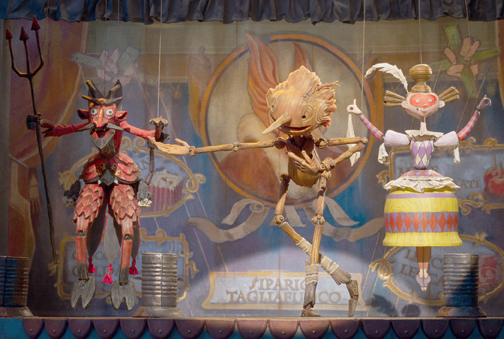
Having broken a promise to attend school, Pinocchio is delighted by the acclaim he
receives as the new star of Count Volpe's marionette show.


Del Toro’s relentlessly morbid and very loose adaptation definitely isn’t for children, who certainly won’t understand the updated shift to war-era Fascist Italy, and likely will be terrified by this setting. Nor can I picture mainstream adults wandering into what superficially appears to be a children’s film.

Unsuspecting parents who gather the kiddies for what they assume will be a family-friendly holiday flick, are apt to be horrified.


Even del Toro hedges this particular bet. “It’s not necessarily made for children,” he admitted, in a recent Los Angeles Times interview, “but children can watch it.”


Seriously?


I think not.


(Del Toro is fond of placing his dark fantasies against the backdrop of real-world horrors; both The Devil’s Backboneand Pan’s Labyrinth are set during the Spanish Civil War.)


Granted, the surrealistic writer/director has a legion of fans, and lovers of this painstaking animation style certainly will embrace this outré fantasy; perhaps, combined, they’ll be sufficient. And, in fairness, co-director Mark Gustafson’s stop-motion work is stunning; whatever else can be said about this film, it exhibits a true sense of wonder.


Pinocchio’s appearance here — rough-hewn, spindly, unfinished (missing one ear), a true marionette — is inspired by artist Gris Grimly’s illustrated 2002 edition of Collodi’s book.


And, backed by fine voice talent, del Toro and Gustafson elicit an impressive range of emotions from these characters.


But my goodness, this film is bleak. And macabre. And sad.


A lengthy prologue introduces wood-carver Geppetto (voiced by David Bradley) and his young son, Carlo (Alfie Tempest). The old man dotes on the boy, who — a model child — is equally devoted to his father: trustworthy, obedient, eager to learn. Alas, his life is cut short by a wartime tragedy.


Geppetto is heartbroken, overwhelmed by grief; his work suffers, leaving unfinished a large wooden effigy of Jesus in the local church, much to the chagrin of the village priest (Burn Gorman). Time passes; finally, in a fit of drunken rage one night, Geppetto makes a “replacement son” and then falls asleep.


A large, feather-winged, luminous blue wood sprite (Tilda Swinton) appears; taking pity on Geppetto, she grants life to the hastily carved little puppet. She then charges his “development” to the erudite and touchingly noble Sebastian J. Cricket (Ewan McGregor, who also narrates this tale).


Friday, December 31, 2021

Don't Look Up: Profoundly unsettling, despite trying too hard

Don't Look Up (2021) • View trailer
3.5 stars (out of five). Rated R, for frequent profanity, sexual candor, graphic nudity and drug use
Available via: Netflix
By Derrick Bang • Published in The Davis Enterprise, 1.7.22

Ouch.


This is about as scathing an indictment of modern American behavior as can be imagined.


Hoping to share their dire and tremendously important discovery on national television,
Randall (Leonardo DiCaprio, center right) and Kate (Jennifer Lawrence, far right) little
realize they're about to be trivialized by hosts Brie (Cate Blanchett) and Jack (Tyler Perry).


Back in 2015, writer/director Adam McKay stunned us with The Big Short, a wildly entertaining and ferociously mocking blend of drama, quasi-documentary and break-the-fourth-wall cinéma vérité, in service of an economic crash course that brilliantly explained the upper-echelon machinations that drove our country off a financial cliff in 2007.

This time, McKay and co-scripter David Sirota set their sights much higher: the cognitive dissonance and blind stupidity that prompt so many Americans to deny the existence of climate change, safe covid vaccines, the results of the 2020 election, and a great deal more.


Willful ignorance runs rampant these days, which gives McKay and Sirota plenty to scream about. While quite a few of this film’s sarcastic bombs hit their target, Don’t Look Up isn’t as artistically tight as The Big Short, and I also miss that earlier film’s inventively cheeky directorial flourishes. Sarcasm and snark once again are in abundance, but McKay’s approach here is more dramatically conventional.


Perhaps that’s because the operative metaphor — and its real-world counterpart — are too sobering, too horrifying, for gleeful frivolity.


The Big Short was fun, whereas this one is deeply unsettling: mad-as-hell, take-no-prisoners storytelling.


Events kick off quietly, as university astronomy professor Randall Mindy (Leonardo DiCaprio) and grad student Kate Dibiasky (Jennifer Lawrence) discover a new comet orbiting our solar system. Their initial excitement dwindles when Kate and a gaggle of fellow grad students watch Randall compute the comet’s trajectory on a white board, to determine whether it’ll be visible when it passes Earth.


The film’s most grimly impactful wallop occurs right here, as Randall — fully absorbed by complex mathematical equations — initially fails to register the implication of the zero he has just written on the board. DiCaprio sells this moment: Randall hesitates, starts to shake his head, knows he hasn’t made a mistake … but nonetheless erases the zero and empties the room. Except for Kate.


Computing the dimensions of the comet is similarly easy. It’s the size of Mount Everest … and if — when — it strikes Earth, in just over six months, it’ll be a planetary extinction event.


Well.


Friday, December 17, 2021

Nightmare Alley: Not worth a visit

Nightmare Alley (2021) • View trailer
Three stars (out of five). Rated R, for strong, bloody violence, sexual content, nudity and profanity
Available via: Movie theaters
By Derrick Bang • Published in The Davis Enterprise, 12.17.21

Mid-20th century touring carnivals, by their very nature, seem … well … sordid.


Squalid. Uneasily unpleasant, as if something nasty is happening in the tent around the corner.


Although Molly (Rooney Mara) is instinctively wary around charismatic carnival newcomer
Stan (Bradley Cooper), his charm and aw-shucks persistence eventually wear her down.
Which isn't good news...


No surprise, such an environment proved alluring to director Guillermo del Toro.

Nightmare Alley began life as a 1946 novel by William Lindsay Gresham (who, rather disturbingly, in 1962 committed suicide — via sleeping pills — in the same hotel room where he had written the first draft). Dashing Hollywood star Tyrone Power, looking for something meatier than the romantic and adventure roles for which he had become famous, persuaded 20th Century Fox’s Darryl F. Zanuck to buy the rights for him.


The resulting film was rushed into production and hit theaters the following year; alas, nobody wanted to see Power play such a morally tainted character, and the movie also endured considerable bad publicity — and moral outrage — due to the story’s squalid elements (quite strong, for the time).


History has been much kinder; it’s now regarded as one of the era’s finest film noir entries … a reputation del Toro’s remake hasn’t a chance of attaining.


Granted, this new adaptation looks terrific; production designer Tamara Deverell and cinematographer Dan Lausten persuasively establish the late Depression era, down to the grime and foulness; and an atmosphere of impending dread hovers over the carnival setting like a shroud.


The performances are uniformly strong, and the characters are riveting, with most of them displaying various shades of corruption. It’s also nice to see del Toro and co-scripter Kim Morgan retain Gresham’s grim conclusion. (The 1947 version “softened” the ending, which is that film’s sole flaw.)


Alas, del Toro’s pacing is lethargic and ponderous to a degree that ruins everything.


The Los Angeles Times recently ran an article titled “Are movies too long?,” and this one’s a poster child for a resounding yes. The 1947 version knew when to get off the stage; it’s a just-right 111 minutes. Del Toro’s remake is a butt-numbing 150 minutes, with nothing to show for such expansion. Indeed, the additional length actually works against the story’s atmosphere and suspense.


That’s a shame, because all concerned otherwise do their best, and the classic elements are in place. Every true noirrequires a louse; a very, very, very bad gal; a second, usually trusting and naïve woman whose virtue will be compromised; and assorted sidebar characters of dubious moral quality.

Friday, August 16, 2019

Where'd You Go, Bernadette (And can you stay there?)

Where'd You Go Bernadette (2019) • View trailer 
2.5 stars. Rated PG-13, for profanity and fleeting drug content

By Derrick Bang

Cate Blanchett’s starring performance in this film is breathtaking: a constantly mesmerizing display of nuance and manic emotional swings, which rise to mischievous playfulness and fall to shattered despair, frequently fueled by a stream-of-consciousness volley of half-finished thoughts and hopes.

Bernadette (Cate Blanchett, left) feigns delight when her daughter Bee (Emma Nelson)
gets accepted to the college-prep boarding school Choate ... but actually is dismayed that
her only child — and best friend — is about to move all the way to Connecticut.
Spending two hours with her character, however, is torture on par with root canal surgery.

Ten minute into this sorta-kinda dramedy, we’re ready to strangle her. Ten more minutes, and we’re eyeing the exits.

Television screenwriter-turned-novelist Maria Semple’s 2012 best-seller is an epistolary novel told mostly via emails, memos, letters and other documents, with occasional first-person commentary by 15-year-old Bee, as she attempts to unravel the “mystery” of her mother. Given that format, our sense of Bernadette develops second-hand, at something of a remove; her bitchy, scattered, nasty, socially unacceptable and self-destructive antics are filtered through the lens of a loving daughter.

Director/co-scripter Richard Linklater, in great contrast, thrusts Bernadette into our faces in real time. Watching her interact with other people — doing and saying the things that took place off-camera (so to speak) in the book — will tax the patience of even Blanchett’s most devoted fans.

The point of the story is that there’s a reason for Bernadette’s narcissistic and frankly intolerable behavior; that’s the “enigma” to be sussed by anybody masochistic enough to endure these personality flaws en route to the film’s (admittedly more satisfying) third act. But boy, getting there is a struggle.

Bernadette Fox is a boldly inventive architect whose imaginative creations once garnered a MacArthur Genius Grant. But that was 20 years ago, before she fled Los Angeles for a reclusive life in Seattle, where she and husband Elgie (Billy Crudup) settled in the shambling wreck of Straight Gate, a “house” that looks like it began life as a sanatorium. Any thoughts of renovating the place apparently vanished when only child Bee (Emma Nelson) arrived, and became the sole focus of Bernadette’s more lucid moments.

Two decades on, the house is an unkempt monstrosity, its haphazard artistic touches overwhelmed by a leaking roof, peeling wallpaper, chunks of fallen plaster and blackberry runners growing up through the carpet. Bee finds this magical, thanks to the forbearance of a worshipful teenage daughter who delights in adult eccentricity. 

But the notion that Elgie puts up with it — has put up with it for years — is beyond comprehension. We’re led to believe that his work as a brilliant Microsoft innovator has made him an often preoccupied, frequently absent husband and father … but still.

Friday, September 21, 2018

The House with a Clock in its Walls: Loses time

The House with a Clock in its Walls (2018) • View trailer 
Three stars. Rated PG, and quite generously, despite sorcery, rude humor, occasional profanity and lots of scary stuff

By Derrick Bang • Originally published in The Davis Enterprise, 9.21.18

At its best — thanks mostly to wildly imaginative production designer Jon Hutman — this film feels like a giddy visit to Disneyland’s Haunted Mansion, filtered through the snarky sensibilities of Lemony Snicket.

Having just determined the nature of the malevolent spell ticking down within the walls of
their home, young Lewis (Owen Vaccaro), his Uncle Jonathan (Jack Black) and their
friend Florence (Cate Blanchett) ponder their next move.
There’s a kid-level sense of atmospheric dread on par with Poltergeist, which is no surprise; Steven Spielberg produced and co-wrote that 1982 classic, and his Amblin Entertainment had a hand in this new fantasy.

But scripter Eric Kripke has taken serious liberties with the 1973 John Bellairs juvenile mystery on which this adaptation is based, and — more damningly — Kripke’s storyline is a clumsy mess: a series of disconnected sequences in desperate need of better transitions and linking material. The film succeeds mostly due to momentum, as opposed to any sense of stability or plot logic.

On top of which, the result is helmed by Eli Roth, a director/writer/producer best known for savagely gory horror films such as Cabin FeverHostel and The Green Inferno. He’s the last person in Hollywood I’d choose to orchestrate a family-friendly fright flick. And while — in fairness — he does tone down his torture-porn sensibilities, glimpses of his vulgar, nastier side nonetheless emerge in this PG-stretching rollercoaster ride.

I’m sure he can’t help it. And such tendencies do this film no favors.

The setting is 1955, in small-town New Zebedee, Michigan. Orphaned 10-year-old Lewis Barnavelt (Owen Vaccaro) has been sent to live with his extremely eccentric Uncle Jonathan (a perfectly cast Jack Black) in a creaky old mansion laden with everything guaranteed to scare the wits out of an impressionable little boy: 

A front garden with an uncomfortably lifelike topiary winged lion. Scores of clocks in every room. A comfortably padded armchair with a tendency to follow one around. A stained-glass window that changes its image. Strange sounds in the night. And — worst of all — a chamber filled with sinister dolls, puppets, marionettes, dummies and other prop figures, many only half-assembled or in need of repair.

On top of which, the house seems possessed by some sort of larger, more malevolent clock, its muffled, almost subliminal ticking emanating from the very walls and foundation.

What kid could ever spend a night in such a place?

Poor Lewis isn’t merely frightened; he also misses his parents terribly, both victims of a tragic accident. He has barricaded himself behind a protective façade of Captain Midnight-style goggles and a fondness for big words; the large suitcase that Uncle Jonathan huffs to his nephew’s upstairs bedroom contains an equal measure of clothes and dictionaries.

Friday, June 8, 2018

Ocean's 8: Larkish ladies of larceny

Ocean's 8 (2018) • View trailer 
3.5 stars. Rated PG-13, and too harshly, for brief profanity, fleeting drug use and mild suggestive content

By Derrick Bang • Originally published in The Davis Enterprise, 6.8.18

As long as reasonable care is taken — sharp script, skilled direction, a competent cast — light-hearted caper thrillers can’t miss.

That’s definitely the case with Ocean’s 8.

With their compatriots "on assignment" at Cartier headquarters, the bulk of the team —
from left, Debbie (Sandra Bullock), Tammy (Sarah Paulson), Nine Ball (Rihanna),
Lou (Cate Blancett) and Constance (Awkwafina) — tracks progress via a computer monitor.
If this new film pales slightly when compared to 2001’s sparkling remake of Ocean’s Eleven, it’s mostly because the formula has lost some luster via repetition. Still, the well-designed gender switch compensates for such familiarity, and there’s no question that director Gary Ross — who also scripted this re-boot, with Olivia Milch — assembles the pieces with élan, and then guides them through a devious chess game laden with twists ... at least one of which likely will be a surprise.

Mostly, Ross delivers the necessary level of fun, which was so crucial to the 2001 predecessor’s success. We always had a sense that George Clooney & Co. were playing themselves, as much as their characters — which was absolutely true of the 1960 Frank Sinatra/Dean Martin original — and that added effervescent bonhomie to the action. These were guys with whom we wanted to share war stories over cocktails; the same is true of this Girls Just Want To Have Fun reworking.

And yes — just to be clear — this gender switch is far better, in every possible way, than 2016’s conceptually similar but otherwise misguided remake of Ghostbusters.

We meet Debbie Ocean (Sandra Bullock) — the equally larcenous sister of Clooney’s Danny Ocean — immediately following a prison stretch of five years, eight months and 12 days. Rather than accept this sentence as a lesson learned, Debbie spent the entire time devising, refining and perfecting what she now believes will be the perfect crime: the theft of the Toussaint, a unique diamond necklace valued at $150 million, which stays locked in an impenetrable vault in the bowels of the Cartier mansion.

All she needs is a crew.

Bullock’s Debbie is perky, poised and polished: utterly unflappable, and generally sporting a mildly self-confident smirk that potential marks immediately find disarming. This contrasts nicely with the wary and somewhat hardened Lou (Cate Blanchett), Debbie’s former partner in crime, who is less than enthusiastic when given the opportunity to resume their illicit ways.

Debbie mocks; Lou challenges. Bullock and Blanchett make an excellent team, and the script teases us with the possibility that their relationship might run deeper than mere professional camaraderie.

Friday, November 3, 2017

Thor: Ragnarok — Thud and blunder

Thor: Ragnarok (2017) • View trailer 
Three stars. Rated PG-13, for intense sci-fi action and violence

By Derrick Bang • Originally published in The Davis Enterprise, 11.3.17

Thor has succumbed to a case of the sillies.

Perhaps concerned by the grim sturm und drang that has turned so many recent superhero epics into dreary slogs, Marvel Studios has authorized a rather drastic realignment of its cinematic God of Thunder. They shifted too far in the opposite direction: The results here feel more like a new try-out team for Guardians of the Galaxy.

Having rather miraculously survived their first gladiatorial punch-out, Thor (Chris
Hemsworth) and the Hulk discover they've been forced to become unlikely roommates
in an oddly appointed cell.
Granted, the myth-specific costumes and flowery Shakespearean dialogue drew snickers in the first two Thor films, but they nonetheless let viewers know that none of it was to be taken seriously. The tone was light, particularly with respect to the sniping between Thor (Chris Hemsworth) and his half-brother Loki (Tom Hiddleston), whose villainy never was as dire as he would have preferred.

But Thor: Ragnarok is a full-blown comedy interrupted only occasionally by super-heroics, and that’s an unfortunate miscalculation. The film’s three credited writers — Eric Pearson, Craig Kyle and Christopher Yost — seem far more interested in replicating the playful banter and witty one-liners that were characteristic of 1930s and ’40s screwball comedies, little realizing that crafting such repartee, and making it sound organic, requires far more skill than is on display here.

Delivering such dialogue also demands a level of thespic skill that Hemsworth sadly lacks. Co-stars Cate Blanchett, Anthony Hopkins and Hiddleston have the acting background required to chew up the scenery, but Hemsworth is far outside his comfort zone. Too many of his line readings smack of desperation.

Worse yet, the core plot — highlighted by Blanchett’s marvelously malevolent über-villainess, Hela — gets sidetracked by an interminable second act that piles on the dumb-bunny gags. It’s sad to see Thor become an object of ridicule in his own series.

The film’s subtitle — ragnarok, also known in Norse mythology as “twilight of the gods” — refers to a final apocalyptic battle that (depending on interpretation) concludes with the destruction of the world, or the universe, or godly realms. For this story, the threat is to Thor’s ancestral home of Asgard, gateway to the “nine realms” that include Midgard (Earth).

Thor seems to have this threat well in hand during a prologue; he handily defeats Surtur, an immense fire demon who is the fabled harbinger of ragnarok. But Loki once again has been up to no good, back in Asgard, having usurped the throne and stripped their father Odin (Hopkins) of his magical power. In this weakened state, he’s no longer able to secure the enchanted prison that has long protected the nine realms from Hela (Blanchett), goddess of death ... and — surprise, surprise — Thor and Loki’s hitherto unknown older sister.

Friday, January 15, 2016

Carol: Nothing to sing about

Carol (2015) • View trailer 
Three stars. Rated R, for nudity and intimate sexuality

By Derrick Bang • Originally published in The Davis Enterprise, 1.15.16

Intimate dramas work best when we understand and empathize with the primary characters: when we feel like we know them.

Even during their first meeting, Therese (Rooney Mara, left) can't help noticing the
smoldering, come-hither gaze that Carol (Cate Blanchett) delivers with a shameless
lack of subtlety.
Despite the scrupulous care with which director Todd Haynes has assembled his new film, it’s almost impossible to become involved with the storyline. The narrative is slow, the tone is sweepingly luxurious, and the performances are overstated: all intentional, since Haynes is imitating the opulent 1950s melodramas made by director Douglas Sirk (Magnificent Obsession, Written on the Wind, Imitation of Life and many others).

Which would be fine, if playwright Phyllis Nagy had done a better job with her adaptation of The Price of Salt, the Patricia Highsmith novel on which this film is based.

Granted, Cate Blanchett delivers another of her carefully sculpted performances as protagonist Carol Aird (although I’d argue that Blanchett did the “anguished socialite” shtick much better in Woody Allen’s Blue Jasmine).

But despite the film’s title, Carol isn’t the most important character in this story, as Highsmith made abundantly clear in her novel. That would be the younger Therese Belivet, who remains an utter cipher as portrayed by co-star Rooney Mara. It’s not entirely her fault; she hits the higher emotional notes reasonably well. But Mara’s Therese has too much “down time,” when she simply stares vacantly toward the camera, as if waiting for Haynes’ next instruction.

More to the point, we know nothing about Therese: her background, the reason she’s so arbitrarily bitchy toward longtime boyfriend Richard (Jake Lacy, who does his best in a thankless role), or — most crucially — why she’s so suddenly infatuated with Carol. We get none of the essential back-story present in Highsmith’s novel.

OK, fine; Therese is trying to “find herself.” But that isn’t good enough; Mara doesn’t sell her half of the dynamic, and therefore the entire film sinks beneath the weight of its own flamboyantly breathy ambiance.

Friday, October 30, 2015

Truth: None to be found

Truth (2015) • View trailer 
Three stars. Rated R, for profanity

By Derrick Bang • Originally published in The Davis Enterprise, 10.30.15


This film is quite intriguing, in part because its title reflects great irony: Almost no “truth” emerges here.

Having finally put their investigation to bed, the 60 Minutes team — from left, Lucy Scott
(Elisabeth Moss), Mary Mapes (Cate Blanchett), Mike Smith (Topher Grace) and Lt. Col.
Roger Charles (Dennis Quaid) — watch their colleague Dan Rather deliver the story to
TV viewers. Sadly, that won't be the end of it...
Director/scripter James Vanderbilt’s politically charged drama is based on the late 2004 events that later came to be known as “Rathergate”: the CBS 60 Minutes news piece that cast doubt on the details of then-president George W. Bush’s National Guard service.

The questions that initially fueled the journalistic investigation — whether strings had been pulled to get Bush into the Texas Air National Guard, as opposed to service in Vietnam; and whether he had, in fact, honorably completed said National Guard service — quickly were submerged beneath a rising tide of questions regarding the legitimacy of the investigation’s sources and “smoking-gun documentation.”

This script is based on Truth and Duty: The Press, the President and the Privilege of Power, the 2005 book by Mary Mapes, who produced the CBS News piece, but Vanderbilt is an unlikely candidate for such an assignment. His previous résumé is limited to crime dramas and high-octane action epics such as The Amazing Spider-Man and White House Down, and his dialog here too frequently sounds like amateur efforts to imitate Aaron Sorkin or David Mamet.

The performances are robust, and Vanderbilt has done reasonably well with this directing debut; he knows how to guide his actors through their scenes. No question, as well, that this is an important story, and one with lessons to be learned. But the narrative is frequently clumsy, the timeline occasionally confusing, and we’re ultimately left with more questions than answers (which, although almost certainly intentional, is nonetheless irritating).

On top of which, Vanderbilt makes a few glaring rookie mistakes, starting with his opening scene, wherein Mapes (Cate Blanchett) begins an intense first meeting with ... somebody. We’re inclined to assume he’s a shrink; we eventually learn, much later, that he’s a lawyer. Either way, he’s a gimmick that allows Mapes to recount her story while it’s still happening, which is simply daft.

The narrative proper begins in the spring of 2004, just as CBS broadcasts Mapes’ breaking-news story of the Abu Ghraib torture and prisoner abuse. It’s a moment of triumph — and a piece that would go on to win CBS and Mapes a Peabody Award — but, in the demanding environment of a news studio, just another assignment completed, with many more to go.

Friday, March 13, 2015

Cinderella: Dreams do come true

Cinderella (2015) • View trailer 
3.5 stars. Rated PG, for mild dramatic tension

By Derrick Bang • Originally published in The Davis Enterprise, 3.13.15

Doubts notwithstanding — and I had plenty — Disney has done a respectable job, with this live-action update of its own 1950 animated classic.

Ella (Lily James, left), surprised to learn that invitations to the upcoming palace ball will be
extended to every maiden in the realm, wonders how she might escape her stepmother's
clutches, in order to attend. For their part, stepsisters Drisella (Sophie McShera, center)
and Anastasia (Holliday Grainger) immediately vow to win the prince's hand in marriage.
Kenneth Branagh’s presence in the director’s chair certainly helps; it stands to reason that the Irish Renaissance man who brought Shakespearean regality to 2011’s Thor could grant (let’s be candid) a fairy-tale trifle with the same degree of dramatic heft.

In lesser hands, Thor could have sunk beneath the weight of its laughably pompous dialogue and overwrought premise ... but no, Branagh gave it class. He does the same here, with this fresh interpretation of Cinderella.

To be sure, he had able assistance, starting with a solid script from writer/director Chris Weitz, still best known for his 2002 adaptation of Nick Hornby’s About a Boy. Weitz’s take on Cinderella is a little bit Grimm (as in Brothers) and a little bit Disney, with a soupçon of modern feminist sparkle. The resulting narrative is appropriately cheerful, poignant, bleak and swooningly romantic, as needs must.

With respect to the latter, wait until you catch Cinderella’s arrival at the Prince’s ball: Rarely has a character been afforded so splendid an entrance, and rarely has a director milked a scene with such unapologetic oomph.

Which brings us to this film’s young star: Lily James, who makes a flawless Cinderella. She’s eminently believable as an unassuming country lass, albeit one who’s well-read and possesses the perceptive wit of a Jane Austen heroine. At the same time, James “cleans up” marvelously, when a bit of Fairy Godmothering transforms ash-begrimed Cinder-Ella into a breathtaking vision who transfixes all in her presence.

James has a natural ingenuousness that Branagh employs to full effect: the sort of sweet sincerity that Christopher Reeve brought to Superman, when he spoke of fighting for “truth, justice and the American way.” Nobody laughed when Reeve delivered that iconic line; well, nobody laughs here either, when James’ Ella — recalling a promise made years back, to her mother — resolutely insists on facing the world with “courage ... and kindness.”

Pronounced just like that, with a slight pause between the two attributes. Again, the sort of statement that, if delivered even the slightest bit wrong, would prompt snickers from our oh-so-sophisticated 21st century audiences.

Trust me: No laughter erupted during Monday evening’s preview screening (at least, not at that particular moment). Indeed, the audience lapped it up. It would appear that Disney’s current run of “princess power” has yet to subside.

Friday, December 19, 2014

The Hobbit, The Battle of the Five Armies: At long last, the grand finale!

The Hobbit: The Battle of the Five Armies (2014) • View trailer 
3.5 stars. Rated PG-13, for intense fantasy action violence and some truly scary monsters

By Derrick Bang • Originally published in The Davis Enterprise, 12.19.14

Peter Jackson certainly knows how to stage a spectacle.

He’d have had a great time during Hollywood’s Golden Age, choreographing the fabled casts of thousands.

As a massive battle between elves, dwarves, humans and nasty orcs rages about them,
Gandalf (Ian McKellen, left) and Bard (Luke Evans) realize that the ghastly orc armies are
being directed by the orc lord Azog the Defiler, standing on a nearby hilltop. Clearly, he
must be stopped ... but how?
That said, he has become a poor judge of narrative structure. Although this final installment of J.R.R. Tolkien’s The Hobbit builds to a rousing, suspenseful, crowd-pleasing climax, this cinematic saga definitely didn’t deserve the three-part presentation that seems to have been dictated entirely by commerce.

Consider the irony: We couldn’t get enough of Jackson’s three-part adaptation of Tolkien’s Lord of the Rings, and fans eagerly snapped up the extended-edition DVDs, to savor all the additional scenes left on the cutting-room floor. That adulation was entirely warranted, because those three books are extremely dense.

But The Hobbit lacks that complexity; it’s a shorter, single book, and — more significantly — is aimed at a much younger audience. Granted, Jackson and his fellow scripters — Fran Walsh, Philippa Boyens and horror maestro Guillermo del Toro — drew from the 125 pages of notes and appendices included with modern editions of The Lord of the Ring ... but, even so, this newest trilogy has suffered from bloat since its first installment. (I still haven’t recovered from the slapstick, Disney-esque dwarf songs in Bilbo’s dining room.)

Although the major plot points have been impressively realized, there’s a definite sense of treading water along the way, and extraneous characters we’d be better off without. Notable case in point: the Master of Laketown (Stephen Fry) and his weaselly aide (Mikael Persbrandt), who popped up in the middle installment and return here. They’re no more than stunt casting, particularly in Fry’s case, and their characters seem to have wandered in from a Blackadder installment. Very poor judgment, on Jackson’s part.

More disappointing, though, is the fact that — in this third and final installment — Martin Freeman’s Bilbo Baggins has become a bystander in his own story. That’s a shame on all sorts of levels, not the least of which is the lessened degree to which we’re able to enjoy Freeman’s marvelously subtle performance. I just love the way he twitches his nose, or starts to say something, checks himself, and then decides that silence is the better part of wisdom.

Freeman gets more mileage out of Bilbo’s double-take decisions not to speak, than many of these supporting characters deliver via pages of dialogue.