Showing posts with label Rooney Mara. Show all posts

Friday, January 13, 2023

Women Talking: A grim yet crucial conversation

Women Talking (2022) • View trailer
Four stars (out of five). Rated PG-13, and too generously, despite considerable dramatic intensity, sexual assault, bloody images and profanity
Available via: Movie theaters

A dozen women, of all ages, gather in the upper loft of a massive barn.


This feels like a small farming community, and they’re dressed plainly; there’s no sign of modern conveniences. It could be one, two, even three centuries ago.


Forced into an impossible decision, the women from two families — from left, Mejal
(Michelle McLeod), Greta (Sheila McCarthy), Neitje (Liv McNeil), Mariche (Jessie Buckley),
Salome (Claire Foy), Autje (Kate Hallett), Ona (Rooney Mara) and Agata (Judith Ivy) —
contemplate a pair of equally life-changing options.


The meeting is prompted by some sort of crisis. But that’s only a catalyst; unhappiness, frustration and even fury have been brewing for a long time. The men in this community have been intolerable for too long, and the women have convened to consider their options: do nothing, leave … or stay and fight back.

A vote is taken, with every female community member weighing in. Because they’re all illiterate, they merely mark an X beneath one of three pencil drawings depicting each option. Their “schooling” has been solely Biblical and heavily evangelical, their compliance dictated by verses burned into their brains.


The vote proves a tie, between leaving or fighting back.


This small subset of women — from three families — has been tasked with weighing the options, considering consequences, and breaking the tie.


Director/scripter Sarah Polley’s moody, expressionistic adaptation of Miriam Toews’ critically hailed 2018 novel is a quietly somber affair that leans toward fable or allegory, but in fact is an explosive shot across the bow of all predatory male behavior.


As soon becomes clear, as the ensuing discussion unfolds, this community’s men have — for generations — been cruelly abusing these women physically, emotionally and spiritually. They’ve been raped in the dead of night, regardless of age, after being rendered unconscious by a livestock anesthetic spray.


Confronted, the following morning, by the bruised and often bloody results of these late-night assaults, their subsequent anguish has been dismissed — by the men — as the work of Satan, ghosts or “wild female imagination.”


This has continued for generations, the women often giving birth to boys who grow up to become men groomed to subsequently rape their own younger sisters.


The immediate emergency has been prompted by a failed assault attempt; the attacker was witnessed by potential adolescent victims Autje (Kate Hallett) and Neitje (Liv McNeil). They’re mostly silent during these proceedings, braiding each other’s hair into an intertwined bond, and — unexpectedly — occasionally supplying remarkably perceptive observations.


The perpetrator was caught and arrested; all of the community’s men have left to post bail in the nearby town. When they return with the accused, it has been made clear that the women will be expected to forgive him, according to “God’s way.”


Hence, the dilemma.

Friday, December 17, 2021

Nightmare Alley: Not worth a visit

Nightmare Alley (2021) • View trailer
Three stars (out of five). Rated R, for strong, bloody violence, sexual content, nudity and profanity
Available via: Movie theaters
By Derrick Bang • Published in The Davis Enterprise, 12.17.21

Mid-20th century touring carnivals, by their very nature, seem … well … sordid.


Squalid. Uneasily unpleasant, as if something nasty is happening in the tent around the corner.


Although Molly (Rooney Mara) is instinctively wary around charismatic carnival newcomer
Stan (Bradley Cooper), his charm and aw-shucks persistence eventually wear her down.
Which isn't good news...


No surprise, such an environment proved alluring to director Guillermo del Toro.

Nightmare Alley began life as a 1946 novel by William Lindsay Gresham (who, rather disturbingly, in 1962 committed suicide — via sleeping pills — in the same hotel room where he had written the first draft). Dashing Hollywood star Tyrone Power, looking for something meatier than the romantic and adventure roles for which he had become famous, persuaded 20th Century Fox’s Darryl F. Zanuck to buy the rights for him.


The resulting film was rushed into production and hit theaters the following year; alas, nobody wanted to see Power play such a morally tainted character, and the movie also endured considerable bad publicity — and moral outrage — due to the story’s squalid elements (quite strong, for the time).


History has been much kinder; it’s now regarded as one of the era’s finest film noir entries … a reputation del Toro’s remake hasn’t a chance of attaining.


Granted, this new adaptation looks terrific; production designer Tamara Deverell and cinematographer Dan Lausten persuasively establish the late Depression era, down to the grime and foulness; and an atmosphere of impending dread hovers over the carnival setting like a shroud.


The performances are uniformly strong, and the characters are riveting, with most of them displaying various shades of corruption. It’s also nice to see del Toro and co-scripter Kim Morgan retain Gresham’s grim conclusion. (The 1947 version “softened” the ending, which is that film’s sole flaw.)


Alas, del Toro’s pacing is lethargic and ponderous to a degree that ruins everything.


The Los Angeles Times recently ran an article titled “Are movies too long?,” and this one’s a poster child for a resounding yes. The 1947 version knew when to get off the stage; it’s a just-right 111 minutes. Del Toro’s remake is a butt-numbing 150 minutes, with nothing to show for such expansion. Indeed, the additional length actually works against the story’s atmosphere and suspense.


That’s a shame, because all concerned otherwise do their best, and the classic elements are in place. Every true noirrequires a louse; a very, very, very bad gal; a second, usually trusting and naïve woman whose virtue will be compromised; and assorted sidebar characters of dubious moral quality.

Friday, July 27, 2018

Don't Worry, He Won't Get Far on Foot: A rewarding stroll

Don't Worry, He Won't Get Far on Foot (2018) • View trailer 
Four stars. Rated R, for dramatic intensity, alcohol abuse, nudity, sexual candor and relentless profanity

By Derrick Bang • Originally published in The Davis Enterprise, 7.27.18

The quickest entry to John Callahan’s caustic, macabre and self-deprecating sense of humor is to understand that this film takes its title from his 1989 autobiography, written 17 years after the traffic accident that left him a C5-6 quadriplegic.

As John Callahan (Joaquin Phoenix) begins to morph into an actual human being, he's
helped along the way by the kindness and patience of Annu (Rooney Mara).
His scratchy, hilariously irreverent cartoons appeared everywhere for a time, from Omni and Harper’s to National Lampoon and Penthouse. Most notably, his work was featured for 27 years in the Portland, Ore., newspaper Willamette Week, where both he and the staff delighted in the occasional protests and boycotts by enraged readers.

That reaction remains true to this day. You can’t help laughing at most of Callahan’s work, but then — just as quickly — you wonder whether you should.

All this said, he isn’t necessarily an ideal subject for a biographical drama … particularly one that wishes to be factually and emotionally accurate. He was as aggressively confrontational as his cartoons; for quite a number of years before and after the accident, he also was an exceptionally nasty alcoholic. It’s not easy to spend two hours with such an unpleasant person, and Joaquin Phoenix doesn’t hold back; his depiction of Callahan is quite brutal at times.

But we are a species which, by nature, believes in the miracle of epiphanies … and few individuals have undergone a greater change. That isthe stuff of captivating film dramas.

Director/scripter Gus Van Sant has spent the bulk of his career crafting compelling sagas about equally challenging — and often unlikable — individuals, from Drugstore Cowboy and My Own Private Idaho up through To Die ForElephant and Paranoid Park. His films intrigue not only for their unusual characters, but also for the often non-linear manner in which he lets a saga unfold.

That’s particularly true of Don’t Worry, which structures its (more or less) chronological narrative via Callahan’s candid recollections, as depicted during numerous Alcoholics Anonymous meetings; a chance encounter with young neighborhood skateboarders; and while addressing a crowd at a popular public presentation, after he had become quite famous. These sequences are further interspersed with animated versions of Callahan’s signature cartoons.

The running thread — the moral — is consistent throughout: Don’t feel sorry for yourself. Shrug it off, whatever it is, and take control.

A valuable lesson: one that took Callahan years to recognize, understand and embrace.

Sunday, December 25, 2016

Lion: Roars too softly

Lion (2016) • View trailer 
Three stars. Rated PG-13, for dramatic intensity

By Derrick Bang

Saroo Brierley’s personal saga is the stuff of harrowing Dickensian melodrama: a deeply emotional and ultimately triumphant journey recounted in his 2014 memoir, A Long Way Home.

Waiting to reunite with an older brother who fails to return for him, 5-year-old Saroo (Sunny
Pawar) boards a parked train, assuming that it eventually will take him back home. Sadly,
and alarmingly, he's in for a nasty surprise.
The story screamed for big-screen treatment, but the result disappoints. Poet and novelist Luke Davies’ script focuses only on the beginning and end of Brierley’s chronicle, ignoring a lengthy middle segment and — as a result — leaving viewers with all sorts of questions. Perhaps more crucially, the film’s powerful first half completely overwhelms what follows; first-time feature director Garth Davis lacks the skill to hold our attention during the increasingly tedious and dull second act.

On top of which, Dev Patel — who plays the twentysomething Brierley — is badly overshadowed by young Sunny Pawar, who plays 5-year-old Saroo.

Pawar’s performance is stunning. Patel ... not so much.

The film clearly has been a marketing challenge, given the various posters created to pique viewer interest. None is very dynamic, perhaps the most misleading dominated by large close-ups of Patel and co-star Rooney Mara, staring into each other’s eyes, thus implying a romantic focus that’s only a very small part of the narrative.

All of which is a shame. Davies didn’t adapt the story very well; Davis brought nothing to the table; and the Weinstein Company bungled the marketing. Brierley deserved far better.

We meet Saroo as an adorably precocious little boy, completely devoted to older brother Guddu (Abhishek Bharate). They live in cruel poverty, in the Ganesh Tilai neighborhood of rural India’s Khandwa, in the Nimar region of Madhya Pradesh. The boys beg, scuffle for odd jobs, and steal coal from moving trains, to supplement the meager wages earned by their single mother, Kamla (Priyanka Bose), who moves rocks at construction sites.

When Guddu gets word of potential work a short nighttime train ride away, Saroo demands to tag along, insisting that he’s strong enough to do anything his brother can do. Guddu relents, but the journey proves exhausting for the little boy; Guddu leaves him to rest on a platform bench, promising to return soon.

But he doesn’t.

Friday, August 19, 2016

Kubo and the Two Strings: An enchanting fable

Kubo and the Two Strings (2016) • View trailer 
Four stars. Rated PG, for dramatic intensity and scary moments

By Derrick Bang

It’s extraordinarily difficult to replicate the look, atmosphere and ambiance of an entirely difficult culture, and yet the Oregon-based Laika animation studio has done just that, with Kubo and the Two Strings.

With a rather large monster preparing to stomp and/or devour them, Kubo is stunned into
temporary immobility. Fortunately, Monkey and Beetle are better prepared for action ... as
also is true of the tiny origami samurai warrior perched on Kubo's shoulder.
Director Travis Knight and a trio of writers — Shannon Tindle, Marc Haimes and Chris Butler — have concocted what feels like an authentic Japanese folk tale, laced with fantastic characters and a little boy who is, himself, a purveyor of stories. The stop-motion animation style will be recognized by fans who adored previous Laika efforts, such as Coraline and ParaNorman, but in this case with an added twist: This new film’s look is inspired by origami and classic Japanese woodblock printing.

The action takes place in a colorful realm of rough-hewn sawtooth patterns, strong linear striations and bold but simple colors, all inspired by the work of woodblock masters such as Kiyoshi Saito and Katsushika Hokusai. The resulting texture — the apparent “feel” of the images — is truly lovely, and unlike anything else we’ve seen from today’s panoply of animation studios.

But of course style cannot be paramount; it must serve the story. That’s absolutely the case here, as we quickly become immersed in an otherworldly narrative with the mythic authenticity of a Hayao Miyazaki fable.

“If you must blink, do it now,” we’re cautioned, as this saga begins. “If you look away, even for an instant, then our hero will surely perish.”

Kubo (voiced by Art Parkinson) is a popular street urchin who lives near a fishing village in ancient Japan, and survives by enchanting townspeople with wild tales of samurai warriors and mythical creatures, all brought to life via origami figures created magically when he plays a guitar-like shamisen. The coins collected are sufficient to buy food and meager supplies for both Kubo and his mother; they live in a cave on a high cliff that overlooks the vast ocean.

Kubo’s mother slips in and out of awareness, suffering from trances that are governed by the rising and setting of the moon. This condition has persisted ever since the perilous ocean journey that brought her and the then-infant Kubo to this land. Worse yet, the boy is missing his left eye, the orb — we’re told — having been plucked out by his grandfather, the evil Moon King (Ralph Fiennes).

During her cognizant moments, Kubo’s mother speaks lovingly of her absent husband, a warrior who lost his life defending his family from the Moon King. And more than anything else, she cautions, Kubo must never, ever linger outside after dark.

Friday, January 15, 2016

Carol: Nothing to sing about

Carol (2015) • View trailer 
Three stars. Rated R, for nudity and intimate sexuality

By Derrick Bang • Originally published in The Davis Enterprise, 1.15.16

Intimate dramas work best when we understand and empathize with the primary characters: when we feel like we know them.

Even during their first meeting, Therese (Rooney Mara, left) can't help noticing the
smoldering, come-hither gaze that Carol (Cate Blanchett) delivers with a shameless
lack of subtlety.
Despite the scrupulous care with which director Todd Haynes has assembled his new film, it’s almost impossible to become involved with the storyline. The narrative is slow, the tone is sweepingly luxurious, and the performances are overstated: all intentional, since Haynes is imitating the opulent 1950s melodramas made by director Douglas Sirk (Magnificent Obsession, Written on the Wind, Imitation of Life and many others).

Which would be fine, if playwright Phyllis Nagy had done a better job with her adaptation of The Price of Salt, the Patricia Highsmith novel on which this film is based.

Granted, Cate Blanchett delivers another of her carefully sculpted performances as protagonist Carol Aird (although I’d argue that Blanchett did the “anguished socialite” shtick much better in Woody Allen’s Blue Jasmine).

But despite the film’s title, Carol isn’t the most important character in this story, as Highsmith made abundantly clear in her novel. That would be the younger Therese Belivet, who remains an utter cipher as portrayed by co-star Rooney Mara. It’s not entirely her fault; she hits the higher emotional notes reasonably well. But Mara’s Therese has too much “down time,” when she simply stares vacantly toward the camera, as if waiting for Haynes’ next instruction.

More to the point, we know nothing about Therese: her background, the reason she’s so arbitrarily bitchy toward longtime boyfriend Richard (Jake Lacy, who does his best in a thankless role), or — most crucially — why she’s so suddenly infatuated with Carol. We get none of the essential back-story present in Highsmith’s novel.

OK, fine; Therese is trying to “find herself.” But that isn’t good enough; Mara doesn’t sell her half of the dynamic, and therefore the entire film sinks beneath the weight of its own flamboyantly breathy ambiance.

Friday, October 9, 2015

Pan: Soaring adventure

Pan (2015) • View trailer 
3.5 stars. Rated PG, for fantasy action violence

By Derrick Bang


Old-style, kid-centric adventure films — those akin to Disney’s In Search of the Castaways or Richard Donner’s The Goonies — have become rare.

Today’s studio heads too frequently taint the formula with coarse humor and/or needlessly unpleasant violence, either (giving them the benefit of the doubt) in a misguided effort to court parents, or (more cynical, but more likely) to obtain the “tougher” PG-13 rating that generally does better business than a family-friendly PG.

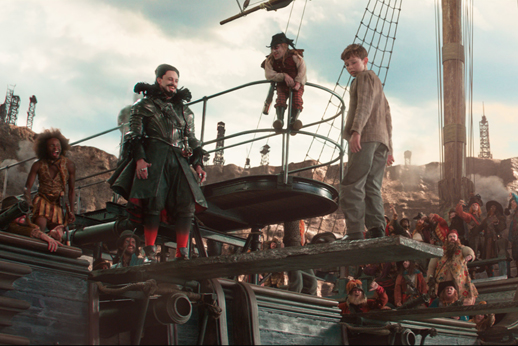
Peter (Levi Miller, right) anticipates certain doom once he's forced off the ship's plank by
the dread Blackbeard (Hugh Jackman, in black). But although the boy doesn't yet know
it, he possesses a magic talent that will surprise everybody...
Which makes director Joe Wright’s Pan something of a minor miracle. It’s a throwback to kinder, gentler times, when young champions relied on pluck and resourcefulness, rather than sarcasm and potty humor. Scripter Jason Fuchs’ imaginative fantasy is a thrilling ride from start to finish: laden with stalwart heroes and opulently dastardly villains, wildly imaginative locales and a high-spirited adolescent hero who could have stepped from the pages of a Charles Dickens novel (with a detour that L. Frank Baum would have appreciated).

Fuchs’ story speculates on a question that might have occurred to young fans of Scottish novelist/playwright J.M. Barrie’s celebrated “boy who wouldn’t grow up.” It’s a tantalizing query: How did Peter Pan become himself?

Fuchs, making a respectable big-screen solo scripting debut, plays with elements of Barrie’s original mythos, while borrowing scenarios and character archetypes from other fantasy sources. The crazy-quilt result is a bit uneven at times, but Wright and editors William Hoy and Paul Tothill keep things moving so rapidly, that you’re not likely to mind.

The action begins at London’s bleak Lambeth Home for Boys, during the height of the WWII blitz, where 12-year-old Peter (Levi Miller, doing an excellent job in his feature debut) and his fellow youngsters are routinely terrorized by Mother Barnabas (Kathy Burke), the imperious and just-plain-mean nun who runs the place. Peter has long suspected that Mother Barnabas has been hoarding all the tasty food rations while forcing the children to subsist on gruel, but in truth her perfidy is much, much worse.

Aside from these suspicions regarding the orphanage provisions, the bigger issue concerns the ongoing — and unexplained — disappearances of a few boys each night. The answer to that question proves calamitous, when Peter is among those snatched the next time around. He finds himself on (of all things) a pirate ship floating high above, which “sails” air currents the way an ordinary vessel would navigate the seven seas.

Friday, January 10, 2014

her: Character flaws

her (2013) • View trailer 
Three stars. Rating: R, for profanity, sexual candor and brief nudity

By Derrick Bang

Writer/director Spike Jonze’s new fantasy is an intriguing cautionary tale aimed squarely at the narcissistic, self-absorbed millennials who increasingly behave as if social media isn’t merely an acceptable substitute for personal contact, but in fact deserves to become the preferred method of interaction.

After confessing that he may be falling in love with his computer operating system,
Theodore (Joaquin Phoenix) is surprised when his longtime friend Amy (Amy Adams)
doesn't react with disgust. Indeed, she seems quite okay with the concept...
In that respect, Jonze displays an uncanny instinct for depicting our deeply disturbing near-future, if such conduct continues unchecked along its current path.

Much as I admire the message, however, the delivery system leaves something to be desired. At 126 minutes, this film is self-indulgent to a fault, moving s-l-o-w-l-y to the point of ponderous tedium, en route to a resolution that we can see coming from miles away.

Were Rod Serling alive today, I’ve no doubt he could have turned this premise into a dynamite half-hour installment of his Twilight Zone TV series (assuming placement on HBO or some other pay-cable network, to preserve the essential adult themes). Jonze, taking a much more leisurely approach, drags us for an monotonous ride that had me checking my watch during the entire second hour.

Jonze burst onto the cinema scene with 1999’s Being John Malkovich — which brought him an Academy Award nomination for best director — and has built his subsequent big-screen career on eccentric and downright bizarre relationship dynamics. He most famously teamed with screenwriter Charlie Kaufman for 2002’s Adaptation, the latter insisting on co-crediting that script with his “fictitious twin brother” Donald, both of whom were depicted in the film by Nicolas Cage.

Adaptation was an alternately hilarious and disturbing analysis of the creative process, and Jonze’s new film certainly follows that template. But instead of a fictitious twin, this story’s co-protagonist is the disembodied voice of a computer operating system that possesses intelligence, perception and a capacity for emotional growth.

In other words, the perfect example of artificial intelligence.

The setting is Los Angeles in a “slight future” that is a welcome utopian relief from the Blade Runner-esque hellholes envisioned in too many recent sci-fi films. The overall infrastructure in this vision of Southern California looks and feels familiar, aside for a greater emphasis on towering buildings, and the ambiance is warm, comfortable and embracing. People wear nice clothes, the weather seems ideal, food is plentiful and tasty, and there’s no trace of crime, neglect or poverty.

OK, so maybe it’s a bit soulless ... which is, of course, precisely the point.

Friday, December 23, 2011

The Girl with the Dragon Tattoo: Not tough enough

The Girl with the Dragon Tattoo (2011) • View trailer
3.5 stars. Rating: R, for brutal violent content, rape, torture, strong sexuality, nudity and profanity
By Derrick Bang • Originally published in The Davis Enterprise, 12.23.11


David Fincher exhausts all his creative juices on this film’s opening credits.

The director who disturbed us so effectively during Se7en and Zodiac delivers a truly creepy set of credits for his handling of The Girl with the Dragon Tattoo. They unspool like some rancid afterbirth of classic James Bond credits, with oil- and rubber-covered figures, barely human, punctured by various sharp-bladed instruments.
Journalist Mikael Blomkvist (Daniel Craig) should be unhappy when he learns
that Lisbeth Salander (Rooney Mara) has been eavesdropping on his laptop
activity; indeed, he could have her arrested. But Blomkvist recognizes
investigative talent, and instead asks Lisbeth to help him solve a
40-year-old murder mystery.

Fincher certainly establishes a mood.

Trouble is, he never matches it from that point forward. Yes, this is an uncomfortable, edgy thriller, with Steven Zaillian’s script reasonably faithful to the late Stieg Larsson’s iconic, best-selling novel. But Fincher brings little to the party in the way of visceral oomph; he simply goes through the motions, as if hamstrung by the heavy expectations riding on this project.

As a result, his film remains in the shadow of Swedish director Niels Arden Oplev’s far more satisfying 2009 version: the first adaptation of Larsson’s book, and clearly the superior effort.

Fincher’s remake simply doesn’t sizzle. At no time does he come close to the suspense he generated with Panic Room, particularly during that tension-laden thriller’s final half hour. The climactic confrontation in The Girl with the Dragon Tattoo should have the same edge-of-the-seat suspense ... but it doesn’t.

Possibly because — as most definitely wasn’t the case with Oplev’s version — the “big reveal” regarding the clandestine villain’s identity isn’t much of a surprise here.

Zaillian made several intelligent decisions with his script. He clarified the relationship between crusading journalist Mikael Blomkvist (Daniel Craig) and his publisher/partner, Erika Berger (Robin Wright); Zaillian also dumped an unnecessary — and eyebrow-rolling — affair that Blomkvist has with Cecilia Vanger (Geraldine James), once he begins his investigation for her uncle, Henrik (Christopher Plummer).

Unfortunately, by minimizing Cecilia’s involvement and compressing the rest of the extended Vanger family — we only meet them en masse once, during a fleeting scene in a hospital waiting room — Zaillian whittles down the likely suspects to ... well, very few. After all, we can hardly worry about people the script scarcely bothers to introduce.

Oplev and his scripters, Nikolaj Arcel and Rasmus Heisterberg, did a far better job with the various members of the arrogant Vanger clan, and therefore kept us guessing.

Thursday, May 6, 2010

A Nightmare on Elm Street (2010): Silly dream

A Nightmare on Elm Street (2010) • View trailer for A Nightmare on Elm Street
Two stars (out of five). Rating: R, for violence, gore, profanity and dramatic intensity
By Derrick Bang • Originally published in The Davis Enterprise, 5.6.10
Buy DVD: A Nightmare on Elm Street • Buy Blu-Ray: A Nightmare on Elm Street [Blu-ray]

Director F.W. Murnau's 1922 silent classic, Nosferatu, frightened the wits out of post-WWI viewers and made a star of icky vampire Max Schreck, in a film that ripped off Bram Stoker's Dracula by changing the relevant names, in an effort to avoid paying the author.

Half a generation later, director Tod Browning made Bela Lugosi a star in 1931's legitimate adaptation of Dracula, a hit that spawned a series of undead sequels.
Running on adrenaline and an ill-advised cocktail of caffeine and uppers in
order to stay awake, Nancy (Rooney Mara) and Quentin (Kyle Gallner) stumble
upon the dread Freddy Krueger's secret lair, where they learn the worst about
the entity terrorizing their nightmares.

Roughly a generation after they subsided, Britain's Hammer Films and star Christopher Lee injected fresh blood  and plenty of sensuality  into the mix, and trigged a new series with 1958's Horror of Dracula. A generation after that, Frank Langella became a swooningly erotic blood-sucker in 1979's Dracula.

And so on, and so on, up to more recent genre hits such as TV's Buffy, the Vampire Slayer and the big-screen Twilight series.

Point being, every new generation wants its own version of iconic monsters, starring brand-name talent of the moment. Bearing that in mind, perhaps we shouldn't be too surprised by the arrival of a re-booted Nightmare on Elm Street, with a well-cast Jackie Earle Haley filling the razor-bladed glove that Robert Englund wielded so well, in so many earlier films.

Except ... Englund's huge shadow is part of this remake's problem.

OK, yes, director Wes Craven's original Nightmare is a quarter-century old at this point, having been released in 1984. (That film had juice, by the way, and still does. It also had Johnny Depp.) But it was followed by umpety sequels  the most recent being 2003's Freddy vs. Jason  and two TV series (1984 and 2005). Englund's Freddy Krueger never really left us, which makes director Samuel Bayer's current retread ... totally irrelevant.

And pointless.

And oddly bloodless, given the franchise's history.

The latter element clearly disappointed last week's Sacramento preview audience, particularly the gore-hounds apparently hoping for something more along the lines of the torture-porn Saw franchise.

In fairness, though, Freddy Krueger never focused on evisceration for its own sake; his most memorable killings, in the stronger films in Englund's series, took full imaginative advantage of the eerie illogic of a given victim's dream world.

And that, perhaps, is this new film's biggest failing: It lacks imagination and quickly devolves into a ho-hum slasher flick.

Bayer, a director of music videos and TV commercials making an ill-advised big-screen debut, hasn't the faintest idea how to generate tension. He also can't coax anything approaching a credible performance from most of his no-name cast members, all of whom look quite long in the tooth to be playing high school students.

The one credible exception is Rooney Mara, who brings some reasonable acting chops to her handling of Nancy, very quickly identified as our "heroine of choice" in Wesley Strick and Eric Heisserer's laughably sloppy script. Mara ensures that Nancy deserves our respect, and the capable actress is responsible for the limited dramatic heft that this picture generates.

The basic set-up, for first-timers: Teens Nancy, Quentin (Kyle Gallner, well remembered from TV's Veronica Mars), Kris (Katie Cassidy), Jesse (Thomas Dekker) and Dean (Kellan Lutz) all live on Elm Street. Of late, they've all been having the same very frightening dream, involving a dark, basement-type building and a shadowy, fedora-clad figure with a disfigured face and razor-bladed fingers.

The first kid checks out before we're aware of what's happening; the second follows quickly thereafter. The remaining three realize that something is pursuing them in their dreams, and that if it kills them while they're asleep, they'll die in real life.

Quite, quite horribly.

Logical problems erupt almost too quickly to tabulate.

To an outside observer, a victim experiences real-world carnage: a body being thrown about a room, blood erupting from multiple slash wounds that appear from nowhere. In one case, this ghastly violence is caught on video camera, under circumstances that are being viewed  and would have been re-viewed  by many, many other people.

People In Authority.

And yet nobody ever seems to think anything's the slightest bit unusual about the gory ways these kids keep dying.

Horror films have a habit of beating the "Why won't you believe me?" protest to death, but in this case it's just plain stupid.

On a more specific level, we eventually learn that the parents of the five teens in question took vigilante justice into their own hands years earlier, after learning that the gardener (Krueger) at a local daycare center, which all their young children attended, was abusing them. The various moms and dads  the only ones granted identities are played by the disposable Clancy Brown and Connie Britton  chased Krueger into a warehouse, set it on fire and burned him to death.

And then moved to different parts of town, swearing to never mention anything about Krueger again, particularly not to their kids.

Doesn't it strike you as rather odd, then, as these same five kids  now teens  start dying under mysterious and horrible circumstances, that their respective parents never even consider the long-ago connection to Krueger? And never think to confess all and warn the remaining and clearly terrified kids, if only to help protect them?

These folks aren't likely to win Parent of the Year awards any time soon.

And, finally, why now? Why this week? Why not when Nancy and the others were 8, 10, 12 or 15?

More than anything else, though, this particular franchise always has suffered from the rather uneasy implications of its premise. Strick and Heisserer's script attempts to have it both ways: Maybe Krueger was unjustly accused ... whoops, no, he definitely was guilty as charged. Which creates a problem.

Englund's Krueger turned into something of a pop-culture hero: definitely the go-to guy in his own film series (which perhaps explained why his teen victims became less and less consequential, over time, on the thespic talent meter). The 1984 film's many sequels kinda-sorta tried to overlook the fact that this guy molested little children.

This new film, as well, has an unpalatable "Chester the Molester" atmosphere about it, most notably during an ill-advised bathtub scene, played for laughs, when Nancy briefly falls asleep and Krueger's razor-gloved hand pops up in the water between her legs, which are splayed out in the position one would expect during a gynecological exam.

The scene is ... creepy. And not in an unsettling, horror-movie vibe.

("Chester the Molester," for the uninitiated  and I hope that's most of you  was an ongoing cartoon strip published in Hustler magazine, which depicted the "saucy" adventures of a guy who wanted to molest pre-pubescent girls. The strip's creator, Dwaine B. Tinsley, was convicted of raping his 13-year-old daughter; he served 23 months of a six-year sentence ... and continued to produce his comic strip while in prison.

(Tinsley died in 2000, and his conviction later was overturned, his now-adult, cocaine-addicted daughter eventually proven to have been less than a reliable witness. We leave the question of justice delivered or denied to other, wiser heads.)

Children  and adults  back in the day found their monsters in supernatural creatures of myth and legend: vampires, the Golem, the Wolf Man, Greek snake-tressed gorgons. I find it interesting that the horror-franchise creations that resonate today are, instead, lifted from newspaper headlines: serial killers (Jason, of Halloween fame) and child molesters (Freddy Krueger).

Vampires, alternatively, have become metaphors for disenfranchised minorities (the Twilight and True Blood books).

What, I wonder, does that say about us culturally, at this point in the road?