Showing posts with label romance. Show all posts

Friday, March 13, 2026

Reminders of Him: A solid redemption drama

Reminders of Him (2026) • View trailer
3.5 stars (out of five); rated PG-13, for profanity, drug use and mild sensuality
Available via: Movie theaters

Author Colleen Hoover has blazed an impressive trail in the young adult romance genre, with an astonishing 24 novels and novellas during the past dozen years.


After yet another near-miss effort to spend even a fleeting moment with the daughter she
never has known, Kenna (Maika Monroe) admits her fears and helplessness to Ledger
(Tyriq Withers), who is trying hard to be fair with her ... and with everybody else.

She’s perhaps best known for 2016’s It Ends with Us, which became her first big-screen feature adaptation in 2024. It was followed by last year’s similarly respectful handling of 2019’s Regretting You, and now director Vanessa Caswill has helmed a respectful, richly emotional adaptation of 2022’s Reminders of Him.

This is the first one Hoover has co-scripted, alongside Lauren Levine.


Hoover’s niche often concerns characters trying to navigate relationships that are fractured, damaged or even toxic. Although the atmosphere can be dark and moody, these are credible, relatable, real-world dramas; no surprise, then, that Hoover has an extremely devoted fan base.


The driving question in Reminders concerns the circumstances under which redemption and forgiveness are possible ... and whether the key character deserves them.


The story begins as Kenna Rowan (Maika Monroe) returns to her home town of Laramie, Wyoming. Her first act, on the city outskirts, seems spiteful; she angrily removes a cross and flower bouquet marking the site of a previous road accident. Then, left on her own — with very few possessions — she makes her way to the ironically named Paradise Apartment complex, and books a unit that almost maxes out her cash in hand.


The feisty landlady, Ruth (Jennifer Robertson, a hoot), offers a slight deduction if Kenna accepts one of the many kittens crawling around the check-in counter.


Her unit isn’t quite a pit, but it’s darn close. (Subsequent moments spent with the kitten, as the story proceeds, are a sweet touch.)


Finding a job is next. But all the doors slam shut when Kenna honestly admits, on the application forms, that she has just been released from prison. This frustrating first day concludes when she winds up in the bar that now occupies the bookstore she once loved. She has a flirty, but brief encounter with the owner, Ledger (Tyriq Withers); the dynamic seems oddly off.


Kenna finally secures a job at a local grocery store, thanks to the kindness of shift manager Amy (Grammy-winning country singer-songwriter Lainey Wilson), who doesn’t probe. Their initial conversation is telling; Amy believes in giving people the chance to prove who they are in the present, rather than who they were in the past. (Nice thought. We need more of that.)

Friday, October 3, 2025

French Lover: An affair to forget

French Lover (2025) • View trailer
Two stars (out of five). Rated TV-MA, for sexual candor, mild nudity and profanity
Available via: Netflix

Although numerous sources have called this romantic dramedy a French, gender-reversed response to 1999’s Notting Hill, the comparison is superficial at best.


Despite the fact that ABel (Omar Sy) repeatedly behaves badly, like a spoiled child, he
always apologizes ... and Marion (Sara Giraudeau) always forgives him. Too many times...

Hugh Grant’s “regular bloke” in that earlier film is a successful bookstore owner, with a solid gaggle of supportive friends; he also has his act together. Sara Giraudeau’s Marion, in director Lisa-Nina Rives’ new film, has neither a job nor savings, is in the midst of messily divorcing her loutish husband Antoine (Amaury de Crayencour), and is an emotional wreck. Her only companion is an adored Great Dane named Claudine.

Even so, Marion’s vulnerability is endearing, and Giraudeau plays her 

well; she’d have been a great character in a different film.


Getting back to Notting Hill, Julia Roberts’ famed Hollywood actress is a nice person ... whereas this story’s similarly celebrated Abel Camara (Omar Sy) is an arrogant, self-centered horse’s ass who expects everything, including female companions, to be handed to him on a silver platter.


Sy, who has charisma to burn, can’t make this jerk appealing. Not even at his better moments.


As a result, this story — scripted by Noémie Saglio and Hugo Gélin, loosely inspired by the Israeli TV series A Very Important Person — never successfully sells its relationship of unequals. Sy and Giraudeau give it their best, and Rives’ film has some charming moments ... but accepting the telegraphed inevitability of where this will conclude, is a major eye-roller.


The story opens with a terrific tracking montage, as Abel swans his way through a TV commercial shoot for a perfume dubbed French Lover; once in the can, he angrily stalks off, believing himself “above” doing such twaddle. He lands in a bistro where Marion works as a waitress; after taking his order, she responds to a text on her phone, at which point Abel narcissistically accuses her of filming him, in order to post on social media.


The resulting brouhaha costs Marion her job, and she stalks off in a huff. Suddenly contrite, full of apologies, Abel slowly paces her while in his car, insisting — at the very least — on being allowed to drive her home.


It’s important to note that although Abel behaves as if his contrition is sincere, he never clarifies why he’s apologizing ... meaning, he never acknowledges his conceited assumption.

Friday, October 18, 2024

Lonely Planet: Love is its own reward

Lonely Planet (2024) • View trailer
3.5 stars (out of five). Rated R, for profanity, sexual candor and fleeting nudity
Available via: Netflix

Romantic dramas come in a variety of flavors, and this one can be filed under Attractive People in a Swooningly Gorgeous Setting.


During a day trip to a colorful town bustling with activity, Katherine (Laura Dern) and
Owen (Liam Hemsworth) discover that they genuinely enjoy each other's company ...
which comes as a surprise to both.

Writer/director Susannah Grant knows the territory, having previously scripted and/or helmed modest charmers such as Ever After: A Cinderellal StoryIn Her Shoes and Catch and Release.

Her notion here is that travel can be transformative: that journeying thousands of miles from the (perhaps stale) familiarity of home, can help people see themselves in a fresh light.


Celebrated author Katherine Loewe (Laura Dern) — stuck on her next book, in part because of relationship strife — abruptly decamps to an upscale literary retreat at a lavish estate in Marrakesh. (Given that she’s hoping for quiet solitude, I’d argue that being surrounded by half a dozen gregarious writers is an odd choice at best ... but we gotta roll with it.)


Convivial host Fatema Benzakour (Rachida Brakni) also has invited first-time New York-based author Lily Kemp (Diana Silvers), whose beach-read hit the best-seller lists and resulted in courtship offers from numerous publishers. She arrives with boyfriend Owen Brophy (Liam Hemsworth); he’s a high-rolling financial “fixer” who matches property-owning clients with corporations that wish to develop the land.


Although present to support Lily, Owen must take conference calls at odd hours of the day and night, due to the five-hour time difference. He and Lily obviously are a mismatched pair; the relationship likely worked while she was struggling to break through, but things are different now ... particularly because she quickly becomes intoxicated by the degree to which she’s fêted by Fatema and the other attendees.


Owen therefore feels increasingly isolated: an obvious outsider in a circle with which he’s wholly unfamiliar. Katherine can’t help noticing; she has a seasoned author’s eye for body language and emotional awkwardness. But she has her own battle to fight, and likely wouldn’t have given Owen much more thought ... until, entirely by accident, he winds up joining her on a bumpy road trip and a day of sightseeing in the Northern African hinterlands.


Because they’re both outsiders — at the retreat, and also amid this unfamiliar culture — they bond as casual friends.


Friday, March 25, 2022

The Lost City: Don't bother finding it

The Lost City (2022) • View trailer
Two stars (out of five). Rated PG-13, for violence, profanity, sexual candor and partial nudity
Available via: Movie theaters

After catching up with several dour, dreary and downright discombobulated films in anticipation of the Oscars, I looked forward to something light and larkish.


Old saying: Be careful what you wish for.


Sporting the least-practical onesie in cinema history, Loretta (Sandra Bullock) suddenly
realizes that she and Alan (Channing Tatum) have stumbled upon key secrets
regarding the "Lost City of D."


The Lost City is impressively dumb, even by the loose standards of such star-driven adventure flicks. The lack of continuity in this script — by co-directors Aaron and Adam Nee, along with three other hands — is matched only by plot holes large enough to drive this story’s MRAP vehicle through.

Mostly, though, all the actors try much too hard: as if adding overwrought emphasis to their line readings will transform a given scene into something meaningful. Or even slightly credible.


One wonders why The Brothers Nee were entrusted with such a large project. Nothing in their résumé suggests the slightest affinity for this genre.


And goodness; they certainly didn’t rise to the occasion.


In fairness, the premise has promise: Insufferably erudite romance novelist Loretta Sage (Sandra Bullock) owes much of her popularity to hunky cover model Alan (Channing Tatum), who has dedicated his career to embodying her heroic character, “Dash.” Personal tragedy has made Loretta a recluse; a rising awareness of how Alan’s tail is wagging her dog, has made her jealous and unwilling to meet fans.


How droll, then, that Loretta and Alan should wind up in the midst of an actual exotic and perilous adventure, much like the swooningly melodramatic escapades in her novels.


Matters kick off when Loretta is kidnapped, following the first disastrous stop of a book tour, by eccentric billionaire Abigail Fairfax (Daniel Radcliffe). Possessing just enough archeological knowledge to make him dangerous, Fairfax has long pursued the legendary “Lost City of D,” where he hopes to find a rare diamond necklace supposedly hidden within.


Loretta and her late husband, both well-versed in archaeology, once explored the region; her newest novel includes some of its ancient pictograph language symbols … hence Fairfax’s determination that she can help him find the treasure. And her unwilling abduction to a remote, jungle-laden volcanic island.


So far, so good. 


Back in the States, Alan tracks her movements via her Smart watch; he recalls an association with former Navy SEAL Jack Trainer (Brad Pitt), who dabbles in yoga and hostage retrieval.


Pitt’s brief involvement with this saga is — by far — the film’s high point: a well choreographed and audaciously skilled bit of Bondian derring-do.


After which, the script turns bone-stupid, and The Brothers Nee completely lose control of their film.

Friday, December 24, 2021

A Journal for Jordan: A heartwarming read

A Journal for Jordan (2021) • View trailer
Four stars (out of five). Rated PG-13, for sexual candor, partial nudity, drug use and mild profanity
Available via: Movie theaters

Messing with a Pulitzer Prize-winner’s memoir requires considerable chutzpah, as I’m sure director Denzel Washington and screenwriter Virgil Williams must’ve been well aware.


It takes quite awhile, But Dana (Chanté Adams) finally persuades Charles
(Michael B. Jordan) to visit her in New York ... at which point, what could be more
romantic than a walk in the park?

Nor is A Journal for Jordan a run-of-the-mill memoir; it’s the deeply moving saga of two wildly dissimilar people who — almost reluctantly — stumbled their way into one of The Great Love Affairs Of All Time, and of the touching legacy that a father left his infant son.

Heavy stuff.


To their credit, Washington and Williams have nobly honored the source material, while delivering a heartfelt romantic drama that — inescapably — builds to a tear-jerking conclusion.


It’s not spoiling anything to reveal that, as this film begins, First Sgt. Charles Monroe King (Michael B. Jordan) is dead; that much is blindingly obvious from our introduction to New York Times journalist Dana Canedy (Chanté Adams), at lowest possible ebb. It’s 2007, and she’s utterly unable to channel or process her grief; she’s prickly at work, irritated by the concern of longtime friends, and hanging on solely because of her infant son, Jordan.


Even under these emotionally battered circumstances, Adams conveys a strong sense of Dana’s initiative, investigative resourcefulness and journalistic chops … along with a hell-you-will refusal to share her work with a colleague, simply because he’s a male colleague. And — quickly determined — a wet-behind-the-ears and clearly unprepared male colleague, at that.


(Will we never get beyond such sexist behavior?)


This scene, in the New York Times bullpen, is a quick glimpse of how Washington and Williams will sketch the rest of their film: via revealing expressions and body language, and concise — but quite telling — exchanges of dialogue.


This is a true relationship drama; the story unfolds via illuminating dialogue exchanges between lovers, parents and children, and caring friends. The overall tone is gentle and mostly quiet, allowing us to enter these characters’ lives, as they bond with each other. Washington extracts sensitive, heartfelt performances from everybody, including the minor players.


We enjoy spending time with them. How often can you say that?


Wednesday, December 23, 2020

Sylvie's Love: Out of tune

Sylvie's Love (2020) • View trailer
2.5 stars. Rated PG-13, which is needlessly harsh, for mild sexual content

At first blush, Sylvie’s Love — an Amazon Prime original — is a charming romantic drama, very much in the cinematic style of its late 1950s/early 1960s setting.


Having discovered their shared interest in quality jazz, Sylvie (Tessa Thompson) and
Robert (Nnamdi Asomugha) can't help wondering if they have other things in common ...
such as a mutual attraction.


We rarely get a film so richly, thoroughly immersed in that period’s jazz scene. The incredibly busy soundtrack is laden with classics — “Waltz for Debby,” “Summertime,” “My Little Suede Shoes,” Sarah Vaughan’s “One Mint Julep” and many, many others — along with era-appropriate originals by score composer Fabrice Lecomte, drolly titled “B-Bop,” “B-Blue” and “B-Loved.”


Stars Tessa Thompson and Nnamdi Asomugha are enchanting together, and we’re easily charmed as their characters meet and begin what becomes a challenging relationship. Nothing is particularly novel about writer/director Eugene Ashe’s narrative, but his film nonetheless delivers an affectionately retro, comfortably familiar vibe.


Until he hits us with a thoroughly ridiculous and wholly unwarranted left turn, as we near the story’s conclusion. Which, frankly, ruins everything.


I don’t often see a filmmaker sabotage his own work so catastrophically.


Following a fleeting (and rather pointless) flash-forward, the story opens during the hot Harlem summer of 1957. Sylvie (Thompson) fills her days helping at her father’s music store — Mr. Jay’s Records — although she actually spends more time glued to a TV set: not as a casual viewer, but as the careful observer of what goes into the production of a show, because she hopes one day to establish a career in television.


Robert (Asomugha) plays tenor sax in a bebop quartet led by the less talented — but much better known — Dickie Brewster (Tone Bell). Robert chafes at the artistic limitations, but, well, a gig is a gig.


Needing to supplement his income, Robert applies for a job at Mr. Jay’s Records, after seeing a “help wanted” sign in the window. He and Sylvie share a flirty meet-cute moment, but she’s unavailable; she’s waiting for her fiancé to return from war service.


“Unavailable” doesn’t meet “uninterested,” of course, and — as the days pass — nature takes its course. This romantic inevitability is given swooning intensity by pop tunes such as Doris Day’s “Fly Me to the Moon,” the Drifters’ “Fools Fall in Love” and Louis Armstrong’s “A Kiss to Build a Dream On.”


Friday, November 20, 2020

Rebecca: A rather pointless remake

Rebecca (2020) • View trailer
Three stars. Rated PG-13, for sexual candor, fleeting nudity and dramatic intensity

Just as every generation gets its own version of The Three Musketeers, we seem destined to get a fresh take on Daphne Du Maurier’s Rebecca every few decades.


The new Mrs. de Winter (Lily James, seated), wholly unfamiliar with her new aristocratic
surroundings, is easy prey for the waspish, scheming housekeeper, Mrs. Danvers
(Kristin Scott Thomas).

It’s hard to top Alfred Hitchcock’s first crack at the novel, back in 1940. For my money, it’s the only adaptation that looks right, thanks to George Barnes ominously moody monochromatic cinematography (which won a well-deserved Academy Award). This is a truly gothic tale; it requires black-and-white cinematography, to highlight all the dark corners and foreboding shadows of one of literature’s most infamous estates.


No fewer than six television adaptations followed, the most notable arriving via PBS; in 1979, on Mystery, and in 1997, on Masterpiece Theatre. Although both are excellent, with terrific casts, they’re too “pretty,” thanks to the color cinematography.


The same is true of this newest adaptation, which arrives as a Netflix original. The cast is strong, with excellent performances from Lily James, Kristin Scott Thomas and Armie Hammer. But Laurie Rose’s opulent cinematography once again is too lush; his outdoor vistas — particularly a breathtaking establishing shot of a beach, from a vantage point out in the ocean — have the striking, painterly quality of a postcard.


This would be fine, if Rose supplied sufficient contrast with the mansion’s many interior sequences. But he doesn’t; nor does director Ben Wheatley seem sufficiently interested in adhering to the story’s gothic atmosphere. He and his scripters — Jane Goldman, Joe Shrapnel and Anna Waterhouse — fail to understand that the Manderley estate is as much a character as its inhabitants.


That said, this film is true to the story’s 1930s setting, which is equally essential. 


Following a fleeting prologue, during which James gives us the novel’s famous opening line — “Last night I dreamt I went to Manderley again” — the story emerges as a lengthy flashback.


She stars as a young woman — never granted a name — introduced as a “paid companion” to the insufferably condescending Mrs. Van Hopper (Ann Dowd). They’re vacationing in Monte Carlo; the young woman is reminded constantly of her lower social status by her mean-spirited patron, who spends considerable time sharing gossip with equally vacuous female aristocrats.

Friday, August 21, 2020

Chemical Hearts: Partial combustion

Chemical Hearts (2020) • View trailer 
3.5 stars. Rated R, for profanity, sexuality and teen drug use
By Derrick Bang • Originally published in The Davis Enterprise, 8.21.20

There’s never been any shortage of stories focused on the bittersweet angst, hopes and heartbreak of young people in love; as one character in this film observes, we can go all the way back to Shakespeare’s Romeo and Juliet.


Henry (Austin Abrams) doesn't understand why Grace (Lili Reinhart) has joined the staff
of the student newspaper; she refuses to write or participate in story-pitching sessions,
preferring to solely edit the work of others.

The premise is universal, and everybody responds to it: a painfully familiar scenario that stretches back centuries.


Amazing, then, that today’s writers continue to find (reasonably) fresh ways to explore the same well-trod territory.


Australian author Krystal Sutherland made a significant splash with her debut novel, 2016’s Our Chemical Hearts; a big-screen adaptation was inevitable, and it debuts today on Amazon Prime. Director/scripter Richard Tanne’s approach gets most of its emotional juice from the quietly sensitive performances by his two stars; alas, his 93-minute film can’t match the philosophical complexity of the 320-page book.


Tanne’s screenplay focuses almost exclusively on the two protagonists; many sidebar characters seem little more than afterthoughts. The result feels somewhat claustrophobic, although — again, to credit the stars — it’s easy to succumb to their predicament.


Seventeen-year-old Henry Page (Austin Abrams) has long coveted the editorship of his high school newspaper: a job he secures as his senior year begins. He’s surprised to discover, however, that he’ll be sharing the position with transfer student Grace Town (Lili Reinhart, recognized from TV’s Riverdale).


She’s an odd duck. She wears guys’ clothing, doesn’t seem interested in making herself look good, speaks only when spoken to … and, even then, with as few words as possible. It isn’t shyness; it feels more like an active disengagement from everything around her. She also has a pronounced, painful limp, and walks with a cane.


(Her being assigned the co-editorship seems a peculiar move on the part of the paper’s faculty advisor, since she expresses no interest in the job. We have to just roll with it.)


Henry fancies himself a romantic, despite never having had a girlfriend; he desperately wants to fall in love. His sudden proximity to Grace suggests possibilities, given that she enjoys love sonnets by Pablo Neruda. She graciously tolerates Henry’s presence, albeit in unusual ways. When he misses the bus, she offers him a lift in her car … which she asks him to drive (likely due to her injury, he assumes). But then she walks back to her place, and — a bit later — somebody comes along and drives her car home.


Friday, August 7, 2020

Under the Riccione Sun: Pleasures abound

Under the Riccione Sun (2020) • View trailer 
3.5 stars. Rated TV-MA, for profanity, drug use and fleeting nudity

By Derrick Bang • Originally published in The Davis Enterprise, 8.7.20


Since it’s not possible to enjoy anything approaching an actual summer vacation, we can experience one vicariously, via Under the Riccione Sun.

Marco (Saul Nanni) has been sweet on Guenda (Fotini Peluso) for years, but she couldn't
care less; she views him solely as a pal who gives great advice on how to reunite with
her former boyfriend.
This Italian charmer — debuting on Netflix — is a standard-issue romance, with budding relationships and unrequited love percolating among attractive, sun-drenched young twentysomethings enjoying a week of leisure at Riccione, a beach community on Italy’s Adriatic coast. So yes: Cinematographer Davide Manca spends considerable time surveying hunky guys and gorgeous gals in tight trunks and the briefest of bikinis. (An impressively wide range of the latter is provided by costume designer Valentina Mezzani.)

I actually approached this film with curiosity, wondering if Italian filmmakers would handle this genre with more grace than we Americans. Answer: Absolutely. Where most domestic examples succumb to coarse vulgarity and exaggerated characters, directors Niccolò Celaia and Antonio Usbergo — operating under the nom de film of “YouNuts” — take a gentler approach.

The result actually is rather sweet, allowing for the liberal application of F-bombs, which these young folks employ as default adjectives, adverbs and (yes) verbs.

Manca’s opening tableau is a stunner: an overhead traveling shot of Riccione’s amazingly huge beach expanse, replete with thousands (!) of geometrically precise umbrellas, cabanas and folding chairs. This is the awesome setting into which the writers — Caterina Salvadori, Enrico Vanzina and Ciro Zecca — pour their characters, and it’d be hard to imagine anything more sparkling and seductive.

Would-be musician Ciro (Cristiano Caccamo) arrives first, hoping to get noticed in some sort of performance competition. When that fails to pan out, he stumbles into employment as a lifeguard, much to the delight of countless cuties. (It should be mentioned that, at 31, Caccamo looks a bit too old for his role.)

Ciro has a girlfriend back home — Violante (Rosanna Sapia) — who routinely checks on him via texts and phone calls. She has good reason; he attracts all manner of female attention, none more aggressive than the flirty Mara (Giulia Schiavo), captain of a beach volleyball team.

Friday, February 14, 2020

The Photograph: Nicely developed

The Photograph (2020) • View trailer 
Four stars. PG-13, for sensuality and brief profanity

By Derrick Bang • Originally published in The Davis Enterprise, 2.14.20


It has been so long between gentle, sensitively constructed relationship dramas, that it took a minor act of will to get back into their rhythm.

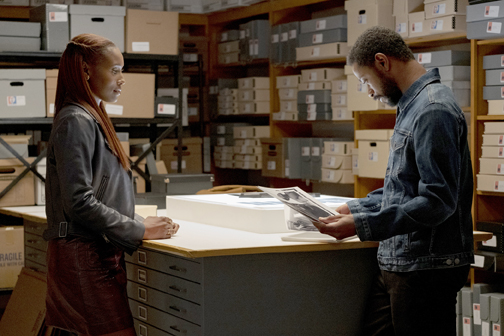
While trying to satisfy his curiosity regarding a famous photographer with humble
Louisiana roots, Michael (LaKeith Stanfield) encounters Mae (Issa Rae), currently
curating an exhibit of the woman's work.
Writer/director Stella Meghie’s thoughtful little film shares its charms without bombast. No car chases or explosions. No gun battles. No ironic catastrophes. No unexpected, life-altering freak accidents. No natural disasters or other indications of Mother Nature’s displeasure. (Well, OK; there is a hurricane. But it serves mostly as a backdrop that heightens the developing intensity between two characters.)

This is just an uncomplicated set of cleverly intertwined love stories between characters separated by time but linked by behavior.

How utterly refreshing.

Meghie has an unerring ear for naturalistic dialog — whether flirty or contemplative — all of which is delivered with persuasive sincerity by her well-sculpted characters. It’s always fun to watch such people fall in love; movies have excelled at that since the medium’s conception (but not so much lately, sad to say).

It’s equally engaging to fret over conflicted, angst-riddled individuals who put head above heart: to wonder whether they’ll see the light and take the offered shot at romance. Or, indeed, if instead we must acknowledge that some folks are destined for a path that doesn’t include the stability (confinement?) of conventional togetherness.

And whether they’ll come to regret such a decision.

Journalist Michael Block (LaKeith Stanfield), a rising star at a New York-based magazine, heads down to Louisiana for a feature piece on how coastal communities are recovering, post-Katrina and Deepwater Horizon oil spill. (Answer: Not well.) His local contact is crab fisherman Isaac Jefferson (Rob Morgan, nicely understated), a modest, easygoing fellow who never felt compelled to abandon the environment in which he grew up.

During an otherwise routine interview, Michael’s attention is drawn to a series of striking, black-and-white photographs, including one of the photographer herself: Christina Eames, a native daughter who broke Isaac’s heart a generation ago, when she left to seek fame and fortune in New York.

Friday, May 17, 2019

The Sun Is Also a Star: Shines sweetly

The Sun Is Also a Star (2019) • View trailer 
3.5 stars. Rated PG-13, for suggestive content and brief profanity

By Derrick Bang

It’s refreshing to see a young adult romance that doesn’t involve people who are white and wealthy.

And aren’t suffering from some exotic, debilitating or fatal disease.

Despite her analytical cynicism, Natasha (Yara Shahidi) finds it hard to resist the charm
assault that Daniel (Charles Melton) mounts so effectively.
Director Ry Russo-Young’s The Sun Is Also a Star is a sweet little charmer, graced with the comfortable chemistry between stars Yara Shahidi and Charles Melton. Scripter Tracy Oliver hits the essential plot beats of Nicola Yoon’s best-selling 2016 novel, although the faith-oriented content is absent (likely viewed as one subtext too many, in a film already laden with considerable emotional baggage).

Russo-Young and cinematographer Autumn Durald also deliver a dreamy portrait of New York City at the bustling height of its melting-pot boisterousness: a vibrant, richly diverse cacophony of cultures, languages, colorful storefronts and wonderfully bizarre public art. It’s a side of the city far removed from Manhattan’s chic opulence, and much more exciting for this absence of aristocratic hauteur.

Jamaica-born Natasha Kingsley (Shahidi) is in a panic, desperately trying to reverse a deportation order mandating her family’s immediate return to their native country. Her father brought them to the States illegally almost a decade earlier, hoping for the better life of an American dream; a random ICE sweep now threatens to rip 17-year-old Natasha from the city she loves, and the educational opportunities that mean so much.

It’s literally the last day before they must return to Jamaica. Natasha leaves their apartment, hoping to get an early morning appointment with a U.S. Customs and Immigration Services (USCIS) case handler.

Elsewhere, first-generation Korean-American Daniel Bae (Melton), college-bound and carrying the weight of family expectation, heads off for a crucial final interview that could determine his entry to Dartmouth. His doting parents (Keong Sim and Cathy Shim) have long desired that he become a doctor — a plan emphasized via Korean ritual, when Daniel was but an infant — but he’d far rather be a poet.

Natasha is pragmatic to the point of cynicism, believing solely in reason, science and logic; if it can’t be quantified and/or manipulated, it doesn’t exist. Daniel is creative, passionate and open to the mysterious, mischievous vagaries of fate, destiny and dreams. He firmly accepts the caprice of deus ex machina improbability (and when’s the last time a film made an ongoing metaphor of that literary phrase?).

Friday, June 9, 2017

My Cousin Rachel: Relatively dreary

My Cousin Rachel (2017) • View trailer 
2.5 stars. Rated PG-13, for sexuality and brief profanity

By Derrick Bang

Oi ... such a yawn.

This fresh adaptation of Daphne Du Maurier’s My Cousin Rachel is a true Masterpiece Theater melodrama: sweeping English countrysides, coastlines and quaint villages; slow, silent glances exchanged between artificially polite aristocrats; and soft-spoken dialog pregnant with implication.

Having come to believe that his earlier impression of Rachel (Rachel Weisz) was
unjustified, Philip (Sam Claflin) decides to show her the letter — from his deceased
guardian — that prompted such mistrust.
But absent Jane Austen’s verbal wit and sparkle, or the suspense and directorial snap that Alfred Hitchcock brought to his 1940 handling of Du Maurier’s Rebecca, this period piece is a rather dull affair ... particularly since Sam Claflin’s protagonist is such a callow, foolish and unforgivably whimpering weenie.

It’s impossible to sympathize with somebody so relentlessly naïve, and who possesses so little personality. He’s like unfinished clay, at the mercy of whoever chooses to mold him.

Nor does director/scripter Roger Michell — who did so much better with Venus and Notting Hill — bring much to these proceedings.

Du Maurier had a habit of giving her protagonists no more than their first names, and thus this saga focuses on Philip (Claflin), orphaned since childhood and raised by his guardian, Ambrose Ashley. The boy grows up on a large country estate on the Cornish coast, where the only women permitted within the walls are the many farm dogs. (Surrey’s West Horsley Place, a lucky find, has just the right mid-19th century ambiance.)

Such details are revealed in a brief narrative flashback, as a grown Philip returns home following a university education that left no significant impression. He finds the estate bereft of its owner, Ambrose’s “health issues” having sent him on a lengthy trip to Italy’s warmer climate. Contact is maintained via letters that Philip shares with his godfather, Nick Kendall (Iain Glen), and Kendall’s daughter, Louise (Holliday Grainger).

Louise is sweet on Philip, but he’s oblivious to such affection, having no experience in such matters (to a degree that becomes increasingly difficult to credit).

The letters continue; Ambrose writes of meeting and marrying a distant mutual cousin named Rachel. They remain in Italy, and then the tone of his letters changes; it seems clear that Rachel has some sort of unhealthy hold over Ambrose. A final letter begs for Philip’s presence, with haste ... but his arrival in Florence is too late. Ambrose has died, and Rachel has left; all such details are revealed during a curt exchange with Rainaldi (Pierfrancesco Favino), a “friend” of Rachel’s whom Ambrose clearly mistrusted.

Back in Cornwall, Philip learns from Kendall that Ambrose never changed his will; Philip remains sole heir to the estate, which will come to him upon his rapidly approaching 25th birthday. This scarcely cheers the young man, enraged over his belief that Rachel somehow caused the death of his beloved guardian. When she sends word of an impending visit, Kendall and Louise caution against “rash” behavior.

They need not have worried. Even in widow’s black, Rachel (Rachel Weisz) is a vision. Philip, cowed by her politeness, deferential manner and apparent fragility, retreats to the cordiality demanded by his upbringing.

Which — right there — is a transition that Claflin can’t begin to sell. Righteous rage to cowed silence, in the blink of an eye? Seriously?

I think not.

And, in turn, all subsequent developments become contrived and equally unpersuasive.