Showing posts with label Hugh Jackman. Show all posts

Friday, May 8, 2026

The Sheep Detectives: Wooly bully!

The Sheep Detectives (2026) • View trailer
Four stars (out of five); rated PG, and needlessly, for mild dramatic intensity
Available via: Movie theaters
By Derrick Bang • Published in The Davis Enterprise, 5.10.26

Director Kyle Balda’s quaint little charmer is certain to appeal to fans of Babe, Charlotte’s Web and other (sorta-kinda) live-action talking animal movies.


This one blends that core premise with a bit of Shaun the Sheep and ... Agatha Christie.


Whenever George (Hugh Jackman) feels gloomy or lonely, he cheers himself by spending
quality time with his favorite sheep, Lily.

The film derives from an intriguing source, adapted from German author Leonie Swann’s 2005 novel, Three Bags Full, which is set in the Irish village of Glenkill. 

Scripter Craig Mazin moves the action to the fictitious English countryside community of Denbrook. (Filming actually took place in and around Oxfordshire, and cinematographer George Steel makes ample use of the lush setting.) Mazin also takes serious liberties with Swann’s characters and the plot; the beguiling result bears little resemblance to her novel.


Eccentric rancher George Hardy (Hugh Jackman) gets along far better with his sheep — all of whom he has named — than with the townsfolk. He writes long narrative letters to somebody named Rebecca, detailing his workaday activities. He’s also an avid fan of mystery books; once chores are done each day, and the sun begins to set, he sits on the steps leading to his tiny trailer home, and reads aloud to his large flock.


At first blush, it seems curious to see all the sheep amble toward the trailer, and settle onto the ground, as if paying attention. As we learn, when George retires for the night, the sheep understand every word, and debate who the culprit might be. 


The lively arguments fly between the patient Mopple (voiced by Chris O’Dowd), the curious Zora (Bella Ramsey), the fluffy Cloud (Regina Hall), the proud and dignified Sir Ritchfield (Patrick Stewart), the shaggy Wool-Eyes (Rhys Darby) and rowdy twins Reggie and Ronnie (Brett Goldstein). Ah, but the wise and perceptive Lily (Julia Louis-Dreyfus) always knows the right answer, well before each novel concludes.


Lily understands the structure of such books, explaining that it’s always a matter of deducing which suspect had means, motive and opportunity.


Meanwhile, budding young journalist Elliot Matthews (Nicholas Galitzine) arrives in Denbrook, having been sent to write a feature on the town’s “cultural festival.” This turns out to be only three paltry tables set up by prickly innkeeper Beth Pennock (Hong Chau), who becomes grievously insulted when Elliot bluntly notes that her “fair” isn’t such a much.


Other key villagers include Tim Derry (Nicholas Braun), the clumsy and sweetly befuddled local policeman; Rev. Hillcoate (Kobna Holdbrook-Smith), the often bewildered local minister; Ham Gilyard (Conleth Hill), the smugly arrogant town butcher; and Caleb Merrow (Tosin Cole), a fellow sheep rancher who leases half of George’s land for his flock.


Beth spits nails every time George’s name is mentioned. George, far from devout, stuns  Rev. Hillcoate and his entire congregation during service one day, by storming into church and dumping a huge wad of bills in the donation plate.

Friday, January 2, 2026

Song Sung Blue: Musical lightning!

Song Sung Blue (2025) • View trailer
Four stars (out of five). Rated PG-13, for dramatic intensity, brief profanity and fleeting drug use
Available via: Movie theaters
By Derrick Bang • Published in The Davis Enterprise, 1.4.26

If writer/director Craig Brewer’s poignant drama weren’t based on actual events, it would be a shameless tear-jerker.


Be advised: The fact that it is based on actual events, makes it even more of a tear-jerker.


Mike (Hugh Jackman, left), Dave (Fisher Stevens, center left) and Mark (Michael
Imperioli, center right) listen intently, as Tom (Jim Belushi) outlines their upcoming
touring schedule.

In the interests of full disclosure, I’ve been a life-long Neil Diamond fan since early high school, which makes me inclined to be both forgiving and potentially hyper-critical. But the latter never came into play, because both Hugh Jackman and Kate Hudson are fabulous singers and performers. 

Brewer’s film, based on Greg Kohs’ 2008 documentary of the same title, deftly profiles small-time musicians Mike Sardina (Jackman) and Claire Stengl (Hudson): how they met, and the magic that occurred once they got together.


Brewer begins unexpectedly, with a tight-tight-tight close-up of Jackman’s face, as Mike gravely recounts some seminal moments in his life: a confession of sorts, which concludes as the camera pulls back, to reveal that he’s at an Alcoholics Anonymous meeting. It’s a special day — his 20-year “sobriety birthday” — and he celebrates it as he has each one before, by concluding with a solo guitar performance of “Song Sung Blue.”


Mike moonlights as a mechanic to support his true passion, as a veteran musician — nicknamed Lightning — on the Milwaukee gigging circuit, performing whatever is demanded at county fairs, small auditoriums and dive bars. After uncharacteristically refusing a gig — insisting that trying to impersonate Hawaiian pop singer Don Ho is too much of a stretch — he chances to catch Claire doing her Patsy Cline act at the Wisconsin State Fair.


They click (to put it mildly).


“I’m not a songwriter, I’m not a sex symbol,” he confesses. “I just want to entertain people.”


“I don’t want to be a hairdresser,” she replies, “I want to sing, I want to dance, I want a garden, I want a cat.”


The relationship happens quickly, both because they’re sympatico … and also because Jackman and Hudson radiate charm and charisma the way the rest of us breathe. Mike and Claire are totally cute together, with a goofy, giddy level of excitement like teenagers experiencing love for the first time.


Both have painful pasts. In addition to his hard-fought sobriety, Mike carries trauma from his service in Vietnam as a “tunnel rat,” and has a failed marriage behind him; Claire also is divorced. 


Mike gets occasional visits from his college-age daughter, Angelina (pop chanteuse King Princess); their relationship is prickly, at best. Claire has two kids — teenage Rachel (Ella Anderson) and adolescent Dana (Hudson Hensley) — who frequently drive her crazy. Both Mike and Claire also struggle financially.


Musically, though, they go together like peanut butter and jelly.

Monday, July 29, 2024

Deadpool & Wolverine: Death of a thousand cuts

Deadpool & Wolverine (2024) • View trailer
Two stars (out of five). Rated R, for constant strong bloody violence, gore, relentless profanity, and crude sexual references
Available via: Movie theaters
By Derrick Bang • Published in The Davis Enterprise, 8.4.24

This isn’t a movie; it’s a string of crude and violent blackout sketches laced with relentless profanity and vulgar one-liners, loosely stitched to a so-called plot that’s dog-nuts even by superhero movie standards.


Having penetrated the Big Bad's weird lair in this aggressively deranged flick,
Wolverine (Hugh Jackman, left) and Deadpool (Ryan Reynolds) realize that they
may be in over their heads...
The result is aimed squarely at arrested adolescent males and the geekiest comic book nerds ... and, judging by the opening weekend’s box office results — $438 million worldwide, shattering the previous record for an R-rated film — the folks at Marvel Studios apparently knew what they were doing.

Let’s call it a triumph of crass commercialism, while acknowledging that mainstream viewers — and even fans of the “conventional” Marvel superhero films — are advised to steer very, very clear. 


This gleefully atrocious burlesque wears “Tasteless” like a badge of honor. But if the wretched excess is removed — to quote Gertrude Stein — there is no there there. After the introductory title credits orgy of slashed throats, impalements, severed limbs, decapitations, gouts of blood, and relentless F-bombs, the realization that the entire film will continue in this manner, isn’t merely disheartening.


It’s boring. Truly.


The primary running joke concerns the constant squabbling and fighting between Deadpool and Wolverine, because — since both have regenerative powers — neither can be killed. Cue all manner of shooting, stabbing and bone-breaking mayhem.


Mildly funny the first time. Not on constant repeat.


Director Shawn Levy and his four co-scripters deserve mild credit for archly breaking the fourth wall and elevating meta to new heights, with foul-mouthed Deadpool (Ryan Reynolds) taking cheeky real-world jabs at Disney, 20th Century Fox and all manner of pop-culture entities. It’s like a Simpsons episode on speed, and when the snarky asides and Easter Eggs arrive with such rat-a-tat intensity, some of them are bound to land. And yes, a few do.


But that’s pretty thin gruel, given the vehicle driving this nonsense.


So: The “plot,” such as it is. Fasten your seatbelts; it’s gonna be a bumpy ride.


Wade Wilson, aka Deadpool, has been trying to go straight — as a car salesman — since his previous adventures in 2018’s Deadpool 2. This effort goes awry when he’s snatched from his life on Earth 10005 by Mr. Paradox (Matthew Macfadyen), a bureaucratic agent of the Time Variance Authority (TVA), responsible for monitoring all temporal law in the Marvel Comics Universe.


(Yes, this is a multiverse mash-up.)

Friday, January 20, 2023

The Son: Growing pains

The Son (2022) • View trailer
Three stars (out of five). Rated PG-13, for dramatic intensity, suicidal content and occasional profanity
Available via: Movie theaters
By Derrick Bang • Published in The Davis Enterprise, 1.20.23 

Director/playwright Florian Zeller’s The Father (2020) is an emotionally harrowing experience, thanks both to Anthony Hopkins’ superbly nuanced, Oscar-winning performance, and a clever non-liner narrative that mirrors the title character’s tragic slide into dementia.


They look happy, but that's misleading; Peter (Hugh Jackman, right) and Kate (Laura
Dern) are beginning to realize that their teenage son Nicholas (Zen McGrath) has
some serious problems.


Zeller’s new film, alas, isn’t nearly as powerful.

For the most part, the actors can’t be faulted; Hugh Jackman, Laura Dern and Vanessa Kirby do solid work, and Hopkins is mesmerizing in a fleeting cameo.


Zen McGrath’s handling of this film’s title character is one weak link; he simply isn’t credible as a teenager struggling with mental illness.


But McGrath isn’t entirely to blame, because he hasn’t been granted sufficiently persuasive material. Scripter Christopher Hampton’s adaptation of Zeller’s stage play frequently feels contrived; the scenario and sequence of events lack credibility.


Peter Miller (Jackman), a high-profile Manhattan attorney with his eyes on a prize career shift to Washington, D.C., has been settling comfortably into life with new partner Beth (Kirby) and their infant son. The story begins with the unexpected arrival of his agitated ex-wife, Kate (Dern), and her revelation that their 17-year-old son, Nicholas (McGrath), hasn’t been to school for a month.


He has pretended to go, leaving her home each weekday morning with what she’d expect to see, in terms of books and other materials; and he has returned at the appropriate time each afternoon. But school officials finally exposed the charade, and Kate has no idea what Nicholas actually has been doing.


Nor does Nicholas offer any sort of defense. He simply insists that he “can’t stay” with his mother any longer, and would prefer to live with his father, Beth and his baby brother.


Beth isn’t thrilled; her expression makes this obvious. But she doesn’t object; she recognizes the importance of a father/son bond, and she clearly wants her relationship with Peter to succeed. Beth never states any of this in so many words, but it’s clear from Kirby’s delicate, quietly shaded performance.


(Although Kirby has been quite busy since, she remains well remembered as Princess Margaret, in television’s The Crown.)

Friday, August 27, 2021

Reminiscence: Not worth remembering

Reminiscence (2021) • View trailer
One star (out of five). Rated PG-13, for violence, drug use, sexual candor and profanity
Available via: Movie theaters and HBO Max
By Derrick Bang • Published in The Davis Enterprise, 8.27.21

Ugh.


Plodding, ponderous, pretentious twaddle.


Not even Hugh Jackman’s considerable charisma can save this one.


Nick (Hugh Jackman) and his colleague Watts (Thandiwe Newton) begin a memory
retrieval session with an uncooperative client, who's about to reveal something
that'll come as a nasty shock.

Actually, that’s part of the problem. Writer/director Lisa Joy obliterated Jackman’s charisma, transforming him into a mope with very little in the way of redeeming qualities.

Lineage counts for a lot; my expectations were low, knowing that Joy is one of the key show-runners who turned HBO’s update of Westworld into similarly tedious nonsense with delusions of grandeur. And — sure enough — she lives down to my worst fears with her feature film debut.


Reminiscence steals the futuristic Blade Runner look as the setting for an Inception-style dive into a reality constantly muddled by recaptured memories, the “twist” being that we’re often not sure which is which. That’s hardly a novel concept, nor is this clichéd premise helped by the fact that we don’t give a damn about any of these characters.


They’re worse than one-dimensional; they’re simply dull. 


Joy’s clumsy attempt to further spice this thin gruel with Raymond Chandler’s hard-edged noir sensibilities — as was done so much better in Blade Runner — is laughable.


Were it not for the stunning visuals crafted by production designer Howard Cummings and special effects maestro Peter Chesney, this would be a total bomb.


The setting is Miami, at some undetermined point in the future. The ocean has risen, due to a climate apocalypse, transforming the city into an American Venice. Water is everywhere; the lower floors of entire blocks of buildings are submerged. (Apparently this hasn’t affected anything structurally, which seems highly unlikely; Joy’s script isn’t long on real-world consequences.)


The chasm between the rich and everybody else has shifted onto fraught new territory: those who can afford to live on dry ground — giving an entirely new meaning to the phrase “land baron” — and everybody else. The result was some sort of war, its outcome left vague (along with everything else in Joy’s sloppy narrative).


Daytime temperatures are dangerously hot, prompting most people to live at night. Even allowing for this narrative element, Joy and cinematographer Paul Cameron go overboard with dark rooms, darker shadows and even darker streets; it’s sometimes difficult to determine what’s happening in a given scene. (If Cameron had dialed the illumination down a bit further, we’d have been spared having to watch the film at all.)

Friday, May 1, 2020

Bad Education: Actually, it's terrific!

Bad Education (2019) • View trailer 
Four stars. Rated TV-MA, for considerable profanity

By Derrick Bang • Originally published in The Davis Enterprise, 5.1.20

Boy, this one couldn’t be better timed.

As we continue to be astonished by the actions of the wealthy, arrogant twits who conspired with Rick Singer to cheat their children into top-flight universities — and the additional hubris of the few parents who blithely insist that they didn’t know their actions were wrong — it’s essential to be reminded that such behavior is nothing new.


School superintendent Frank Tassone (Hugh Jackman) and faithful colleague Pam Gluckin
(Allison Janney) always look like cats who've swallowed a particularly tasty canary. One
wonders who they might be torturing, in the high school basement.
Director Cory Finley’s Bad Education isn’t merely a marvelously scathing piece of filmmaking, anchored by top-flight performances from Hugh Jackman and Allison Janney; it’s also a crafty cautionary tale lifted from actual events. Mike Makowsky’s script is impressively faithful to what actually went down at a prestigious Long Island high school in 2002.

The HBO original film airs many times during the next few weeks, starting Sunday and Monday evenings (and also is available to stream, via HBO Go or HBO Now). 

But do yourself a favor: Don’t investigate until after watching this film. Much of its fun comes from the way Finley and Makowsky tease, hint and beguile us during their initial two acts, with a subtly snarky tone that often belies the atmosphere of impending doom — of what sort, we initially can’t imagine — that hangs over these proceedings.

Considerable credit goes to Jackman, for his (typically) charismatic portrayal of Frank Tassone, the capable, extraordinarily successful and much-revered superintendent of New York’s Roslyn school district. Finley opens the film on tight close-ups of Frank, as he primps and dresses in tailored CEO apparel for another typical day at work: at first blush, a sequence of disarming banality.

But Frank’s glance in the mirror lingers perhaps half a beat too long, his satisfied smile perhaps just a shade too narcissistic.

Jackman’s performance throughout is laden with such subtle tics, twitches and gestures, slyly suggesting that — at all times — Frank, himself, is adjusting, modulating and refining a performance.

Or maybe the man is simply vain, physically fit and fastidiously diet-conscious, forever swilling health drinks that resemble liquid charcoal. Nothing wrong with that, as long as he delivers. And Frank definitely has delivered during his tenure, building Roslyn High School into the state’s fourth-highest performer for seniors admitted to prestigious universities.

With that has come a corresponding rise in property values and community wealth, delighting realtors, the school board, and all the rest of Roslyn’s movers and shakers. As far as they’re concerned, Frank walks on water.

It’s hard to argue, particularly as Jackman radiantly portrays him.

Wednesday, December 20, 2017

The Greatest Showman: An apt superlative

The Greatest Showman (2017) • View trailer 
Four stars. Rated PG, for bits of dramatic intensity

By Derrick Bang • Originally published in The Davis Enterprise, 12.22.17


This lavish, opulently stylish musical, based very loosely on the early life and career of Phineas Taylor Barnum, is a slice of magic realism in the style of last year’s La La Land.

First-time director Michael Gracey delivers this splashy romp with a degree of razzle-dazzle that would have delighted Barnum himself. Given Gracey’s earlier credits as a visual effects artist and supervisor, we shouldn’t be surprised by the often stunning production and dance numbers, many of them powered by Ashley Wallen’s breathtaking choreography.

When shameless promoter P.T. Barnum (Hugh Jackman, right) decides to gain some
respect from New York City's aristrocratic elite, he seeks out respected author and
playwright Phillip Carlyle (Zac Efron). But will this writer of failed plays be willing to
descend from his lofty perch?
As is true of many musicals, some of Benj Pasek and Justin Paul’s original songs are Barnum-style show-stoppers; others ... sorta-kinda just hang there. The power anthems attached to the best sequences, however, will be remembered long after the lights come up: most notably the title song and “This Is Me,” the latter a triumphant statement of personal dignity, on behalf of the colorful but publicly shunned members of Barnum’s performing troupe.

The film also maintains its momentum thanks to Hugh Jackman’s vibrant performance as Barnum: a role that allows the actor to exercise the singing and dancing chops he displayed so magnificently in the stage musical The Boy from Oz (a side of his talent likely overlooked by those familiar only with various Marvel superhero movies).

Casting directors Tiffany Little Canfield and Bernard Telsey took care to avoid the mistake made in La La Land, which would have been vastly superior with two stars who actually could sing and dance. Jackman’s spellbinding performance is ably supported by a similarly adept roster of co-stars, beginning with the equally enthusiastic Zac Efron, returning to the genre that made him a star in the High School Musical trilogy.

Jenny Bicks and Bill Condon’s script plays fast and extremely loose with Barnum’s actual life, although they certainly get the tone right: a masterpiece of style over substance, with the same wink-wink-nudge-nudge hokum that the celebrated showman practiced himself.

A brief childhood prologue suggests that young Barnum’s impossible ambitions — as the only son of a poor, working-class father — get their momentum from his immediate devotion to Charity, the aristocratic girl who catches his eye, and grows up to become his wife. Their younger selves are played charmingly by Ellis Rubin and Skylar Dunn, and they share a touching ballad — “A Million Dreams” — that carries the narrative to adulthood and marriage (Michelle Williams taking over as Charity).

Now ensconced in the whirlwind of mid-19th century New York City, frustrated by a series of clerking jobs, Barnum hatches a mad scheme financed by a bald-faced bank swindle: a museum of the unusual and unseen. But it’s primarily a static waxworks show that proves of little interest to passersby.

“You need something living,” his young daughters Caroline and Helen insist (the two girls winningly played by Austyn Johnson and Cameron Seely).

Friday, March 3, 2017

Logan: Beneath contempt

Logan (2017) • View trailer 
No stars (turkey). Rated R, and generously, for relentless profanity and strong, brutal violence

By Derrick Bang

Discussing the big-screen adaptation of The Hunger Games: Mockingjay, back in late 2014, gave me the excuse to indict Suzanne Collins’ reprehensible source novel as a complete betrayal of her characters, and of her readers: a needlessly nasty finale that cruelly (and pointlessly) killed major supporting characters while turning resourceful Katniss Everdeen into a sniveling victim.

When their attempt to enjoy one restful night is interrupted by a squadron of gun-toting
killers, Logan (Hugh Jackman) and Laura (Dafne Keen) do their best to survive.
It was the most senseless, deliberately mean-spirited betrayal of a heroic franchise — by its original author, no less — that I’d ever encountered.

Until now. This film is even worse.

Logan doesn’t merely trash the long-beloved character of Wolverine, played here (for the ninth time!) by Hugh Jackman; director James Mangold and his gaggle of co-writers defecate all over the entire X-Men franchise and, by extension, the broader Marvel superhero universe. All this, with the apparent blessing of the parent company, given the familiar pre-credits Marvel Entertainment logo.

Shame on everybody involved.

Whereas 2014’s exciting X-Men: Days of Future Past cleverly employed backwards time travel as a means of re-booting the franchise — with smiles all around during the unexpectedly happy ending — Logan takes the opposite approach, moving the action forward to 2029. The tidings are grim: All of Logan’s X-Men comrades are dead, via some horrific event that apparently involved both Charles Xavier/Professor X (Patrick Stewart) and an evil scientific genius named Dr. Zander Rice (Richard E. Grant).

I say “apparently,” because while the film repeatedly references this ghastly occurrence, we never get details.

A despondent Logan, his once-invulnerable body being poisoned by the adamantium enhancements to his skeletal frame, is drinking his days away while earning chump change as a limo driver. His lair, across the border in Mexico, also serves as a hideout for Xavier, stricken with Alzheimer’s, senile dementia or some other brain disorder. Their sole companion is the albino mutant Caliban (Stephen Merchant), who fears that he’s doing little but watching his two friends die. Slowly.

Unlike the rival DC universe, which occasionally indulges in such canonical mischief by branding the results “imaginary stories” or “elseworlds tales,” Mangold makes no such reassurances here. This is the way things are ... and they’re about to get worse.

Friday, February 26, 2016

Eddie the Eagle: Truly soars

Eddie the Eagle (2016) • View trailer 
3.5 stars. Rated PG-13, and too harshly, for mildly suggestive material and partial nudity

By Derrick Bang • Originally published in The Davis Enterprise, 2.26.16


Winning isn’t everything.

Sometimes merely participating, and doing your best, is enough. More than enough.

When Bronson Peary (Hugh Jackman, left) finally, reluctantly, agrees to help train wannabe
ski-jumper Michael "Eddie" Edwards (Taron Egerton), the task proves an uphill challenge
for a young man with no athletic grace whatsoever.
We tend to forget, after the increasingly overblown sequels, that in his 1976 film debut, Sylvester Stallone’s Rocky Balboa merely wanted to “go the distance.” And that’s all he did, which is — in great part — what makes that film such an endearing classic.

British director Dexter Fletcher’s charming Eddie the Eagle is cut from the same cloth. This whimsical underdog saga is fueled by an engaging performance from Taron Egerton, superbly cast as Michael “Eddie” Edwards, the wannabe British ski-jumper who made such an improbable — and improbably triumphant — showing at the 1988 Calgary Winter Olympics.

An opening statement is careful to note that this big-screen account of Edwards’ exploits is “inspired” by actual events, which allows scripters Simon Kelton and Sean Macaulay to play fast and loose with a few details. They’re careful to retain the essential broad strokes that brought Edwards to Calgary, and of course his performance at the Olympics is a matter of record (and can be viewed in any number of YouTube videos).

But various supporting characters have been conflated or invented outright, in the manner we’d expect from a crowd-pleasing, feel-good movie. That’s less of an issue in this particular case, as such liberties merely augment the myth-making that put Edwards in the history books. Somehow, it feels appropriate.

Besides which, when the result is this enjoyable, it’s hard to complain.

We meet young Eddie as the bespectacled only child of working-class Cheltenham parents Janette (Jo Hartley) and Terry (Keith Allen), the latter a construction plasterer by trade. Despite poor vision, worse knees — the boy is shackled into a leg brace — and an utter lack of coordination, Eddie lives and breathes a foolish notion of growing up to become an Olympian.

Fletcher brings us through Eddie’s childhood with a brief prologue that highlights the boy’s stubborn pluck, much to the delight of his doting mother, and the exasperation of his aggrieved father. Hartley and Allen are delightful: She’s the mum we’d all love to have, while Allen — all bluster and bluff — makes ample use of his busy background as a popular character actor.

And how can we not adore a child who believes that holding his breath underwater for not quite a minute will qualify for some obscure Olympic event?

Friday, October 9, 2015

Pan: Soaring adventure

Pan (2015) • View trailer 
3.5 stars. Rated PG, for fantasy action violence

By Derrick Bang


Old-style, kid-centric adventure films — those akin to Disney’s In Search of the Castaways or Richard Donner’s The Goonies — have become rare.

Today’s studio heads too frequently taint the formula with coarse humor and/or needlessly unpleasant violence, either (giving them the benefit of the doubt) in a misguided effort to court parents, or (more cynical, but more likely) to obtain the “tougher” PG-13 rating that generally does better business than a family-friendly PG.

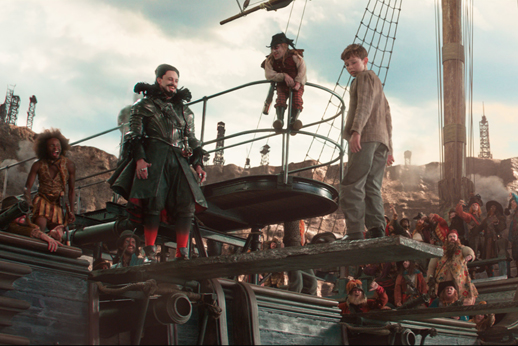
Peter (Levi Miller, right) anticipates certain doom once he's forced off the ship's plank by
the dread Blackbeard (Hugh Jackman, in black). But although the boy doesn't yet know
it, he possesses a magic talent that will surprise everybody...
Which makes director Joe Wright’s Pan something of a minor miracle. It’s a throwback to kinder, gentler times, when young champions relied on pluck and resourcefulness, rather than sarcasm and potty humor. Scripter Jason Fuchs’ imaginative fantasy is a thrilling ride from start to finish: laden with stalwart heroes and opulently dastardly villains, wildly imaginative locales and a high-spirited adolescent hero who could have stepped from the pages of a Charles Dickens novel (with a detour that L. Frank Baum would have appreciated).

Fuchs’ story speculates on a question that might have occurred to young fans of Scottish novelist/playwright J.M. Barrie’s celebrated “boy who wouldn’t grow up.” It’s a tantalizing query: How did Peter Pan become himself?

Fuchs, making a respectable big-screen solo scripting debut, plays with elements of Barrie’s original mythos, while borrowing scenarios and character archetypes from other fantasy sources. The crazy-quilt result is a bit uneven at times, but Wright and editors William Hoy and Paul Tothill keep things moving so rapidly, that you’re not likely to mind.

The action begins at London’s bleak Lambeth Home for Boys, during the height of the WWII blitz, where 12-year-old Peter (Levi Miller, doing an excellent job in his feature debut) and his fellow youngsters are routinely terrorized by Mother Barnabas (Kathy Burke), the imperious and just-plain-mean nun who runs the place. Peter has long suspected that Mother Barnabas has been hoarding all the tasty food rations while forcing the children to subsist on gruel, but in truth her perfidy is much, much worse.

Aside from these suspicions regarding the orphanage provisions, the bigger issue concerns the ongoing — and unexplained — disappearances of a few boys each night. The answer to that question proves calamitous, when Peter is among those snatched the next time around. He finds himself on (of all things) a pirate ship floating high above, which “sails” air currents the way an ordinary vessel would navigate the seven seas.

Friday, March 6, 2015

Chappie: Too many nuts, not enough bolts

Chappie (2015) • View trailer 
Three stars. Rated R, for violence, gore and constant profanity

By Derrick Bang

The best part about Chappie is the title character: not the robot per se, but the marvelous motion-control “performance” given by Sharlto Copley, which was built into a CGI character by the film’s video effects wizards.

Once Chappie falls in with rather evil companions, his "maker" Deon (Dev Patel) tries to
share some important moral imperatives ... such as Thou Shalt Not Kill. But while this
suddenly sentient robot understands the notion of conscience, his "monkey see, monkey do"
tendencies often yield less than ideal results.
We never see Copley on screen, of course, and there’s certainly no way that he could be concealed within this robot’s streamlined mechanical form ... but the actor grants this character a personality, awareness and sense of presence that evoke the similarly brilliant manner in which Andy Serkis brought Gollum to life, in Peter Jackson’s Lord of the Rings and Hobbit films.

I only wish that director Neill Blomkamp’s film were the equal of its star.

The South African-born Blomkamp burst on the cinematic scene with 2009’s stunning District 9, a thoughtful sci-fi parable that explored racism, class divides and political skullduggery, while simultaneously building to a rip-roaring climax: a neat trick in all respects.

But Blomkamp has recycled many of the same story elements in subsequent projects, to diminishing returns. Its much bigger budget notwithstanding, 2013’s Elysium played the same narrative card: the violent efforts of an oppressed underclass to rebel against a harsh and long-established social order, with the catalyst being a lone individual who undergoes a spiritual and even physical transformation.

And here we are at Chappie, Blomkamp’s third sci-fi epic, and — as in District 9 — our central character once again is an innocent forced to adapt to horrific circumstances, while unwittingly becoming the face of social upheaval.

This time, though, Blomkamp and co-scripter Terri Tatchell have compounded the sense of déjà vu by borrowing heavily from previous cinema sci-fi. The result too frequently feels like a clumsy blend of Robocop (the 1987 original) and Australian director George Miller’s savage, post-apocalyptic Mad Max series, stitched together like Frankenstein’s monster.

Along with elements that have become Blomkamp clichés after only three films, most particularly the testosterone-enraged, alpha-male villain who comes after our hero with bigger, badder hardware: David James’ Koobus, in District 9; Copley’s Kruger, in Elysium; and now Hugh Jackman’s Vincent Moore, in Chappie. They’re all the same character: unhinged psychopathic thugs. Been there, grimaced at that.

Friday, May 23, 2014

X-Men: Days of Future Past — One for the ages

X-Men: Days of Future Past (2014) • View trailer 
Four stars. Rated PG-13, for nonstop action violence, considerable grim content and brief profanity

By Derrick Bang • Originally published in The Davis Enterprise, 5.23.14

This one cooks.

The X-Men film series has earned high marks from its debut back in 2000, notwithstanding the frustrating rival studio issues that prevent these characters from operating within the larger tapestry of the “Marvel Universe” project that includes Iron Man, Thor, Captain America and the Avengers.

After learning that black-ops types plan to conduct dangerous — even lethal — medical
experiments on some helpless mutants, a furious Raven (Jennifer Lawrence, second
from right) gets quite irate with the goons responsible, while helping the others escape.
Director Bryan Singer got Marvel’s “merry mutants” off to an excellent start with the first two films, and he returns here, batteries fully charged, for a rip-snortin’ adventure that satisfies on every level.

Longtime comic book fans, who’ve followed these characters since their debut back in September 1963, can point to three periods of writer/artist genius during the series’ half-century history. Old-timers still cite the Roy Thomas/Neal Adams run, despite its brevity, as the highlight of 1969 and early ’70. The subsequent generation scoffs at that choice, pointing instead to the bravura Chris Claremont/Jim Lee run from 1989 through ’91.

In between, though, we enjoyed four years of greatness from late 1977 through early ’81, thanks to Claremont’s imaginative stories and artist/co-author John Byrne’s artwork. And that run produced a two-parter, “Days of Future Past,” which remains one of the all-time best comic book stories, anywhere ... not to mention one of the most ingenious time-travel narratives ever concocted (and cited as such in a recent issue of the British pop culture magazine SFX).

Fan reaction was guarded, when word broke that this new X-Men film would adapt that classic tale. Doing it justice would be difficult enough; carefully sliding it into the big-screen mythos already established by the first three films and 2011’s X-Men: First Class, even harder. Screenwriters Simon Kinberg, Jane Goldman and Matthew Vaughn therefore deserve considerable credit, because they pulled it off. And then some.

Failing to give Claremont and Byrne a “story by” acknowledgment, however, is utterly indefensible. And I rather doubt that Claremont was mollified by his eyeblink cameo.

To a degree, this film also has been shaped by the wattage of its primary stars, most notably Jennifer Lawrence, who has become huge since first playing the shape-shifting Raven/Mystique in First Class. Hugh Jackman’s ultra-cool Wolverine also is front and center, as are James McAvoy’s angst-ridden Charlie Xavier and Michael Fassbender’s smoothly malevolent Erik Lehnsherr/Magneto.

But wait, I hear you cry. Patrick Stewart and Ian McKellen also appear in this adventure ... and aren’t they also Xavier and Magneto?

Well, yes ... and that’s the nature of time-travel stories. Done properly, we get to eat our cake, and have it, too. And this is one tasty treat.