Showing posts with label Adeel Akhtar. Show all posts

Friday, November 18, 2022

Enola Holmes 2: The game's still afoot!

Enola Holmes 2 (2022) • View trailer
Four stars (out of five). Rated PG-13, for dramatic intensity, violence and bloody images
Available via: Netflix

I concluded my review of this film’s 2020 predecessor by expressing the hope that it would be popular enough to generate a sequel.


My wish has been granted.


Enola Holmes (Millie Bobby Brown), justifiably pleased with herself, after deducing one
of the puzzles on her older brother Sherlock's "clue board," favors us viewers with a
smile of satisfaction.


Enola Holmes 2 is every bit as stylish, witty and entertaining as the young heroine’s first on-screen escapade. Almost all the major stars have stepped back into their characters; director Harry Bradbeer and writer Jack Thorne also have returned. The one holdout is Sherlock Holmes’ older brother Mycroft, and he isn’t missed; Sam Claflin made him too much of a boorish crank in the previous entry.

Unlike that first film, this one isn’t based on one of author Nancy Springer’s Enola Holmes books; Bradbeer and Thorne have concocted an original tale that feels right in this young heroine’s wheelhouse. Better yet, this adventure places these fictitious characters within an actual 1888 major event (and, unless you’re a scholar of 19th century British history, you’re not likely to see it coming, until revealed within the end credits).


Following the successful resolution of her first case, now a bit older and wiser, Enola (Millie Bobby Brown) has optimistically set up her own private detective agency. Alas, all the adverts in the city cannot stop the look of dismay that crosses the face of would-be clients, when they realize Enola is (horrors!) a young woman.


Worse yet, on the few occasions she’s able to retain somebody long enough to explain that she did, after all, solve a high-profile case, the response is invariably something along the lines of “Didn’t Sherlock Holmes actually solve that?”


Disappointed beyond words, Enola prepares to close things down. Cue the last-minute arrival of young Bessie (Serrana Su-Ling Bliss, cute as a button), a penniless “matchstick girl” who works atrocious hours in a match-making factory with her sister Sarah (Hannah Dodd) and scores of other orphaned girls. Sarah has gone missing; Bessie hopes Enola will be able to find her.


With Bessie’s help, Enola poses as a new matchstick worker. She meets Mae (Abbie Hern), one of the older matchstick girls; and quickly runs afoul of the factory’s foreboding foreman, Mr. Crouch (Lee Boardman, appropriately ill-tempered). Employing quick wits and a handy diversion, Enola sneaks upstairs and sees factory owner Henry Lyon (David Westhead) in a meeting with Treasury Minister Lord Charles McIntyre (Tim McMullan) and his secretary, Mira Troy (Sharon Duncan-Brewster).


A high-ranking Cabinet official, discussing something with the owner of a grubby matchstick factory?


Odd, that.

Friday, October 22, 2021

The Electrical Life of Louis Wain: Heartbreaking study of a tormented artist

The Electrical Life of Louis Wain (2021) • View trailer
Four stars (out of five). Rated PG-13, for dramatic intensity and brief profanity
Available via: Movie theaters and (beginning November 5) Amazon Prime

One rarely encounters such a Dickensian life, outside of a Charles Dickens novel.


Artist Louis Wain’s personal and professional life was just as tragic, as the majority of his vast output was playfully joyous. He remains, to this day, one of the most beloved commercial illustrators in English history; during the Edwardian era, it was the rare home that lacked one of his posters, or many of his children’s books.


Louis (Benedict Cumberbatch) and Emily (Claire Foy) are
surprised to find a scruffy, rain-soaked kitten in their
garden. They'll soon be even more surprised by the
degree to which this little feline affects the arc of
Louis' artistic career.


He also deserves credit for helping elevate the humble pussycat into a companion worthy of being a pet, rather than a pesky creature best relegated to the streets.

Author H.G. Wells famously noted — during a radio broadcast reproduced in this biographical drama — that “He has made the cat his own. He invented a cat style, a cat society, a whole cat world. English cats that do not look and live like Louis Wain cats are ashamed of themselves.”


Wain also was quite popular on this side of the pond, at the beginning of the 20th century, and then much later, in the 1970s, when his more outré cat paintings were ubiquitous among the, ah, college-age psychedelic set.


Director Will Sharpe’s poignant, deeply sensitive film is highlighted by sublime performances from Benedict Cumberbatch and Claire Foy. The script, by Sharpe and Simon Stephenson, is remarkably faithful to Wain’s life and career … the all-too-brief highs and numerous shattering lows of which, are almost too much to bear.


Indeed, this saga’s midpoint, highlighted by an intensely intimate scene between Cumberbatch and Foy, surely ranks as one of the saddest, most heartbreaking moments ever captured on film.


The story begins in the early 1880s, when — following their father’s unexpected death — 20-year-old Louis (Cumberbatch), as the family’s lone male, is forced to support his mother and five younger sisters. 


Fortunately, he has a remarkable — and rapid — facility for drawing and painting, which he’s able to do with both hands simultaneously (which Cumberbatch depicts persuasively). Louis specializes in animals and country scenes, and within a few years is selling work to journals such as the Illustrated Sporting and Dramatic News and, a bit later, the Illustrated London News.


Unfortunately, Louis also suffers from a mental illness — possibly schizophrenia — which would remain undiagnosed throughout his lifetime. Symptoms include an irrational fear of drowning, which strikes unexpectedly. For the most part, he keeps such demons at bay via the manic intensity with which he fills every minute of every hour: sketching, tinkering with useless inventions, “composing” unmelodic musical works, and even sparring uselessly in an amateur boxing ring.


Along with a frenzied fascination with the wonders of electricity, which he comes to believe is a defining force in life and the universe.


So, yes: Cumberbatch once again is portraying an eccentric and deeply unstable genius, who’s all tics and twitches. But it must be acknowledged that his Louis Wain is completely distinct from his Sherlock Holmes, or his Alan Turing, or his Hamlet.

Friday, October 2, 2020

Enola Holmes: The game's afoot!

Enola Holmes (2020) • View trailer
Four stars. Rated PG-13, and ludicrously, for occasional peril
By Derrick Bang • Originally published in The Davis Enterprise, 10.2.20

I love when it’s obvious, mere minutes into a film, that we’re in for a lot of fun.


When her mother vanishes under mysterious circumstances, Enola Holmes (Millie Bobby
Brown) is forced to request help from her older brothers, Sherlock (Henry Cavill, left)
and Mycroft (Sam Claflin) ... who prove to have unacceptable plans for her future.

Enola Holmes — debuting on Netflix — is an absolutely delightful adaptation of The Case of the Missing Marquess, the first book in Nancy Springer’s young adult series about the hitherto unrevealed teenage younger sister of Sherlock and Mycroft Holmes. The setting is London, the year 1884: just as Sherlock is in the process of establishing his credentials, following the successful resolution of “A Study in Scarlet” and “The Adventure of the Speckled Band.”


The literary Enola is plucky, intelligent and resourceful; as depicted here by Millie Bobby Brown — who shot to fame via TV’s Stranger Things — she’s also mischievous, endearing and quite captivating. Director Harry Bradbeer and scripter Jack Thorne don’t merely break the fourth wall; they shatter it completely, with Enola frequently pausing to address us viewers directly, or to shoot us a knowing glance.


That’s a tricky gimmick to employ, as it risks trivializing the story, and/or becoming too “cute.” But Bradbeer and Brown pull it off with Ă©lan, thanks in great part to the young actress’ facility with a well-timed line of dialogue. She essentially draws us into Enola’s unfolding adventure, as if we’re well-trusted confidants.


Bradbeer also spices this live-action adventure with occasional Victorian-style “stick figure” graphics, courtesy of animators Luca De Giglio and Lucas Scapim; they’re employed much the way Terry Gilliam’s similarly retro animation bridged the comic sketches in a Monty Python TV episode. They serve here as brief history lessons, character introductions, or depictions of Enola’s deductive reasoning.


She’s clever and physically adept, having been schooled in both book knowledge and jiu-jitsu self-defense skills, courtesy of her free-thinking and rather eccentric mother, Eudoria (Helena Bonham Carter). Although forced to endure the late 19th century laws and social traditions that place so many restrictions on women, Eudoria is a steadfast supporter of the suffrage cause, and wants to help create a world where her daughter can have freedom and power.


Carter is absolutely perfect for the role. She radiates authority, determination and calm resolve, along with a knowing gaze that bespeaks an impressive intellect. (This is, after all, the woman who raised the world’s most famous consulting detective; we have to assume that he got some of that acumen from his mother!)


Friday, September 29, 2017

Victoria and Abdul: A revealing friendship

Victoria and Abdul (2017) • View trailer 
3.5 stars. Rated PG-13, and too harshly, for dramatic elements and mild profanity

By Derrick Bang

History is laden with fascinating incidents and anecdotes, and — here’s the amazing thing — more pop up all the time.

Having been granted the privilege of serving "the jelly" — at the request of Queen Victoria
(Judi Dency) — Abdul (Ali Fazal, center) does his best to maneuver the wobbly dessert,
while Sir Henry Ponsonby (Tim Pigott-Smith) watches nervously.
You’d think, given the tireless methodology of modern research, that we’d have uncovered pretty much everything by now. Chances are, not even close.

Case in point: The unlikely, all but unknown — and (deliberately) mostly concealed — camaraderie that bonded Britain’s Queen Victoria and a former Muslim Indian clerk named Abdul Karim. The saga came to light in 2010, with the publication of research journalist Shrabani Basu’s Victoria & Abdul: The True Story of the Queen’s Closest Confidant; the details were assembled from the hitherto undiscovered journals of both Abdul and Victoria, the latter written in Hindustani Urdu (!).

The narrative immediately demanded even wider exposure, and this thoughtful big-screen translation comes courtesy of director Stephen Frears: an apt choice, given the similar sensitivity he brought to the depiction of Elizabeth II, in 2006’s The Queen. Scripter Lee Hall has adapted Basu’s book with grace and the sly wit at which the British excel, particularly when they’re poking gentle fun at themselves.

The thoroughly captivating result is anchored by the venerable Judi Dench, taking a second crack at the role she first played in 1997’s Mrs. Brown (which, rather intriguingly, details a similarly “imprudent” incident in Queen Victoria’s life). But while Dench dominates this new film — how could she not? — Ali Fazal also deserves credit for the elegance with which he has brought an equally compelling character to life.

This is late during Queen Victoria’s reign, when she has become — in her own words — fat, lame, cantankerous and impotent (along with several other marvelous pejoratives that I couldn’t jot down quickly enough). The regal routine, and life itself, have become tedious things to be endured, rarely enjoyed. She suffers fools not at all, let alone gladly; each day begins with chiding admonitions about diet and “movement” from the royal physician, Dr. Reid (Paul Higgins).

Dench always has excelled at withering glances, and they get plenty of exercise here. Victoria is well aware of the obsequious jockeying that takes place behind closed doors, as her many children — led by heir apparent Bertie (Eddie Izzard) — and court hangers-on curry favor and snipe at each other. No conversation comes close to actual candor; she can’t trust anybody to be sincere, and she’s well aware that everybody is waiting for her to die.

Friday, July 7, 2017

The Big Sick: Just what the doctor ordered!

The Big Sick (2017) • View trailer 
Four stars. Rated R, for profanity

By Derrick Bang • Originally published in The Davis Enterprise, 7.7.17

Stand-up comics have a significant advantage, when it comes to autobiographical projects; they’ve fine-tuned such material during years of comedy club appearances.

As their relationship blossoms, Kumail (Kumail Nanjiani) and Emily (Zoe Kazan) spend
more and more time together, even as both continue to insist — with diminishing
conviction — that this "isn't anything serious."
The results can be terrific, as demonstrated by (for example) Nia Vardalos’ My Big Fat Greek Wedding and Billy Crystal’s 700 Sundays.

The Big Sick is a similarly delightful experience: by turns sweet, funny and poignant, with a gently instructive cross-cultural moral that we desperately need these days.

The film stars Pakistani-American actor/comedian Kumail Nanjiani, perhaps best recognized from his starring role on HBO’s Silicon Valley. He co-wrote The Big Sick with his wife, Emily V. Gordon; the film depicts their real-life courtship, which started when, as a grad student, she attended one of his stand-up appearances at a Chicago comedy club.

The relationship gets off to a shaky start. Although Kumail (playing himself) and Emily (Zoe Kazan) enjoy each other’s company, neither is looking for a relationship. She’s focused on finishing a master’s degree in couples and family counseling, in order to begin a career as a therapist; he’s enduring the grueling, grinding ordeal of trying to hone a stand-up set in front of frequently unforgiving audiences.

Then there’s the other issue. She’s a modern American white gal; he belongs to a conservative Muslim family, with parents — Azmat (Anupam Kher) and Sharmeen (Zenobia Shroff) — who expect him to enter into a traditional Pakistani arranged marriage. Like they did, and like his older brother Naveed (Adeel Akhtar) did, with his wife Fatima (Shenaz Treasury).

Kumail faithfully has dinner once a week with his family: chaotic affairs with (in his own words) “five different conversations going on, people talking over each other, and everyone’s very loud.” Which wouldn’t be so bad, except that Kumail’s mother always sets a sixth place at the table, in case an eligible young Pakistani woman “happens” to drop in. Which one always does.

Bearing a photo and résumé. Which Kumail dutifully takes back to his apartment, once dinner concludes, and tosses into a cigar box laden with similar profiles.

So yes, there’s a strong echo of Greek Wedding, albeit from a Pakistani perspective. But there’s also a significant difference, because Kumail can’t work up the courage to tell his parents about Emily (whereas she has shared everything about him with her folks). He’s paralyzed by anecdotes about adult children and other relations banished from their families, for similar “transgressions.”

Unfortunately, Kumail also doesn’t share his lack of candor with Emily: a nagging secret that eats at him, as their didn’t-want-a-relationship blossoms into a genuine love affair.

This can only end badly ... but Kumail can’t imagine how badly.

Friday, October 9, 2015

Pan: Soaring adventure

Pan (2015) • View trailer 
3.5 stars. Rated PG, for fantasy action violence

By Derrick Bang


Old-style, kid-centric adventure films — those akin to Disney’s In Search of the Castaways or Richard Donner’s The Goonies — have become rare.

Today’s studio heads too frequently taint the formula with coarse humor and/or needlessly unpleasant violence, either (giving them the benefit of the doubt) in a misguided effort to court parents, or (more cynical, but more likely) to obtain the “tougher” PG-13 rating that generally does better business than a family-friendly PG.

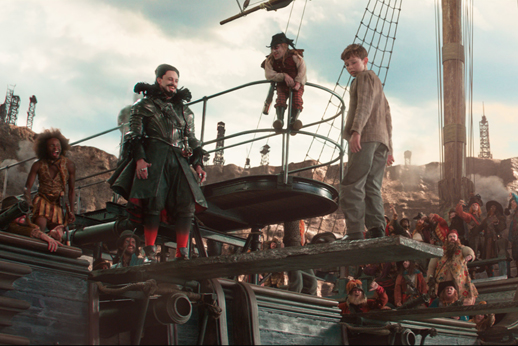
Peter (Levi Miller, right) anticipates certain doom once he's forced off the ship's plank by
the dread Blackbeard (Hugh Jackman, in black). But although the boy doesn't yet know
it, he possesses a magic talent that will surprise everybody...
Which makes director Joe Wright’s Pan something of a minor miracle. It’s a throwback to kinder, gentler times, when young champions relied on pluck and resourcefulness, rather than sarcasm and potty humor. Scripter Jason Fuchs’ imaginative fantasy is a thrilling ride from start to finish: laden with stalwart heroes and opulently dastardly villains, wildly imaginative locales and a high-spirited adolescent hero who could have stepped from the pages of a Charles Dickens novel (with a detour that L. Frank Baum would have appreciated).

Fuchs’ story speculates on a question that might have occurred to young fans of Scottish novelist/playwright J.M. Barrie’s celebrated “boy who wouldn’t grow up.” It’s a tantalizing query: How did Peter Pan become himself?

Fuchs, making a respectable big-screen solo scripting debut, plays with elements of Barrie’s original mythos, while borrowing scenarios and character archetypes from other fantasy sources. The crazy-quilt result is a bit uneven at times, but Wright and editors William Hoy and Paul Tothill keep things moving so rapidly, that you’re not likely to mind.

The action begins at London’s bleak Lambeth Home for Boys, during the height of the WWII blitz, where 12-year-old Peter (Levi Miller, doing an excellent job in his feature debut) and his fellow youngsters are routinely terrorized by Mother Barnabas (Kathy Burke), the imperious and just-plain-mean nun who runs the place. Peter has long suspected that Mother Barnabas has been hoarding all the tasty food rations while forcing the children to subsist on gruel, but in truth her perfidy is much, much worse.

Aside from these suspicions regarding the orphanage provisions, the bigger issue concerns the ongoing — and unexplained — disappearances of a few boys each night. The answer to that question proves calamitous, when Peter is among those snatched the next time around. He finds himself on (of all things) a pirate ship floating high above, which “sails” air currents the way an ordinary vessel would navigate the seven seas.