Showing posts with label 2013. Show all posts

Thursday, February 18, 2016

Boy and the World: A colorful, lyrical — and grim — parable

Boy and the World (2013) • View trailer 
Four stars. Rated PG, for dramatic intensity

By Derrick Bang

This one sneaks up on you.

Brazil’s Academy Award nominee in the Animated Feature category is a dazzling, extremely personal and ultimately quite sobering allegory by writer/director Alê Abreu ... although, at first, it doesn’t seem that way.

Having made his way to the big city, Cuca is dismayed to discover a wasteland of trash
and human misery: the result of unchecked industrialization that rewards the wealthy
"pretty people" at the expense of the laborers who support their lavish lifestyles.
The opening act is aggressively simplistic, the characters little more than stick figures placed against the sort of random, wildly colorful landscape that one would expect from a small child playing with crayons. Indeed, our young hero — Cuca — is a small child.

He’s introduced while enjoying the carefree playtime typical of innocent youngsters brought up in a cozy rural environment: darting through fields, and allowing his imagination to run riot in an opulent kaleidoscope of fanciful adventures (such as jumping high enough to land on the overhead clouds).

Cuca can be happy via the simple act of planting a seed, particularly when helped by his beloved parents.

The pacing is slow, the cacophonous, hand-drawn visuals unapologetically haphazard and weird. The apparent “story,” such as it is, unfolds without dialog ... or, at least, without dialog that matters. Brief and occasional conversations emerge as little more than unintelligible grunts and whistles, much like the “talking” in Britain’s Shaun the Sheep.

Instead of dialog, Cuca’s escapades unfold against a lyrical musical score by Ruben Feffer and Gustavo Kurlat: merely a hint of the rich, genre-blending melodies to come.

The alluring visuals and music notwithstanding, you’ll likely start to chafe, wondering if anything of consequence is coming. The answer is absolutely, but — at least initially — patience is required.

Matters turn a bit more serious one morning, as Cuca watches his father depart on an oddly metallic, centipede-esque train (the first hint that Abreu’s animation style won’t remain as minimalist as we might expect). The boy doesn’t understand why Dad is leaving, although we assume the latter is seeking work. But Cuca isn’t willing to wait behind, like his patient mother; he charges out of the house, determined to reunite his family.

And thus begins a journey that unfolds like a tapestry — deliberately — and becomes increasingly complicated and politically charged, just as Abreu’s animation style turns equally complex.

Tuesday, February 17, 2015

One Chance: Quite endearing, if slightly flawed

One Chance (2013) • View trailer 
3.5 stars. Rated PG-13, and needlessly, for brief profanity and mild sexual candor

By Derrick Bang


[Note: I’ve given up on waiting for this film to be granted wide release in the States; it obviously ain’t gonna happen. The Weinstein Company initially promised us this British import in late 2013, and then delayed it to last spring, and then granted it limited release in October. Apparently, that’s all we’ll get ... and yet there’s also no word yet of home video release, despite its DVD availability across the pond for at least a year now. Such are the idiosyncrasies of U.S. film distribution ... and, regardless, I’m not letting this review go to waste!]

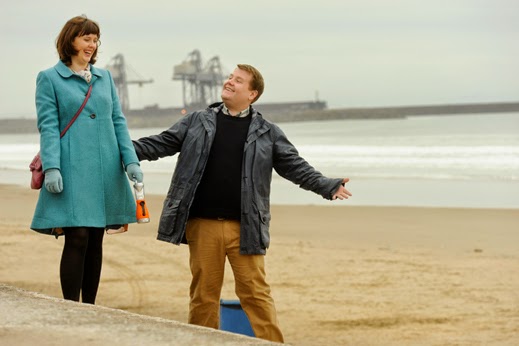
During a courtship that's frequently too cute for words, Paul (James Corden) never misses
an opportunity to serenade Julz (Alexandra Roach) with one of his favorite opera arias.
Some people are blessed and cursed in equal measure, and that’s certainly the case with Britain’s Paul Potts. Although graced with a lovely voice and a childhood fondness for opera and choir singing, these interests made him a frequent target for contemptuous peers in the Bristol-based, former quarry hamlet of Fishponds, where he grew up.

The rather unusual arc of Potts’ subsequent life is the subject of this whimsical, sometimes melancholy biographical drama from David Frankel, who previously charmed us with gentle character-clash comedies such as The Devil Wears Prada and the under-appreciated The Big Year.

Frankel is a good choice for this material; I’m less certain about scripter Justin Zackham, thus far known only for The Bucket List and The Big Wedding, both broad-strokes comedies fronted by A-list casts. One Chance is his first feature-length stab at factual material; while retaining many elements crucial to Potts’ life, Zackham plays fast and loose with other important details, for no apparent reason.

The real Potts has two brothers and a sister, all of whom are MIA in this film. Their father was a bus driver, not a steelworker. Most crucially, Potts wasn’t nearly as socially inept as this film suggests; he was elected the youngest member of the Bristol City Council as a Liberal Democrat in 1996, a position he held for seven years. That far-from-minor detail also remains MIA.

It could be argued that none of this matters, in the telling of a real-life Cinderella story, and that’s true ... to a point. But Potts’ actual experiences are sufficiently compelling to warrant a more accurate account of his ups and downs; heightening his misfit qualities, to make him even more of an underdog, feels like gilding the lily.

Even so, Frankel and Zackham skillfully work our emotions, building us to what should be a joyfully shared triumph ... and then they pull the rug out from under us. I’ve rarely seen a feel-good film so badly miscalculate its finale, employing a hasty voice-over to replace what should have been, at the very least, an ecstatic montage.

It’s an atrocious use of said-bookism: We don’t want to be told what happens during the climax, we want to watch it happen. Good grief, that’s basic Storytelling 1A.

Sigh.

Thursday, October 16, 2014

Tracks: An incredible journey of the soul

Tracks (2013) • View trailer 
Four stars. Rated PG-13, for dramatic intensity, fleeting profanity and partial nudity

By Derrick Bang

We’ll probably never truly know why 25-year-old Robyn Davidson arrived in central Australia’s Alice Springs in 1975, and then spent two years learning how to train and manage the country’s remarkable wild camels.

No matter how harsh the environment, Robyn (Mia Wasikowska) resolutely rises each
morning and embarks on another daylong trek across the Australian Outback, accompanied
solely by four camels and her faithful dog.
She had endured a childhood marred by disappointment and tragedy — her mother having committed suicide when Robyn was only 11 — so it’s easy to believe that she had personal demons to exorcise, and things to prove to herself.

Nor are we apt to know what then prompted the young woman to embark on an ill-advised solo trek from Alice Springs to where the Indian Ocean lapped against the West Australian coast, accompanied only by four camels and her beloved black dog, Diggity. The 1,700-mile journey across the harsh and unforgiving Australian Outback took nine months, during which she easily could have died any number of times.

Some people embrace such trials for the sheer challenge; as the saying goes, they climb the mountain or cross the desert “because it’s there.” By her own admission, Davidson seems to have undertaken this trip as a journey of personal discovery: a way to become a better version of herself.

“When there is no one to remind you what society’s rules are,” she has said, reflecting back on her journey, “and there is nothing to keep you linked to that society, you had better be prepared for some startling changes.”

The truly remarkable thing is that director John Curran, scripter Marion Nelson and star Mia Wasikowska have managed to bring Davidson’s incredible journey to the big screen with equal emphasis on the glorious, majestically inhospitable Australian Outback itself, and the impact it had on this solitary traveler. Their film is both a beautifully composed glimpse of an often barren and yet beautiful land, and an intimate portrait of an angry young woman trying to find inner peace.

And she is angry, as we first encounter her ... impatient, brittle and quick to take offense, and yet also oddly vulnerable: a duality that Wasikowska conveys quite well. She nails Robyn’s surface contradictions: uncomfortable in the presence of other people, probably to the point of anthropophobia, and yet dependent upon them for jobs, favors and money. And resentful of that same dependence.

And yet when Wasikowska manages one of Robyn’s shy, uncertain smiles, it lights up her entire face: easy to see, then, why she and her unlikely expedition attracted the interest of the National Geographic Society, which agreed to fund her trip in exchange for photographic coverage.

Monday, September 15, 2014

Jerusalem: Engaging overview of a remarkable city

Jerusalem (2013) • View trailer 
Four stars. Unrated, suitable for all ages

By Derrick Bang

Israel could use some positive buzz these days, and this reverential National Geographic/IMAX documentary is just what the doctor ordered.

The Dome of the Rock
Director/co-writer Daniel Ferguson’s thoughtful film eschews overt political content, instead concentrating on the history of this holiest of cities, and the spiritual pull that has made it so important, for so long, to Jews, Muslims and Christians. At the same time, Ferguson and co-scripter Sheila Curran Bernard slyly add an inclusive message by having three teenagers — one from each faith — share their respective impressions of the city they call home.

It’s a clever ploy, more so because three young women — Revital Zacharie, Farah Ammouri and Nadia Tadros — have been selected to speak plainly and earnestly about their devotion to faiths that haven’t always been that respectful of their gender. Each of these teens serves as a guide through portions of their particular Jerusalem, their narrative, off-camera observations quite heartfelt.

These aren’t actresses, although all three make charming subjects as cinematographer Reed Smoot’s massive IMAX cameras follow them through bustling markets and tightly packed corridors, and into temples, churches and mosques. That said, Zacharie makes the strongest impression, particularly during a brief scene shared with her grandfather, a Jewish scholar who has written numerous books on Jerusalem’s history.

Mostly, though, you’ll be awed — even left breathless — at the sights unveiled within this film. Smoot favors gentle, sweeping pans and slowly tracking close-ups, scenes seamlessly fading into each other.

Those familiar with the sheer size and complexity of IMAX camera gear will wonder precisely how Ferguson and Smoot managed to get many of these shots, notably those in especially tight quarters. Patience obviously played a factor as well; the press notes speak of the constant need to liaise with various religious, political and community authorities.

One stunning sequence — the “Ceremony of the Holy Fire,” which takes place annually on Orthodox Holy Saturday within the Church of the Holy Sepulchre — was obtained only after securing permission from the six churches with custodial authority: Greek Orthodox, Armenian Apostolic, Latin Catholic, Syrian Orthodox, Egyptian Coptic and Ethiopian Orthodox.

The results justify whatever effort was required. During scarcely a minute, we’re overwhelmed by a ritual that is both solemn and joyous, as all the assembled pilgrims do their best to ignite their individual torches from the “divine light” that emerges from Jesus’ traditional tomb.

Wednesday, July 9, 2014

Snowpiercer: Full steam ahead!

Snowpiercer (2013) • View trailer 
Four stars. Rated R, for profanity, extreme violence and gore, and drug content

By Derrick Bang


South Korean filmmaker Bong Joon Ho came to my attention in early 2007, with the Stateside release of The Host, a taut, eye-popping monster flick that blended savvy political commentary with impressive levels of tension and excitement ... and more than a little dark-dark-dark humor.

Having captured Mason (Tilda Swinton, center) and made her their unwilling guide, Curtis
(Chris Evans, left) makes her lead the way as his desperate band moves from one train
car to the next, never certain of what they'll find beyond each new door.
Ho delivers the same mix with Snowpiercer, with a notable upgrade: While portions of The Host reflected the naturalistic, guerrilla-style filmmaking of a modest budget, this new film is an A-list production all the way. It looks spectacular in every respect, and is further enhanced by a top-quality cast of familiar faces from both American and South Korean cinema.

The grim, cautionary nature of Ho’s storytelling hasn’t diminished; he remains convinced that humanity doesn’t deserve the planetary paradise on which we reside. Give us half a chance, and we’ll screw it up. The horrific creature that wreaked havoc in The Host was spawned by arrogant Americans who polluted South Korea’s Han River with dangerous chemicals; the post-apocalyptic events in Snowpiercer result from our “brilliant” attempt to reverse the effects of global warming.

I’m reminded of the conversations known to have taken place prior to the initial atomic bomb tests in the 1940s — attributed to either or both Edward Teller and J. Robert Oppenheimer, depending on the source — and which explored the possibility that even a single bomb might ignite Earth’s atmosphere via a fusion reaction, and thus destroy the world. Such fears notwithstanding, Those In Charge pulled the switch, and I guess we can conclude that God (and Mother Nature) watched over us that day.

Luck isn’t with us this time. The essential back-story unfolds during a quick montage prologue, as news reports discuss the dispersal of a chemical agent designed to reverse the effects of global warming. We may well imagine a similar cautionary conversation about unintended consequences, but no matter: This switch also is pulled, perhaps just as recklessly, and the results are miraculous. At first.

Until the entire planet is plunged into a lethal ice age, destroying all life.

But this catastrophic result wasn’t instantaneous; time allowed a microcosm of humanity to be saved on board a sleek, lengthy train originally designed as the ultimate, self-contained vacation vehicle for rich tourists wanting to circumnavigate the globe. Now transformed into a futuristic Noah’s Ark, there’s just one problem: Seventeen years have passed, and there’s still no safe place to “land.”

The train races around the world, its nickname derived from the pointed “snout” and high-tech engines and gyroscopic computers that allow it to blast through the frequent snowdrifts and frozen ice that block the track.

Friday, July 4, 2014

Begin Again: A melody-laden charmer

Begin Again (2013) • View trailer 
Four stars. Rated R, for profanity

By Derrick Bang • Originally published in The Davis Enterprise, 7.4.14

It’s a bit rough around the edges at first, the approach uncertain, the artist perhaps nervous and worried about looking foolish.

A needless concern.

With Dan (Mark Ruffalo, far right) acting as an on-the-fly director, Greta (Keira Knightley)
performs one of her songs in a New York City alley, accompanied by several talented
instrumentalists, and watched by a gaggle of neighborhood children.
I could be discussing the first song we see performed by Greta (Keira Knightley), reluctantly and a bit shyly, in front of an indifferent bar crowd. But I’m actually talking about this film itself: Perhaps writer/director John Carney is that clever, to have mirrored Greta’s stumbling debut before the public eye, with our reaction to the manner in which her story unfolds.

Because, in both cases, the talent involved can’t help but win us over.

Begin Again is the newest offering from the Irish filmmaker who charmed us so thoroughly with the saga of a Dublin busker in 2006’s Once, a film cherished just as much for its music — and that marvelous, Academy Award-winning song, “Falling Slowly” —  as for the gently romantic manner in which its story unfolded.

Carney’s new film once again revolves around music, but the setting and tone are both different and somewhat grittier. This narrative has a villain, but it’s an entity rather than an individual: the music industry, depicted as the instrument by which pure expression is quashed, either benignly or overtly. Remaining true to one’s dreams, passions and (reasonable) expectations is the ideal here: a goal too easily corrupted, as we shall see, by outside forces conscious only of the bottom line.

Those who adore New York for its cornucopia of emotions and experiences will delight in Carney’s rapturous depiction: a Big Apple we’ve not seen idolized so passionately since Woody Allen’s Manhattan, back in 1979. This is a New York of joyous romance, much like the Paris of Jean-Pierre Jeunet’s Amélie: the city as we imagine it, based on cinematic valentines like this one.

The story opens in the aforementioned East Village bar, as the unwilling Greta is dragged to the stage for one song: a brief musical interlude noticed by nobody except Dan (Mark Ruffalo), whose presence — in that bar, at that moment — is explained during the first of Carney’s clever flashbacks. Dan, once a lauded record label exec, has fallen on hard times prompted by a crisis in his personal life; the result is growing friction with his longtime partner, Saul (Mos Def), which climaxes in yet another humiliation.

Dan also drinks too much, and has been doing so for too long. But his radar remains unimpaired: He’s drawn, moth to flame, by this hesitant performance by a British singer/songwriter who’d rather be anywhere else.

Friday, June 13, 2014

Words and Pictures: Graceless and clumsy

Words and Pictures (2013) • View trailer 
2.5 stars. Rated PG-13, for sexual candor, profanity and nude sketches

By Derrick Bang


I cannot imagine what people were thinking.

This film is being marketed as a frothy romantic comedy involving a New England prep school English teacher and an art instructor, who encourage their respective students to engage in a friendly rivalry to determine whether words or pictures are the superior form of communication. Meanwhile, of course, the two instructors fall in love.

At first blush — and demonstrating excellent taste — Dina (Juliette Binoche) wants
nothing to do with the arrogant and conceited Jack (Clive Owen). But she cannot help being
intrigued by his proposal that their respective students embrace a challenge to determine the
comparative value of language, spoken or written, and images, drawn, painted or
photographed. So, game on!
Don’t believe it. That’s a serious distortion of the truth.

Gerald Di Pego’s original screenplay actually concerns an arrogant, alcoholic English instructor who lays waste to everything and everybody in his orbit, committing an escalating series of reprehensible acts while sliding further and further into uncontrolled drinking. The story is a downer from its opening scenes, with a few more dreary details thrown in as sidebar elements, just in case the central plot isn’t depressing enough.

Evidence suggests, after completion, that saner heads recognized this film as a stinker, since it sought U.S. release for almost a year. The eventual takers — Lionsgate and Roadside Attractions — must have been reluctant suitors, because the online press materials are minimal (only four photos from which to choose, instead of the usual two or three dozen), and most visibly because the film has been dumped quietly during an early summer season dominated by much glitzier popcorn flicks.

Fair enough. I just can’t figure out what prompted stars such as Clive Owen and Juliette Binoche to accept the assignment in the first place. Under no circumstances could Di Pego’s script have seemed reasonable, let alone rational. And although veteran director Fred Schepisi (Roxanne, Last Orders and Empire Falls, among others) gamely coaxes strong performances from his two leads, that can’t change the fact that they’re trying to make a silk purse from a sow’s ear.

Owen plays Jack Marcus, a charismatic honors English instructor at Maine’s bucolic Croyden Prep, who has long coasted on the adulation of students who enjoy his playful nature. But these “likable big brother” characteristics, which teens find so enchanting, are viewed as irritating and condescending by almost all of Jack’s colleagues. The lone exception is Croyden’s history instructor, Walt (Bruce Davison), a longtime friend who occasionally indulges Jack’s fondness for intricate word games.

Jack’s most visible problem is an ongoing slide into alcoholism, with lunchtime nips of vodka having blossomed into drunken public displays that have gotten him blackballed at a tony local restaurant. In part, Jack’s drinking results from professional panic; although hired as a noted author and poet, back in the day, he hasn’t been able to write anything for years.

Friday, May 9, 2014

Belle: Rings a robust note

Belle (2013) • View trailer 
Four stars. Rated PG, and mostly harmless, aside from an unexpectedly vulgar sexual assault

By Derrick Bang • Originally published in The Davis Enterprise, 5.9.14

Even under dire circumstances, virtuous individuals will stand against the entrenched horror of grim mob rule, risking social censure at best, their very lives at worst.

With her future — and happiness — on the line, Dido (Gugu Mbatha-Raw, left) accepts
some sage relationship advice from her foster mother, Lady Mansfield (Emily Watson),
before determining what her gentleman caller has in mind.
Oskar Schindler clandestinely defied Nazis and saved the roughly 1,200 Jews employed in his German factories. Civil rights activist César Chávez essentially shamed the United States into acknowledging and improving the wretched conditions under which primarily Latino laborers harvested foodstuffs. Polish shipyard worker Lech Walesa founded the Solidarity Movement that led to the fall of communism in his own country, and likely hastened the demise of the Soviet Union.

Which brings us to William Murray, the first Earl of Mansfield, a late 18th century barrister, politician and judge whose enlightened but highly unpopular decisions did much to encourage England’s eradication of slavery and the financially lucrative slave trade.

Murray may not be the central character in director Amma Asante’s thoroughly engaging Belle, but his presence looms large over the events depicted in this period drama. I must point out, however, that Misan Sagay’s script is far more fancy than fact; she plays fast and loose with historical accuracy, and it’s best to regard this depiction of Dido Elizabeth Belle as wish-fulfillment ... a suggestion of what might (should?) have been, rather than what was.

Sagay candidly admits, in this film’s press notes, that she was “inspired” to write this story after viewing a painting displayed at the University of St. Andrews, in Scotland. The 1779 work, a typically aristocratic portrait at one time credited to Johann Zoffany, depicts two beautifully outfitted young women — one black, one white — who, from their stance and expressions, appear to be both affectionate friends and equals.

Which, needless to say, would have been quite unusual at the time.

Asante and Sagay adhere closely to established fact during a brief prologue, with Captain Sir John Lindsay (Matthew Goode) bringing his illegitimate mixed-race daughter, Dido, to be raised at Hampstead’s Kenwood House by his uncle and aunt, Lord and Lady Mansfield (Tom Wilkinson and Emily Watson), while he returns to his naval duties. This childless couple already are raising another grand-niece, Elizabeth Murray, roughly the same age as Dido (which makes them third cousins, if I have that straight).

Lord and Lady Mansfield likely initially accept Dido as a companion for Elizabeth, but there’s no question that the former grows up in privileged surroundings, well treated in a household that tolerates both her illegitimacy and dark skin.

Wednesday, April 30, 2014

The Lunchbox: A wonderful meal

The Lunchbox (2013) • View trailer 
Five stars. Rated PG, for no useful reason, and suitable for all ages

By Derrick Bang

Movie buffs live for this moment: the thrill of discovery, striking when you least expect it.

The Lunchbox, an impressively accomplished feature debut for writer/director Ritesh Batra, is a bittersweet romantic charmer: by turns droll, sensitive and achingly poignant. And although we’re thoroughly absorbed by the core story involving two lonely people, Batra also delivers a perceptive analysis of big-city Mumbai, as it struggles at a cultural crossroads sparked by the age-old clash between tradition and progress.

On top of which, we get some astute social commentary on the nature of love, the sad fate of those who settle, and the possibly greater emotional rewards for those who defy expectations and, well, take an impulsive plunge.

Not bad, for a 104-minute film that spends almost all of its time with just three characters.

Batra’s narrative also is a cinematic valentine to the grand tradition of epistolary novels, ranging from classics such as Fanny Hill and Dracula, to more modern examples such as The Color Purple and The Perks of Being a Wallflower.

Indeed, I frequently was reminded of Helene Hanff’s marvelous 1970 book, 84, Charing Cross Road, for reasons that I can’t specify without spoiling some of the delights to be found in Batra’s film.

And, finally, mention must be made of the wholly immersive performances from the excellent cast, starting with veteran Indian actor Irrfan Khan, who seems everywhere these days. Aside from a busy schedule in his native country, American audiences will recognize him from Slumdog Millionaire and The Amazing Spider-Man; he also was the best part of Ang Lee’s film adaptation of Lifeof Pi, as the adult Pi Patel.

He stars here as Saajan Fernandes, a government accountant who has toiled for 35 years in an employee- and paper-strewn office that could, in different hands, be the subject of biting satire. But Batra’s touch is resolutely serious, his approach matter-of-fact. We’ve absolutely no doubt that scores of such offices exist throughout Mumbai, equally staffed (stuffed?) with quiet men who juggle facts and figures, struggling with pencil, ink and hand calculators, nary a computer to be seen.

Saajan is weeks from retirement, and therefore saddled with the responsibility of training his excitable young replacement: Shaikh (Nawazuddin Siddiqui), about whom, more in a moment.

Batra’s plot is driven by his story’s fourth primary “character,” the astonishing Mumbai tradition orchestrated daily by the dabbawallahs, a community of roughly 5,000 deliverymen who ferry between 175,000 and 200,000 hot meals from the kitchens of housewives to the offices of their husbands. The numbers are staggering, the process nothing short of amazing, as these lunches cross the city via bicycle, bus and train ... even during monsoons.

The positions are hereditary, dating back some 130 years, and even more impressive for the fact that almost all dabbawallahs are illiterate. The meals reach their proper destinations via a complex code of colors and symbols: a system that even led to a flattering 2010 study by the Harvard Business School ... a point of pride mentioned by one dabbawallah, at a key moment in this story.

Friday, April 25, 2014

The Railway Man: Journey to serenity

Railway Man (2013) • View trailer 
Four stars. Rated R, for highly disturbing scenes of torture and war violence

By Derrick Bang • Originally published in The Davis Enterprise, 4.25.14

It’s somewhat ironic that the “code of silence” shared by former British prisoners of war who survived their WWII ordeal, while forced to help construct the Siam-Burma railway, seems to have been echoed by filmmakers.

The calm before the storm: Patti (Nicole Kidman) has fallen deeply in love with Eric
(Colin Firth), despite knowing very little about his past. Details will emerge soon enough,
at which point we'll find out just how determined this woman can be, when it comes to
uncovering the truth.
Following the 1957 release of director David Lean’s classic (if fictionalized) Bridge on the River Kwai, nobody has re-visited those events on the big screen.

Ironic, because — as often happens — truth is far more powerful than fiction. And, in this particular case, even a bit stranger.

Director Jonathan Teplitzky’s adaptation of Eric Lomax’s memoir, The Railway Man, is a deeply personal film: by turns grim, heartbreaking and spiritually uplifting. It’s propelled by yet another impressive and emotionally complex performance from star Colin Firth, who appears to be cornering the 21st century market on delicately articulated psychological turmoil.

Merely to glance upon Firth’s face is to share in the grief of a man we don’t yet know; the invisible scars radiate from him in waves.

But Firth isn’t alone. He’s matched, scene for scene, by Nicole Kidman’s equally fine work. Her part isn’t as showy, but it’s just as crucial; she delivers the same persuasive power with small gestures. A tilt of the head, a half-smile that vanishes before blossoming fully. The beginnings of a comment, swallowed before any words escape her lips. A sense that this woman constantly walks on eggshells, lest she unknowingly awaken more dormant memories in the man she loves, but doesn’t yet know or understand.

Memorably deft performances, in both cases.

For the most part, the same can be said of scripters Frank Cottrell Boyce and Andy Paterson, who labored for years to turn Lomax’s book into a film. Their first act is a clever tease: deceptively light and sweet, almost a frothy romance, before dark storm clouds begin to smother the cheerful, sun-speckled tone.

The longer second act is horrific, in the manner of all powerful WWII sagas. The narrative may be far removed from the usual Western European setting, and the enemy faces may be different, but barbarism is universal. We wonder, once again, at man’s ability to debase and torture his peers. Not even war — not even this war — seems an adequate excuse for such spiteful cruelty.

The third act ... well, that’s where Boyce and Paterson falter a bit. But only a bit, and I’ll get back to that.

Friday, April 18, 2014

Dom Hemingway: For whom the belle tolls

Dom Hemingway (2013) • View trailer 
Three stars. Rated R, for nudity, sexual content, violence, drug use and pervasive profanity

By Derrick Bang


We’ve recently been blessed with a couple of show-stopping soliloquies.

Fresh out of prison, Dom (Jude Law, left) cheerfully follows longtime friend and criminal
colleague Dickie (Richard E. Grant) on a trip to the South of France, where Dom fully
expects to be rewarded — very generously — for keeping his mouth shut during a
12-year stretch.
Matthew McConaughey’s coked-out stock-whisperer scene, as he describes the concept behind fugazi to a still-naïve Leonardo DiCaprio, is by far the best part of the otherwise bloated Wolf of Wall Street. It’s acting genius on McConaughey’s part; he’s positively electrifying.

The same can be said of Jude Law’s opening monologue in Dom Hemingway, as he waxes rhapsodic about the most cherished part of his male anatomy. It’s a jaw-dropping introduction to this film’s title character, with Law going on an on and on, never pausing for breath, in a single dynamite take for cinematographer Giles Nuttgens, who just lets the camera roll. Law builds to a ferocity that would have riveted 16th century, standing-room patrons at the Globe Theatre ... although, it must be admitted, the profanity present in this lust-laden oration would have scorched the earth for miles around.

Law builds to a furious, fulminating, saliva-laden climax — in more ways than one — and leaves us utterly breathless.

I’d love to say the rest of writer/director Richard Shepard’s film lives up to this prologue. Sadly, not the case.

Although he’d been busy for well over a decade earlier, Shepard came to everybody’s attention with 2005’s The Matador, a marvelously stylish crime noir comedy. Shepard’s cheeky script notwithstanding, that film got much of its juice from the way star Pierce Brosnan — normally regarded as refined, genteel and immaculately turned out — went down and dirty as a world-weary assassin for hire.

Brosnan’s scruffy stomp through a hotel lobby, clad only in his skivvies, may have been that year’s best single movie scene.

Shepard clearly tries for the same vibe with Dom Hemingway, but his unfocused script can’t settle on a particular mood. Although the narrative could be considered a journey toward redemption by a career criminal who regards himself as the world’s best safe-cracker, the tone shifts wildly from real-world tension and lethal danger, to family melodrama, and even the heightened fantasyland of magic realism.

Friday, March 28, 2014

Sabotage: Vicious, vulgar trash

Sabotage (2014) • View trailer 
No stars (turkey). Rating: Rated R, for strong bloody violence and gore, relentless profanity, nudity, drug use and sexuality

By Derrick Bang • Originally published in The Davis Enterprise, 3.28.14


Oh, how the mighty have fallen.

Our rough 'n' tumble "heroes" — from left, Neck (Josh Holloway), Breacher (Arnold
Schwarzenegger), Pyro (Max Martini) and Tripod (Kevin Vance) — infiltrate a drug cartel
safe house, taking down all opposition while cracking wise. Because real DEA agents
behave like this all the time, donchaknow.
Once upon a time, in the 1980s and early ’90s, Sylvester Stallone and Arnold Schwarzenegger vied for the crown of box-office action champ: the former riding the momentum of his Rocky and Rambo franchises; the latter embracing a string of solid sci-fi/fantasy entries such as Conan the Barbarian, Predator and — needless to say — The Terminator.

Now they’re in a race to the bottom.

I was astonished — and saddened — when Stallone popped up about a year ago, in the loathsome Bullet to the Head. Exiting that bit of distasteful junk, I couldn’t imagine any (former) big-name star doing worse.

Color me surprised, because along comes Schwarzenegger and this repugnant turkey.

Back in the day, you’d have had to stay up late on a Friday night — at home — to see this sort of grade-Z shoot-’em-up on Cinemax. No self-respecting actor would have signed on for such grindhouse trash, and no self-respecting studio would have dared release such a thing theatrically.

My, how times have changed.

Sabotage isn’t merely offensively, viciously, gratuitously violent; it’s also stupid beyond measure.

Director David Ayer has made a minor splash with gritty urban thrillers such as Harsh Times and Street Kings — don’t feel bad, if they escaped your notice — but his primary Hollywood rep results from his impressive one-two punch as a writer, in 2001: collaborating on The Fast and the Furious, and as sole scripter on Training Day, which brought Denzel Washington an Academy Award.

Based on his subsequent career, Ayer has been chasing the belief that amorality for its own sake is what sells in these United States. Why bother with plot or character, when one can wallow in the sleaze of ghastly depravity?

He has teamed here with co-writer Skip Woods, who also made some noise in 2001, with the stylishly nasty Swordfish, and more recently got involved with glossy action junk such as The A-Team and A Good Day to Die Hard. Nothing to brag about, to be sure, but also nothing to be ashamed of. Until now.

Friday, March 21, 2014

Muppets Most Wanted: Sophomore slump

Muppets Most Wanted (2014) • View trailer 
Three stars. Rating: suitable for all ages, despite a truly meaningless PG rating

By Derrick Bang

At 112 minutes, this return visit with the Muppets is too long.

Director/co-scripter James Bobin starts well, with a droll song-and-dance opener that cleverly cites the various mistakes and shortcomings that plague most sequels ... and then, as this film progresses, he succumbs to almost all of them.

Kermit isn't at all sure about the wisdom of signing a contract with the smarmy Dominic
Badguy (Ricky Gervais), but the rest of the Muppets cast aside any doubts after
hearing about a planned European stage tour. What could possibly go wrong?
For the most part, Bret McKenzie’s songs are lyrically witty and staged in a manner that plays to the well-known character quirks of the large Muppet cast. Wry, Muppet-ized send-ups of classic tunes also prompt a giggle, whether Allen Toussaint’s “Working in the Coal Mine,” the Doobie Brothers’ “Long Train Running” or the iconic theme from Titanic, “My Heart Will Go On.”

The problem, eventually, is sheer music overload ... particularly when we factor in nods to Tchaikovsky, Strauss, Wagner, “The Rainbow Connection” and an entire production number lifted whole cloth from A Chorus Line.

Too much music. Way too much music.

Although Muppets Most Wanted is (more or less) propelled by a core plotline, the script — Bobin shares credit with Nicholas Stoller — too frequently feels random and unfocused, as if bits were being concocted on the fly.

It would appear that star Jason Segel had much to do with the success of 2011’s The Muppets, since he also co-wrote that screenplay with Stoller. That predecessor had two solid storylines: The re-assembling of the Muppet troops supplied a great first act, after their long big-screen absence, but the film’s heart came from the unlikely relationship between Segel’s Gary and his Muppet “brother,” Walter.

Muppets Most Wanted lacks that softer side. It’s little more than a series of songs, sight gags and comedy sketches: a format that worked quite well during the half-hour installments of television’s The Muppet Show, back in the late 1970s and early ’80s, but wears thin here and — dare I say it? — grows a bit tedious. Even dull.

And, judging by the increasingly restless behavior of the children present at last weekend’s preview screening, even they got bored. Not a good sign.