Showing posts with label Biography. Show all posts

Friday, January 3, 2025

A Complete Unknown: Not come Oscar time!

A Complete Unknown (2024) • View trailer
Five stars (out of five). Rated R, for profanity
Available via: Movie theaters

Director James Mangold’s mesmerizing depiction of Bob Dylan’s early years is laden with electrifying moments.


Early on, Joan Baez (Monica Barbaro) is the self-assured, veteran stage performer,
and Bob Dylan (Timothée Chalamet) is just a nervous kid ... but that dynamic changes
quickly, and quite dramatically.
The first comes quickly, when a scruffy 19-year-old leaves Minnesota for New York’s Greenwich Village, with little more than a guitar and the clothes he wore, in order to visit Woody Guthrie, with whom he had become obsessed after reading the legendary folk singer’s autobiography.

It’s January 1961: a quietly intimate moment in the hospital room where Guthrie (Scoot McNairy) has long been under care for Huntington’s disease (for which there was no treatment, at the time). His frequent visitor is Pete Seeger (Edward Norton), who has learned how to understand his longtime friend’s mostly unintelligible attempts at speech. Young Dylan (Timothée Chalamet) appears in the doorway; Seeger invites him inside.


Guthrie spots the guitar slung against Dylan’s back, and gestures for a song.


The young man obliges.


Like ... wow.


Movie magic at its finest.


A similarly powerful scene comes much later; it involves a cigarette passed between two people standing on opposite sides of a chain-link fence: unexpectedly sweet, intimate ... and sad.


Mangold and co-scripter Jay Cocks based their film on Elijah Wood’s 2015 non-fiction book, Dylan Goes Electric: Newport, Seeger, Dylan and the Night that Split the Sixties. The result is rigorously authentic to actual events — warts and all — allowing for occasional fabrications for dramatic purposes. The time frame is brief, from early 1961 to the galvanic, game-changing evening of July 25, 1965, during Dylan’s closing set at that year’s Newport Folk Festival.


To say that Chalamet fully inhabits this performance is the worst of understatements. It isn’t merely an uncanny replication of Dylan’s look, posture, mannerisms and the cadence of his mumbled, almost whispered speaking voice. Chalamet also sings and performs more than 40 songs during the course of this rhapsodic film, often sounding more like Dylan than the man himself.


The dramatic arc here will be familiar to those who’ve followed the careers of artists who burst explosively onto the scene, and then become pigeon-holed. Some are content to stay in such boxes, cheerfully riding the money machine; others — the genuinely talented — chafe at public expectations.


The resulting weight can be crippling. What, if anything, does an artist owe his public?

Friday, December 29, 2023

Maestro: Rhapsodic

Maestro (2023) • View trailer
Four stars (out of five). Rated R, for profanity and drug use
Available via: Netflix
By Derrick Bang • Published in The Davis Enterprise, 1.5.24

This film’s title suggests that it’s about a man: acclaimed composer/conductor Leonard “Lenny” Bernstein.


But that’s not entirely true. Director Bradley Cooper’s thoughtful, lovingly crafted tone poem actually focuses on the lengthy, loving and tempestuous relationship between Bernstein and actress Felicia Montealegre Cohn.


When Felicia (Carey Mulligan) wants Lenny (Bradley Cooper) to slow down and truly
pay attention to her, they sit in a field, back to back: a sweet tableau laden with
quiet intimacy.


The result certainly is one of the year’s most visually sumptuous and imaginatively staged dramas. Cooper and cinematographer Matthew Libatique collaborated meticulously, almost intimately, in a manner rarely seen in today’s films; every setting, every frame, is a work of art.

Cooper and Libatique also worked together on 2018’s A Star Is Born, which earned the latter a well-deserved Academy Award nomination.


As was the case with that earlier film, Cooper again wears three hats: director, co-scripter — with Josh Singer — and star. Thanks to the finely crafted work of prosthetic makeup designer Kazu Hiro, Cooper’s transformation is uncanny: particularly during the onset of Bernstein’s career, in the 1940s. 


The performance goes much deeper than mere appearance. Cooper also nails the cadence of Lenny’s stiff, formal manner of speaking — adding emphasis with frequent pauses, as if ensuring his listeners are hanging onto every word — along with the man’s charismatic presence. He wasn’t merely the most interesting person in a given room; he consumed the very atmosphere.


He talks — and smokes — constantly. His running commentary is as relentless as the chained cigarettes.


Lenny also was his own, fiercest taskmaster. We get a sense that he rarely slowed down — perhaps didn’t even know how to do so — because he wanted to maximize the potential of each moment: whether composing, conducting, teaching, partying or indulging in a liberated sexual lifestyle that occasionally threatened his career.


The latter is a running undercurrent in Cooper and Singer’s script, which is drawn heavily from archival video footage, documentaries and interviews — notably those by TV newsman Edward R. Murrow and journalist John Gruen, briefly depicted in this film — and daughter Jamie Bernstein’s 2018 memoir, Famous Father Girl.


Following a brief color prologue that catches an aging Lenny during a solemn, meditative moment, the film stock shifts to monochrome as we bounce back to the World War II era, and the fortuitous event that launched his career. After having spent a few preceding years in Manhattan teaching piano and coaching singers, Lenny was appointed assistant conductor of the New York Philharmonic.


His lucky break came on November 14, 1943, when guest conductor Bruno Walter called in sick at the last moment. Lenny made his debut on short notice, without any rehearsal, facing an ambitious program that included works by Richard Strauss, Miklôs Rózsa and Richard Wagner.


Between the live national CBS Radio broadcast and the following day’s celebratory front-page story in The New York Times, Lenny became famous overnight.

Friday, September 22, 2023

A Million Miles Away: Earthbound

A Million Miles Away (2023) • View trailer
3.5 stars (out of five). Rated PG, for no particular reason
Available via: Amazon Prime
By Derrick Bang • Published in The Davis Enterprise, 9.22.23

José Hernández’s remarkably impressive life and career definitely warrant a suitably exhilarating film.


Sadly, this one isn’t it.


José Hernández (Michael Peña, center), newly hired as an electrical and computer
engineer at California's Lawrence Livermore National Laboratory, finds that his input
is neither requested nor appreciated by his white colleagues. During meetings, he often
doesn't even get a seat at the table.


The script — by Bettina Gilois, Hernán Jiménez and director Alejandra Márquez Abella, based on Hernández’s 2012 autobiography — jarringly skips massive chunks of his early years, and is quite sloppy with respect to the passage of time. It’s also frequently hard to determine what year it is, and when various things take place.

Die-hard NASA fans will be able to fill in the gaps, but casual viewers will wonder if key scenes wound up on the cutting-room floor.


That’s a shame, because all the performances are strong and heartfelt, particularly Michael Peña’s starring role as Hernández. The film also excels at its depiction of family dynamics, and the strong ties binding him with his parents, his cousin Beto (Bobby Soto), and (eventually) his wife Adela (Rosa Salazar) and her family.


That said, it could be argued that Abella spends too much time on these relationships, at the expense of a more thorough depiction of how José gets from A to B, and then to C and D.


The story begins in the late 1960s, as the families of 7-year-old José (endearingly played in these early scenes by Juan Pablo Monterrubio) and Beto (Leonardo Granados) divide their lives between home in La Piedad, Michoacán, Mexico, and work each year as farmworkers, moving from one California town to another. Education is scattered and inconsistent, as the boys shuttle from one school to the next.


On top of which, they’re often both exhausted, sometimes — in a poignant scene — falling asleep on their school desks.


Even so, young José has a thirst for learning, and receives encouragement from a teacher (Michelle Krusiec) who sees a spark in his eager gaze. “You’re a force of nature,” she tells him. “Nothing will stop you.”


José’s father Salvador (Julio César Cedillo) also has a telling encounter with a guidance counselor. “A tree doesn’t like to be uprooted and planted somewhere else every few months,” she points out. “It will grow, but it won’t thrive.”

Friday, July 21, 2023

Oppenheimer: Bravura filmmaking

Oppenheimer (2023) • View trailer
4.5 stars (out of five). Rated R, for profanity, nudity and strong sexual content
Available via: Movie theaters
By Derrick Bang • Published in The Davis Enterprise, 7.21.23

This is, without question, one of the most ambitiously powerful films ever made.


Director/scripter Christopher Nolan’s attention to detail, and his flair for dramatic impact, are nothing short of awesome. Viewed on a giant IMAX screen, the result often is overwhelming.


U.S. Army Corps of Engineers veteran Leslie Groves (Matt Damon, left), tasked with
running the Manhattan Project, is constantly vexed by the demands that come from
head scientist J. Robert Oppenheimer (Cillian Murphy).


This deep dive into the tortured life of J. Robert Oppenheimer also boasts a panoply of well-sculpted characters: many familiar by reputation (or notoriety), others just as fascinating. All are played by an astonishing wealth of top-flight acting talent.

Best of all, Nolan’s adaptation of Kai Bird and Martin J. Sherwin’s Pulitzer Prize-winning American Prometheus: The Triumph and Tragedy of J. Robert Oppenheimer — published in 2005, and written over a period of 25 years — has the political complexity and narrative fascination that we’ve come to expect from Aaron Sorkin and William Goldman. Jennifer Lame’s pow-pow-pow editing also is terrific.


All that said, Nolan does himself no favors with a needlessly outré prologue that blends ostentatiously surreal imagery — representing the anxiety-laden guilt and terror that later plagued Oppenheimer — with Ludwig Göransson’s shrieking loud synth score. It’s much too intentionally weird and off-putting.


Göransson’s score and the film’s equally thunderous sound effects remain distracting during the first half-hour, obscuring dialogue while we struggle to absorb the initial character and information dump.


Nolan eventually settles comfortably into a multifaceted storytelling structure that cuts back and forth between Oppenheimer’s post-WWII security clearance hearing, held in the spring of 1954; and the June 1959 Senate hearings over whether former Atomic Energy Commission (AEC) chairman Lewis Strauss would be confirmed as President Eisenhower’s choice pick for U.S. Secretary of Commerce.


The former was a one-sided witch hunt deliberately kept out of the public eye, the latter a headline-generating circus very much in the public eye.


Oppenheimer, present throughout his 1954 hearing, reads a statement that opens the film’s third — and primary — narrative focus: his own life and career.


These sequences, as Oppenheimer’ history unfolds, are filmed in glorious 65mm color. (It remains true: Well-crafted film stock still is more satisfying — sharper, warmer, more vibrant — than digital.) 


The Strauss Senate hearings — an event beyond Oppenheimer’s control, in which he plays almost no role, although his presence is felt throughout — is shot in grainier black-and-white. The result feels more sinister and mysterious; first impressions of the key players ultimately prove misleading, as Nolan craftily moves his film into its third act.


But that comes much later.

Friday, June 23, 2023

Stan Lee: Biased and banal

Stan Lee (2023) • View trailer
Two stars (out of five). Rated TV-14, for no particular reason
Available via: Disney+

The best part of director David Gelb’s affectionate documentary is that Stan Lee narrates his own story throughout, thanks to audio clips culled from numerous media appearances, and extensive interviews conducted shortly before he died in 2018.


But that’s also a liability, because — as can be confirmed by anybody who has paid attention, for the past half-century — the only thing larger than Lee’s creative talent was his ego. He was incapable of acknowledging the importance of equally gifted colleagues.

(Walt Disney had the same failing, claiming proprietary credit — and 22 Academy Awards — while conveniently overlooking the people who did the actual work.)


Following a promising first act, Gelb’s film devolves into one-sided hagiography: the film equivalent of Lee’s insufferably narcissistic books, 2002’s Excelsior! The Amazing Life of Stan Lee and 2015’s Amazing, Fantastic, Incredible: A Marvelous Memoir


(Sean Howe’s Marvel Comics: The Untold Story gives a far more balanced view of what actually occurred.)


Gelb’s failure to adopt an impartial approach is unfortunate, because Lee’s early career would be no less impressive.


He was born Stanley Martin Lieber in New York City on Dec. 28, 1922. From a young age, he wanted to make something of himself — to gain steady employment — in great part because his father was so frequently out of work. Young Stanley’s first job was as an office boy “for the city’s second-largest trouser manufacturer,” but that stint proved brief; he was fired the week before Christmas.


In 1939, he became the “third assistant office boy” for Martin Goodman’s fledgling Timely Publications, which immediately unleashed a wealth of pulp magazines, digest-sized magazines and comic books. The latter debuted with Marvel Comics No. 1, released in October that year; the cover story featured the Human Torch.


Numerous other titles quickly followed, featuring superheroes such as the Sub-Mariner, the Patriot, the Angel, the Destroyer and — most significantly — Captain America. Jack Kirby did much of the artwork, alongside writer Joe Simon; both are heard briefly, as they recall those early days.

Friday, December 23, 2022

I Wanna Dance with Somebody: Celebratory

I Wanna Dance with Somebody (2022) • View trailer
3.5 stars (out of five). Rated PG-13, for drug use, profanity and emotional abuse
Available via: Movie theaters

Film biographies live or die on the basis of the starring performance, and Naomi Ackie is by far this project’s strongest asset (although, in fairness, she’s surrounded by an equally strong supporting cast).


As her career explodes, and she finds herself surrounded by an increasing number of
"takers," Whitney Houston (Naomi Ackie) knows that she always can trust
Clive Davis (Stanley Tucci) to look out for her best interests.


Ackie persuasively runs the complex emotional arc of Whitney Houston’s tempestuous — and tragically brief — career: modest ingénue; giddy breakthrough artist; savvy judge of what works best; regal diva; betrayed daughter; out-of-control mega-celebrity, blind to the way in which she’s torching her own brand; and, ultimately, wan and emaciated substance abuser.

During the best and brightest moments, Ackie’s mimicry is almost eerie: the warmly radiant smile; the shrewd, theatrical hand gestures and body language; and — most crucially — the sheer magnetic presence this woman displayed, both on stage and during quieter moments. She lights up an otherwise quiet room, sucks all the air out of a massive, sold-out theater.


What Ackie does not do, however, is sing; she lip-synchs everything to Houston’s actual vocals. (It is, credit where due, extremely convincing lip-synching.)


This, perhaps, is the most visible example of the compromises, omissions and tread-very-carefully decisions that director Kasi Lemmons and scripter Anthony McCarten were forced to make, every step of the way: both in order to please the many surviving associates and family members, and to avoid potential defamation lawsuits.


This is most obvious during McCarten’s “softening” of Bobby Brown (Ashton Sanders), and the ludicrously restrained manner in which the film deals with his abusive behavior during their 14-year train wreck of a marriage.


On the other hand — and no doubt a reflection of our more enlightened times — McCarten’s depiction of Houston’s bisexuality is refreshingly frank, along with her long, complex relationship with best friend (and eventually executive assistant) Robyn Crawford (Nafessa Williams). 


Their flirty, meet-cute connection, as young women, is one of this film’s many pleasures. Williams is similarly excellent as the effervescent lover turned steadfast, truth-telling watchdog, as Whitney’s career ascends and then heads into troubled waters. Robyn’s feisty, take-no-prisoners loyalty cracks only briefly, when the necessity of a heterosexual “image” derails any chance of a longstanding romantic relationship.


Robyn’s crestfallen expression — and rage — are heartbreaking, when this moment of truth arrives.

Friday, November 25, 2022

The Fabelmans: Spielberg bares his soul

The Fabelmans (2022) • View trailer
4.5 stars (out of five). Rated PG-13, for dramatic intensity, occasional mild profanity, brief violence and fleeting drug use
Available via: Movie theaters

Most films never attempt the breathtaking impact of a truly transformative moment; a lucky few manage one, perhaps two.


This film has many.


The magic, transformational moment: As his parents (Paul Dano and Michelle Williams)
watch, young Sammy (Mateo Zoryon Francis-DeFord) is blown away by his first
big-screen movie experience.

Steven Spielberg’s semi-autobiographical ode to the relentless drive of artistic passion is gorgeously lensed throughout by cinematographer Janusz Kaminski, who won Academy Awards while working with Spielberg on Schindler’s Listand Saving Private Ryan. This affectionate big-screen love letter isn’t merely laden with a sense of wonder; it’s about that sense of wonder, which can render those so afflicted helpless in its grip.

Along the way, this quietly compelling story — co-written by Spielberg and Tony Kushner (Angels in America) — is a moving coming-of-age saga: poignant, whimsical, occasionally laugh-out-loud hilarious, and (aren’t they always?) heartbreaking. It’s also a classic American narrative about heading west to find new fortune and freedom.


As for Spielberg’s insistence that it’s merely semi-autobiographical … well, it’s actually far more accurate than most big-screen films claiming to be wholly biographical.


Events begin in snowy, stormy New Jersey in 1952. Young Sammy Fabelman (Mateo Zoryon Francis-DeFord) is about to be taken to his first movie by parents Burt (Paul Dano) and Mitzi (Michelle Williams). The boy is frightened by the notion of confronting “giant people” — a concern no doubt influenced by anticipatory descriptions from his excessively technical father (about whom, more in a moment) — but his mother assures him the experience will be magical.


The film in question is The Greatest Show on Earth, and we eavesdrop as the boy’s eyes go wide during the climactic train wreck (which is a stunning sequence even today, and must’ve blown the minds of patrons at the time).


It’s Christmastime, and Burt makes a weak joke about having trouble finding their house, as they return home after the movie. “It’s the dark one,” Sammy grouses, disappointed by their lack of holiday lights.


He also has been dithering about what he wants for Hanukkah, but inspiration suddenly strikes. Over the course of the celebration’s eight days — in a charming montage — he receives the individual cars, transformer and locomotive of a Lionel train set.

Friday, January 21, 2022

The Tender Bar: Wisdom served wry

The Tender Bar (2021) • View trailer
Four stars (out of five). Rated R, for considerable profanity and some sexual candor
Available via: Amazon Prime
By Derrick Bang • Published in The Davis Enterprise, 1.21.22

The best coming-of-age stories possess a carefully calculated blend of warmth and gentle humor, along with the beating heart of such sagas: the relationship between mentor and mentee.


J.R. (Daniel Ranieri, left) soon realizes that school books aren't the sole source of
education. Some of life's best lessons come in a bowling alley, particularly when the
wisdom is dispensed by the boy's doting Uncle Charlie (Ben Affleck).


Director George Clooney’s precise touch with The Tender Bar absolutely honors the tone of Pulitzer Prize-winning journalist J.R. Moehringer’s best-selling memoir, with its rich cast of quirky characters. At times, this feels like a modern, true-life Charles Dickens story: not a surprise, since books — and particularly Dickens — play an important role.

I only wish William Monahan’s screenplay had done a better job with Moehringer’s book. Condensing a 384-page tome into a 106-minute film obviously requires compromise, but — due to an ill-advised narrative decision — viewers likely will be dissatisfied with the result.


The story begins in 1972, as 9-year-old J.R. (Daniel Ranieri) spends hours each day scanning radio channels for “The Voice,” as he calls the deadbeat DJ father who deserted him and his mother Dorothy (Lily Rabe) years earlier. Despite her best efforts, she can’t make ends meet; reluctantly, she packs J.R. and their meager possessions into a car and drives to Manhasset, Long Island, returning to the now-dilapidated house where she grew up.


The homecoming isn’t entirely welcoming. Her curmudgeonly and unapologetically blunt father (Christopher Lloyd) views this as a sign of failure; we get a sense that he never forgave Dorothy the mistake of having taken up with her ex-husband. Her mother (Sondra James) is more cordial; her brother Charlie (Ben Affleck), still living with his parents — also to his father’s disgust — is pragmatic and sympathetic.


To J.R. — who goes by those initials because he’s actually a junior, which he refuses to acknowledge — Charlie is Uncle Charlie: an attentive, doting purveyor of wisdom and sage advice. J.R. does not want for love; Dorothy is fiercely protective, and a great believer in his potential — she repeatedly insists that he’ll one day go to Yale — but she also battles chronic depression.


Laid-back Uncle Charlie takes the edge off. While his approach to “parenting” probably wouldn’t win the approval of Social Services, he’s just what J.R. needs.


Affleck’s performance is sublime. Charlie is a self-educated truth-seeker with a closet full of classic books — this fascinates J.R. — and he works as a bartender at a local pub called Dickens, where additional stacks of books vie for space with the colorful liquor bottles. Affleck’s bearing is charismatic; it’s no surprise that the bar regulars hang on his every word, just as J.R. does.


Affleck’s line deliveries invariably include a trace of New York sass or snark, stopping just short of smugness. Charlie is never condescending; he grants respect to all who deserve it. (J.R.’s estranged father, who drops in just often enough to disappoint the boy further, is one of the exceptions.) 


Friday, December 10, 2021

tick, tick ... BOOM! — Explosively dazzling

tick, tick ... BOOM! (2021) • View trailer
Four stars (out of five). Rated PG-13, for dramatic intensity, brief profanity and fleeting drug references
Available via: Netflix

The creative process can be soul-deadening.


We in the outside world tend to think solely in terms of a result. For example, Rent was a smash success from the nanosecond it opened on Broadway in April 1996, and it brought creator Jonathan Larson the Pulitzer Prize for Drama, along with Tony Awards for Best Musical, Best Book of a Musical, and Best Original Score, along with a boatload of other honors.


While working his day job at the Moodance diner, Jonathan (Andrew Garfield) suddenly
finds himself dancing with — among many others — Bernadette Peters, during a
high-spirited production number titled "Sunday."


But how did Larson get there?

Like most so-called “overnight successes,” Larson was anything but, as this musical reveals. tick, tick … BOOM! got its start as a one-man autobiographical “rock monologue” initially titled Boho Days, and performed by Larson at the Village Gate and New York Theater Workshop on December 14, 1992. The piece is a painfully autobiographical account of the struggle he endured while spending eight years writing his first professional musical, Superbia.


Not quite a decade later, tick, tick … BOOM! was reconstructed by playwright/director David Auburn as a three-person show at New York’s Jane Street Theater, where on November 11, 1992, a 21-year-old theater major named Lin-Manuel Miranda attended a performance.


We all know what happened to him.


It’s therefore not merely serendipitous, but absolutely proper, that Miranda make his feature film directing debut with this screen adaptation. And — no surprise — he has done a superb job.


The film is anchored by a sensational lead performance from Andrew Garfield, starring as Larson: a mesmerizing blend of acting chops and heartfelt singing, given that he anchors or solos most of the musical numbers. It’s the sort of exhilarating effort that transcends artifice; not even half an hour into this film, we’re firmly convinced that it is Larson on the screen.


Steven Levenson’s screenplay follows Jon during the eight frenzied days leading up to a crucial workshop performance of Superbia. This coincides with the looming arrival of his 30th birthday: a milestone that weighs heavily, because he regards it as the last-gasp chance for being “discovered” at the appropriate point of what he hopes will become a career.


The pressure of this “ticking clock” — which we occasionally hear, albeit faintly, when it isn’t overwhelmed by the frequently passionate songs — acts as a metronome for everything else being balanced: his day job as a waiter at the Moondance Diner; the dwindling relationship with girlfriend Susan (Alexandra Shipp), whose desire to pursue her own ballet career is pulling her elsewhere; and the decision by longtime best friend Michael (Robin de Jesús) to abandon the acting grind for a stable, 9-to-5 job in advertising … which Jon regards as a sell-out (while nonetheless being envious of Michael’s doorman apartment).


And, as these eight days pass, the advancing specter of the AIDS epidemic also looms large.

Friday, September 24, 2021

The Eyes of Tammy Faye: An appalling gaze

The Eyes of Tammy Faye (2021) • View trailer
2.5 stars (out of five). Rated PG-13, for sexual content and drug abuse
Available via: Movie theaters

I’m hard-pressed to think of anybody whose life story interests me less.


Director Michael Showalter and scripter Abe Sylvia’s adaptation of the 2000 Fenton Bailey/Randy Barbato documentary clearly intends a re-evaluation of Tammy Faye Bakker, the more flamboyant half of husband Jim Bakker’s impressively massive PTL (Praise the Lord) broadcasting network and religious empire.


With their media empire crumbling amid multiple financial and moral scandals,
Tammy Faye (Jessica Chastain) and Jim Bakker (Andrew Garfield) make a
last-ditch effort to plead their case on national news shows.


Being dragged once again through their decade of naked avarice and shameless hypocrisy, as they enjoy a lavish lifestyle funded by donations from gullible souls who bankrupted themselves in the belief they were helping God save the downtrodden, is almost beyond endurance.

That said…


The agony is intensified by the astonishing persuasiveness with which stars Jessica Chastain and Andrew Garfield portray the televangelist couple. It’s frankly spooky; more than once, I had to remember that this was a film, and not the 2000 documentary.


Chastain’s performance goes much deeper than the surface affectations of Tammy Faye’s clown-worthy makeup, hairstyles and trendy on-air garb. Chastain nails the head tilts, the perky smile, the gently swaying “moments with God” and — most notably — the initially cute Betty Boop voice, which becomes insufferable as Tammy Faye grows older.


Garfield, in turn, oozes insincere, egomaniacal smarm from the moment Jim and Tammy Faye meet, at Minnesota’s North Central Bible College. She’s sweet and impressionable; he radiates “stalker.” We see the wheels spinning behind Garfield’s gaze, as the far-thinking Jim immediately recognizes that this plain-spoken but clearly suggestible young woman will be an important asset to his future plans.


They marry almost immediately, much to the chagrin of her mother Rachel, played with richly nuanced depth — total honor and heart — by the always magnificent Cherry Jones.


The goal of a biographical film such as this — the reason for its existence — should be to explore the background of an individual who grows up to become such an unabashed monster. Alas, Sylvia’s script doesn’t give us much. 


A brief flashback introduces us to adolescent Tammy Faye (Chandler Head), Rachel’s only child by a brief marriage that ended in divorce. Although she re-marries, making Tammy Faye the eldest of eight children in a blended family, Rachel remains a pariah in this tiny Minneapolis community, despite total devotion and commitment to her faith. As a result, Tammy Faye is forbidden to attend the Pentecostal church where her mother plays piano alongside a fire-and-brimstone preacher, lest she remind parishioners of the divorce.


But Tammy Faye wants to attend, wants more than anything to be part of this environment: to hear the word of God. After watching services from outside, via a window, she shrewdly perceives what is necessary. So she resolutely enters the church the following Sunday, walks up to the preacher, and collapses onto the floor in a rapturous fit, complete with muttered gibberish. The congregation is ecstatic.

Friday, April 9, 2021

The U.S. vs. Billie Holiday: A missed opportunity

The U.S. vs. Billie Holiday (2020) • View trailer
Three stars. Rated R, for strong drug content, nudity, sexual candor, violence, lynching images and considerable profanity

J. Edgar Hoover has a lot to answer for.


He’s name-checked but never actually seen in director Lee Daniels’ harrowing study of jazz chanteuse Billie Holiday’s final tempestuous decade, available via Hulu. But Hoover’s spirit hovers over an early back-room meeting that includes Sen. Joseph McCarthy (Randy Davison), Roy Cohn (Damian Joseph Quinn), Congressman John E. Rankin (Robert Alan Beuth), Congressman J. Parnell Thomas (Jeff Corbett) and a gaggle of other sclerotic, racist martinets determined to make America safe for their wealthy white friends and colleagues.


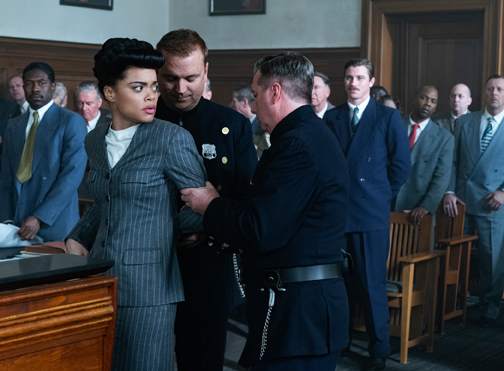
Despite having been assured by her attorney that she'll be sent to a rehab hospital,
Billie Holiday (Andra Day) is horrified to hear the judge sentence her to "a year and a day"
at West Virginia's Alderson Federal Prison Camp.
By — in this case — removing Holiday from the equation.


Not a difficult task, given that her well-publicized heroin habit dovetails nicely with the “war on drugs” championed ruthlessly by U.S. Federal Bureau of Narcotics Commissioner Harry J. Anslinger (Garrett Hedlund, much too young for this key role).


The concern — a primary focus of Pulitzer Prize-winning playwright Suzan-Lori Parks’ screenplay, adapted from a chapter in journalist Johann Hari’s non-fiction dissection of the war on drugs, Chasing the Scream — is that Holiday’s signature song, “Strange Fruit,” is “stirring up the masses” (Black and white, it should be mentioned).


And, Lord knows, we can’t have that.


Daniels’ film is anchored by star Andra Day’s all-in, absolutely mesmerizing portrayal of Holiday: as astonishing an impersonation as could be imagined, even more so given that this is Day’s starring debut. And yes, to anticipate the obvious question: She does all of her own singing … and her replication of Holiday’s ragged, whiskey-soaked, gravel-on-grit delivery is equally impressive.


That said, Day isn’t similarly well served by Daniels’ slow, clumsy film, or by some of the odd narrative choices in Parks’ script: most notably a weird framing device involving flamboyantly gay radio journalist Reginald Lord Devine (Leslie Jordan, as a wholly fictitious character), which sets up the flashback that bounces us to February 1947. 


It’s a celebratory evening, with Holiday performing before an enthusiastic sell-out crowd at New York’s Café Society, the country’s first racially integrated nightclub. The audience includes Holiday’s friend and occasional lover, Tallulah Bankhead (Natasha Lyonne); her husband Jimmy Monroe (Erik LaRay Harvey); and worshipful ex-soldier Jimmy Fletcher (Trevante Rhodes).


Backstage, we meet Holiday’s loyal family unit: stylist Miss Freddy (Miss Lawrence); hairdresser Roslyn (Da’Vine Joy Randolph), also charged with caring for Billie’s beloved dogs; trumpeter — and frequent heroin partner — Joe Guy (Melvin Gregg); and saxophonist Lester “Prez” Young (Tyler James Williams, all grown up from his TV days in Everybody Hates Chris).


The care and attention they pay each other is genuinely touching, throughout the entire film. They’re far more attentive and compassionate than husband Jimmy: merely one of many examples, as we’ll see, of Holiday’s lamentable taste in men.