Showing posts with label Christian Bale. Show all posts

Friday, October 7, 2022

Amsterdam: A great place to visit

Amsterdam (2022) • View trailer
Four stars (out of five). Rated R, for violence and bloody images
Available via: Movie theaters
By Derrick Bang • Published in The Davis Enterprise, 10.7.22

“Some of what follows actually happened,” the initial title card promises.


And how.


Our heroes — from left, Burt (Christian Bale), Valerie (Margot Robbie) and Harold
(John David Woodman) — finally realize that Henry (Michael Shannon, far right) and
Paul (Mike Myers) haven't been entirely candid with them.


Writer/director David O. Russell’s audacious new film is a cheeky banquet of historical fact and fiction, served up as a comedic thriller about loyalty, love and the dogged determination to do the right thing, even in the face of overwhelming odds.

The impressive ensemble cast is highlighted by fascinating performances from leads Christian Bale (once again, almost unrecognizable), Margot Robbie and John David Washington.


Russell’s story hits the ground running and never lets up, its twisty plot unfolding against a slightly stylized tone that begins as mild burlesque, but soon turns increasingly, believably sinister.


And — let it be stated — there’s no question Russell also intends this as a strong cautionary parallel to our current times. 


As philosopher George Santayana famously observed, Those who do not learn history are doomed to repeat it.


The setting is 1933 in uptown New York, where WWI comrades Dr. Burt Berendsen (Bale) and attorney Harold Woodman (Washington) have become “fixers of last resort” for those down on their luck or low on money, and particularly for the many physically and emotionally shattered veterans who’ve been ignored by the U.S. government.


(Although granted so-called “bonus certificates” with a face value equal to each soldier’s promised payment with compounded interest, these scripts could not be redeemed until 1945 … which hardly helped unemployed individuals during the height of the U.S. Depression. In July 1932, President Hoover ordered the U.S. Army to clear the campsites of 43,000 desperate demonstrators who had gathered in Washington, D.C. The soldiers, along with their wives and children, were driven out, after which their shelters and belongings were burned.


(Sound familiar?)


Burt is quite the flamboyant kook, forever “inventing” restorative and pain-relieving medicines that won’t be available for decades — if ever — and cheerfully testing them on himself. His dilapidated office is filled with suffering veterans hoping to feel better — and in some severe cases look better — while Burt does everything to help cheer them up.


Bale’s performance is sublime, starting with the unreliable — and persuasively realistic — glass eye that constantly pops out of its socket: the result of a war injury. Burt is unkempt, unshaven, seemingly flustered and reckless … and yet possessed of acute intelligence and sharp perception.


Bale appears to be channeling Peter Falk’s Detective Columbo, with a superficially harmless and disarming manner that conceals razor-sharp awareness.

Friday, July 8, 2022

Thor: Love and Thunder — A mighty bore

Thor: Love and Thunder (2022) • View trailer
Two stars (out of five). Rated PG-13, for sci-fi violence, occasional profanity, suggestive content and partial nudity
Available via: Movie theaters
By Derrick Bang • Published in The Davis Enterprise, 7.8.22

A bit of levity is welcome in a superhero film; otherwise, the thrashing, bashing and smashing would become tedious.


But too much levity is just as bad, and this film crosses that line. And then some.


When the malevolent Gorr floods New Asgard with all manner of icky, shadowy monsters,
even Thor (Chris Hemsworth) quickly feels overwhelmed.


The fourth Thor entry is a relentlessly silly clown show, and the blame clearly belongs to director/co-writer Taika Waititi; he pushes the inane dialogue and burlesque atmosphere even further than he did with 2017’s mostly silly Thor: Ragnarok.

In Waititi’s hands, Chris Hemsworth’s Thor is little more than a strutting buffoon.


Granted, a touch of Shakespearean egotism is appropriate; we are dealing with a near-omnipotent Norse God. Conceit comes with the territory. Director Kenneth Branagh — perfect for the assignment — better understood the balance, when he helmed the first film, back in 2011.


Waititi immediately shows his hand, during a prologue that finds Thor still allied with the Guardians of the Galaxy (with whom he departed Earth, following the events in 2019’s Avengers: Endgame, for those not up to date). The Guardians are trying to protect blue-skinned Indigarrians from an invading force determined to take over the planet; Thor sits out the battle until things turn dire, at which point he and his lightning-spitting battle axe make short work of the entire enemy army.


Much to the annoyance of the exhausted Guardians, who’ve clearly had enough of this swaggering narcissist. As we also will, very quickly.


That’s bad enough; far worse is the collateral destruction of the Indigarrians’ holiest of holies, which Waititi and co-scripter Jennifer Kaytin Robinson discard as a cheap laugh.


That’s unforgiveable … and a dire indication of things to come.


The “big bad” this time is Gorr the God Butcher (Christian Bale, almost unrecognized beneath make-up), a once-pious individual who renounced worship after the death of his entire species. Rage and despair allowed Gorr to be infected by the malevolent spirit of a god-killing sword, and he has since been systematically eliminating gods, universe by universe.


Next stop: New Asgard, on Earth.


Ah, yes … New Asgard. The actual Asgard, Thor’s celestial realm — along with most of his fellow warriors — was destroyed during Thor: Ragnarok. The remaining Asgardians have made a home in New Asgard, which has blossomed into an excruciatingly cutesy Norse theme park.


Look closely, and you’ll spot Matt Damon, Sam Neill, Melissa McCarthy and Hemsworth’s brother Luke, as a quartet of so-wooden-they-warp stage actors.

Friday, November 15, 2019

Ford V Ferrari: Turbo-charged!

Ford V Ferrari (2019) • View trailer 
Four stars. Rated PG-13, for dramatic intensity and occasional profanity

By Derrick Bang • Originally published in The Davis Enterprise, 11.15.19

Christian Bale never ceases to amaze.

His performances are “all in” to a degree most actors couldn’t even contemplate, let alone accomplish. Nor is it merely the surface gimmick of his extreme weight losses and gains; Bale never appears to be “acting.” He simply becomesthat person, whether an industrial worker fearing for his sanity (The Machinist); a former boxer turned crack addict (The Fighter); or an ex-neurologist-turned-stock market savant suffering from Asperger syndrome (The Big Short).

Having made yet another series of adjustments, driver/engineer Ken Miles (Christian Bale,
left) prepares to test-drive their high-performance vehicle again, while designer
Carroll Shelby (Matt Damon) waits apprehensively.
Or, in this case, feisty English sports car racing engineer and driver Ken Miles. Five minutes into this film, Bale ceases to exist. He is this guy. The mannerisms, posture, short temper and pugnacious attitude are wholly unlike any other character he has played, during a career that began when he was 12. 

That said, Bale’s Ken Miles is by no means defined solely by his truculence; the scenes he shares with Caitriona Balfe and Noah Jupe — also excellent, as Miles’ wife Mollie and their young son Peter — depict a kinder, gentler and loving man wholly at odds with the automotive genius who suffers fools not at all, let alone gladly.

(For the record, Bale dropped 70 pounds to play Miles, after having plumped up for Dick Cheney, in Vice.)

The notion that Bale has yet to win a Best Actor Oscar defies comprehension.

His sublime performance is far from the only high point in Ford V Ferrari, director James Mangold’s consistently absorbing, fascinating and suspenseful depiction of the American automobile company’s hare-brained, mid-1960s decision to challenge Italy’s boutique car-maker in the annual 24-hour Le Mans endurance race. Despite a running time of 152 minutes, Mangold’s film is never less than compelling … and the racing sequences are breathtaking. 

Cinematographer Phedon Papamichael and a trio of editors — Andrew Buckland, Michael McCusker and Dirk Westervelt — deserve considerable applause. Sound designer Jay Wilkinson deserves an Academy Award.

Kudos, as well, to scripters Jez Butterworth, John-Henry Butterworth and Jason Keller, for bravely tackling the corporate back-story and hijinks that led to this automotive clash. The narrative execution is never less than enthralling, to the same degree that 1976’s All the President’s Men turned plodding investigative journalism into a gripping suspense thriller.

Nor do the writers fill time with the soapy relationship melodrama relied upon by 1969’s Winning and 1971’s Le Mans. This film is cars, cars and nothing but cars … and that’s not a bad thing. If you’re not a racing fan prior to seeing Ford V Ferrari, you certainly will be 152 minutes later.

Friday, January 11, 2019

Vice: Evolution of a monster?

Vice (2018) • View trailer 
Three stars. Rated R, for profanity and violent images

By Derrick Bang • Originally published in The Davis Enterprise, 1.11.19

It’s sad when the whole doesn’t live up to the sum of its parts.

Vice is turbo-charged by a jaw-dropping performance from star Christian Bale: as wholly immersive as Gary Oldman’s similarly masterful portrayal of Winston Churchill, in 2017’s Darkest Hour. Bale’s impersonation is equally convincing; at times, you’d swear that Dick Cheney himself were on the screen.

The fateful meeting: Presidential candidate George W. Bush (Sam Rockwell, right) wants
Dick Cheney (Christian Bale) as his running mate, a traditionally toothless position that
interests the latter not at all ... until he perceives the degree to which this particular
U.S. president could be controlled and manipulated.
Bale is (in)famous for putting soul andbody into his performances, having dropped 70 pounds for his emaciated role in 2004’s The Machinist, then regaining the weight — plus another 30 pounds — the following year, for the first of his three stints as Batman/Bruce Wayne. More recently, he briefly porked up to 228 for the convincing pot belly sported in 2013’s American Hustle.

Now, in order to step that much more persuasively into Cheney’s shoes, Bale bleached his eyebrows, shaved his head … and gained 40 pounds.

But Bale doesn’t rely exclusively on such physical attributes; he wholly inhabits the man’s bearing, stance, brooding gaze and terse, clipped manner of speech. And the most important feature of all: the reptilian, thousand-yard stare with which Cheney could cut a person dead (or, at the very least, render the recipient into cowed silence).

Amy Adams doesn’t rest in Bale’s shadow. Her handling of Cheney’s wife Lynne is equally compelling, Adams’ acting chops every bit as authoritative. Writer/director Adam McKay clearly has assumed that just as Cheney was the (mostly) unseen power behind George W. Bush, Lynne was the (mostly) unseen power behind her husband.

Vice more or less profiles Cheney’s rise from alcoholic twentysomething ne’er-do-well to Master of the World: an often macabre and deeply disturbing validation of the old warning that power corrupts, and absolute power corrupts absolutely.

McKay audaciously acknowledges, via introductory lines of text against an otherwise black screen, that he couldn’t possibly have any inside knowledge regarding many (most? all?) of the conversations taking place between this cheeky film’s numerous real-world characters. Even so, the blend of supposition and known fact is — at times — grimly unsettling, particularly when further juxtaposed against McKay’s satiric tone.

It’s not easy to simultaneously chuckle and gasp with revulsion, but you’ll do so. More than once.

Wednesday, December 23, 2015

The Big Short: A grand romp

The Big Short (2015) • View trailer 
4.5 stars. Rated R, for profanity and nudity

By Derrick Bang • Originally published in The Davis Enterprise, 12.23.15

This is the mostly audaciously entertaining economics course you’ll ever take.

The Big Short isn’t merely a ferociously impudent adaptation of financial journalist Michael Lewis’ nonfiction 2010 book of the same title. Under the careful guidance of writer/director Adam McKay and co-scripter Charles Randolph, it’s a blistering primer that explains — precisely and unflinchingly — why the country fell off a cliff in 2007.

Mark Baum (Steve Carell, seated center) and his talented young financial analysts — from
left, Vinnie (Jeremy Strong), Danny (Rafe Spall) and Porter (Hamish Linklater) — react
with various degrees of concentration, disbelief and anger while Jared Vennett (Ryan
Gosling, seated far right) outlines his improbable scheme for making a fortune by
betting against the entire American financial institution. Jared's assistant Chris (Jeffry
Griffin) wisely keeps his mouth shut.
At the same time, it’s a raucous and yet tightly controlled showcase for a gaggle of unlikely antiheroes, played with whole-immersion glee by a top-flight cast of scene-stealers. McKay employs every trick in the filmmaking book, from Robert Altman-style overlapping dialog to characters who routinely emphasize a point by breaking the fourth wall and addressing us directly.

It sounds like total chaos, and in lesser hands that likely would have been the case. But McKay & Co. deliver the equivalent of the best, most savagely satirical Saturday Night Live sketch ever made ... and they keep it going for a full 130 minutes. True, the result sometimes feels like a series of self-contained scenes, but they’re strung together to build a cohesive narrative that is breathtaking, suspenseful and wildly entertaining.

And, ultimately, infuriating and unbelievable. Because it’s absolutely true.

Think we all got screwed by the 2007 housing bubble collapse? You have no idea how badly, or the degree to which the fat-cat, blithely indifferent — and, in many cases, reprehensibly ignorant — Wall Street and banking oligarchy danced on the ashes of your investments, retirement accounts and foreclosed homes.

McKay’s film reveals all, in torturous — and yet excruciatingly funny — detail, via the activities of a quintet of outliers and weirdoes, real people all, who smelled a rat early on and...

... wait for it ...

... still waiting? ...

... took a financial position against the supposedly rock-solid American housing industry.

Everybody else thought these guys were lunatics. Huge Wall Street corporations cheerfully took their wildcat investments, believing them the equivalent of going “all in” on the off-chance that a single number would come up on a colossal roulette wheel with 100,000 slots.

Because — and here’s the thing — most of the idiots pulling the country’s financial strings didn’t have the slightest idea what they were doing.

And the others were fully aware, but did it anyway, because a) they knew they’d never get caught; and b) knew that even if they did get caught, they’d undoubtedly be “punished” with a slap on the wrist and a fat bonus.

History — history that goes back only eight years — has proven them correct.

Tuesday, December 24, 2013

American Hustle: Delectable con job

American Hustle (2013) • View trailer 
Four stars. Rating: R, for pervasive profanity, sexual candor, fleeting nudity and brief violence

By Derrick Bang • Originally published in The Davis Enterprise, 12.24.13

Why can’t more movies be this exhilarating?

Wait, I know ... we need bad movies to remind us just how much fun the good ones can be.

Knowing that their scheme has expanded to include the involvement of a particularly
nasty organized crime boss, Irving (Christian Bale, left) and Sydney (Amy Adams) try
to quell their nervous tension prior to a crucial meeting. Their FBI handler, Richie
(Bradley Cooper), on the other hand, isn't smart enough to realize how dangerous
their work is about to become.
David O. Russell has matured into an intoxicating director: one who plans and executes his films with the joie de vivre of a master choreographer. His flawed characters radiate the barely concealed desperation of people clinging to their own emotional wreckage, forever seeking the means to their salvation: some elusive Next Best Thing.

In The Fighter, it was a pro boxing title shot; in Silver Linings Playbook, a much more modest dance contest. In both cases, we rooted for these people despite their serious shortcomings; heck, celebrating the rise of the underdog is part of the American credo. Besides, how could one not adore Micky and Charlene (Mark Wahlberg and Amy Adams) in The Fighter, or Pat and Tiffany (Bradley Cooper and Jennifer Lawrence), in Silver Linings Playbook?

In each case, the combination of street savvy and emotional vulnerability was irresistible. That Pat and Tiffany also were mentally unstable just made them more worthy of redemption.

And so it is with the folks at the heart of American Hustle. They likely aren't worth redemption, at least not in the legal sense, but we can’t help admiring the moxie of these unrepentant criminals, larcenous chutzpah and all. And Russell imbues this film — every scene, every conversation, every frame — with the same exhilarating rush that these protagonists employ to con their marks into some very bad behavior.

American Hustle is loosely based on the real-world FBI Abscam sting that went down in the late 1970s and early ’80s. The movie began life as a script by Eric Singer that made the 2010 Hollywood “Black List” of best as-yet-unproduced screenplays. Singer’s much more factual approach focused on Mel Weinberg, the con artist employed by the FBI to orchestrate the sting that eventually resulted in the conviction of one U.S. senator, six members of the U.S. House of Representatives and a New Jersey state senator, along with other lesser officials.

Ben Affleck briefly considered Singer’s script as a follow-up to The Town, but Russell eventually brought the project to fruition. In the process, Russell modified Singer’s material in order to assemble a roster of fictionalized caricatures, no doubt feeling that an operation as wildly audacious as Abscam needed some equally colorful participants. And, so, the core details here remain accurate — the nature of the operation, the eventual convictions — but the players are, well, brazenly impudent social misfits. At best.

Friday, December 6, 2013

Out of the Furnace: Not much warmth

Out of the Furnace (2013) • View trailer 
Three stars. Rating: R, for strong violence, profanity and drug content

By Derrick Bang • Originally published in The Davis Enterprise, 12.6.13

I’ll be happy when Hollywood gets over its current fixation on dull, dour and dreary protagonists.

The first encounter between Russell (Christian Bale, right) and the malevolent DeGroat
(Woody Harrelson) is accidental, and the latter suggests that it would be unwise to
invite a second meeting. But this is the sort of grim drama that demands precisely that
subsequent clash, under far more lethal circumstances.
Director/co-scripter Scott Cooper apparently intends his new film to occupy the urban noir territory inhabited by Dennis Lehane or Elmore Leonard, where the mean streets are inhabited by working stiffs just trying to get along, until they lock horns with giggling psychopaths. But Cooper and co-writer Brad Ingelsby haven’t anywhere near the narrative chops of their aforementioned betters, and this new drama plays out like an average episode of TV’s Justified ... minus the gallows humor, and characters about whom we give a damn.

Any kind of humor, for that matter. I won’t accuse Cooper of attempting to out-bleak Cormac McCarthy, but he gets close at times.

The cast can’t be faulted; the actors do everything required of this grim narrative. Indeed, at first blush we can’t help being impressed by a cast that includes Christian Bale, Woody Harrelson, Sam Shepard, Casey Affleck, Forest Whitaker, Willem Dafoe and Zoe Saldana. That’s a strong ensemble, and everybody imbues their respective roles with emotional depth and a persuasive sense of presence.

But as the screenplay drones on, our expectations waver. This two-hour flick is v-e-r-y slow, and it becomes apparent that all these people are doomed, in one way or another. The best possible outcome is surviving to be stuck in the dying Rust Belt hamlet of Braddock, Pa., where the local steel mill — which has given honest work to generations of blue-collar workers — is about to shut down.

And the worst? A bullet in the brain. After a tediously contemplative speech.

The absence of hope hangs over this storyline like a shroud; it’s accompanied by a similar absence of any spiritual values. Braddock’s men folk work hard, drink harder, sleep like the dead and then rise to repeat the ritual, day after grinding day. I’d love to acknowledge Cooper and Ingelsby for insightful commentary on the fading American dream, but that would be giving them far too much credit. This saga is simply depressing.

A brief prologue introduces us to Harrelson’s Harlan DeGroat, a crafty, ferociously brutal monster with a hair-trigger temper, who clearly is Nobody To Be Messed With. (So, naturally, we can expect our other players to do precisely that.) As has been the case numerous times before, Harrelson is completely believable in such a role; he’s the stuff of ghastly nightmares, his devious grin far scarier than his hardened scowl.

Friday, July 20, 2012

The Dark Knight Rises: Opulent and ominous

The Dark Knight Rises (2012) • View trailer
Four stars. Rating: PG-13, and somewhat generously, for intense sequences of violence and action, along with some sensuality and fleeting profanity
By Derrick Bang • Originally published in The Davis Enterprise, 7.20.12


Unlike the cinematic Superman — always portrayed as the true-blue Boy Scout, as honorably American as baseball, motherhood and apple pie — Batman’s on-screen image has changed, depending on whose hand has pulled the strings.

After sneaking into Wayne Manor under false pretenses, and stealing
something from a concealed safe, Selina Kyle (Anne Hathaway)
believes that she has gotten away clean. Imagine her surprise, then,
when Bruce Wayne (Christian Bale) cuts in during a high society
dance and seems to know a great deal about her...
The 1960s Batman was known by his colorfully campy TV series; Tim Burton went operatic and kinky for the late 1980s re-boot.

A generation later, Christopher Nolan’s take on the dark night detective has focused on psychology: the seriously dysfunctional variety. Following the obligatory origin story in 2005’s Batman Begins, Nolan then explored the depths of depravity with 2008’s The Dark Knight. Nobody, but nobody, could fail to be mesmerized by the chilling, capricious evil represented by the late Heath Ledger’s magnificent portrayal of the Joker.

The Dark Knight also displayed a disturbing undertone, with its notion that regular folks, if backed into a corner and frightened badly enough, would squabble and tear out each other’s throats with the ferocity of mad dogs. Nobility, self-sacrifice and God’s grace are granted only to the shadowy warrior heroes of Nolan’s Gotham City; her civilians apparently don’t warrant such lofty virtues.

This is a dreadfully cynical view of humanity, although Nolan — along with frequent scripting collaborators David S. Goyer and Jonathan Nolan — made it play reasonably well in The Dark Knight. Ledger’s memorably scary presence was balanced by glimmers of the good and gentle, notably from Maggie Gyllenhaal’s Rachel, Aaron Eckhart’s Harvey Dent and Gary Oldman’s honest Police Commissioner Jim Gordon.

Surely, then, Nolan would move in a different direction for his wrap-up, with The Dark Knight Rises.

Well ... no.

This storyline is even more dystopian, its view of humanity even more depressing; Nolan and his same two collaborators have populated Gotham City with folks who apparently couldn’t survive without their superheroic totems, and probably don’t deserve to survive, regardless. When things get bad in this saga — and they get very, very bad — the common herd turns ugly and every bit as depraved as Ledger’s Joker.

I’ve always been an optimist, viewing the glass as half-full, when it comes to humanity’s behavior during a crisis; Nolan’s glass apparently is 7/8 empty. If this is his commentary on how the 99 percent would “handle” the 1 percent, we should be grateful he’s not likely to hold public office.

Thursday, December 23, 2010

The Fighter: A knock-out

The Fighter (2010) • View trailer for The Fighter
Five stars (out of five). Rating: R, for profanity, drug use, boxing violence and sensuality
By Derrick Bang


The opening image is startling: a slice of documentary-verite with two men on a couch. We recognize the actor at left; it’s definitely Mark Wahlberg. But the guy at right ... we know, from the poster outside the theater, that Wahlberg’s co-star is Christian Bale. But this can’t be Bale ... not this gaunt, wild-eyed, tousle-haired, hyperactive crack addict. Not possible.

Indeed, possible.
While local cop Mickey O'Keefe (left) looks on with unconcealed dismay,
Dicky Eklund (Christian Bale, right) once again attempts to take far too much
credit for any of his half-brother Micky Ward's (Mark Wahlberg) success.

Bale has an infamous reputation as a control freak and method perfectionist; he quite notoriously dropped 63 pounds – sliding down to a health-threatening 110 – in order to bring additional credibility to his portrayal of the emaciated title character in 2004’s The Machinist. (The film tanked, but Bale’s performance certainly wasn’t the reason.)

In The Fighter, Bale once again has drunk deep from the well of physical verisimilitude, for his role as one-time Massachusetts boxing prospect Dicky Eklund: a small-town scrabbler whose shining hour was a toe-to-toe bout with Sugar Ray Leonard.

But that was years ago. As The Fighter opens, Dicky is ostensibly “training” younger half-brother Micky Ward (Wahlberg), mostly as a means of maintaining his own cachet in the blue-collar community of Lowell, which ferociously nourishes its local heroes. But Dicky’s off-ringside behavior has become too much even for Lowell’s loyalty; when not being arrested for various minor crimes, the one-time contender holes up in a dilapidated crack house with a motley collection of substance-abusing losers barely able to stand ... or even string three words into a short sentence.

Dicky is so far gone that he fails to perceive the actual significance of the documentary crew that has been recording his every move, along with a sidebar focus on Micky. Dicky believes he’s the subject of a rags-to-riches-to-redemption puff piece, when in fact the HBO crew is working on an episode of its American Undercover series: “High on Crack Street: Lost Lives in Lowell.”

Friday, July 3, 2009

Public Enemies: Alluring villainy

Public Enemies (2009) • View trailer for Public Enemies
Four stars (out of five). Rating: R, for violence, profanity and brief nudity
By Derrick Bang • Originally published in The Davis Enterprise, 7.3.09
Buy DVD: Public Enemies • Buy Blu-Ray: Public Enemies (Special Edition) [Blu-ray]


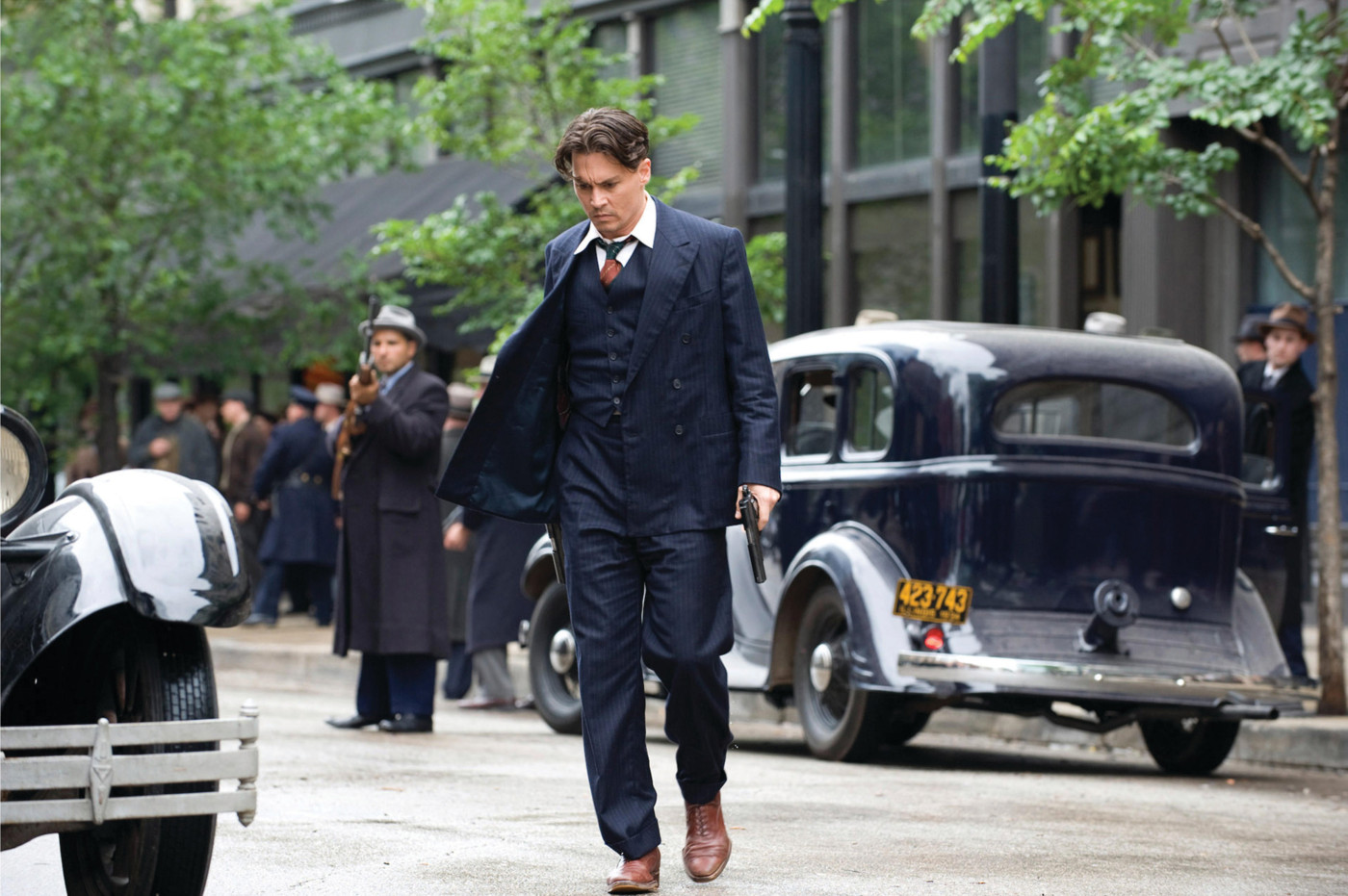
The difficult trick is to make John Dillinger somehow appealing  or, at the very least, interesting  without sanitizing one of America's most notoriously vicious criminals.

Trust Johnny Depp to unerringly walk that extremely fine line.
Judging by Johnny Depp's portrayal of John Dillinger in this film, one would
think the notorious bank robber disliked killing people, and did so only with
great reluctance. History suggests otherwise, but Depp makes us believe that
this guy has a semblance of conscience.

Public Enemies, thanks to Depp's superbly nuanced performance as Dillinger, belongs in the company of Bonnie and Clyde, as one of Hollywood's great pop-culture portraits of American crime. Indeed, director Michael Mann's Public Enemies has much in common with Bonnie and Clyde, which was billed with the lurid tag line "They're young ... they're in love ... and they kill people."

Back in 1967, director Arthur Penn's unexpectedly gory crime saga was a trend-setter, foreshadowing the culture of violence that soon would pervade Hollywood. Its unsettling blend of casual brutality and glamorous star power  Warren Beatty and Faye Dunaway were "it" at the time  has been duplicated with equal panache by Mann, with the dazzling celebrity wattage handled just as effectively by Depp and co-star Marion Cotillard, fresh from her Academy Award win for La Vie en Rose.

Sadly, the violence in Public Enemies is nothing new, with bloody deaths by Tommy-gun a frequent occupational hazard for good guys and bad guys alike, as this narrative  scripted by Ronan Bennett, Ann Biderman and Mann, from the book by Bryan Burrough  moves inexorably toward Dillinger's well-known date with destiny at Chicago's Biograph movie theater on July 22, 1934.

Aside from Depp's excellent work, this film's distinctive style comes courtesy of Mann, who orchestrates the carnage with the same snap and panache that made 2004's Collateral such a visceral experience. The difference is that we don't really have a virtuous and principled protagonist to root for  Christian Bale's Melvin Purvis is a bit too chill to be sympathetic  although you'll no doubt need to resist that bewitching gleam in Depp's eye.

Alfred Hitchcock was famous for this ability to "trick" audiences into identifying with his many villains; we unconsciously wanted Robert Walker Jr. to reach the dropped cigarette lighter with which he planned to frame the hero in Strangers on a Train, just as we hoped Barry Foster would successfully pry his distinctive tie pin  which might identify him to the pursuing police  from the rigor-frozen fingers of his recent victim, in Frenzy.

Mann and Depp accomplish the same feat, as Purvis and his fellow FBI agents repeatedly close on Dillinger and his associates: Despite knowing Dillinger's eventual fate, we keep hoping that he'll survive this skirmish, and then that one, and then the next ... because, darn it, Depp makes the guy too interesting to lose.

Friday, May 22, 2009

Terminator Salvation: Big and bad

Terminator Salvation (2009) • View trailer for Terminator Salvation
3.5 stars (out of five). Rating: PG-13, for action violence and brief profanity
By Derrick Bang • Originally published in The Davis Enterprise, 5.22.09
Buy DVD: Terminator Salvation • Buy Blu-Ray: Terminator Salvation (Director's Cut) [Blu-ray]


The explosive action in Terminator: Salvation  which is relentless and, frankly, exhausting  comes in two flavors:

• Intimate and often deliciously creepy skirmishes between one or two civilians and a single human-sized robot (think of these as the classic "Schwarzenegger models");
While investigating Skynet's primary production facility, John Connor
(Christian Bale, left) and Kyle Reese (Anton Yelchin) fail to notice a rather
nasty surprise looming just behind them. And that's nothing to the shock Reese
would experience, if Connor were to explain the precise nature of their
relationship...

• Frankly ludicrous battles between clumps of civilians and massive land-based or airborne killing machines.

The former sequences deliver plenty of suspense and serve as pleasant reminders of what made 1984's Terminator and 1991's Terminator 2: Judgment Day such great action epics.

The latter, alas, appear to have been snatched from the upcoming Transformers sequel: diverting as live-action cartoon chases, but impossible to take seriously on any level. It's preposterous to believe that our puny and quite vulnerable heroes could outrun, outmaneuver and ultimate destroy any of these behemoths, let alone do so on a fairly regular basis.

To be sure, director McG (Joseph McGinty Nichol) and editor Conrad Buff do their best to prevent us from being bothered by such details. After a quiet and deliberately mysterious prologue, their film kicks into high gear and never lets up. The action scenes are well staged, and they make excellent use of production designer Martin Laing's vision of an apocalyptic, post-nuclear California.

Writers John Brancato and Michael Ferris also deserve credit for adhering so well to the increasingly confused continuity demanded by the time-travel elements of three previous films and a just-canceled TV series. Terminator Salvation expands upon established Terminator lore, while adding some reasonable extrapolations and even setting up the necessary "future" elements that will bring the action "back" to what we've already witnessed in the 1984 franchise-starter.

The downside, of course, is that this new film will be utterly incomprehensible to anybody not exceedingly well-versed in what has come before.