Showing posts with label Jennifer Lawrence. Show all posts

Friday, June 23, 2023

No Hard Feelings: Not so sure about that

No Hard Feelings (2023) • View trailer
Three stars (out of five). Rated R, for sexual content, graphic nudity, brief drug use and relentless profanity
Available via: Movie theaters
By Derrick Bang • Published in The Davis Enterprise, 6.23.23

Director Gene Stupnitsky’s bawdy entry can’t decide what it wants to be.


At times, it displays the energetic, no-holds-barred raunch typical of classics such as The 40-Year-Old VirginBridesmaids and There’s Something About Mary. A scrappy beach fight scene here is the stuff of cinema legend.


After an enjoyable day at the local boardwalk, Maddie (Jennifer Lawrence) is
delighted by the prize that Percy (Andrew Barth Feldman) has won for her.


But at other times we’re expected to empathize with the two primary characters as authentic people, with credible feelings and angst.

It’s almost impossible to achieve both goals; the former too frequently undercuts the latter … particularly given the mean-spiritedness of Stupnitsky and John Phillips’ script. The line between funny and cruel is very thin, and this film too frequently slides onto the wrong side.


Maddie Barker (Jennifer Lawrence), a longtime resident of the Long Island village of Montauk, is appalled by how incoming rich jerks have transformed her community. Rising property taxes are threatening the house in which she grew up, and which holds the memory of her late mother. Maddie’s jobs as bar maid and Uber driver no longer keep up with the bills, and — as this story begins — her car is repossessed by former short-term lover Gary (Ebon Moss-Bachrach).


Now reduced to getting around on roller skates, and lacking the additional Uber income, the situation rapidly becomes even more dire. Then Maddie is alerted to an unusual Craigslist job listing from wealthy helicopter parents seeking somebody to “date” their introverted 19-year-old son, and bring him out of his shell before he leaves for Princeton in the fall. The payment: a free Buick Regal.


The quotation marks around the word “date” are telling.


Although the set-up smells uncomfortably like pimping, Maddie is desperate … and pragmatic; her love life has been limited to a long string a short-timers and one-night stands. How different could this be?


She therefore arranges to meet Laird and Allison Becker (Matthew Broderick and Laura Benanti, both deadpan hilarious), who live in a cluelessly privileged world. Their son, Percy (Andrew Barth Feldman), has no friends, rarely leaves his room, and hasn’t learned to drive; his parents worry that Princeton will eat him alive.


Although their ad specified a woman in her “young 20s,” Maddie argues that her 32-year-old self is guaranteed to be “more sensitive” to the situation. (Lawrence is indeed 32.) Laird and Allison accept this rationale, and caution that Percy must never know about the arrangement. (Well, no kidding.) They explain that he volunteers at a local animal shelter, and suggest that Maddie visit as a potential dog adopter.


At which point, this film goes off the rails for the first time (and certainly not the last).

Friday, December 31, 2021

Don't Look Up: Profoundly unsettling, despite trying too hard

Don't Look Up (2021) • View trailer
3.5 stars (out of five). Rated R, for frequent profanity, sexual candor, graphic nudity and drug use
Available via: Netflix
By Derrick Bang • Published in The Davis Enterprise, 1.7.22

Ouch.


This is about as scathing an indictment of modern American behavior as can be imagined.


Hoping to share their dire and tremendously important discovery on national television,
Randall (Leonardo DiCaprio, center right) and Kate (Jennifer Lawrence, far right) little
realize they're about to be trivialized by hosts Brie (Cate Blanchett) and Jack (Tyler Perry).


Back in 2015, writer/director Adam McKay stunned us with The Big Short, a wildly entertaining and ferociously mocking blend of drama, quasi-documentary and break-the-fourth-wall cinéma vérité, in service of an economic crash course that brilliantly explained the upper-echelon machinations that drove our country off a financial cliff in 2007.

This time, McKay and co-scripter David Sirota set their sights much higher: the cognitive dissonance and blind stupidity that prompt so many Americans to deny the existence of climate change, safe covid vaccines, the results of the 2020 election, and a great deal more.


Willful ignorance runs rampant these days, which gives McKay and Sirota plenty to scream about. While quite a few of this film’s sarcastic bombs hit their target, Don’t Look Up isn’t as artistically tight as The Big Short, and I also miss that earlier film’s inventively cheeky directorial flourishes. Sarcasm and snark once again are in abundance, but McKay’s approach here is more dramatically conventional.


Perhaps that’s because the operative metaphor — and its real-world counterpart — are too sobering, too horrifying, for gleeful frivolity.


The Big Short was fun, whereas this one is deeply unsettling: mad-as-hell, take-no-prisoners storytelling.


Events kick off quietly, as university astronomy professor Randall Mindy (Leonardo DiCaprio) and grad student Kate Dibiasky (Jennifer Lawrence) discover a new comet orbiting our solar system. Their initial excitement dwindles when Kate and a gaggle of fellow grad students watch Randall compute the comet’s trajectory on a white board, to determine whether it’ll be visible when it passes Earth.


The film’s most grimly impactful wallop occurs right here, as Randall — fully absorbed by complex mathematical equations — initially fails to register the implication of the zero he has just written on the board. DiCaprio sells this moment: Randall hesitates, starts to shake his head, knows he hasn’t made a mistake … but nonetheless erases the zero and empties the room. Except for Kate.


Computing the dimensions of the comet is similarly easy. It’s the size of Mount Everest … and if — when — it strikes Earth, in just over six months, it’ll be a planetary extinction event.


Well.


Friday, June 7, 2019

Dark Phoenix: Better than average

Dark Phoenix (2019) • View trailer 
3.5 stars. Rated PG-13, for considerable sci-fi violence, disturbing images and fleeting profanity

By Derrick Bang

Comic book writers are notorious for adjusting, revising, reworking or even completely undoing the mythic back-stories and details of long-established characters. 

The spooky, otherworldly Vuk (Jessica Chastain, right) insists that she can help the
confused and increasingly overwhelmed Jean (Sophie Turner) control cosmic powers
that are literally off the chart. Naturally, Vuk's motivations are far less than pure...
Nothing is sacrosanct: not even death. If so-and-so perished nobly while saving the universe, s/he can be resurrected five years later via some previously undisclosed loophole. (If all else fails, rely on time travel.)

Putting up with this is difficult enough with comic books, but at least such contrived and manipulative nonsense can be “justified” during multiple issues over the course of many months.

It’s a lot more disconcerting when the newest X-Men entry — Dark Phoenix — makes absolute hash of the continuity established in previous films … or so it seems. Apoplectic fans sputtering “But … but … but!” are advised to pay closer attention to what went down in 2014’s X-Men: Days of Future Past.

Which is how writer/direct Simon Kinberg gets away with the jaw-dropper that hits during this new film’s second act.

It also kinda/sorta justifies — albeit with an eyebrow lift — this film’s more-or-less replication of events already covered in 2006’s X-Men: The Last Stand. Both are based on the iconic Chris Claremont/Dave Cockrum/John Byrne “Dark Phoenix Saga,” which played out in comic book form from 1976 to ’80 (back when only one X-Men comic book hit the stands each month, and boy, those were simpler times).

At its core, this is a common superhero plot device: What happens when a good hero turns bad?

Having proven themselves heroic after events in 2016’s (thoroughly unsatisfying) X-Men: Apocalypse, Professor Charles Xavier (James McAvoy) and his mutant students happily bask in the unaccustomed glow of public acclaim. Charles has a direct line to the U.S. president; children eagerly purchase dolls and other ephemera related to their favorite X-Man … or X-Woman, as the shape-shifting Raven (Jennifer Lawrence) tartly suggests should be the team’s actual designation, given how frequently the gals save the day.

That’s no mere idle comment. Female characters are front and center in this film, and it’s darn well about time.

Friday, March 2, 2018

Red Sparrow: Flies high

Red Sparrow (2018) • View trailer 
Four stars. Rated R, for strong violence, torture, graphic nudity, profanity and sexual content

By Derrick Bang

Red Sparrow has the crisp, nefarious and extremely nasty verisimilitude of actual spycraft, and with good reason; it’s based on a 2013 novel by Jason Matthews, who spent 33 years with the CIA’s Directorate of Operations, where — as acknowledged in a 2015 New York Times interview — he recruited and managed foreign agents, “often in places where such activity was forbidden.”

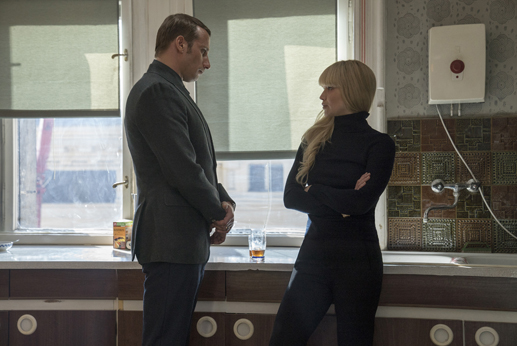
Having endured a regimen of vile and debasing treatment while at a specialized spycraft
school, Dominika (Jennifer Lawrence) now feels nothing but contempt for her
Uncle Vanya (Matthias Schoenaerts), who she once naïvely assumed wanted
only the best for her.
Justin Haythe’s screenplay adaptation has the slow burn of a complex John Le Carré espionage thriller, which must please Matthews, a fan of both that author and Ian Fleming. Frankly, I’m astonished; Haythe has no obvious experience with spy thrillers, and is most recently known for junk such as The Lone Ranger and the execrable A Cure for Wellness. It’s nice to see this significantly more polished side.

Austrian director Francis Lawrence obviously has developed a rapport with star Jennifer Lawrence, having helmed her final three Hunger Games outings. Red Sparrow is far more serious stuff: a thoroughly absorbing saga of regret, duplicity and reprehensible manipulation, set in a clandestine zone of prickly, real-world geopolitics.

Matthews must be congratulating himself for prescience: Such scheming cloak-and-dagger stuff seems even more credible now, at a time when Russia’s destabilizing activities have become daily front-page news.

Lawrence stars as Dominika Egorova, a talented member of the Bolshoi Ballet, introduced as she takes the stage for a standard performance (if anything done by Bolshoi dancers can be considered “standard”). Francis Lawrence cross-cuts from these scenes to others involving the late-night exchange of information between deep-cover CIA operative Nate Nash (Joel Edgerton) and a mole buried deep within upper-level Russian security operations.

Both sequences go awry. Dominika suffers an on-stage accident that destroys her career — an early, horrifying example of this film’s willingness to shock — while Nate’s meeting is exposed by the chance arrival of Russian police officers.

For Dominika, it’s a shattering, end-of-the-world catastrophe, and not merely because she spent her entire childhood training to be a dancer. She’s the only child of an invalided single mother (Joely Richardson) to whom she is devoted, and whose care — and the reasonably nice apartment in which they live — have been funded by her Bolshoi career.

Salvation — if it can be termed thus — comes from Dominika’s Uncle Vanya (Matthias Schoenaerts), who has kept a protective gaze on his deceased brother’s family. But Vanya’s interest is far from benign; his “solution” to Dominika’s plight involves drawing her into his realm of spycraft, with the specific goal of molding his niece into a seductress able to corrupt Westerners into betraying their country.

Hardly a healthy attitude for an uncle to have about his only niece.

Friday, September 15, 2017

Mother! — A nauseating miscarriage

Mother! (2017) • View trailer 
No stars (Turkey). Rated R, for strong and disturbing violent content, sexuality, nudity and profanity

By Derrick Bang • Originally published in The Davis Enterprise, 9.15.17

I never would have believed that the same calendar year could produce another mainstream film as self-indulgently loathsome as February’s A Cure for Wellness.

Actually, this one’s worse.

As her companion (Javier Bardem) inexplicably tolerates the intrusive presence of ever
more strangers in their huge home, our increasingly helpless heroine (Jennifer
Lawrence) wonders — and worries — where it'll all end.
Darren Aronofsky has pushed the borders of good taste — and any semblance of rational narrative structure — ever since 2000’s Requiem for a Dream. When tethered to somebody else’s (reasonably) coherent script — as with The Wrestler and Black Swan — his worst tendencies remain checked. He also can be a gifted actor’s director, having guided stars to Academy Award nominations and victories.

But when Aronofsky directs and writes ... look out.

Case in point: Mother!

Whether allegory, parable or primal scream, this blast of wretched excess is overwrought, insufferably distasteful and — once we reach the dog-nuts third act — vile beyond words. This abomination is guaranteed to enrage patrons into demanding refunds, after which they’ll stumble home, scarred for life, and in desperate need of a shower. And a means to sterilize their brains.

Alas, some things can’t be unseen.

On top of everything else, Aronofsky is guilty of stretching facile symbolism way past sustainability. Mother! might’ve made a decent 25-minute short subject; as a 121-minute assault on viewer sensibilities, it’s an exercise in mind-numbing overkill.

I carefully avoid spoilers, because even bad movies — well, most of them — deserve a chance to impress or surprise. But there’s simply no way to discuss Mother! without revealing Big Secrets. For which I apologize, in advance.

No characters are named. Our heroine (Jennifer Lawrence) shares an imposing mansion — isolated in a field, surrounded by a forest, far from any semblance of civilization — with her husband/lover/keeper (Javier Bardem). The place is a fixer-upper; she paints, plasters walls, handles plumbing and wood-working chores. She has been working thusly for quite some time, essentially re-building what had been a fire-gutted ruin.

He’s a poet, suffering the damnation of writer’s block. She’s patient, sympathetic, nurturing. She prepares his meals, encourages him to try, try again.

Friday, December 23, 2016

Passengers: A bumpy ride

Passengers (2016) • View trailer 
3.5 stars. Rated PG-13, for dramatic intensity, sexuality and brief chaste nudity

By Derrick Bang • Originally published in The Davis Enterprise, 12.23.16

Science-fiction authors figured this out a long time ago: Trans-galaxy “sleeper ships” need functioning human crew members — in some cases, generations of same — in order to handle the dire emergencies that inevitably occur.

Trying to make the most of a bad situation that seems likely to last for the rest of their
lives, Jim (Chris Pratt, center) and Aurora (Jennifer Lawrence) briefly distract
themselves by chatting with an amiable android bartender (Michael Sheen).
That said, and given a current corporate climate that values human life on a par with plumbing fixtures, I’m willing to believe that a huge colony transport would be sent to its light-years-distant destination with 5,000-plus hibernating passengers, monitored solely by ship-wide computers. Cost-efficiency, y’know. Don’t want to waste all the money and resources necessary to feed and house attentive crewmembers.

Passengers is an old-style sci-fi pulp adventure constructed with top-drawer, 21st century movie-making pizzazz. The latter does its best to obscure the hoary melodramatic clichés that run rampant through Jon Spaihts’ original screenplay; for the most part director Morten Tyldum delivers an engaging outer space escapade, with enough momentum to keep viewers entertained.

That’s assuming we can forgive an eye-rolling climax on par with Chief Engineer Montgomery Scott, back in the days of TV’s original Star Trek, shouting “Ya canna change the laws of physics ... she’s gonna blow!”

Actually, that’s the lesser of the two key issues that must be overcome in Spaihts’ script. The first is a major plot point, and a deliberate moment of character development; based on the reactions from Monday evening’s preview audience, some viewers won’t be able to get past the moment in question.

All of which I hint at with deliberate vagueness; this film builds suspense by slowly teasing its various revelations.

Our first glimpse of the space-bound Avalon is appropriately awesome, the huge ship’s rotating drive system and passenger quarters protected by a forward-mounted shield array, slowly crossing the screen in an introductory scene that evokes fond memories of the similar first view of the Discovery, from 2001: A Space Odyssey. Visual effects gurus Erik Nordby and Greg Baxter have fabricated a golly-gosh magnificent vessel: equal parts opulent luxury liner and bad-ass interstellar convoy craft.

The autonomous shields precisely deflect all stray space debris, until — giving us barely enough time to absorb the vessel’s splendor — encountering an asteroid field surrounding a daunting, moon-sized body. The shields hold, but the impact nonetheless resonates.

Friday, May 27, 2016

X-Men: Apocalypse — Thud and blunder

X-Men: Apocalypse (2016) • View trailer 
2.5 stars. Rated PG-13, and quite generously, for gratuitously fleeting profanity and distasteful, soul-crushing violence

By Derrick Bang


Enough, already.

Things were bad enough last summer, when Avengers: Age of Ultron gave us characters capable of re-shaping reality, along with a celestial scheme to return Earth to its Ice Age. Hollywood’s apparent need for superhero movies that forever increase the sense of scale — like a junkie craving ever-stronger fixes — was plain outta control.

When Charles Xavier (James McAvoy, center) is alerted to the presence of an ultra-
powerful mutant, he and his comrades — from left, Raven (Jennifer Lawrence), Moira
Mactaggert (Rose Byrne), Alex Summers (Lucas Till) and Hank McCoy (Nicholas Hoult) —
try to determine how best to find this entity.
This newest X-Men entry is even worse, with a villain who literally can re-shape the planet according to whim: a level of power so off the chart that the very notion of this guy being stopped by anybody, let alone young and largely untested mutant heroes, is simply ludicrous.

What, I wonder, could be next? A baddie who’ll pull the Moon out of its orbit? Destroy Saturn and her rings? Extinguish our sun? Annihilate entire galaxies?

It’s impossible to care about any of this film’s sturm und drang, because its screenplay — credited to Simon Kinberg, Michael Dougherty, Dan Harris and director Bryan Singer — doesn’t spend enough time with character development. Worse yet, the little we do get is needlessly grim and mean-spirited: the same problem of tone that infected Batman V Superman a few months back.

The early X-Men films were entertaining by virtue of the wary ensemble dynamic that united such radically different characters into a team, and for the way that everybody’s strange and weird powers were blended into a cohesive fighting unit. That camaraderie is all but lost in this smash-fest, which instead revels in an arrogantly callous level of civilization-snuffing carnage that I’ve not seen since the distasteful 2012, which depicted mass death with all the gravitas of a pinball machine.

Singer’s tone is about the same here, with John Ottman’s bombastic score adding even more portentous fury. And just to seal that atmospheric deal, Ottman’s original themes are augmented, at (ahem) apocalyptic moments, by the equally dour second movement (“Allegretto”) of Beethoven’s Symphony No. 7.

Not much fun to be had, all told, in this 143-minute endurance test.

Friday, December 25, 2015

Joy: Not quite enough of it

Joy (2015) • View trailer 
3.5 stars. Rated PG-13, for fleeting profanity

By Derrick Bang • Originally published in The Davis Enterprise, 12.31.15


Few stories are more engaging than rags-to-riches empowerment sagas.

Particularly when they’re (somewhat) true.

Joy (Jennifer Lawrence, center) is astonished, and angered, when she discovers the
degree to which her half-sister Peggy (Elisabeth Röhn) has betrayed her ... a
transgression that their father, Rudy (Robert De Niro), blandly tolerates.
Writer/director David O. Russell’s third collaboration with star Jennifer Lawrence is based loosely on the astonishing life of American inventor/entrepreneur Joy Mangano, whose career arc is just about the best modern Horatio Alger story one could imagine.

Unfortunately, Russell has mucked it up a bit, by surrounding his leading lady with a motley crew of supporting characters, some of them just-plain-weird burlesques who belong in an entirely different film.

As was the case with Russell’s American Hustle — which sorta/kinda depicted what went down during the FBI’s late 1970s/early ’80s Abscam sting — the telling here is more “interpretive” than literal fact. Thanks to this wealth of oddly eccentric characters, at times the heightened tone feels like the off-kilter universe we’d expect in a Coen brothers movie (particularly Fargo).

But the key elements in Russell and co-plotter Annie Mumolo’s story are authentic, and the film is fueled by another powerhouse performance from Lawrence. If Joy ultimately lacks the exhilarating pizzazz of American Hustle and Silver Linings Playbook, it’s not for lack of effort on her part. It’s more a case of the various thematic elements not coalescing quite as successfully, and some of the characters being too off-balance.

I’m also not happy with the clumsy narrative device. The story is introduced and occasionally punctuated by off-camera commentary from our heroine’s grandmother Mimi (Diane Ladd), speaking from a not-too-distant remove. Although her remarks smooth a few of the flashback transitions, for the most part this gimmick is superfluous, even bothersome.

A brief prologue introduces Joy as a little girl (played here by Isabella Crovetti-Cramp), with imaginative sparkle; she’s the sort of kid who builds her own little worlds with scissors, tape and construction paper.

It’s likely part defense mechanism, as the home environment is tempestuous. Her father, Rudy (Robert De Niro), flits from one woman to the next; he also has anger-management issues, although his occasional rages never are directed at Joy or her half-sister Peggy (Madison Wolfe).

Friday, November 21, 2014

The Hunger Games: Mockingjay, Part 1 — Fails to catch fire

The Hunger Games: Mockingjay, Part 1 (2014) • View trailer 
Three stars. Rated PG-13, for violence, disturbing action and dramatic intensity

By Derrick Bang • Originally published in The Davis Enterprise, 11.21.14

As was true of its two predecessors, this newest big-screen installment in the Hunger Games franchise follows its source quite closely.

Which, in this case, isn’t a good thing.

When Katniss (Jennifer Lawrence, foreground right) agrees to check on the injured civilians
in a District 8 hospital, she's joined by, from left, Commander Paylor (Patina Miller) Gale
(Liam Hemsworth), Boggs (Mahershala Ali) and Pollux (Elden Henson).
Suzanne Collins’ third novel is gawdawful: a complete betrayal of her characters, and of her readers. I can’t imagine what the author was smoking when she wrote it, but this much is obvious: Her heart wasn’t in it, and — in hindsight — she should have quit after the first one.

My sympathies therefore lie with scripters Peter Craig and Danny Strong, tasked with making a cinematic silk purse out of this sow’s ear of a book. With credits such as The Town, Game Change and Lee Daniels’ The Butler, they seem an odd choice to craft a post-apocalyptic narrative that spends so much time inside the head of a strong and resourceful young woman, which may explain why Katniss Everdeen is such a mess in this film.

Not even Jennifer Lawrence, who aside from her considerable talent certainly knows this character by now, can persuasively deliver the frankly ludicrous emotional arcs demanded by this storyline.

On top of which, this film suffers the problem that plagued the penultimate Harry Potter film. Both J.K. Rowling’s The Deathly Hallows and Collins’ Mockingjay save most of their action for the second half, limiting the first portions to sidebar exposition and increasingly melodramatic angst.

If Hollywood, in its cynical desire to wring as much money as possible from these franchises, chops each final book in half, we’re therefore tormented with a two-hour film “teaser” that accomplishes ... almost nothing. Harry Potter 7.1 was a yawn: a time-filler that should have been subtitled Harry and Hermione Go Camping.

Hunger Games 3.1, in turn, should be dubbed Katniss Has a Good Cry. Repeatedly.

It’s not that Katniss doesn’t deserve an emotional collapse; goodness knows, she has been through a lot during the year-plus covered by the first two books (and films). But it’s distressing to see a character who initially impressed us as a resourceful fighter, suddenly transformed into a near-helpless victim who gets acted upon.

Granted, Katniss is destined to regain her spunk as things continue, but that’s a discussion for next year’s Hunger Games 3.2.

Meanwhile, we’re stuck with this one.

Friday, May 23, 2014

X-Men: Days of Future Past — One for the ages

X-Men: Days of Future Past (2014) • View trailer 
Four stars. Rated PG-13, for nonstop action violence, considerable grim content and brief profanity

By Derrick Bang • Originally published in The Davis Enterprise, 5.23.14

This one cooks.

The X-Men film series has earned high marks from its debut back in 2000, notwithstanding the frustrating rival studio issues that prevent these characters from operating within the larger tapestry of the “Marvel Universe” project that includes Iron Man, Thor, Captain America and the Avengers.

After learning that black-ops types plan to conduct dangerous — even lethal — medical
experiments on some helpless mutants, a furious Raven (Jennifer Lawrence, second
from right) gets quite irate with the goons responsible, while helping the others escape.
Director Bryan Singer got Marvel’s “merry mutants” off to an excellent start with the first two films, and he returns here, batteries fully charged, for a rip-snortin’ adventure that satisfies on every level.

Longtime comic book fans, who’ve followed these characters since their debut back in September 1963, can point to three periods of writer/artist genius during the series’ half-century history. Old-timers still cite the Roy Thomas/Neal Adams run, despite its brevity, as the highlight of 1969 and early ’70. The subsequent generation scoffs at that choice, pointing instead to the bravura Chris Claremont/Jim Lee run from 1989 through ’91.

In between, though, we enjoyed four years of greatness from late 1977 through early ’81, thanks to Claremont’s imaginative stories and artist/co-author John Byrne’s artwork. And that run produced a two-parter, “Days of Future Past,” which remains one of the all-time best comic book stories, anywhere ... not to mention one of the most ingenious time-travel narratives ever concocted (and cited as such in a recent issue of the British pop culture magazine SFX).

Fan reaction was guarded, when word broke that this new X-Men film would adapt that classic tale. Doing it justice would be difficult enough; carefully sliding it into the big-screen mythos already established by the first three films and 2011’s X-Men: First Class, even harder. Screenwriters Simon Kinberg, Jane Goldman and Matthew Vaughn therefore deserve considerable credit, because they pulled it off. And then some.

Failing to give Claremont and Byrne a “story by” acknowledgment, however, is utterly indefensible. And I rather doubt that Claremont was mollified by his eyeblink cameo.

To a degree, this film also has been shaped by the wattage of its primary stars, most notably Jennifer Lawrence, who has become huge since first playing the shape-shifting Raven/Mystique in First Class. Hugh Jackman’s ultra-cool Wolverine also is front and center, as are James McAvoy’s angst-ridden Charlie Xavier and Michael Fassbender’s smoothly malevolent Erik Lehnsherr/Magneto.

But wait, I hear you cry. Patrick Stewart and Ian McKellen also appear in this adventure ... and aren’t they also Xavier and Magneto?

Well, yes ... and that’s the nature of time-travel stories. Done properly, we get to eat our cake, and have it, too. And this is one tasty treat.

Tuesday, December 24, 2013

American Hustle: Delectable con job

American Hustle (2013) • View trailer 
Four stars. Rating: R, for pervasive profanity, sexual candor, fleeting nudity and brief violence

By Derrick Bang • Originally published in The Davis Enterprise, 12.24.13

Why can’t more movies be this exhilarating?

Wait, I know ... we need bad movies to remind us just how much fun the good ones can be.

Knowing that their scheme has expanded to include the involvement of a particularly
nasty organized crime boss, Irving (Christian Bale, left) and Sydney (Amy Adams) try
to quell their nervous tension prior to a crucial meeting. Their FBI handler, Richie
(Bradley Cooper), on the other hand, isn't smart enough to realize how dangerous
their work is about to become.
David O. Russell has matured into an intoxicating director: one who plans and executes his films with the joie de vivre of a master choreographer. His flawed characters radiate the barely concealed desperation of people clinging to their own emotional wreckage, forever seeking the means to their salvation: some elusive Next Best Thing.

In The Fighter, it was a pro boxing title shot; in Silver Linings Playbook, a much more modest dance contest. In both cases, we rooted for these people despite their serious shortcomings; heck, celebrating the rise of the underdog is part of the American credo. Besides, how could one not adore Micky and Charlene (Mark Wahlberg and Amy Adams) in The Fighter, or Pat and Tiffany (Bradley Cooper and Jennifer Lawrence), in Silver Linings Playbook?

In each case, the combination of street savvy and emotional vulnerability was irresistible. That Pat and Tiffany also were mentally unstable just made them more worthy of redemption.

And so it is with the folks at the heart of American Hustle. They likely aren't worth redemption, at least not in the legal sense, but we can’t help admiring the moxie of these unrepentant criminals, larcenous chutzpah and all. And Russell imbues this film — every scene, every conversation, every frame — with the same exhilarating rush that these protagonists employ to con their marks into some very bad behavior.

American Hustle is loosely based on the real-world FBI Abscam sting that went down in the late 1970s and early ’80s. The movie began life as a script by Eric Singer that made the 2010 Hollywood “Black List” of best as-yet-unproduced screenplays. Singer’s much more factual approach focused on Mel Weinberg, the con artist employed by the FBI to orchestrate the sting that eventually resulted in the conviction of one U.S. senator, six members of the U.S. House of Representatives and a New Jersey state senator, along with other lesser officials.

Ben Affleck briefly considered Singer’s script as a follow-up to The Town, but Russell eventually brought the project to fruition. In the process, Russell modified Singer’s material in order to assemble a roster of fictionalized caricatures, no doubt feeling that an operation as wildly audacious as Abscam needed some equally colorful participants. And, so, the core details here remain accurate — the nature of the operation, the eventual convictions — but the players are, well, brazenly impudent social misfits. At best.

Friday, November 23, 2012

Silver Linings Playbook: A heart of gold

Silver Linings Playbook (2012) • View trailer
Four stars. Rating: R, for sexual candor, brief nudity and relentless profanity
By Derrick Bang • Originally published in The Davis Enterprise, 11.23.12


Mental illness isn’t funny, and — thankfully — Hollywood has matured past the point of believing otherwise; standard-issue “loony-bin comedies” have gone the way of lovable drunks. When cinema tackles the topic these days, it’s generally with warmth and compassion, as with (for example) Adam and The Soloist.

Although Tiffany (Jennifer Lawrence) agrees to help Pat (Bradley Cooper) win back his
ex-wife, this assistance comes at a price: Pat must agree to train with Tiffany for an
upcoming dance competition. Needless to say, this is not an endeavor with which
Pat feels comfortable...
But every individual’s life is equal parts hilarity and heartbreak, which also goes for people battling emotional disorders. The key is to craft a story that acknowledges but doesn’t exploit the situation, at which point we can comfortably laugh with, and not at, the characters; the marvelous Benny & Joon is an excellent example.

All of which brings us to Silver Linings Playbook, directed and scripted by David O. Russell (The Fighter, Flirting with Disaster), and based on Matthew Quick’s debut 2008 novel. Russell’s cinematic approach can be quite eclectic, and he has a tendency to drift toward the heightened wackiness of Wes Anderson, but with lesser results; happily, Russell mostly eschews such tendencies here.

At first blush, his approach to Silver Linings Playbook is as tense, jittery and nervous as its badly damaged protagonist, Pat Solatano (Bradley Cooper), whom we meet as his mother (Jacki Weaver, as Dolores) checks him out of a state institution. The details emerge gradually; Pat’s eight-month stay resulted from a plea bargain that kept him out of jail after he came close to beating a man to death (with cause, it might be argued).

Pat has anger management issues, which is blindingly obvious from the moment we lay eyes on him. He grew up with undiagnosed bipolar mood swings, somehow holding things together long enough to finish school, obtain a teaching credential and marry ... but then the inner demons became too much.

Now, as we confront Pat’s manic ups and downs — Cooper so explosively forceful, so potential dangerous, that we can’t take our eyes off him — his mother’s optimistic decision to bring him home seems naïve, perhaps even hazardous. We sweat every scene, wondering if Pat will go off like a time bomb.

Pat is the worst-case scenario: perceptive enough to recognize that the meds that control his symptoms also diminish his ability to experience any joy. He’s required by law to take the meds — a condition of his release — but he doesn’t want to, because he knows that he loses himself. He prefers, as a result, to rely on a daily regimen of mental and physical exercise that seeks the “silver lining” in any given situation.

Sunday, March 25, 2012

The Hunger Games: A heroine for the ages

The Hunger Games (2012) • View trailer
3.5 stars. Rating: PG-13, for violence and dramatic intensity, all involving teens
By Derrick Bang • Originally published in The Davis Enterprise, 3.25.12


First, the crucial issue: Jennifer Lawrence is Katniss Everdeen. Every physical characteristic, every delicately shaded emotional nuance.

It’s as if Lawrence stepped off the pages of Suzanne Collins’ novel.

Katniss (Jennifer Lawrence, right) watches footage from previous Hunger Games
bouts, hoping to learn from the successes — and failures — of her predecessors,
while her disillusioned mentor, Haymitch (Woody Harrelson), and the effete
Effie (Elizabeth Banks) carefully guard their own thoughts.
This comes as no surprise, to those who were mesmerized by Lawrence’s Oscar-nominated performance in 2010’s Winter’s Bone. That unflinching, Ozark mountains girl possessed the same blend of stubborn, often foolish courage and troubled vulnerability, the latter emerging only when she thought nobody was looking.

Even then, when the film adaptation of Collins’ The Hunger Games was just an anticipatory gleam in Hollywood’s eye, savvy observers knew that the big-screen Katniss had been found.

Lawrence embraces this role — one of the early 21st century’s most iconic young female characters, alongside Lisbeth Salandar and Bella Swan — and makes it her own. She is, even during her quiet moments, so much more interesting than Kristen Stewart’s pouty, bland and detached handling of Bella, in the increasingly disappointing Twilight film series. Even though Bella is — should be — the focus of those stories, Stewart inevitably is the least interesting figure on camera.

Not so with Lawrence, who owns this adaptation of The Hunger Games.

Gary Ross — a sharp writer (Big, Dave) who graduated to writer/director, with Pleasantville and Seabiscuit — has made an honorable adaptation of Collins’ enormously popular novel. This screen interpretation is faithful in much the manner of the early Harry Potter films: All the essential plot elements make it to the screen; all the characters are deftly cast, and play their roles persuasively.

Production designer Philip Messina has done a smashing job with the various settings, from the hard-scrabble mining community that Katniss calls home, to the opulent, cruelly ornamental capital of this alternate reality, where decadent, self-absorbed aristocrats gambol without giving a thought to the deprived, desperate 99 percent.

(Make no mistake: Ross — sharing scripting credit with Collins and Billy Ray — doesn’t miss this obvious opportunity for a pointed jab at our rapidly widening, real-world class divide.)

Costume designer Judianna Makovsky does an equally fine job, particularly with the horridly colorful outfits worn by the mindless, oblivious Effie Trinket (Elizabeth Banks). And literally dozens of make-up artists and hair stylists work similar miracles, re-creating the hilariously outrageous fashions sported by the patrician jet-set.

You probably sense, gentle reader, that I’m building up to a “but” ... and, indeed, I am. We’ll get to that in a bit.