Showing posts with label Marion Cotillard. Show all posts

Friday, November 25, 2016

Allied: Does love bind?

Allied (2016) • View trailer 
3.5 stars. Rated R, for violence, profanity, fleeting nudity and brief drug use

By Derrick Bang • Originally published in The Davis Enterprise, 11.25.16


At first blush, this feels like an old-style WWII espionage drama of the sort whose absence is lamented by longtime moviegoers — such as my parents — who often grouse that They Don’t Make ’Em Like This Anymore.

Shortly after adopting his cover identity as the devoted husband of Marianne (Marion
Cotillard), Max (Brad Pitt) fears that he may have been recognized by a Nazi officer: a
potential catastrophe that requires a quick solution...
Given the French Moroccan setting, stars with the wattage of Brad Pitt and Marion Cotillard, and a swooningly romantic script that even name-checks Casablanca, one almost expects Bogie and Bacall to come strolling in from the surrounding desert.

Steven Knight is a terrific screenwriter, with solid experience in the crime and espionage genres; his highlights include 2002’s Dirty Pretty Things and 2007’s Eastern Promises. No surprise, then: He delivers a corker of a first act for Allied, and then swings the plot into an unexpected direction that cranks up the suspense.

Unfortunately, things get messy during an contrived third act, which piles eye-rolling coincidence atop unrealistic behavior, the latter from characters who’ve previously been depicted as far too intelligent, to suddenly turn brainless. Cut to a positively eye-rolling epilogue, and the film squanders the considerable good will that it has built.

Seriously, Steven ... what were you thinking?

In fairness, such climactic, over-the-top melodrama also is old-school, so Knight and director Robert Zemeckis obviously knew precisely what they were doing. I’m simply not sure that today’s savvier viewers will be as willing to forgive such theatrical excess, as was the case back in the 1940s and ’50s.

And it’s a shame, because the first 90 minutes are thoroughly compelling, and — yes — luxuriously atmospheric.

The year is 1942, and the film opens as Canadian airman Max Vatan (Pitt) parachutes into the desert outside of Casablanca. His emergency mission, orchestrated by the British Special Operations Executive (BSOE): to assassinate Germany’s visiting ambassador. The groundwork for this mission has been established by undercover French resistance fighter Marianne Beauséjour (Cotillard), who has spent weeks among her Nazi “friends,” waxing eloquent about the beloved husband soon to visit from Paris.

The handsome and affable Max looks and sounds the part ... to a point. As Marianne immediately notices, his carefully rehearsed accent is more Québécois than Parisian, which is a problem: French Moroccans wouldn’t know the difference, but he’d never fool Nazi officials who had spent any time in France.

Wednesday, December 16, 2015

Macbeth: Macawful

Macbeth (2015) • View trailer 
One star. Rated R, for strong violence and fleeting sexuality

By Derrick Bang

This is Shakespeare; I knew the guy had to die eventually.

Trouble is, even his death seemed to take forever. Like everything else in this dreadful film.

Fair is foul, and foul is fair ... except that everything about this turkey is foul, including any
sense of an actual relationship between Macbeth (Michael Fassbender) and his wife
(Marion Cotillard).
I’ve seen Macbeth at least a dozen times on stage, TV and the big screen, with the mad king played by the likes of Orson Welles, Jon Finch, Sean Connery (believe it or not, back in 1961) and Ian McKellen, the latter a Royal Shakespeare Company production with Judi Dench as Lady Macbeth (definitely a high point, in productions of “the Scottish play”).

Goodness, I’ve even watched Sam Worthington lumber about in a contemporary update of the play, set amidst criminal gangs in Melbourne (far from a high point).

Do a title search on Macbeth at the Internet Movie Database, and you’ll come up with 95 matches, with adaptations clocking in from — among other countries — Japan, Australia, Russia and India.

Look far and wide, though, and you’ll not find a big-screen Macbeth that is worse than what director Justin Kurzel has unleashed this holiday season. Rarely has this play — or any other — been presented with such plodding, ponderous dreariness, its crackling dialog reduced to monotonous speeches mumbled by actors apparently instructed to utter every line with a complete lack of involvement.

This is Shakespeare, for goodness’ sake; impassioned monologues and overwrought performances are de rigueur. Instead, we get an entire cast that behaves like extras from a George Romero zombie movie, which is to say the slow, shambling walking dead, marked by dull, vacant expressions.

Michael Fassbender and Marion Cotillard are exceptional actors; their Macbeth and Lady Macbeth should have leaped ferociously from the screen. Instead, for reasons known only to Kurzel, they hunch, cower and sulk, often standing motionless and staring into vacuous nothing, muttering their lines so softly, and with such little energy, that we often can’t even hear what they’re saying.

Which, perversely, could be a blessing. Students of Shakespeare will be appalled by the way scripters Jacob Koskoff, Michael Lesslie and Todd Louiso have butchered this play, committing artistic murders far more heinous than any of Macbeth’s on-screen blood-letting. Motivation and (ir)rational thought are abandoned, with far too many key events occurring seemingly at random.

Friday, March 20, 2015

Two Days, One Night: Every worker's nightmare

Two Days, One Night (2014) • View trailer 
Four stars. Rated PG-13, for dramatic intensity

By Derrick Bang • Originally published in The Davis Enterprise, 3.20.15


This one’s brutal.

Writer/directors Jean-Pierre and Luc Dardenne have uncorked an absorbing splash of cinema verité that is no less gripping for its low-budget origins: a working-class calamity that feels like it could happen to a friend, a neighbor ... or even you.

Having just learned that she has been voted out of a job by most of her own co-workers,
Sandra (Marion Cotillard, center) persuades the company owner (Baptiste Sornin) to hold
a second ballot. She now has two days, with the help of best friend Juliette (Catherine
Salée), to persuade a majority of their colleagues to change their minds.
The disturbing script is a sly update of classic psychological short stories such as Shirley Jackson’s “The Lottery,” or Richard Matheson’s “Button, Button.” Both explore the superficiality of morality and personal integrity: the point at which seemingly good people will cave, their ethics forgotten in the face of temptation, reward ... or fear.

The Belgian Dardenne brothers’ Deux Jours, Une Nuit (Two Days, One Night) revolves around a similarly ghastly quandary, in this case as it affects the victim.

We meet Sandra (Marion Cotillard), a working-class Belgian mother, just as she has completed a medical leave of absence. The cause remains unspecified, but clues point to a nervous breakdown of some sort; she’s clearly fragile, emotionally shattered. She’s resting at home, regaining her strength after (perhaps) her first day back at work on the production floor at Solwal, a small company that manufactures solar panels.

The phone rings, with grim news from her co-worker and best friend, Juliette (Catherine Salée). The company owner, Mr. Dumont (Baptiste Sornin), has decided that things have been almost as efficient during Sandra’s absence. Wanting to be “fair,” he has put the matter to a vote among Sandra’s blue-collar colleagues: If they agree to work harder in her continued — permanent — absence, each will receive a bonus of 1,000 Euros.

In other words, if they vote for the bonus, Sandra will be fired.

The vote goes 14 to 2, against. This is the news that Juliette — one of Sandra’s lone supporters — has just called to share, this late Friday afternoon.

Sandra is frantic; she and her husband, Manu (Fabrizio Rongione), need their combined incomes to meet mortgage payments on the home they’ve recently purchased, in a triumphant step up from public housing. It’s impossible to chart the profusion of emotions that cross Sandra’s face, as she tries to absorb what has happened, and the implications behind this catastrophe.

Cotillard earned a well-deserved Academy Award nomination for this role, and it’s easy to see why; she slips persuasively into Sandra’s skin. Because of both her performance and the script’s real-world honesty, we quickly forget that we’re watching a drama; it feels much more like a documentary. An awful one, at that.

Friday, July 20, 2012

The Dark Knight Rises: Opulent and ominous

The Dark Knight Rises (2012) • View trailer
Four stars. Rating: PG-13, and somewhat generously, for intense sequences of violence and action, along with some sensuality and fleeting profanity
By Derrick Bang • Originally published in The Davis Enterprise, 7.20.12


Unlike the cinematic Superman — always portrayed as the true-blue Boy Scout, as honorably American as baseball, motherhood and apple pie — Batman’s on-screen image has changed, depending on whose hand has pulled the strings.

After sneaking into Wayne Manor under false pretenses, and stealing
something from a concealed safe, Selina Kyle (Anne Hathaway)
believes that she has gotten away clean. Imagine her surprise, then,
when Bruce Wayne (Christian Bale) cuts in during a high society
dance and seems to know a great deal about her...
The 1960s Batman was known by his colorfully campy TV series; Tim Burton went operatic and kinky for the late 1980s re-boot.

A generation later, Christopher Nolan’s take on the dark night detective has focused on psychology: the seriously dysfunctional variety. Following the obligatory origin story in 2005’s Batman Begins, Nolan then explored the depths of depravity with 2008’s The Dark Knight. Nobody, but nobody, could fail to be mesmerized by the chilling, capricious evil represented by the late Heath Ledger’s magnificent portrayal of the Joker.

The Dark Knight also displayed a disturbing undertone, with its notion that regular folks, if backed into a corner and frightened badly enough, would squabble and tear out each other’s throats with the ferocity of mad dogs. Nobility, self-sacrifice and God’s grace are granted only to the shadowy warrior heroes of Nolan’s Gotham City; her civilians apparently don’t warrant such lofty virtues.

This is a dreadfully cynical view of humanity, although Nolan — along with frequent scripting collaborators David S. Goyer and Jonathan Nolan — made it play reasonably well in The Dark Knight. Ledger’s memorably scary presence was balanced by glimmers of the good and gentle, notably from Maggie Gyllenhaal’s Rachel, Aaron Eckhart’s Harvey Dent and Gary Oldman’s honest Police Commissioner Jim Gordon.

Surely, then, Nolan would move in a different direction for his wrap-up, with The Dark Knight Rises.

Well ... no.

This storyline is even more dystopian, its view of humanity even more depressing; Nolan and his same two collaborators have populated Gotham City with folks who apparently couldn’t survive without their superheroic totems, and probably don’t deserve to survive, regardless. When things get bad in this saga — and they get very, very bad — the common herd turns ugly and every bit as depraved as Ledger’s Joker.

I’ve always been an optimist, viewing the glass as half-full, when it comes to humanity’s behavior during a crisis; Nolan’s glass apparently is 7/8 empty. If this is his commentary on how the 99 percent would “handle” the 1 percent, we should be grateful he’s not likely to hold public office.

Friday, June 17, 2011

Midnight in Paris: Enchanted dream

Midnight in Paris (2011) • View trailer for Midnight in Paris
4.5 stars. Rating: PG-13, and needlessly, for mild sexual content
By Derrick Bang • Originally published in The Davis Enterprise, 6.17.11


Back in 1979, Woody Allen opened his film Manhattan with the following rhapsodic voice-over:

He adored New York City. He romanticized it all out of proportion. To him, New York meant beautiful women and street-smart guys who seemed to know all the angles. No matter what the season was, this was still a town that existed in black-and-white, and pulsated to the great tunes of George Gershwin.
The displaced Gil (Owen Wilson), already enchanted by his unexpected
surroundings, is further mesmerized by the coquettish Adriana (Marion
Cotillard), who guides him through a side of Paris that offers fresh surprises
from one moment to the next.

A bit more than three decades later, three minor swaps — the city so named, luxurious color for black-and-white, Cole Porter for George Gershwin — could have allowed the same soliloquy to apply to the deliriously romantic montage of images that kicks off Allen’s Midnight in Paris.

This is an idealized vision of Paris, much the way Manhattan was an idealized vision of New York: cinematic love letters to iconic cities with palpable heartbeats. The Paris of Allen’s new film doesn’t — can’t — really exist, any more than the similarly strawberry-lensed Paris of Jean-Pierre Jeunet’s 2001 masterpiece, Amélie.

Although Allen remains an astonishingly prolific filmmaker — 42 big-screen features to his credit, going back to 1966, with an even more impressive one per year, without fail, since 1982 — he hasn’t had a no-argument-about-it critical and popular hit since 1986’s Hannah and Her Sisters. That’s not to say he hasn’t done fine work since then — Radio Days, Crimes and Misdemeanors, Mighty Aphrodite and Vicky Cristina Barcelona immediately come to mind — but merely that such films aren’t likely to stand alongside his best.

Well, add another title to Allen’s list of classics, because Midnight in Paris is grand, glorious, witty fun ... and extremely sharp and savvy filmmaking.

Although the delectable conceit that fuels this story has echoes of Brigadoon and even Shakespeare’s A Midsummer Night’s Dream, Allen’s shrewdly clever script moves in an entirely different direction and takes a playful poke at folks who tediously — or naively — insist that things were much better “in the good ol’ days.” Indeed, Allen eats his cake and has it, too, by waxing poetically about the charms of times past ... while cautioning those who’d try to take up residence.

Gil (Owen Wilson) and his fiancée, Inez (Rachel McAdams) are vacationing in Paris while planning their upcoming wedding: an impending union of remarkably dissimilar sensibilities. Although a wildly successful Hollywood screenwriter, Gil chafes at the soulless emptiness of this career, and thus is trying to write a novel; he rather vaguely hopes that Paris will prove a proper environment for this effort. Inez, perfectly content with the largess that Gil’s income provides, wastes no opportunity to belittle or bluntly dismiss this new artistic goal. Gil tolerates her put-downs with good-natured calm, in part because he secretly worries that she may be right.

Friday, July 3, 2009

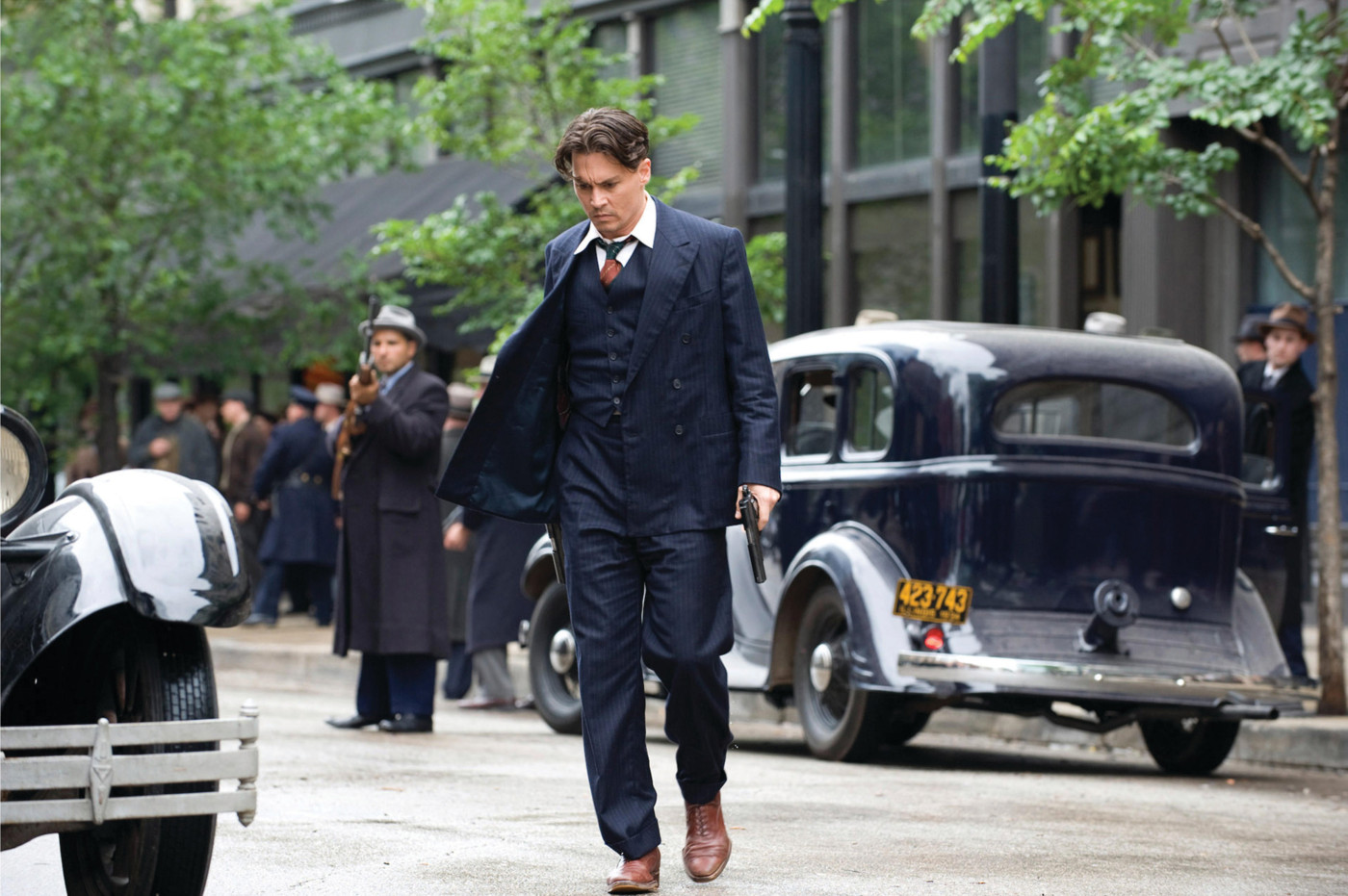
Public Enemies: Alluring villainy

Public Enemies (2009) • View trailer for Public Enemies
Four stars (out of five). Rating: R, for violence, profanity and brief nudity
By Derrick Bang • Originally published in The Davis Enterprise, 7.3.09
Buy DVD: Public Enemies • Buy Blu-Ray: Public Enemies (Special Edition) [Blu-ray]


The difficult trick is to make John Dillinger somehow appealing  or, at the very least, interesting  without sanitizing one of America's most notoriously vicious criminals.

Trust Johnny Depp to unerringly walk that extremely fine line.
Judging by Johnny Depp's portrayal of John Dillinger in this film, one would
think the notorious bank robber disliked killing people, and did so only with
great reluctance. History suggests otherwise, but Depp makes us believe that
this guy has a semblance of conscience.

Public Enemies, thanks to Depp's superbly nuanced performance as Dillinger, belongs in the company of Bonnie and Clyde, as one of Hollywood's great pop-culture portraits of American crime. Indeed, director Michael Mann's Public Enemies has much in common with Bonnie and Clyde, which was billed with the lurid tag line "They're young ... they're in love ... and they kill people."

Back in 1967, director Arthur Penn's unexpectedly gory crime saga was a trend-setter, foreshadowing the culture of violence that soon would pervade Hollywood. Its unsettling blend of casual brutality and glamorous star power  Warren Beatty and Faye Dunaway were "it" at the time  has been duplicated with equal panache by Mann, with the dazzling celebrity wattage handled just as effectively by Depp and co-star Marion Cotillard, fresh from her Academy Award win for La Vie en Rose.

Sadly, the violence in Public Enemies is nothing new, with bloody deaths by Tommy-gun a frequent occupational hazard for good guys and bad guys alike, as this narrative  scripted by Ronan Bennett, Ann Biderman and Mann, from the book by Bryan Burrough  moves inexorably toward Dillinger's well-known date with destiny at Chicago's Biograph movie theater on July 22, 1934.

Aside from Depp's excellent work, this film's distinctive style comes courtesy of Mann, who orchestrates the carnage with the same snap and panache that made 2004's Collateral such a visceral experience. The difference is that we don't really have a virtuous and principled protagonist to root for  Christian Bale's Melvin Purvis is a bit too chill to be sympathetic  although you'll no doubt need to resist that bewitching gleam in Depp's eye.

Alfred Hitchcock was famous for this ability to "trick" audiences into identifying with his many villains; we unconsciously wanted Robert Walker Jr. to reach the dropped cigarette lighter with which he planned to frame the hero in Strangers on a Train, just as we hoped Barry Foster would successfully pry his distinctive tie pin  which might identify him to the pursuing police  from the rigor-frozen fingers of his recent victim, in Frenzy.

Mann and Depp accomplish the same feat, as Purvis and his fellow FBI agents repeatedly close on Dillinger and his associates: Despite knowing Dillinger's eventual fate, we keep hoping that he'll survive this skirmish, and then that one, and then the next ... because, darn it, Depp makes the guy too interesting to lose.