Showing posts with label Ciaran Hinds. Show all posts

Wednesday, February 25, 2026

Is This Thing On? — A captivating ensemble piece

Is This Thing On? (2025) • View trailer
Four stars (out of five). Rated R for sexual candor, drug use and frequent profanity
Available via: Amazon Prime and other VOD options

Relationships, like laptops, sometimes need to hit Reset.


Director Bradley Cooper’s thoughtful, unhurried character study opens on a close-up of Alex Novak (Will Arnett), present solely in body, as a parent at a school activity being thoroughly enjoyed by a gaggle of kids that includes adolescent sons Felix (Blake Kane) and Jude (Calvin Knegten).


At one point, as their marriage unravels, Alex (Will Arnett) is surprised by the intensity
with which Tess (Laura Dern) angrily laments missing the happier, more
spontaneous person that he once was.

Alex scarcely pays attention, his head leaning against a wall, eyes staring into nonethingness, expression a blend of disinterest, resignation and helplessness.

He knows — as we soon learn — that this is the last such event he and wife Tess (Laura Dern) will attend as a couple. “This isn’t working,” they’ve mutually agreed ... “this” being the American dream of a home, two kids, two lovably large dogs (Charlie and Lucy) and a successful career (his days occupied by something “in finance”).


The unspoken middle-age crossroads finds them flailing.


Alex soon will move into an apartment, as a “trial separation,” but they haven’t told anybody yet: not their friends, not his parents, and certainly not their sons. This school event, followed by a regular game night with friends — Christine (Andra Day) and the aptly nicknamed Balls (Cooper); and Stephen (Sean Hayes) and Geoffrey (Scott Icenogle) — will be Alex and Tess’ final hurrah.


The group conversation is lively; Alex occasionally smiles and nods, but he clearly isn’t paying attention. He isn’t present in the moment. Cinematographer Matthew Libatique favors tight close-ups, which amplify Arnett’s vacuous, forlorn expression.


Balls — typically late to arrive, typically stoned — trips on a carpet coming in, dumping an entire carton of milk.


“Don’t cry over spilt milk,” Tess says (a line that’s a bit too on the nose). It becomes clear that her cheerfulness is a pose that occasionally evaporates, exposing ... something. Disappointment? Anger? Certainly not relief.


All this aside, during the next few days Alex and Tess are sensitive to their sons’ reactions and needs; both boys, in their feature acting debuts, deliver heartfelt and refreshingly natural performances under Cooper’s careful guidance.

Wednesday, December 27, 2023

The Family Plan: Amiable spyjinks

The Family Plan (2023) • View trailer
3.5 stars (out of five). Rated PG-13, for comedic action violence, brief sexual candor and fleeting profanity
Available via: Apple TV+

This one couldn’t be more ridiculous.


But it’s an enjoyable level of “silly,” which makes all the difference: perfect for a turn-off-the-brain Friday evening.


It's Vegas, baby! Only Dan (Mark Wahlberg, far left) knows why he has made this road
trip with the family — from left, baby Max (Iliana Norris), Jessica (Michelle Monaghan),
Nine (Zoe Colletti) and Kyle (Van Crosby) — but they're about to find out.


David Coggeshall’s larkish script is a far cry from the horror genre that has dominated his career until now. The premise here may be cliché in the realm of spy comedies, but he develops it well, and grants us an appealing set of characters. Director Simon Cellan Jones and editor Tim Porter maintain a reasonably brisk pace, although their two-hour film would be tighter with 10 to 15 minutes shaved off.

Even so, I didn’t mind the length.


Dan Morgan (Mark Wahlberg) has carved out a happy suburban life as a devoted husband and father of three children. He’s content in his career as a successful car salesman; he’s amiable and remarkably persuasive. The key word he’d use to describe his life is peaceful: no stress, no excitement, no grandiose desires.


The key word his family likely would use is boring. Wife Jessica (Michelle Monaghan), although happy, wouldn’t be bothered if Dan showed more ambition; teenagers Nina (Zoe Colletti) and Kyle (Van Crosby) roll their eyes at the day-to-day sameness.


Ten-month-old Max (Iliana Norris), cute as a button, isn’t old enough to be bothered.


Ah, but...


Sharp-eyed viewers may wonder, early on, why Dan takes such pains to avoid publicity. His caution goes up in smoke one day, thanks to a burst of unwelcome social media ... and suddenly he’s confronted by a hardened killer, while grocery shopping with Max strapped in a chest pouch.


This is each viewer’s make-or-break moment. If the resulting supermarket skirmish seems too silly — Dan doing his best to evade this thug, scrambling to improvise, while keeping Max out of harm’s way — then you may as well stop now. But if you’re able to roll with this cleverly choreographed fracas, what follows will be equally enjoyable.


(Frankly, I found it hilarious.)


Turns out Dan was an elite government assassin in his former life, tasked with eliminating the world’s deadliest threats. He racked up a sizeable stack of enemies in the process — most particularly the vengeful McCaffrey (Ciarán Hinds, suitably malevolent) — who now know where to find him.


Friday, March 4, 2022

Belfast: Deeply moving snapshot of a nation in crisis

Belfast (2021) • View trailer
Five stars (out of five). Rated PG-13, for violence and profanity
Available via: Movie theaters, Amazon Prime and other streaming services

Armed with an impressive seven Academy Award nominations, Kenneth Branagh’s riveting, semi-autobiographical drama has just become available via streaming services.


This is must-see cinema.


Buddy (Jude Hill, his back to camera) listens quietly while his mother (Caitriona Balfe),
grandmother (Judi Dench) and grandfather (Ciarán Hinds) explain what has been
happening in their neighborhood.


It isn’t easy to layer an era of chaos, tumult and danger with warmth and humor, and Branagh — who wrote the script, as well as directing — has done so sublimely. He wisely followed John Boorman’s lead, who in 1987’s Hope and Glory similarly depicted the horrors he experienced as a child in London during World War II.

In this case, Branagh’s quasi-surrogate self is 9-year-old Buddy, played with beguiling innocence and impishness by Jude Hill, in a stunning feature film debut. Because this story is viewed through Buddy’s experiences and imagination, Hill is in practically every scene, and he capably carries the film; he’s beyond adorable. 


Branagh extracts an amazingly accomplished and nuanced performance from this young lad. It’s a crime that he didn’t secure a Best Actor nod to accompany all the other well-earned nominations.


Cinematographer Haris Zambarloukos opens with an imposing, full-color overview of today’s Belfast. We then slide into a crowded, working-class pocket neighborhood; the image turns monochromatic as we’re whisked back to the summer of 1969. Children play merrily in the sun-dappled streets; adults chat amiably while walking to and from the little shops nestled in between row houses.


Everybody knows everybody else. When Buddy’s Ma (Caitriona Balfe) calls him in for tea, the message is passed along via children and adults until it finally reaches him. 


Then, suddenly, anarchy: An angry mob rounds a street corner like a swarm of maddened bees, laying waste to homes, shop windows, vehicles and anything else in their path … with a focus on Catholic families. It’s the opening salvo of the five-day political and sectarian violence that quickly spread through Ireland and led to the 30-year conflict dubbed “The Troubles.”


Buddy, terrified, stands frozen like a deer caught in headlights. We see the disconnect in his gaze; the boy cannot begin to comprehend the savage reality of what’s happening.


In that instant, his life — and that of his family, and everybody else — is altered. Forever. The calm of sociable neighborliness has been shattered, never to return; Catholic and Protestant families, once close friends, now eye each other warily. (Buddy and his family are Protestants.)


In the aftermath, streets are barricaded; watchers are posted 24/7. Buddy’s universe — this tiny portion of Northern Belfast — has become an artificial island.


Friday, October 12, 2018

First Man: A troubled landing

First Man (2018) • View trailer 
Three stars. Rated PG-13, and too harshly, for dramatic intensity and fleeting profanity

By Derrick Bang • Originally published in The Davis Enterprise, 10.12.18

Director Damien Chazelle and screenwriter Josh Singer jump into their film with an edge-of-the-seat sequence: the highest of solo pilot Neil Armstrong’s numerous test flights in the X-15 rocket airplane.

While Janet Armstrong (Claire Foy) putters in the kitchen, her husband Neil (Ryan Gosling)
and their elder son Rick (Gavin Warren) work on a jigsaw puzzle during a rare moment
of family bonding, unaware that a phone call is about to bring disturbing news.
It’s a savagely cut cacophony of images: the shuddering and jouncing aircraft; the roar of the rocket engines that blast Armstrong (Ryan Gosling) up to 207,500 feet; similarly jittery close-ups on his determined expression.

And then utter silence, as the engines switch off (intentionally) ,and Armstrong gets a panoramic view of the blue globe below, against the dark-night contrast at the edge of space.

Totally, amazingly breathtaking.

But that’s just the preamble. Armstrong’s return to Earth goes awry when the X-15 begins to “bounce” off the upper atmosphere, sending him even higher into the mesosphere above. Utter chaos, as he tries to compensate while mentally plotting a new landing spot, having zoomed past the planned touchdown at Edwards Air Force Base.

Like, wow.

First Man is laden with sequences even superior to this one, given a degree of verisimilitude — by visual effects supervisor Paul Lambert — wholly on par with the we-are-there reality viewers experienced while watching 2013’s Gravity. It becomes clear that Armstrong had more lives than a cat, and also possessed seat-of-the-pants math and physics calculating skills that made him just this side of a walking computer. (A good thing, too, given the limitations of 1960s mainframes.)

If only this film’s quieter moments were handled as well.

Singer’s script is adapted from James R. Hansen’s 2005 best-seller, First Man: The Life of Neil A. Armstrong, the pilot/astronaut’s only official biography. The film’s intimate “family” element takes place in between stunning piloting events that could be considered myth, were the details not so well known: the aforementioned 1962 X-15 flight, the 1966 Gemini 8 crisis, the 1968 mishap with one of the Earthbound Lunar Lander Research Vehicles, and — the reason for this film’s existence — the 1969 Apollo 11 mission.

Considerable time is spent with Armstrong’s home life, particularly early on, as he and his wife Janet (Claire Foy) agonize over the final months of their 2-year-old daughter, Karen, who died while being treated for a malignant tumor at the base of her brain stem. This is a lot to take in, so quickly, and explanations are minimal. 

The presentation of this chapter establishes the style Chazelle and cinematographer Linus Sandgren use throughout the film: lots of tight close-ups and jiggle-cam tracking shots, like one would expect from home movies. This suggests documentary-style authenticity — which Chazelle likely intended — but it also assumes considerable pre-existing knowledge of the part of the viewer, and repeatedly leaves questions unanswered.

I got a sense, heightened as the film continued, that this 141-minute drama has been distilled from a longer director’s edit. Details are left unexplained; scenes cut abruptly to unrelated events.

Friday, March 2, 2018

Red Sparrow: Flies high

Red Sparrow (2018) • View trailer 
Four stars. Rated R, for strong violence, torture, graphic nudity, profanity and sexual content

By Derrick Bang

Red Sparrow has the crisp, nefarious and extremely nasty verisimilitude of actual spycraft, and with good reason; it’s based on a 2013 novel by Jason Matthews, who spent 33 years with the CIA’s Directorate of Operations, where — as acknowledged in a 2015 New York Times interview — he recruited and managed foreign agents, “often in places where such activity was forbidden.”

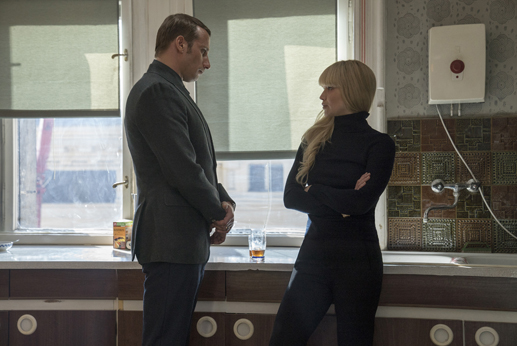
Having endured a regimen of vile and debasing treatment while at a specialized spycraft
school, Dominika (Jennifer Lawrence) now feels nothing but contempt for her
Uncle Vanya (Matthias Schoenaerts), who she once naïvely assumed wanted
only the best for her.
Justin Haythe’s screenplay adaptation has the slow burn of a complex John Le Carré espionage thriller, which must please Matthews, a fan of both that author and Ian Fleming. Frankly, I’m astonished; Haythe has no obvious experience with spy thrillers, and is most recently known for junk such as The Lone Ranger and the execrable A Cure for Wellness. It’s nice to see this significantly more polished side.

Austrian director Francis Lawrence obviously has developed a rapport with star Jennifer Lawrence, having helmed her final three Hunger Games outings. Red Sparrow is far more serious stuff: a thoroughly absorbing saga of regret, duplicity and reprehensible manipulation, set in a clandestine zone of prickly, real-world geopolitics.

Matthews must be congratulating himself for prescience: Such scheming cloak-and-dagger stuff seems even more credible now, at a time when Russia’s destabilizing activities have become daily front-page news.

Lawrence stars as Dominika Egorova, a talented member of the Bolshoi Ballet, introduced as she takes the stage for a standard performance (if anything done by Bolshoi dancers can be considered “standard”). Francis Lawrence cross-cuts from these scenes to others involving the late-night exchange of information between deep-cover CIA operative Nate Nash (Joel Edgerton) and a mole buried deep within upper-level Russian security operations.

Both sequences go awry. Dominika suffers an on-stage accident that destroys her career — an early, horrifying example of this film’s willingness to shock — while Nate’s meeting is exposed by the chance arrival of Russian police officers.

For Dominika, it’s a shattering, end-of-the-world catastrophe, and not merely because she spent her entire childhood training to be a dancer. She’s the only child of an invalided single mother (Joely Richardson) to whom she is devoted, and whose care — and the reasonably nice apartment in which they live — have been funded by her Bolshoi career.

Salvation — if it can be termed thus — comes from Dominika’s Uncle Vanya (Matthias Schoenaerts), who has kept a protective gaze on his deceased brother’s family. But Vanya’s interest is far from benign; his “solution” to Dominika’s plight involves drawing her into his realm of spycraft, with the specific goal of molding his niece into a seductress able to corrupt Westerners into betraying their country.

Hardly a healthy attitude for an uncle to have about his only niece.

Friday, November 17, 2017

Justice League: And so it begins...

Justice League (2017) • View trailer 
3.5 stars. Rated PG-13, for sci-fi action and violence

By Derrick Bang

Seeing director Zack Snyder’s name attached to this film was not happy news, given the degree to which he ruined both 2013’s Man of Steel and last year’s Batman v Superman: Dawn of Justice.

Having responded to the bat-signal illuminated by Police Commissioner Gordon (J.K.
Simmons, far left), the newly formed Justice League — from left, Wonder Woman (Gal
Gadot), Cyborg (Ray Fisher), Batman (Ben Affleck) and The Flash (Ezra Miller) —
learn that Gotham City is, once again, in serious trouble.
Snyder has much in common with director Michael Bay, similarly notorious for the Transformers franchise. Both favor bloated, soulless, humorless slugfests that wreak havoc on landscapes and cityscapes, while casually snuffing hundreds (thousands?) of civilian bystanders. Their films are the very definition of mindless product over art.

On the other hand, I was cheered to note Joss Whedon as co-scripter on Justice League. As the writer/director of 2012’s The Avengers, Whedon established the template for solid, successful superhero epics. Fans have recognized Whedon’s gift since television’s Buffy slayed her first vampire, back in 1996: He has an unerring talent for blending action fantasy with a (frequently droll) human element, which eases our suspension of disbelief.

And is a helluva lot more fun.

It’s easy to spot Whedon’s touch in Justice League, which is most successful during its first and second acts, as the stage is set, and the players assembled. It’s equally easy to see that the third act belongs to Snyder ... but not entirely. Even here, we get the vicarious relief of the unmistakable Whedon touch.

Justice League picks up in the immediate wake of Batman v Superman. The latter is dead, having perished at the hands of a Kryptonian monster genetically engineered by the villainous Lex Luthor. The country (the world?) is sliding quickly into anarchy, humanity apparently having abandoned hope after losing its gallant symbol for truth, justice and the American way.

(Ah ... but is Big Blue really, truly dead?)

Bruce Wayne (Batman) and Diana Prince (the Amazon Wonder Woman) are doing their best to stem the lawless tide, but they operate in the shadows; they’re not “living symbols” in the manner of Superman. Worse yet, Batman has been encountering winged “parademons” — very hard to kill — that seem to be seeking something.

Mindful of the need for additional super-powered allies, in order to hold off whatever comes next, Bruce and Diana reach out to three promising individuals: Barry Allen (Ezra Miller), a twentysomething nerd transformed by a lightning strike into The Flash; Arthur Curry (Jason Momoa), dubbed Aquaman, and heir to the underwater kingdom of Atlantis; and Victor Stone (Ray Fisher), a once-promising college football player nearly killed in a horrific accident, and “saved” when his scientist father Silas (Joe Morton) employed alien tech to transform his son into the biomechanical Cyborg.

Wednesday, August 28, 2013

Closed Circuit: They're watching us!

Closed Circuit (2013) • View trailer 
Four stars. Rating: R, for profanity and brief violence
By Derrick Bang


Nobody does an edgy, paranoid espionage thriller better than the British.

No doubt it comes from living under the unblinking eyes of all those surveillance cameras. (Big Brother, indeed!)

With their supposedly slam-dunk case having gone increasingly pear-shaped, Martin
(Eric Bana) and Claudia (Rebecca Hall) wonder about their next step. Trouble is,
they shouldn't even be a "they"; because of the nature of this terrorism trial, Martin
and Claudia aren't supposed to communicate ... even when each begins to worry
about pernicious surveillance.
Way back in the day, Closed Circuit would have been a tidy little B-entry, designated as the bottom-of-the-bill companion to some prestige A production. The irony is that many of those so-called B-films were far more entertaining than their big-budget cousins.

The same can be said for Closed Circuit, which outshines several of this summer’s disappointing blockbusters: better acting and directing, and a vastly superior script.

And yet, sadly, it probably won’t make a dime. Getting released immediately prior to the Labor Day weekend is akin to television’s Saturday evening kiss-of-death timeslot: Nobody will notice.

That’s a shame, because scripter Steven Knight definitely knows his way around this genre, having previously dazzled us with his twisty plots for 2002’s Dirty Pretty Things and 2007’s Eastern Promises. This guy can write; he has a gift for putting ordinary people into extraordinary situations, while avoiding the burst of brilliant resourcefulness that turn American action stars into invulnerable, lone wolf superheroes.

When the two protagonists in this narrative eye each other bleakly, during a calm between storms, and acknowledge that there’s no way to put this particular Humpty Dumpty together again — no successful exit to the catastrophe — we know they’re right. The situation is beyond salvation, beyond their control.

And, maddeningly, it always has been.

Closed Circuit — marvelous triple-entendre title, by the way — opens its ripped-from-the-headlines story with a terrorist attack at a busy London market. With 120 civilians dead and the British public screaming for justice, an anonymous tip leads police to one surviving member of the suspected terrorist cell: Farroukh Erdogan (Denis Moschitto).

Preparations begin for what promises to be the trial of the century.

Friday, March 9, 2012

John Carter: Thud and blunder

John Carter (2012) • View trailer
Two stars. Rating: PG-13, for relentless fantasy violence
By Derrick Bang • Originally published in The Davis Enterprise, 3.9.12


What a slab of meat.

A clumsy, disorganized and bone-stupid script is the biggest problem afflicting John Carter, but Taylor Kitsch’s stiff and wooden starring performance also leaves much to be desired.

After capturing John Carter (Taylor Kitsch, right), the Thark chieftan Tars Tarkas
(center) argues the displaced Earthman's fate with a rival warrior, Tal Hajus, while
the entire tribe waits to see what will happen next.
The young actor, who made such a strong impression as a troubled high school football player on TV’s Friday Night Lights, has made a laughably poor transition to big-screen leading man. Given his much stronger work on the tube, blame must be assigned director Andrew Stanton: an accusation given greater weight by the similarly dismal acting delivered by Kitsch’s co-stars.

When even seasoned professionals such as Ciarán Hinds and Mark Strong look silly, the guy in charge clearly is at fault.

Stanton (Finding Nemo, Wall-E) is the second Pixar filmmaker to make the ambitious leap from pixels to flesh-and-blood performers, but he hasn’t done nearly as well as colleague Brad Bird, who recently brought such stylish snap to Mission Impossible: Ghost Protocol. Based on this evidence, Stanton can’t direct live actors, period.

But — as mentioned above — that isn’t this film’s worst sin. The haphazard script scarcely makes sense from one action sequence to the next; it feels as if scenes are being fabricated on the fly. Stanton and co-scripters Mark Andrews and Michael Chabon have made an absolute mess of Edgar Rice Burroughs’ characters, not to mention the novel (1912’s A Princess of Mars, first in what became an 11-book series) on which this misfire is based.

Chabon’s participation should raise some eyebrows. You’d certainly think that the Pulitzer Prize-winning novelist who brought us The Amazing Adventures of Kavalier & Clay would better understand how to deliver a pulpish sci-fi adventure, but the evidence here suggests otherwise.

Most cruelly, Stanton & Co. have maligned the character of Carter much the way vintage Hollywood films bungled the big-screen adaptation of Burroughs’ other, more famous creation. Tarzan — born John Clayton, later Viscount Greystoke — was a perceptive, noble and impressively intelligent man who rejected the “hypocrisy of civilization” in order to lead a purer life in the African jungle with his wife, Jane.

Needless to say, the archetypical film image of Tarzan — forever cemented by Johnny Weissmuller’s disheveled, monosyllabic jungle warrior — made a mockery of such lofty origins.

The same is true of this film’s concept of John Carter. Granted, the 19th century Southern cordiality is present, as are Carter’s virtuous instincts; he also has been granted a tragic back-story. And, to their credit, Stanton and his fellow scripters retain the clever mystery revolving around Carter’s Earthly “death” in 1881, which triggers a summons to his nephew, Edgar “Ned” Burroughs (Daryl Sabara).

But once Carter gets zapped to Mars by a mysterious amulet, he turns into little more than a Martian version of Conan the Barbarian. Scratch that: Next to Carter, Conan could have been a Rhodes scholar. What follows is pulp-style twaddle at its worst ... and even that might have been all right, if Stanton had acknowledged and embraced such a campy atmosphere.

But no: All this nonsense is intended to be taken seriously, which turns the film into the worst sort of big-screen comic book.

Friday, February 10, 2012

The 2011 Oscar Shorts: Tiny sparks, mighty flames

The 2011 Oscar Shorts (2011)
Four stars. Unrated, but certainly suitable for all ages
By Derrick Bang • Originally published in The Davis Enterprise, 2.10.12


Oscar season — just a few weeks to go! — means that it’s time for another cherished part of the annual ritual: the road-show program of Academy Awards short subjects.

A little boy enters a most unusual family business, in Pixar's thoroughly
charming "La Luna."
Until quite recently, access to these short films remained limited; a few popped up randomly on PBS or cable/satellite channels, but for the most part we never saw more than the glimpses afforded during the actual Academy Awards broadcast. This changed five years ago, thanks in great part to the increased marketability of feature-length documentaries.

Folks take notice when films such as 2005’s March of the Penguins rake in just shy of $80 million in the United States alone, and when nonfiction cousins such as Spellbound and Young @ Heart out-perform mainstream alternatives. We also mustn’t overlook the popularity of efforts by Michael Moore and Morgan Spurlock.

And so, thanks to the involvement of art houses such as Sacramento’s Crest Theater — and what I imagine must be nightmarish contractual arrangements, with 10 different films involved — we now have the opportunity, each year, to savor cinema’s answer to the novella and short story.

In some cases, the short-short story.

Beginning with the live-action nominees, Norwegian director Hallvar Witzo does wonderful things with scripter Linn-Jeanethe Kyed’s Tuba Atlantic, a droll study of how 70-year-old Oskar (Edvard Haegstad) handles some rather unsettling news from his doctor. The prognosis: only six more days of life. (“That’s very precise,” Oskar mutters.)

Oskar (Edvard Haegstad) hates seagulls; their shrill cries are upsetting his
precious few remaining days of life. Young Inger (Ingrid Viken), assigned to
help him "prepare" for his fate, scarcely understands this old coot, but she's
determined to make a difference as his moral hourglass runs out.
Oskar’s a cantankerous coot, living alone at the edge of the bitterly cold ocean. He has embraced novel methods — involving a machine gun and dynamite-filled fish — of killing the raucous seagulls that make sleep impossible. His beloved isolation is invaded by the inappropriately cheerful Inger (Ingrid Viken), a bubbly teen with a mission, as a Jesus-preaching “Angel of Death” assigned to help Oskar through the “five stages” of accepting his fate.

Both these characters are captivating misfits, forever living in the shadows of more successful siblings. Inger suffers the humiliation of braces, while her sister dates two boys; Oskar long ago lost touch with his brother Jon, who moved to the United States. Oskar initially wants nothing to do with Inger’s “ministrations,” of course, but events — and a huge, rather peculiar “something” concealed beneath a massive tarp, and pointing out toward sea — will conspire to build a most unlikely relationship.

This film’s one shortcoming: The white subtitles, often projected against the setting’s snow-white background, can be very difficult to read. Do your best; the effort is worthwhile.

Friday, February 3, 2012

The Woman in Black: Laughably gloomy

The Woman in Black (2012) • View trailer
Two stars. Rating: PG-13, for dramatic intensity and numerous scenes of children in peril
By Derrick Bang • Originally published in The Davis Enterprise, 2.3.12


This film opens with such promise.

Having deliberately encouraged the nasty, black-garbed specter of Eel Marsh
House to show itself, Arthur Kripps (Daniel Radcliffe) hopes to bring closure
to the tormented spirit, thus eliminating its campaign of terror against the
residents of a nearby village.
Sherlock Holmes’ England comes to vibrant life at the hands of production designer Kave Quinn, and star Daniel Radcliffe seems fully comfortable in this early 20th century setting. Scripter Jane Goldman concisely sketches a tragic back-story for this bereft young man — a solicitor named Arthur Kipps, whose wife died in childbirth — and director James Watkins gently surrounds us with an atmosphere of melancholy.

The mood turns intriguing, then ominous, as Kipps' legal firm sends him to the tiny, remote village of Crythin Gifford (actually Halton Gill, in the middle of Northern England’s Yorkshire Dales: a truly lovely location). Mrs. Alice Drablow, a reclusive widow and sole resident of outlying Eel Marsh House — separated from the rest of the community by a lone roadway that floods with each high tide — has passed away; the estate is in something of a mess.

Kipps’ job is to ensure that no late-stage codicils might be lying about the paper-strewn mansion, thus invalidating the will filed back in London.

The local villagers are wary and terrified of ... something ... that they fail to share with Arthur. Eel Marsh House is haunted, of course, by The Woman in Black; this big-screen adaptation of Susan Hill’s 1982 novel is — by design — a classic Victorian ghost story.

Unfortunately, the film’s rich atmosphere goes to waste once we move past this prologue and its essential details; the story quickly runs off the rails, becoming sillier by the moment. Nothing makes sense, least of all the villagers’ increasingly idiotic response to a curse they’ve apparently lived with for years.

Worse yet, Watkins sabotages his own efforts at building nervous tension by relying increasingly on in-our-face smash cuts, accompanied by both shrieks from the eponymous phantasm and discordant screeches from Marco Beltrami’s thoroughly obnoxious score.

In other words, we’re never actually frightened by these proceedings, merely startled by very loud noises. There’s a big difference, and the distinction — Watkins’ failure to generate actual terror — quickly grows tedious.

Friday, January 6, 2012

Tinker Tailor Soldier Spy: Whac-A-Mole

Tinker Tailor Soldier Spy (2011) • View trailer
3.5 stars. Rating: R, and too harshly, for brief violence, occasional profanity and eyeblink nudity
By Derrick Bang • Originally published in The Davis Enterprise, 1.6.12


If your theater of choice offers the faux “classified dossier” of notes, characters and background information on this film, I strongly suggest you grab a copy.

You’ll need it.

Better still, arrive at least 10 minutes early, so you’ll have plenty of time to study the bloody thing.
Never underestimate the value of an employee who has been recently sacked:
Smiley (Gary Oldman, right) questions former MI6 duty officer Jerry Westerby
(Stephen Graham), while Smiley's younger associate, Peter Guillam (Benedict
Cumberbatch) watches the master at work. The issue at hand: Did a field
operative actually send a message during a crucial operation, or was that a lie?

Although scripters Bridget O’Connor and Peter Straughan have done an impressive job of condensing John Le Carré’s massive, genre-breaking spy novel, the drawback is a sense of having been dropped smack into the middle of an extremely complicated story.

O’Connor, Straughan and director Tomas Alfredson simply assume that we’ll be able to pick up what we need to know, concerning roughly a dozen characters, as the film progresses. This already difficult task is further complicated by a raft of flashbacks, often arriving without warning; heck, we don’t even learn that this is 1973, until a ways into the unfolding plot.

Nor is that all; we’re also expected to understand British Cold War politics and immediately grasp the internecine squabbling that infects the upper-echelon members of Britain’s Secret Intelligence Service, reasonably well known by spy buffs as MI6, but here always code-named “the Circus.”

Ah, yes: That’s another thing. This story is rife with jargon, and not simply the terms and code names given field agents or their operations. You’ll need to grasp the purposes of lamplighters, scalphunters, wranglers and shoemakers, suss the distinction between mothers and debs, and understand the differing responsibilities of ferrets, housekeepers and janitors.

Mind you, I eat this stuff up, and O’Connor and Straughan work hard to make things clear in context. But much as I enjoyed the Machiavellian maneuvering among the characters played by this sublimely talented cast, this is a film that only die-hard Anglophiles could love ... and even they would be well advised to have read Le Carré’s book first.

More than anything else, Alfredson captures the grim atmosphere of despair that permeates Le Carré’s novel: the bleak misery of a working environment where trust is a fickle commodity at best, and loyalty often is for sale to the highest bidder. The people at the Circus can’t have normal relationships; by definition, they always worry about motivation and deception.

Establishing this unsettling, unstable mood is what Alfredson does best, as he demonstrated so well with the intriguingly inverted “vampire dynamics” of Let the Right One In (the Swedish version). We’re uneasy at all times, worried that our central character — veteran agent George Smiley, played with thoughtful precision by Gary Oldman — will make a fatal mistake while pursuing the clandestine assignment with which he has been charged.

And “fatal” covers a lot of territory, as well. In this world, disgrace and dishonor are far worse than mere death.

Friday, January 28, 2011

The Rite: All wrong

The Rite (2011) • View trailer for The Rite
Two stars (out of five). Rating: R, for profanity, sexual vulgarity, violence and dramatic intensity
By Derrick Bang


You’d better be careful, Sir Anthony, or your career will take the downward trajectory that turned Rod Steiger into such a cautionary tale.

Steiger garnered three Academy Awards nominations during a little more than a decade, and took home the gold for his starring role in 1967’s In the Heat of the Night. His moving supporting performance in 1981’s The Chosen proved to be his final truly respectable role; from that point forward, he was reduced to self-parodying comedy cameos and trailer-trash exploitation flicks along the lines of American Gothic, The Neighbor and (words fail me) Captain Nuke and the Bomber Boys.
Don't ever address the demon directly, Father Trevant (Anthony Hopkins, left)
warns Michael (Colin O'Donoghue), and don't ever look it in the eyes. But of
course the younger man does both those things throughout this laughable film.
This problem crops up repeatedly in The Rite, which routinely ignores or
violates the very "rules" established by its own narrative.

It was a grinding, embarrassing 20 years before we lost Steiger in 2001, by which time a new generation had grown up believing him nothing but a second-rate hack with – so it seemed – the worst agent in town.

Consider the uncomfortable parallel to Hopkins: a four-time Oscar nominee and winner, for 1991’s The Silence of the Lambs, who is much too content, these days, to deliver throwaway, self-parodying performances in dead-on-arrival projects such as Slipstream and the ill-advised remake of The Wolfman. And whatever the fan expectation for the upcoming big-screen version of the Marvel Comics superhero Thor, the discovery that Hopkins has been tagged to play the All-father Odin elicits nothing but snickers. And deservedly so.

All of which brings us to The Rite, a “January stiff” in every sense of the term. We know we’re in trouble, right from the top, when an opening crawl claims that Michael Petroni’s screenplay is “inspired by” actual events, and “suggested by” journalist Matt Baglio’s serious effort to document a controversial topic in his nonfiction book, The Rite: The Making of a Modern Exorcist.

In other words, Petroni’s script doesn’t even try for authenticity, and this film lacks the honesty to call itself fiction. And when the final scene (mercifully!) fades to black, a final text crawl “informs” us what these “actual” characters are doing in our real world.

Yeah, right.

Swedish director Mikael Hafstrom, who did a reasonable job with the 2007 big-screen adaptation of Stephen King’s short story “1408,” gets full credit for an unsettling mood. Hafstrom has the Swedish sensibility for stark tableaus and gloomy establishing shots: abandoned playgrounds, dilapidated hotel courtyards and darkened, dusk-like skies.

And rain. Plenty of rain.

Thursday, March 13, 2008

Miss Pettigrew Lives for a Day: Absolutely delightful

Miss Pettigrew Lives for a Day (2008) • View trailer for Miss Pettigrew Lives for a Day
Four stars (out of five). Rating: PG-13, for plenty of innuendo and fleeing nudity
By Derrick Bang • Originally published in The Davis Enterprise, 3.13.08
Buy DVD: Miss Pettigrew Lives for a Day

One impeccably timed performance in a comedy is a treasure.

Two are a revelation.

After being dragged along to a high-society fashion show, the still shabbily
dressed Guinevere Pettigrew (Frances McDormand, left) -- painfully aware of
how much she doesn't fit these surroundings -- wonders how much longer she
can pull off her charade as "social secretary" to irrepressible American singer
Delysia Lafosse (Amy Adams).

Watching Frances McDormand and Amy Adams spar in Miss Pettigrew Lives for a Day is akin to sitting courtside during a fast-paced tennis match between champions: Both actresses work their considerable talents to the max, as if each scene were a competition.

But there are no losers here, and we viewers are the winners: This cleverly retro farce is delightful from start to finish, and you'll not be able to take your eyes off McDormand or Adams. Indeed, when both share the screen — which happens quite frequently — it's difficult to know who to watch. Both spice their performances with carefully composed body English and hilarious little bits of business: a tilt of the head here, a calculated pause and raised eyebrow there.

To borrow from a Cole Porter song that'd be right at home in this environment, the result is de-lovely.

Although feeling very much like a transplanted stage comedy, Miss Pettigrew Lives for a Day actually is based on a 1938 novel by Winifred Watson, a British author whose sexually charged book — no doubt a revelation for forward-thinking women of her day — must've raised more than a few eyebrows. The novel is practically a blueprint for a pre-WWII Hollywood screwball comedy, and I'm amazed it hasn't been adapted until now.

Director Bharat Nalluri — a veteran of recent, top-notch British TV shows such as Spooks, Hustle and Life on Mars — embraces the material as though born to the genre. Working from a finely tuned script by David Magee (Finding Neverland) and Simon Beaufoy (The Full Monty), Nalluri guides his talented cast through a fast-paced adult fairy tale that balances its witty dialogue and hilarious plot complications with the real menace of England's impending war with Germany.

Composer Paul Englishby delivers a rollicking, jazz-hued soundtrack that perfectly evokes the era; the result — very much in the mold of Anne Dudley's main theme to the beloved British TV series, Jeeves and Wooster — saucily punctuates this naughty mix of ethical dilemmas and bedroom hijinks.

The story takes place in 1939 London, on the eve of what savvy citizens know is the ramp-up to another nightmare. Times are hard, emotions are high, and jobs are hard to come by; the stuffy gatekeeper at an employment agency therefore is disinclined to help when middle-age governess Guinevere Pettigrew (McDormand) is sacked from yet another placement.