Showing posts with label Penelope Wilton. Show all posts

Wednesday, May 25, 2022

Downton Abbey: A New Era — A carefully calculated crowd-pleaser

Downton Abbey: A New Era (2022) • View trailer
Four stars (out of five). Rated PG, for no particular reason
Available via: Movie theaters

This certainly is the epitome of “comfort cinema.”


As this ensemble cast has expanded since the series 2010 debut, writer/creator Julian Fellowes has done an impressive job of granting every new character ample individuality, exposure and melodramatic plot points. We’ve lost only two major players, over time — Matthew and Sybil Crawley (Dan Stevens and Jessica Brown Findlay) — while adding several dozen more.


After sound engineer Stubbins (Alex McQueen, in headphones) orders total silence from
everybody else, Lady Mary (Michelle Dockery) tries hard to match her spoken dialogue
to the silent images being projected on a screen.


Goodness, it takes several minutes, during this sequel’s title credits montage, just to run through the entire cast list.

Not that this is any sort of problem. Fellowes knows his audience, just as all the players have grown comfortable with their roles. Spending another two hours with these characters is like enjoying an evening with beloved friends and relatives.


This film’s subtitle — “A New Era” — is both apt and a bit misleading. On the one hand, it does signify both a pop-culture shift (about which, more in a moment) and a change in fortune for both the Crawley family and a few of their “downstairs” servants. Yet the rise of such working-class individuals, and the accelerating decline of the aristocracy — which played such a key role in the TV series’ final season — is largely ignored here, even though we’ve moved forward another year, to 1928.


Indeed, this film concludes on a note that suggests nothing has changed in this respect, as if the real-world’s socio-political clock had ceased to move forward. Granted, that prompts a cheerful, audience-pleasing tableau, if this is to be our final glimpse of these characters — assuming Fellowes isn’t persuaded to do yet another film — but it’s a bit of a cheat.


Not that fans will care a whit.


The story begins as Tom Branson (Allen Leech), the Earl of Grantham’s widowed son-in-law, marries Lucy Smith (Tuppence Middleton): a celebration that makes good on the previous film’s swooningly romantic finale. This is the “upstairs” answer to the earlier, humbler but equally romantic wedding of adorably impertinent assistant cook Daisy (Sophie McShera) and footman Andy (Michael Fox), now living in the tenancy home of her father-in-law, Mr. Mason (Paul Copley).


Two unexpected events land simultaneously. The British Lion Film Studio expresses interest in shooting its next silent costume drama, The Gambler, at Downton Abbey — a notion that horrifies the Earl, Robert Crawley (Hugh Bonneville), and retired butler Mr. Carson (Jim Carter) — and the Dowager Countess Violet Crawley (Maggie Smith) learns that she has been bequeathed a villa in the south of France, in the will of the recently deceased Marquis de Montmirail. 


The latter prompts all manner of raised eyebrows, but Violet refuses to provide any explanation; she tartly refers only to her “mysterious past” (a line delivered with Smith’s typically arch smugness).

Friday, May 20, 2022

Operation Mincemeat: Very well done

Operation Mincemeat (2022) • View trailer
Four stars (out of five). Rated PG-13, for brief war violence, disturbing images and brief profanity
Available via: Netflix
By Derrick Bang • Published in The Davis Enterprise, 5.20.22

World War II has long gifted cinema with a wealth of heroic, unusual and downright astonishing stories … but none is more bizarre or audacious than this one.


Having been fully briefed about the necessary parameters, North London coroner
Bentley Purchase (Paul Ritter, center) pulls out a cadaver that might suit the requirements
of Ewen Montagu (Colin Firth, far right) and Charles Cholmondeley (Matthew Macfadyen).


In early 1943, the Allies desperately sought a means to break the Nazi stranglehold on mainland Europe, but the only feasible route appeared to be invading Sicily and then pushing northward. Unfortunately, this lone option was tooobvious; Hitler also recognized it as the likely approach, and was fully prepared to thwart such an effort with the full might of the German army. The loss of Allied lives would have been incalculable.


A few years earlier, Lt. Cmdr. Ian Fleming — then assigned to Rear Adm. James Godfrey, head of British naval intelligence — had drafted what came to be known as the “Trout Memo.” (Yes, that Ian Fleming. Seriously.)


The memo — “Trout,” as in hoping to fool the Nazis hook, line and sinker — contained 54 suggested schemes designed to deceive the Axis Powers. Item 28 was a macabre ploy that Fleming lifted from 1937’s The Milliner’s Hat Mystery, one of several Inspector Richardson mysteries by British author Basil Thomson.


So, consider: A now-obscure novelist gives British naval intelligence the idea for a daring act of real-world espionage duplicity, as proposed by an officer — Fleming — who would go on to create the world’s best-known fictitious secret agent.


No surprise, then, that this legendary bit of WWII lore would appeal to director John Madden, who similarly played with the historical line between real and make-believe, in 1998’s Shakespeare in Love. Michelle Ashford’s engaging script is adapted from Ben Macintyre’s meticulously researched 2010 nonfiction bestseller of the same title.


The resulting film is fascinating. Ashford has done an impressive job of condensing the many key details, without losing track of the saga’s complexity … and while adding a few fictitious embellishments for dramatic intensity. (I’d argue they were unnecessary, but opinions might differ.)


The key players here are barrister-turned-naval intelligence officer Ewen Montagu (Colin Firth); Royal Air Force flight lieutenant-turned-MI5 counter-intelligence agent Charles Cholmondeley (Matthew Macfadyen); Godfrey (Jason Isaacs), who oversaw what eventually developed into “Operation Mincemeat”; MI5 clerk Jean Leslie (Kelly Macdonald), who played a key role in the scheme; and MI5 head secretary Hester Leggett (Penelope Wilton), whose talent for credible love letters also proved crucial.


Friday, October 9, 2020

Summerland: A deeply emotional sojourn

Summerland (2020) • View trailer
Four stars. Rated PG, for no particular reason
By Derrick Bang • Published in The Davis Enterprise, 10.16.20

I marvel at the variety and emotional sensitivity of World War II-based dramas that continue to arrive from across the pond.


As Alice (Gemma Arterton) grows more tolerant of Frank's (Lucas Bond) presence,
she becomes willing to share her interest in the fascinating atmospheric phenomenon
known as Fata Morgana mirages.

Clearly, several generations of our British cousins continue to be profoundly impacted by the Blitz, which terrified the London populace for eight harrowing months, from September 1940 through May 1941. (And a noisy subset of Americans complain that the sensible request to wear a mask is too restrictive? Please.)


Writer/director Jessica Swale’s engaging and clever scripted Summerland — available via Amazon Prime and other streaming platforms — focuses on this era through the lens of yet another fresh perspective. Her film is fueled by a richly nuanced performance from star Gemma Arterton, who — in turn — is surrounded by a talented ensemble cast that brings this drama to vibrant life.


The setting is a tiny community nestled along the seaside cliffs of Southern England’s Kent district; the story’s catalyst is “Operation Pied Piper,” the mass evacuations designed to keep children safe in outlying rural locations during the Blitz, while their parents remained behind in cities across Britain.


Alice Lamb (Arterton) is a reclusive researcher/writer who lives in a quaint home overlooking the ocean. She’s constantly tormented by local children: in part because they always get such a furious rise out of her; and also because much of the community suspects she might be a “Nazi spy.” (Not really. But tongues do wag…)


Her isolation is rudely interrupted when she’s assigned a young boy — Lucas Bond, as Frank — who arrives in the newest wave of displaced children. Alice is furious, wanting no part of such an intrusion; the townsfolk — led by genial school headmaster Mr. Sullivan (the quietly excellent Tom Courtenay) — are equally firm. She must do her part.


Fine, she replies waspishly, but only for one week: until you can find him another home.


We cringe during these early scenes, because Alice doesn’t even try to conceal her disgust over the situation in general, and poor Frank in particular; she couldn’t care less if his feelings get bruised. But — intriguingly — he’s a remarkably resilient boy, and he accepts her hostility with equanimity (although Bond ensures that we see the distress in his gaze, when Alice isn’t looking).


Friday, August 28, 2020

The Guernsey Literary and Potato Peel Pie Society: A tasty treat

The Guernsey Literary and Potato Peel Pie Society (2018) • View trailer 
Four stars. Rated TV-14, for dramatic intensity
By Derrick Bang • Originally published in The Davis Enterprise, 8.28.20

Films with excessively long titles generally should be regarded with suspicion.


As two classic examples, nothing can be gained from watching 1962’s The Incredibly Strange Creatures Who Stopped Living and Became Mixed-Up Zombies!!? or 1967’s Oh Dad, Poor Dad, Mamma’s Hung You in the Closet and I’m Feelin’ So Sad.


As the members of the Guernsey book club watch with varying degrees of amusement —
from left, Isola (Katherine Parkinson), Eben (Tom Courtenay), young Eli (Kit Connor),
Amelia (Penelope Wilton) and Dawsey (Michiel Huisman) — Juliet (Lily James, far
right) bravely agrees to taste the infamous potato peel pie.

Happily, The Guernsey Literary and Potato Peel Pie Society — exclusive to Netflix — is an entirely different creature: a solid British charmer from director Mike Newell, who brought us Enchanted AprilFour Weddings and a Funeral and Mona Lisa Smile. Scripters Don Roos, Kevin Hood and Thomas Bezucha have fashioned a solid adaptation of the best-selling 2008 book by Mary Ann Shaffer and Annie Barrows: not an easy task, given that it’s an epistolary novel, composed entirely of letters written between characters.


(Actually, the book’s creation is a fascinating story unto itself; curious souls are encouraged to research how Shaffer came to write it … but was unable to finish it.)


We meet author Juliet Ashton (Lily James) midway through a cross-country tour to promote her newest book; the setting is 1946, in a post-war England just beginning to rebuild itself. She is accompanied by publisher and best friend Sidney Stark (Matthew Goode), a solicitous fellow with the good-natured patience to tolerate his favorite writer’s occasional whims.


Such as her impulsive decision, following the exchange of a few letters, to visit the island community of Guernsey. Her curiosity is piqued by a farmer named Dawsey Adams (Michiel Huisman), who mentions belonging to a local book club dubbed, yes, the Guernsey Literary and Potato Peel Pie Society.


Her departure displeases dashing American GI Mark Reynolds (Glen Powell), whose proposal she has just accepted (too rashly, we suspect). Even so, he graciously agrees to await her return.


Juliet’s arrival in Guernsey is greeted with enthusiasm by Dawsey and the other book club members: Eben Ramsey (Tom Courtenay), Amelia Maugery (Penelope Wilton) and Isola Pribby (Katherine Parkinson). Juliet soon learns that the “Society” was concocted during the early days of Guernsey’s German occupation, as a fabricated justification for breaking curfew (briefly revealed in a flashback prologue).


Needing to maintain the charade in order to satisfy a Nazi chaperone, the Society continued to meet on a regular basis. Even after their “minder” grew bored and stopped attending, the group realized how much they valued a book’s ability to whisk them away from what had become a bleak and brutal existence.


Saturday, September 21, 2019

Downton Abbey: A joyous reunion

Downton Abbey (2019) • View trailer 
Four stars. Rated PG, for no particular reason

By Derrick Bang

Goodness. What more could one desire?

Despite having settled everybody quite pleasingly, when Downton Abbey concluded its television run on Christmas Day 2015, creator/writer Julian Fellowes once again has worked his magic: ingeniously concocting fresh upstairs/downstairs dramas that unite the aristocratic Crawley family and its voluminous house staff.

When cascading events at Downton prove too overwhelming for the comparatively
untrained head butler, Lady Mary (Michelle Dockery, center) asks Mr. Carson (Jim Carter)
to return, much to the amusement of Mrs. Hughes (Phyllis Logan).
Mind you — as always was the case, during six enthralling television seasons — the Crawleys remain more progressive than most of their stuffy peers, and the staff manages far more impertinence and independent thinking, than ever would have been allowed, back in the day. Such is the shrewdness of Fellowes, who layers these one-century-removed escapades with enough modern attitude to reference contemporary issues, without damaging the period authenticity.

All the while making us smile, occasionally giggle and — yes, even this — shed a tear or two.

Very little has changed here, aside from the slight march of time. Fellowes managed to assemble just about the entire cast: a frankly stunning achievement, given that several of these talented actors have moved on with their individual careers. The only notable absence is Lily James’ Lady Rose MacClare, and I do miss the warmth of her sparkling smile; she always was a breath of effervescence, alongside the far more severe Lady Mary (Michelle Dockery) and Lady Edith (Laura Carmichael).

This big-screen adventure unfolds like an even better Christmas special; the enhanced budget’s only noticeable impact is a broader location backdrop for production designer Donal Woods to fill — which he does splendidly — and cinematographer Ben Smithard’s spectacular swooping shots of Downton and a few of its equally majestic neighbors.

Indeed, the film opens on an extremely clever sequence, as Smithard’s camera follows the posting of a Most Important Letter, while it crosses England by train and — finally — reaches its destination by individual carrier. That would be Downtown, of course, and our first glimpse of its familiar grounds is accompanied by the equally familiar swell of composer John Lunn’s iconic theme. 

Theater patrons breathed an audible sigh of happy satisfaction, at that moment.

The year is 1927. Some children have grown a bit older; a few new moppets have arrived. The aforementioned letter announces the impending arrival of their Majesties King George V and Queen Mary, who will stay at Downton for a full day, during a tour of Grantham and the surrounding countryside. This news naturally causes all manner of consternation, given the precise dictates of custom, tradition and regard. 

The Earl (Hugh Bonneville) and his wife, Cora (Elizabeth McGovern) — Mary and Edith’s parents — have all manner of details to coordinate, not the least of which is the royal parade scheduled for the same afternoon: an event eagerly anticipated by all the local townsfolk. Downstairs, Mrs. Hughes (Phyllis Logan), Mr. Bates (Brendan Coyle), Mrs. Patmore (Lesley Nicol) and all the other servants are just as excited about this opportunity to attend to the most prestigious guests in the land.

Friday, July 1, 2016

The BFG: A colossal triumph

The BFG (2016) • View trailer 
Five stars. Rated PG, for fantasy peril and some scary scenes

By Derrick Bang • Originally published in The Davis Enterprise, 7.1.16

Roald Dahl’s children’s books are cherished for all sorts of reasons, including his ability to concoct astounding creatures and astonishing realms that require a reader’s imagination, because such wonders couldn’t possibly be replicated on the big screen.

After gaining the trust of her immense new friend (Mark Rylance), Sophie (Ruby Barnhill)
learns of his skill at catching and bottling "dream stuff," which then can be used to help
London's denizens sleep more peacefully.
At least, not until quite recently.

Dahl has done quite well by Hollywood over the years, with fabulous adaptations of The Witches, James and the Giant Peach and Fantastic Mr. Fox, not to mention a couple of quite popular renditions of Charlie and the Chocolate Factory.

The many talented individuals behind those films notwithstanding, nothing approaches the pure magic — the jaw-dropping sense of wonder — delivered by director Steven Spielberg and an amazing team of collaborators, in The BFG.

Back in the day, the producers of Christopher Reeve’s first Superman film promised that we’d believe a man can fly. Well, Spielberg and his crew make us believe that giants stride the earth. The verisimilitude is so natural, so persuasive, that we often disregard the boring technicalities of special effects, choosing instead to accept the fantastic at face value: no small thing, in these jaded times.

Everything is orchestrated to perfection: the late Melissa Mathison’s poignant, deftly sculpted screenplay (her final completed assignment); Janusz Kaminski’s lavish cinematography, rich with warm color tones that enhance the film’s cozy atmosphere; the ingenious production design and set decoration by Rick Carter and Elizabeth Wilcox; and — most particularly — John Williams’ delicately intricate score.

Williams, recently the first composer to be honored with the American Film Institute’s Life Achievement Award, is no stranger to ornately layered soundtracks and iconic character themes. But even in a lengthy career distinguished by scores of memorable scores, this one is one of his finest.

Williams’ music for The BFG is all-encompassing; it feels as if every scene, every character, has its own theme. His score plays like a continuous, massive symphony that brings Spielberg’s handling of this gentle parable to even greater emotional heights.

Dahl published his book in 1982, and Spielberg’s film is set in the same decade. It opens with a slow pan of late-night London, Kaminski employing some sort of cinematographic trick that makes the streets, vehicles and buildings seem somehow smaller than usual: almost like an immense, three-quarter-size fairy tale village. We glide into an orphanage, where the matron’s final rounds are watched, surreptitiously, by 10-year-old Sophie (Ruby Barnhill).

Friday, May 11, 2012

The Best Exotic Marigold Hotel: Make a reservation

The Best Exotic Marigold Hotel (2011) • View trailer
Four stars. Rating: PG-13, for sexual candor and fleeting profanity 
By Derrick Bang 


Change can be difficult — sometimes heartbreaking — even when embraced willingly.

It becomes considerably worse when change is forced upon us.

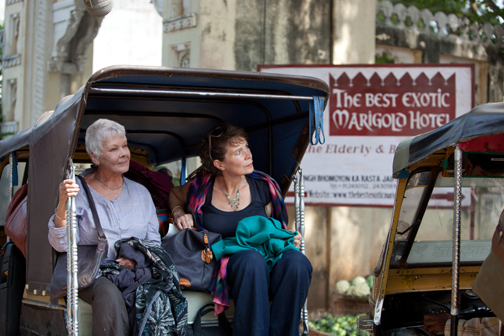
Evelyn (Judi Dench, left) and Madge (Celia Imrie) bravely embrace the hustle
and bustle of Jaipur, the city where they've elected to spend their "golden years."
Some of their companions, back at the self-professed Best Exotic Marigold
Hotel, lack this adventurous spirit ... which, obviously, is their loss.
During the prologue to director John Madden’s thoroughly charming The Best Exotic Marigold Hotel, we meet seven individuals who fear they’ve reached that point in their lives — “of a certain age,” as the fashionably polite suggest — when society deems them irrelevant. Worse yet, all these folks are further burdened by their own personal baggage, in some cases a soul-crushing weight that has dragged them down for decades.

Recently widowed Evelyn (Judi Dench) has just learned, to her humiliation, that her husband left her financially stranded and — by relegating her to the role of “companion” — unable to fend for herself. Graham (Tom Wilkinson), a High Court judge, finally has let cynicism overrule compassionate objectivity. Muriel (Maggie Smith), a fearful, reflexive xenophobe, needs hip replacement surgery.

Singletons Madge (Celia Imrie) and Norman (Ronald Pickup), refusing to gracefully accept their advanced years, continue to seek sexual thrills like thirtysomething sybarites. Tragically, marital bliss died long ago for Jean (Penelope Wilton) and Douglas (Bill Nighy); now she only snipes at him, while he patiently endures.

Fans of British cinema already realize they need read no further; with a cast like this, how could Madden’s adaptation of Deborah Moggach’s These Foolish Things — screenplay by Ol Parker — miss?

It doesn’t, of course. The Best Exotic Marigold Hotel is a gentle reminder that life doesn’t stop at 60; that new experiences are to be embraced, not avoided; that fate truly does reward the brave; and that it’s never too late to make new friends or find new lovers.

Through chance, serendipity and design — and, in Muriel’s case, medical necessity (no waiting time for her surgery) — all these retirees find themselves on the same plane to India, responding to the skillfully worded promise of colorful brochures and come-hither Internet sites extolling the luxurious accommodations of Jaipur’s Best Exotic Marigold Hotel.