Showing posts with label Tommy Lee Jones. Show all posts

Friday, October 20, 2023

The Burial: We totally dig it!

The Burial (2023) • View trailer
Four stars (out of five). Rated R, for profanity
Available via: Amazon Prime
By Derrick Bang • Published in The Davis Enterprise, 10.20.23

You can’t beat a well-mounted underdog saga … particularly one that boasts veteran scene-stealers such as Tommy Lee Jones and Jamie Foxx, and is based on actual events.


In this case, rather unusual actual events.


When their case takes an unexpected turn for the worst, Jeremiah O'Keefe (Tommy Lee
Jones, left) wonders if he did the right thing, even with shrewd attorney Willie Gary
(Jamie Foxx) at his side.


Biloxi-based entrepreneur Jeremiah “Jerry” O’Keefe was in the “funeral business” his entire life, continuing a family tradition that dated back to the end of the Civil War. By the time he reached comfortable old age, O’Keefe owned eight Mississippi-based funeral parlors, along with a parallel funeral insurance business.

But the approach of the 21st century found O’Keefe in financial difficulty for reasons beyond his control. In an effort to raise funds, he agreed to sell three of his funeral homes to Canadian businessman Ray Loewen, who headed a consortium that owned an increasingly large number of Canadian and American funeral parlors.


Loewen’s preferred tactic: He’d purchase available funeral homes in a given region, undercut smaller competitors until they went out of business, and then scoop up their operations at fire sale prices.


In O’Keefe’s case, Loewen simply stalled on signing and honoring their contract, waiting for the Biloxi businessman to go bankrupt. O’Keefe, justifiably outraged, got a lawyer.


But not just any lawyer…


What subsequently went down has become a thoroughly engaging legal duel in the capable hands of director Maggie Betts, who also co-wrote the script with Doug Wright, based on journalist Jonathan Harr’s equally absorbing October 1999 New Yorker article. But this isn’t merely a depiction of courtroom theatrics; Betts and Wright spend the lengthy first act introducing and developing the primary players, all well portrayed, so that we sympathize with everybody.


Except for Loewen. Bill Camp makes him an arrogant, unapologetic swine: an amoral skunk we want brought to his knees. Camp is the ideal villain.


On the surface, Jones’ O’Keefe is an amiable fellow: a doting husband and father of 13 children (!), and grandfather to 43. (We glance in awe at his wife, Annette, played with similar devotion by Pamela Reed.) But Jones’ bearing and expression also display the steel of a long-successful businessman, decorated World War II fighter ace, and former two-term mayor of Biloxi. This isn’t a man to take lightly.


And, let it be said, Jones is a longtime master of the cut-them-dead withering gaze.

Friday, September 20, 2019

Ad Astra: Voyage to nowhere

Ad Astra (2019) • View trailer 
No stars (turkey). Rated PG-13, for violence, brief dramatic intensity and fleeting profanity

By Derrick Bang • Originally published in The Davis Enterprise, 9.20.19


Put the ballots away; the contest for 2019’s worst big-budget Hollywood production has concluded.

Doesn’t matter what emerges between now and Dec. 31; nothing will be poorer than Ad Astra.

Having reached the Mars outpost, Major Roy McBride (Brad Pitt) is warned by Helen
Lantos (Ruth Negga), superintendent of the American sector, that his military superiors
have been less than candid with him.
This portentous, deadly dull and hopelessly self-indulgent train wreck is the most outrageously overblown sci-fi misfire since 2000’s Battlefield Earth. And that’s woeful company to keep.

Ad Astra is what happens when directors get too full of themselves. History is littered with similar studio miscalculations: Michael Cimino, and Heaven’s Gate; Steven Spielberg, and 1941; Warren Beatty, and Ishtar; Barry Levinson, and Toys. Mega-budget stinkers, every one of them.

James Gray — who co-scripted with Ethan Gross — and star/co-producer Brad Pitt have topped them all.

As I’ve observed before, when science-fiction goes bad, it goes very bad.

Rarely have 122 minutes passed with such agonizing sluggishness. This is the film for folks who thought 1968’s 2001: A Space Odyssey wasn’t slow enough.

It’s also the film to watch, for those who can’t get enough of Pitt. You’ll never again see so many tight close-ups and relentlessly slow takes on his face; cinematographer Hoyte Van Hoytema lingers on every dimple, blemish and wrinkle with the adoration of a reverential acolyte.

Nor is it a happy face. Ever. Pitt spends the entire film in mostly silent remorse and (supposedly) thoughtful brooding. His line deliveries are quiet, flat and emotionless: completely in contrast to his character’s hilariously overblown off-camera narration, where each sentence is separated by pauses so pregnant they could deliver. You’d think Gray and Gross believed their text had been lifted from Moses’ stone tablets.

I despise preachy, pompous science fiction. It’s the first refuge of so-called storytellers who believe that a futuristic setting is the only way they can impart Wisdom Relevant To Our Contemporary Lives. The result is invariably condescending and insufferably patronizing.

Beyond all that — aside from the relentless pomposity — Gray and Gross fail on the most primary level: They don’t tell a good story. The journey isn’t interesting, and the “resolution” leaves far too many key questions and issues unresolved … after which, we get a bewildering epilog that feels as though it has been yanked in from some other film.

Friday, July 29, 2016

Jason Bourne: One helluva ride

Jason Bourne (2016) • View trailer 
4.5 stars. Rated PG-13, for intense action and violence, and brief profanity

By Derrick Bang • Originally published in The Davis Enterprise, 7.29.16

Wow.

Director Paul Greengrass certainly hasn’t lost any of his juice. This newest installment in the Bourne franchise is relentless: It hits the ground running, never lets up for two full hours, and is bookended by a pair of spectacular action sequences.

After learning that Nicky (Julia Stiles) has obtained proof of CIA black-ops programs that
relate to his past, Bourne (Matt Damon) arranges to meet her at an Athens plaza, where
they hope to blend into a melee between rioting civilians and local police officers.
Unfortunately, this chaos does nothing to stop the efforts of pursuing CIA teams.
I wouldn’t have thought Greengrass ever could top the mano a mano melees in 2004’s Bourne Supremacy, but he has ... and then some. Jason Bourne is a taut, breathtaking experience, its giddy momentum the result of equally fine work by editor Christopher Rouse, a longtime Greengrass colleague (and Academy Award winner, for 2007’s The Bourne Ultimatum).

Greengrass and Rouse also collaborated on the timely, ripped-from-the-headlines script, which references the “safety or security?” argument at the heart of the recent spat between Apple Inc. and the FBI. The players have been altered to avoid lawsuits, but there’s no question which side of the fence our filmmakers occupy. Having navigated conspiracy-laden waters for more than a decade, Greengrass clearly doesn’t trust government agencies to have their citizens’ best interests — or privacy — at heart.

And with paranoia running rampant these days, this film definitely captures the national zeitgeist.

When last seen, Bourne (Matt Damon) had successfully back-tracked his actual identity, along with those responsible for the CIA training that transformed him into a hardened assassin. The victory was pyrrhic, as it left him without friends or a country. Convinced that the CIA would have him “erased,” he simply vanished.

Having remained off the grid for nearly a decade, Bourne has become a ragged, rootless shell, subsisting on meager earnings from underground bare-knuckle boxing matches. Damon’s grim features are weary and despondent during this introductory montage: the quiet despair of a man lacking purpose.

Then, suddenly, a blast from the past: He gets a message from former CIA colleague Nicky Parsons (Julia Stiles), who — also long on the run — has joined a hacking collective with the goal of exposing CIA dirty tricks. Her quest has borne fruit: 30 years’ worth of black ops files that include Operation Treadstone — which “created” Bourne — and something new called “Iron Hand.”

Even more damning, Nicky has uncovered additional details pertaining to Bourne’s actual identity — David Webb — along with the strong suggestion that his father, Richard (Gregg Henry), was directly involved with Treadstone. This revelation lends context to another of Bourne’s still fragmented memories: something having to do with a long-ago lunchtime meeting with his father.

Friday, September 13, 2013

The Family: Dysfunction reigns

The Family (2013) • View trailer 
Three stars. Rating: R, for violence, considerable profanity and brief drug use

By Derrick Bang


Comedy is hard. Dark comedy is much harder.

Giovanni (Robert De Niro) and Maggie (Michelle Pfeiffer, back to ccamera) naturally wish
to know how their children fared, during their first day at a new French school. Warren
(John D'Leo) and Belle (Dianna Agron) downplay their activities, unwilling to admit that
their larcenous instincts — a family quality — will allow them to own the school by the
end of the week.
In theory, this film is the droll saga of a Mafia family trying to maintain the low profile demanded of the Witness Protection Program, while too easily sliding into former bad (i.e. violent) habits, much to the ongoing consternation of their FBI handler. That’s a premise with considerable comedic potential, particularly when the handler is played by Tommy Lee Jones at his morose, long-suffering best.

And things would have been fine, had our protagonists confined their lethal behavior to the various goombahs trying to find and whack them, and if said goombahs had limited their nasty tendencies toward each other.

But far too many innocent bystanders get killed along the way, sometimes quite unpleasantly. It’s rather hard to chuckle when another inquisitive neighbor gets shot between the eyes. That simply isn’t funny, and it, ah, kills the mood. Repeatedly.

The trouble is, veteran French action director Luc Besson doesn’t seem to know what kind of movie to make this time; his script — co-written with Michael Caleo, from Tonino Benacquista’s comedic novel Malavita — keeps sliding back and forth between the grim “straight” drama of La Femme Nikita or The Professional, and the far lighter, satiric tone of The Fifth Element. These styles are mutually incompatible, and the result is rather a mess.

Caleo, I note, co-wrote one episode of TV’s The Sopranos with that show’s creator, David Chase. That may have been the serio-comic mood Besson hoped to achieve, since Chase masterfully blended sarcastic humor with heinous violence in his groundbreaking show. And, at times, Besson and Caleo almost get there ... but then they spoil it with another dollop of brutal behavior.

Giovanni Manzoni (Robert De Niro) and his family have spent years on the run, at various locations in the States and now France, due to the persistence of mob bosses infuriated by his having ratted them out. Giovanni’s wife, Maggie (Michelle Pfeiffer), has grown accustomed to packing and unpacking; teenagers Belle (Dianna Agron) and Warren (John D’Leo) have resigned themselves to the constant uprooting faced by military kids.

Now, newly ensconced in a sleepy French village in the Normandy countryside, saddled with the fresh identity of “Fred Blake,” Giovanni attempts, once again, to blend. On impulse, he greets neighbors by claiming to be a writer of history; trouble is, the locals know far more about his fabricated topic — the D-Day invasion — than he does.

FBI handler Robert Stansfield (Jones) isn’t amused; that’s precisely the sort of sloppy thinking that could get “Fred” exposed as ... well, as somebody other than who he claims to be.

Friday, November 16, 2012

Lincoln: The greatness of a man

Lincoln (2012) • View trailer
Four stars. Rating: PG-13, for grim war violence, dramatic intensity and fleeting profanity
By Derrick Bang


Steven Spielberg’s Lincoln, fueled both by Tony Kushner’s lyrical screenplay and Daniel Day Lewis’ astonishing performance, may be one of the finest period dramas ever brought to the big screen.

A delegation from the Confederacy is en route with an offer of peace that could end
the four-year Civil War, but Lincoln (Daniel Day-Lewis, right) knows that if the Southern
states return to the union, all hope of passing the 13th Amendment will vanish. He
therefore plays a dangerous waiting game, despite the warning from Secretary of State
William Henry Seward (David Strathairn), who worries that any public hint of this delay
would blossom into a public relations nightmare.
It’s akin to time travel: Our 19th century United States comes to vibrant life, thanks to impeccable work by production designer Rick Carter (an Oscar winner for Avatar), costume designer Joanna Johnston and, most particularly, cinematographer Janusz Kaminski (Oscars for Schindler’s List and Saving Private Ryan). You can practically feel the dust, grit and coal smoke coming off the screen.

Kushner’s dense script demands — and receives — a massive cast, with scores of speaking parts. The role call is a Who’s Who of names we remember from history class, and the driving narrative often unfolds with the confrontational snap of TV’s West Wing.

And yet...

For all its authenticity and casting excellence, Spielberg’s 150-minute film is long, slow and occasionally ponderous. It’s also claustrophobic at times, with some dialogue exchanges seemingly designed for stage presentation (no surprise there, I guess, since Kushner is a Pulitzer Prize-winning playwright who “moonlights” in cinema).

The focus is narrow, as well. Although based in part on Doris Kearns Goodwin’s book, Team of Rivals: The Political Genius of Abraham Lincoln, Kushner concentrates exclusively on the events of January 1865, with a brief epilogue in April of that same year. The goal, during this climactic point of Lincoln’s presidential career: passing the 13th Amendment to the U.S. Constitution, in order to abolish slavery. Permanently.

The novel twist, which conflicts juicily with Lincoln’s generally accepted image: the degree to which he risked delaying the Civil War, already a four-year conflict that had claimed hundreds of thousands of young soldiers on both sides, in order to win passage of that amendment in the House of Representatives.

Wednesday, August 8, 2012

Hope Springs: An acting storm in a narrative vacuum

Hope Springs (2012) • View trailer
Three stars. Rating: PG-13, and rather generously, despite blunt sexual candor and sexuality
By Derrick Bang


As a movie, this is an odd experience.

The ritual is the same every morning: Arnold (Tommy Lee Jones) comes
downstairs to a breakfast of two eggs and a single strip of bacon,
faithfully provided by his wife, Kay (Meryl Streep). He never talks to
her, instead burying his face in the daily newspaper. Her attempts at
actual conversation — forget about intimacy — are met with
bewildered indifference? And this is a marriage worth saving?
Vanessa Taylor’s plot is spare to the point of minimalism: Kay and Arnold, going through the motions of a loveless marriage, struggle to resurrect the original magic while seeing a celebrated couples’ counselor.

That’s it.

What this means, in practical terms, is that we spend nearly all of this 100-minute film watching Kay, reduced to almost helpless insecurity by years of neglect, as she attempts to survive her proximity to a grumpy, emotionally abusive husband. Not much fun.

But because these roles are played by Meryl Streep and Tommy Lee Jones, both superbly adept at subtle gestures and expressions that speak volumes, the result certainly is more interesting than would be the case with lesser performers. When speaking of our finest actors, I’ve occasionally confessed that I’d pay to watch them shop for groceries, because even that would be fascinating.

Well, at one point Kay and Arnold do shop for groceries, and Streep and Jones do turn it into a fabulous scene. No argument.

But the overall result, in sum, still feels more like an extended acting exercise than a feature-length film. Matters aren’t helped by director David Frankel’s pacing, which is deliberate and sluggish. His scene compositions are lackluster to the point of monotony, and he favors tight-tight-tight close-ups that quickly become tiresome.

We really don’t need to see every crease in Jones’ craggy features, nor does he need that sort of “cheating” to help sell a scene.

The story is restricted, almost entirely, to Kay, Arnold and Dr. Feld (Steve Carell, effectively modulated). Elisabeth Shue gets one quick scene as a cheerful bartender; Becky Ann Baker scores twice, as a tart-tongued waitress in a small-town diner; Jean Smart has two similarly brief moments as Kay’s best friend. The performers who play Kay and Arnold’s son, daughter and son-in-law register not at all; they’re practically blank slates during their quick appearances.

Friday, May 25, 2012

Men in Black III: Still well-suited

Men in Black III (2012) • View trailer
Four stars. Rating: PG-13, for sci-fi action violence and some disgustingly unpleasant monsters
By Derrick Bang • Originally published in The Davis Enterprise, 5.25.12


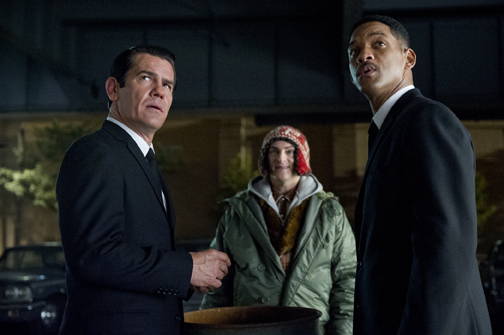
Ten years may have passed, but nothing has changed: same gonzo hardware; same outrageous — and dangerous — aliens; same giddy Danny Elfman score; same stoic, sourpuss expression on Tommy Lee Jones’ face.


Having time-jumped back to 1969, Agent J (Will Smith, right) finds it hard
enough to persuade his partner Agent K's younger self (James Brolin, left) of the
severity of their mission. Things get even more complicated with the arrival of
Griffin (Michael Stuhlbarg), a hyper-dimensional alien with the ability to see
all outcomes — good and bad — of every possible reality.
Come to think of it, Jones hasn’t changed a jot in a decade. Perhaps he’s actually an alien in disguise?

Men in Black III is a hoot ’n’ a holler, and a welcome return to form after this series’ somewhat disappointing sophomore installment, back in 2002. And while it’s still not possible to recapture the 1997 original’s gleefully warped freshness, this third entry’s writers — Etan Cohen, David Koepp, Jeff Nathanson and Michael Soccio — have done a nifty job with an ingenious premise that stimulates plenty of snarky one-liners.

On top of which, Will Smith’s comic timing remains every bit as reliably droll as Jones’ slow, impassive takes.

The narrative kicks off with a slick jailbreak engineered by Boris The Animal (Jemaine Clement), a truly nasty baddie with a morphology that gets ickier as the film proceeds. Boris — a Boglodite who gets enraged when people add “The Animal” to his name — has been incarcerated on the Moon for the past 40-plus years, where Agent K (Jones) put him after a particularly nasty skirmish at Cape Canaveral, back on July 16, 1969.

If you don’t immediately register the significance of that date, surrender your geek cred card at the door.

With Boris seeking vengeance, Agent J (Smith) tries to pull the file on that old MIB case. Unfortunately, he finds the information restricted: rather mysterious, given his usual security clearance. Attempts to gain access get him nowhere; the new head of MIB, Agent O (Emma Thompson), leaves him with an enigmatic warning: “Don’t ask questions you don’t want the answers to.”

Funny thing, J reflects; that’s precisely what K has said, on numerous occasions.

(Thompson’s Agent O has taken over for Rip Torn’s Agent Zed, from the previous two films. For some reason, Torn opted out of this installment.)

Friday, July 22, 2011

Captain America: Gung-ho glory

Captain America: The First Avenger (2011) • View trailer
Four stars. Rating: PG-13, and perhaps too harshly, for sci-fi violence and action
By Derrick Bang • Originally published in The Davis Enterprise, 7.22.11


We're in good hands with this fellow.

And I don't mean Captain America, although he also has our backs. I'm referring to director Joe Johnston, who has the perfect touch for this sort of material: precisely the proper blend of dramatic heft, low-key humor and well-choreographed action scenes.
Steve Rogers (Chris Evans, center), having seized an opportunity to lead a
rescue mission deemed impossible by his superior officer, discovers that his
silly, USO-show costume might serve an important symbolic purpose after all.

Johnston understands the balance necessary for us to buy into fantasy, and he also sets a mean period stage; we always feel part of whatever era and locale his projects exploit. And he clearly has a fondness for retro superhero sagas, having delivered an impressively authentic and entertaining — and sadly undervalued — adaptation of The Rocketeer, back in 1991.

But Johnston is equally at home with the fully grounded and more gently emotional requirements of an intimate character drama such as 1999's October Sky, or the all-stops-out roller coaster ride found in 2001's Jurassic Park 3. The latter may have been formulaic and a shadow of its predecessors, but somebody had to step into Steven Spielberg's shoes ... and, to his credit, Johnston made sure his continuation wasn't a pale shadow.

And since I'm waxing poetic about Johnston's earlier accomplishments, let me also praise 2004's thoroughly engrossing horse-racing saga, Hidalgo ... which also never found its audience. Some directors just can't catch a break.

But Johnston certainly snatched the gold ring this time. Armed with a pitch-perfect script — Christopher Markus and Stephen McFeely, take a bow — and a skilled ensemble cast, Johnston has delivered a well-told fantasy saga that feels as innocently high-spirited and pridefully patriotic as America itself, during the turbulent days of World War II.

At the same time, Johnston fulfills the genre requirements expected by the Marvel Comics geeks who always sharpen their blogging knives, in anticipation of disrespectful or otherwise inferior big-screen adaptations. Markus and McFeely know their stuff, and they've managed the quite impressive task of nailing this patriotic symbol of two eras. Bear in mind that Cap, although still a stalwart of contemporary comics fiction, emerged as a red, white and blue avenger in the 1940s ... and yet hasn't aged.

Ah, therein lies a tale...

Which I'll not spoil.

Following a suitably intriguing prologue, we meet scrawny Steve Rogers (Chris Evans): the epitome of a 98-pound Brooklyn weakling, but no less determined to sign up for his chance to help end Hitler's Nazi reign. But no recruiting office wants an undersize mutt who also suffers from asthma and a dozen other physical issues, and Steve should know; he has tried every "Uncle Sam wants you" station within easy travel, using a variety of aliases.

Friday, January 28, 2011

The Company Men: Downsize this

The Company Men (2010) • View trailer for The Company Men
Three stars (out of five). Rating: R, for profanity and brief nudity
By Derrick Bang


Although made with good intentions and well performed by an earnest cast, The Company Men ultimately drowns beneath writer/director John Wells’ soggy sentimentality and contrived character dynamics.

Not to mention a Pollyanna “resolution” that will infuriate anybody suffering long-term unemployment as a result of the current economic downtown. At the risk of inserting a major spoiler, we all should be lucky enough to catch the attention of a well-heeled sugar daddy.
Although unemployed and facing no prospects, Bobby (Ben Affleck, right)
breezily refuses an offer of work from his blue-collar brother-in-law, Jack
(Kevin Costner), which merely reinforces the latter's belief that his sister
married a world-class idiot.

Wells tries to eat his cake and have it: utterly impossible, when dealing with a subject this grave, this immediate, this ripped from the headlines. If Bobby Walker (Ben Affleck), Gene McClary (Tommy Lee Jones) and Phil Woodward (Chris Cooper) are intended to represent men downsized and left feeling impotent by the loss of their stature as primary family bread-winners, then Wells must remain true to this premise. Instead, he eventually opts for a jarring fairy tale outcome apparently intended to send people from the theaters with optimistic smiles.

Nonsense. While it’s true we usually seek solace and escapism from the movies, we also expect consistency and fair play on the part of the filmmaker. 2009’s Up in the Air felt real, and made shrewd, perceptive statements about the widening divide between greedy corporate CEOs and rank-and-file employees; The Company Men is trite, dishonest and ultimately insulting.

The story begins as Bobby, smugly confident of the good life he has provided for his family, arrives at work after an early morning round of golf, only to discover that he has been swept up in a fresh round of layoffs at GTX, a large manufacturing conglomerate with more than 60,000 employees (although not for long). Bobby simply cannot – will not – believe it: This can’t be happening to him.

Still, he’s bright, cocky and talented; he breezily insists, when joining the ranks at a local professional job placement service – funded for a few months, as part of the GTX severance package – that he’ll be “outta here in a few days.”

His wife, Maggie (Rosemarie DeWitt, delivering this film’s most sensitive performance), knows better. Although resolutely in her husband’s corner, she knows he’s but one of thousands of middle-age MBAs seeking new placement; she advises selling his beloved Porsche, canceling the country club membership and cutting back on “routine” expenses that have left them with absolutely no cushion.