Showing posts with label Michael Stuhlbarg. Show all posts

Friday, April 11, 2025

The Amateur: Could be more professional

The Amateur (2025) • View trailer
3.5 stars (out of five). Rated PG-13, for strong action violence and some profanity
Available via: Movie theaters
By Derrick Bang • Published in The Davis Enterprise, 4.13.25

Robert Littell’s long reign as an espionage author got an early start with this 1981 novel, which jumped to the big screen that same year, as a tidy little thriller starring John Savage, Christopher Plummer and Marthe Keller.


Despite his best efforts, Charlie (Rami Malek) simply lacks the killer instinct required of
a good CIA field agent, as his handler, Henderson (Laurence Fishburne) points out.

Despite — or because of — its fidelity to Littell’s book, most critics pooh-poohed a plot they found laughably contrived. (Hey, I liked it anyway.)

Perhaps bearing that in mind, scripters Ken Nolan and Gary Spinelli have retained only the bare bones of Littell’s plot for this remake, while modernizing events with all sorts of computer modeling, surveillance technology and satellite spycraft that didn’t exist in the early 1980s.


Ironically, the result becomes just as unlikely and increasingly contrived, as the solid first act moves into the second and third. That said, director James Hawes and editor Jonathan Amos move events at a briskly enjoyable pace, and everything is anchored by Rami Malek’s richly nuanced and persuasively credible performance.


Charlie Heller (Malek) is a brilliant but deeply shy and introverted CIA decoder, who works in a basement office at the agency’s Langley headquarters. He has three passions in life: his work, his beloved wife Sarah (Rachel Brosnahan) and solving puzzles.


Sarah is his polar opposite: vivacious and outgoing ... but gently understanding and tolerant of Charlie’s preference for isolation. She therefore isn’t surprised when he declines to join her for a trip to London, to attend a conference.


His world collapses, upon arriving for work the next day. His Langley superiors — Moore (Holt McCallany), head of the covert Special Activities Center; and Alice O’Brien (Julianne Nicholson) CIA director — inform him that Sarah has been killed by terrorists who invaded the London conference.


(Even at this moment, when compassion seems called for, McCallany plays his role so aggressively, that he may as well have “Doing And Concealing Bad Stuff” tattooed on his forehead.)


Standing in O’Brien’s office, Charlie wilts like a stalk of old celery. Malek’s performance is shattering: the epitome of loss, grief, shock and a level of rage that has no outlet.


Back at his desk, as the next few days pass, Charlie employs his computer skills to identify and compile detailed dossiers of the four terrorists involved. But when he presents this information to Moore and his close colleague Caleb (Danny Sapani) — head of the CIA’s Nuclear Proliferation branch — Charlie is stunned to discover that a) they already know; and b) apparently aren’t doing anything about it.


Moore threatens Charlie with insubordination, if he doesn’t drop the matter.


Wrong move.


By coincidence — and thanks to a mysterious, heavily encrypted online source dubbed Inquiline — Charlie has gained possession of damning information about unsanctioned covert CIA operations. Armed with some of these documents, he blackmails Moore and Caleb into sending him to “agent training school,” so that he can travel overseas, track down the terrorists, and execute them himself (!).


As an added threat, Charlie promises that — if anything should happen to him, in the meanwhile — copies of said documents will be distributed to major news outlets.


He’s sent for a crash course in field work, under the tutelage of Henderson (Laurence Fishburne), a retired CIA colonel who coldly assesses Charlie’s lack of physical prowess. Even so, Charlie proves quite adept at some tasks — improvising tactical explosives, as one example — but utterly hopeless at even holding a gun, let alone shooting one.


One of Fishburne’s many fine moments concerns the latter, when Henderson challenges Charlie to point a loaded gun at him ... and, despite teeth-gritting effort, he can’t.


“Some people are killers,” Henderson finally says, gently. “You aren’t.”


Charlie eventually heads to London and then — following his own leads — Paris, where he knows how to find the first terrorist.


And we’re off to the races.


Nolan and Spinelli concoct clever — if improbably elaborate — ways for Charlie to proceed with his mission. On the other hand, he doggedly proceeds through unfamiliar locales — eventually including Marseille and Istanbul — like a seasoned tourist, which he obviously isn’t, and always is able to determine exactly where to go.


Setbacks abound, and it’s frankly amazing that no matter how many times Charlie is forced to abandon his equipment — and everything else — he’s always able to buy a fresh set-up, and continues to have money for lodging, meals and so forth.


As if the terrorists aren’t bad enough, he’s soon being followed and attacked from all sides, including the KGB (!). At one point, finally desperate, he reaches out to Inquiline ... about which, I’ll say no more.


The film is saved by the fact that all characters are portrayed convincingly by each member of the large ensemble cast. Malek’s delicately shaded performance contains multitudes; he’s thoroughly engaging in every scene. Charlie veers from stubborn determination to lingering grief, and Malek’s expression is particularly heartbreaking when Charlie keeps “seeing” Sarah at unexpected moments.


“You should go home,” he’s told, at one point.


“I can’t,” he replies, forlornly. “She’s not there.”


Henderson’s transformation from compassionate instructor to implacable pursuer is jarring — but not unexpected — and Fishburne makes the guy quite lethal. Nicholson is terrific as O’Brien, unimpressed by Moore’s glib assurances, and clearly underestimated by him. Jon Bernthal is appropriately mysterious as a field agent dubbed The Bear, who owes a debt to Charlie; Michael Stuhlbarg is chilling as Schiller, the guy who led the London terrorist attack.


The ubiquitous Adrian Martinez is a welcome ray of sunshine as Carlos, one of Charlie’s CIA techie colleagues, and it’s a shame his role wasn’t expanded.


In a droll nod to this film’s 1981 predecessor, Marthe Keller pops up briefly, as a florist.


Hawes and cinematographer Martin Ruhe make ample use of the many international backdrops, none more charming than the fishing community setting that dominates Charlie’s time in Marseille.


Although this obviously is a check-your-brains-at-the-door thrill ride, Malek and his co-stars make it more compelling than the plot deserves.


And, sometimes, that’s enough. 

Friday, February 2, 2018

Call Me By Your Name: An incandescent depiction of love

Call Me By Your Name(2017) • View trailer 
Four stars. Rated R, for nudity, frank sexual content and profanity

By Derrick Bang • Originally published in The Davis Enterprise, 2.2.18

One cannot imagine more perfect circumstances under which to fall in love.

Or a more lyrical and sensitive depiction of same.

Meals at the Perlman home invariably take place outside, surrounded by the estate's lush
orchards: genial gatherings during which Professor Perlman and his wife (Michael
Stuhlbarg and Amira Casar, left) make newcomer Oliver (Armie Hammer, second from
right) feel at home, while their teenage son Elio (Timothée Chalamet) keeps his
thoughts to himself.
Director Luca Guadagnino’s sweetly poignant Call Me by Your Name captures the jokey, nervous, wary and (ultimately) full-throttle rush of falling in love: not of first love, necessarily, but rather of true love. The bond that proves life-changing: the one that we instinctively know, deep down, will be remembered — savored — forever, regardless of how long it lasts.

Credibly conveying this flurry of complex emotions on the big screen isn’t easy, because — in real life — so much of such intimate surrender is private, and wordless. Movies are great when it comes to playful eroticism or naked lust, but attempts to convey genuine passion — and goodness, such attempts are legion — too often are cluttered with relentless (and unnecessary) dialog.

Guadagnino and scripter James Ivory understood this, and deftly rose to the challenge of adapting André Aciman’s 2007 novel. Ivory just collected a well-deserved Academy Award nomination for his efforts.

The setting is Northern Italy; the year is 1983, before computers and Smart phones would become ubiquitous thieves of shared personal time. Professor Perlman (Michael Stuhlbarg), a distinguished scholar in the field of Greco-Roman culture, traditionally spends summers with his wife, Annella (Amira Casar), and their son, Elio (Timothée Chalamet), in the family’s 17th century villa.

It’s a long, lazy busman’s holiday of sorts, with research interrupted frequently by biking, outdoor sports, swims in the nearby lake, and languid, wine-fueled meals. Seventeen-year-old Elio, an accomplished pianist, takes after his father; the boy reads voraciously, transcribes music, and flirts with the numerous local girls, most notably Marzia (Esther Garrel). Clothing is sparse; sex is in the air.

The villa is surrounded by trees, all laden with fruit as ripe as the lithe young bodies.

As is his custom, Perlman invites a graduate student to share his research during a six-week sojourn. This summer’s arrival is 24-year-old Oliver (Armie Hammer), who is pursuing his doctorate.

Oliver is hip, flip and immediately — confidently — at ease in these new surroundings. Elio, amused and annoyed by this brash newcomer, manifests teenage aloofness and mild condescension. Oliver, in turn, responds with slightly mocking indifference.

Or maybe something else is going on.

Monday, December 25, 2017

The Shape of Water: Flows exquisitely

The Shape of Water (2017) • View trailer 
Five stars. Rated R, for nudity, strong sexual content, profanity and violence

By Derrick Bang • Originally published in The Davis Enterprise, 12.29.17

Truly adult fairy tales may be the rarest of movie treasures, given how almost everything these days — particularly what emanates from corporate Hollywood — is designed for all-ages audiences.

When things start to go awry in the top-secret facility where they all work, paranoid
government agent Richard Strickland (Michael Shannon) interrogates everybody, including
cleaning women Elisa (Sally Hawkins, center) and Zelda (Octavia Spencer, center right).
We need look elsewhere for thoughtful, intelligent and provocative alternative fare: the cinematic equivalent of, say, Neil Gaiman’s The Ocean at the End of the Lane (far more disturbingly graphic — but just as imaginative — as his Coraline or The Graveyard Book).

France’s Marc Caro comes to mind, with Delicatessen and The City of Lost Children, the latter co-directed with Jean-Pierre Jeunet, equally adept at the genre, as evidenced by Amélie and Micmacs. Spain’s Alejandro Amenábar gave us The Others.

But they all pale alongside Mexico’s Guillermo del Toro, whose intriguing early efforts in this rarefied environment — Mimic and The Devil’s Backbone — were but a prelude to the masterful Pan’s Labyrinth: by far one of the most unsettling and provocative blends of fantasy and real-world horror ever brought to the big screen.

Until now.

The Shape of Water is an entirely different sort of Del Toro masterpiece: a richly detailed parable of lonely people coping with extraordinary circumstances, while confronting the monsters in our midst. The narrative — co-written by Del Toro and Vanessa Taylor — has the lyrical quality of a gently poignant fable, which nonetheless conceals the sort of savagely ironic message beloved by Rod Serling.

It feels like one thing, upon entry: becomes something entirely different, before we’re allowed to exit.

Best of all, the film is powered by a truly stunning starring performance by Sally Hawkins, who in a few short years has emerged as one of the world’s finest and most sensitively nuanced actresses. She has enjoyed a remarkable year: This film follows her delicately crafted work in summer’s Maudie, and her unforgettable portrayal of Nova Scotia folk artist Maud Lewis.

Nobody could have expected a second, equally transcendent performance in the same year. Her character here is similarly disenfranchised, and yet entirely different: a lonely, quietly withdrawn woman who blossoms — like a flower unveiling luminescent colors in bright sunlight — under highly unusual conditions.

The setting is Baltimore; the time is the early 1960s. On the one hand, this is recognizably our reality, as evidenced by familiar clothes, cars and (frequently intolerant) attitudes. People amuse themselves, at home after work, with soporific sitcoms such as Mr. Ed and The Many Loves of Dobie Gillis. Lurid news reports are a daily reminder of post-atomic Cold War paranoia.

And yet other aspects quickly signal that this isn’t quite our world, but in fact a closely related parallel reality.

Friday, December 9, 2016

Miss Sloane: Superbly written political drama

Miss Sloane (2016) • View trailer 
Four stars. Rated R, for profanity and occasional sexuality

By Derrick Bang • Originally published in The Davis Enterprise, 12.9.16

Abraham Lincoln tried — and failed — to abolish lobbyists.

“Lobbyists have more offices in Washington than the President,” Will Rogers famously observed. “You see, the President only tells Congress what they should do. Lobbyists tell ’em what they will do.”

Having decided to take a shot at persuading senators to back a bill enhancing gun
background checks, Elizabeth Sloane (Jessica Chastain, foreground) gains the support
of junior lobbyists, from left, Franklin (Noah Robbins), Lauren (Grace Lynn Jung), Alex
(Douglas Smith) and Ross (Al Macadam).
Ayn Rand was somewhat more blunt: “Lobbying ... is the result and creation of a mixed economy: of government by pressure groups. Its methods range from mere social courtesies and cocktail party or luncheon “friendships,” to favors, threats, bribes, blackmail.”

One cringes at the thought of what lobbyists will be able to accomplish, dealing with a president who apparently stalled at fifth grade.

Director John Madden’s Miss Sloane would have been a provocatively charged political drama at any time; given the current circumstances, it’s also quite chilling. First-time writer Jonathan Perera’s electrifying script positively sizzles in the hands of star Jessica Chastain, who tears into the pungent dialogue with the ferocity of a starving lion. She doesn’t merely portray the title character; she charges into the role with messianic fervor.

Perera’s personal saga is just as compelling as his debut screenplay. He was 30 years old, working as an elementary school teacher in South Korea, when he began the project. Once finished, he solicited Hollywood industry reps via cold online queries; his script made the rounds, placing No. 5 on 2015’s celebrated “Black List” of most-liked but as-yet unproduced screenplays.

FilmNation Entertainment picked it up; Madden (Shakespeare in Love, The Debt, The Best Exotic Marigold Hotel) signed on to direct; Chastain agreed to star.

Perera’s dialog has the rat-a-tat intensity of Aaron Sorkin’s best work, with similar hot-button political relevance. It’s compelling, fascinating, suspenseful and crazy-making, lifting rocks and shining a light on slimy Capitol “business as usual” practices much the way The Big Short indicted behind-the-scenes banking shenanigans.

Perera retained sole scripting credit: almost unheard of, these days, for a newcomer. He’s guaranteed to garner an Academy Award nomination, as will Chastain.

Her title character, Elizabeth Sloane, is a high-powered lobbyist heading a team for a well-established “white shoe” firm headed by George Dupont (Sam Waterston). She’s brilliant, ruthless and utterly unscrupulous; she also has no life outside of her work. It’s telling that we never see her eating breakfast, changing clothes, watering plants or doing anything else that would suggest a home life.

Friday, November 11, 2016

Arrival: They're here!

Arrival (2016) • View trailer 
Four stars. Rated PG-13, for dramatic intensity and brief profanity

By Derrick Bang • Originally published in The Davis Enterprise, 11.11.16


Michael Crichton’a The Andromeda Strain pretty much invented the modern sci-fi techno thriller, and it was made into a crackling 1971 thriller by director Robert Wise.

After confronting the alien spacecraft that has terrified the entire United States, linguist
Louise Banks (Amy Adams) and physicist Ian Donnelly (Jeremy Renner) are garbed in
protective haz-mat suits, prior to their first meeting with the ship's inhabitants.
The tone was pure procedural, with a gaggle of scientists researching and conferencing in labs, to determine why a highly lethal microorganism killed everybody in a small Arizona town, except for a geriatric Sterno addict and a relentlessly cranky baby.

Few films since then have successfully duplicated that formula, because it’s a difficult tightrope walk: too many talking heads, and the result is boring; too much contrivance and coincidence, and audiences roll their eyes in contemptuous disbelief.

Director Denis Villeneuve gets the balance just right with Arrival, easily one of the most intelligent “first contact” movies Hollywood ever has delivered. Scripter Eric Heisserer embraced the challenging assignment of adapting sci-fi author Ted Chiang’s  2000 Nebula Award-winning novella, and the result is impressively faithful: fascinating, clever and suspenseful, with an out-there finale certain to fuel debates as impassioned as those that greeted the conclusion of 2001: A Space Odyssey.

The story also boasts one of the most truly unusual alien cultures ever conceived, the depiction of which is likely to forever change most viewers’ perception and understanding of language.

Finally, the film is an uncomfortably timely reminder of the dangerous levels of nationalism and xenophobia currently running amok throughout this country and the globe, and the consequences of failing to recognize that — at the end of the day — we’re a single species sharing this planet, and that it behooves us to behave accordingly.

To cases, then:

Northeastern university professor Louise Banks (Amy Adams), an internationally respected linguist, is surprised one day to discover that her huge, entry-level language class is almost empty. The reason becomes clear as breaking news reports interrupt all radio and television broadcasts: A disturbingly large something has landed in a deserted Montana meadow.

Actually, “landed” is the wrong word; the semi-cylindrical object hovers about 20 feet off the ground.

Friday, April 22, 2016

Miles Ahead: A bizarre, self-indulgent cacophony

Miles Ahead (2015) • View trailer 
Three stars. Rated R, for relentless profanity, nudity, drug use and flashes of violence

By Derrick Bang

Following an astonishing prolific decade of studio work — with 32 (!) albums released on Prestige, Blue Note and Columbia during the 1950s — Miles Davis hit mainstream acclaim with 1959’s now-legendary Kind of Blue, followed in quick succession by Sketches of Spain and Someday My Prince Will Come, the latter inspired by his wife Frances, who was pictured on the LP cover.

Don Cheadle's performance as Miles Davis is so spot-on that it's eerie, down to the
smallest details. Alas, the film that surrounds this superb acting isn't nearly as satisfying.
Those forever remained the go-to albums for many of Davis’ most enthusiastic fans, much to the jazz trumpeter/composer’s ongoing annoyance. He hated looking back, and he absolutely hated being “defined” by his 1950s/early ’60s sound; God forbid that one should even pigeonhole his work by calling it “jazz.”

“Jazz is an Uncle Tom word,” he famously said, during a December 1969 Rolling Stone interview. “It’s a white folks word.” When pressed, he insisted that rock and jazz both deserved to be termed “social music.”

Like most truly inquisitive artists, Davis thrived on exploring and challenging music’s very essence and form. His output during the latter 1960s and early ’70s became increasingly outré, unmelodic and challenging for even the most patient listener: wild, harsh, flamboyant, unrestrained — granted, always technically proficient — dissonant and cacophonous.

As if he were trying to be provocative, and daring people to dislike the result.

The same can be said of Don Cheadle’s aggressively weird “cinematic reflection” on Davis’ life and career ... or, at least, some portions thereof. This project obviously is a labor of love for Cheadle, who directed, stars, co-produced and co-wrote the script (the latter credit shared with Steven Baigelman, Stephen J. Rivele and Christopher Wilkinson).

The result is, by turns, celebratory, random and maddening: as gleefully bizarre and uncompromising as much of Davis’ latter-day music. To be sure, the film is anchored by Cheadle’s flat-out astonishing portrayal of Davis: less an acting challenge and far more some sort of full-immersion experience, as if the actor somehow figured out a way to “wear” Davis, like a suit of clothes.

From the raspy voice to the smug, condescending attitude and flashes of hot-tempered anger; from the often clumsy gait that seemed so unusual, contrasted with the always loving embrace with which Davis handled his horn ... it’s positively spooky.

Whether Cheadle’s riveting performance is sufficient compensation for the bizarre narrative style, though ... that’ll be up to individual viewers.

Friday, December 4, 2015

Trumbo: The writer as triumphant gadfly

Trumbo(2015) • View trailer 
Four stars. Rated R, for profanity and coarse sexual candor

By Derrick Bang • Originally published in The Davis Enterprise, 12.4.15

You have to love ironic serendipity.

When Trumbo was scripted, and then green-lighted for production, and then filmed — with much of its dialog lifted directly from legendary Hollywood screenwriter Dalton Trumbo’s actual speeches and testimony, and delivered so superbly by star Bryan Cranston — nobody could have anticipated that this impeccably mounted and rigorously authentic drama would be released just as our country is poised to repeat the same ghastly mistake made with Japanese American citizens during World War II, and the so-called “Communist sympathizers” who were blacklisted during the 1950s.

Packed tightly into a movie theater filled with eager patrons, Dalton Trumbo (Bryan Cranston)
and his wife, Cleo (Diane Lane), await the film's all-important credits.
One of whom — Trumbo — is the subject of director Jay Roach’s heartfelt and thoroughly mesmerizing film.

Mesmerizing for two reasons: because of scripter John McNamara’s skillful adaptation of veteran journalist Bruce Cook’s 1976 biography, written with Trumbo’s full cooperation; and because of Cranston’s richly nuanced portrayal of the feisty novelist, screenwriter and social agitator.

No question: Trumbo was a character, and Cranston captures the famed scribe’s numerous eccentricities, righteous indignation and insufferable idealism. Trumbo fought the good fight, and lived to talk about it; his thorn-in-the-side persistence — assisted, at just the right moment, by a few Hollywood heavyweights — helped break the blacklist, and put an end to the ultimately ineffectual scare-mongering tactics that emanated from the House Un-American Activities Committee.

Roach and McNamara re-create this shameful bit of American history with the same darkly droll tinge of humor with which Trumbo peppered both his casual conversation and his screenplays. Actually, that’s an misstatement; Trumbo’s conversation rarely was casual, and Cranston gleefully chews into McNamara’s dialog — and Trumbo’s own words — with the enthusiasm of a hyena tearing at a carcass.

We’ve been down this road before, notably with 1976’s The Front — made with numerous individuals, both in front of and behind the camera, who had been smeared by the blacklist — 1991’s Guilty by Suspicion and 2005’s Good Night, and Good Luck.

The latter was highlighted by David Strathairn’s eerily authentic portrayal of broadcast journalist Edward R. Murrow. Cranston takes a slightly different approach with Trumbo, nailing the man’s behavior and wonderfully rich verbal vitriol, without really trying to imitate him. As easily observed in the period photos and news clips that appear during the closing credits, Cranston doesn’t really look much like Trumbo.

By my, he sure sounds and acts like him.

Friday, October 23, 2015

Steve Jobs: A tarnished Apple

Steve Jobs (2015) • View trailer 
3.5 stars. Rated R, for profanity and dramatic intensity

By Derrick Bang • Originally published in The Davis Enterprise, 10.23.15

The ensemble cast is strong, impeccably directed and well-suited to each role.

The dialog is rat-a-tat enthralling: classic Aaron Sorkin arguments and badinage, with verbal zingers and snarky rejoinders landing like physical blows, recipients wincing in pain or retreating behind wary glances. It’s the stuff that made The Social Network and TV’s West Wing and The Newsroom so spellbinding: the intelligent, sharp-edged and fast-paced discourse that we’re neither clever enough, nor quick-witted enough, to deliver in real life.

Struggling to find some way to connect with the young daughter whose paternity he denies,
Steve Jobs (Michael Fassbender) encourages Lisa (Makenzie Moss) to play with a
spanking-new Macintosh computer. "You can't break it," he promises.
It feels more like an intimate, minimalist stage play, and in fact Sorkin has structured it that way, with three distinct acts. I was reminded, more than once, of David Mamet’s Glengarry Glen Ross, made into a similarly mesmerizing 1992 film.

But those characters were fictitious, if familiar archetypes that we’d likely find in the rapacious atmosphere of a high-end, nail-the-deal-no-matter-what real estate office.

Steve Jobs, in contrast, profiles the actual Apple guru, with ample attention paid to the close advisors circling his incandescent star. (He doesn’t appear to have any actual friends.)

And not once, not for a second, did I feel that Sorkin and director Danny Boyle had come anywhere close to capturing the actual Steve Jobs. This relentlessly distracting fact ruins the entire film. Although clearly a sort of “truthiness” — the script is adapted from Walter Isaacson’s thoroughly researched biography of Jobs — this drama seems to exist in a parallel universe where Sorkin has indulged in his own myth-making.

Goodness knows, Jobs was highly skilled at crafting and stage-managing the persona he displayed in public. And, in the interest of full disclosure, Sorkin has described this film as an “impressionistic portrait” of Jobs: an abstraction concocted to surround the Apple guru with the same six characters, at three crucial points in his career, and let them “bang on each other.”

A “heightened version of real life,” Boyle adds, in the press notes.

Balderdash. Those quotes sound like a defensive excuse: an effort to get ahead of the negative publicity destined to emerge — and it definitely has — after Jobs’ actual associates begin to complain, quite noisily, that Sorkin’s so-called portrait is pure hooey.

The degree to which this does or doesn’t prove off-putting will depend on each viewer’s allegiance to truth, and/or a sense of the real-world Jobs. Taken purely on its own merits, Boyle and Sorkin’s film deserves all the descriptive accolades cited in my opening paragraphs; it is riveting.

But even if we give Boyle and Sorkin the benefit of that particular doubt, we cannot escape one glaringly obvious problem: The Steve Jobs depicted here is a relentless, abusive, unapologetic bully. Michael Fassbender’s nuanced performance notwithstanding, there’s no trace of the persuasive, charismatic futurist who inspired and demanded greatness from his associates and staff.

This big-screen Jobs is just a cruel bastard. He couldn’t inspire anybody to change a light bulb, let alone deliver the miracles that routinely emerged from Apple. And all viewers, even clueless tech luddites, will understand the utter wrongness of this dynamic.

That said, one cannot argue with Sorkin’s clever narrative structure.

Friday, August 9, 2013

Blue Jasmine: Superb study in self-delusion

Blue Jasmine (2013) • View trailer 
4.5 stars. Rating: PG-13, for dramatic intensity, mature thematic material and brief profanity
By Derrick Bang • Originally published in The Davis Enterprise, 8.9.13


From the first scene, we can’t take our eyes off her: an unholy cross between Vivien Leigh’s Scarlett O’Hara and Gloria Swanson’s Norma Desmond, layered with the bland contempt that comes only from Manhattan socialites.

During a visit to New York, working-class Ginger (Sally Hawkins, right) encourages her
husband, Augie (Andrew Dice Clay, center right) to seek investment advice from the
wealthy and privileged Hal (Alec Baldwin), an aggressive Wall Street shark married to
Jasmine (Cate Blanchett). Ginger figures there's no downside; after all, Jasmine is her
sister, and nothing is more important than family ... right?
Cate Blanchett’s title character in Woody Allen’s Blue Jasmine is a frightening creature: a woman so accustomed to aristocratic excess that she cannot fathom existence among the 99 percent. Yet she’s also a figure to be pitied, and that’s the hypnotic magic of Blanchett’s performance: We simultaneously loathe and feel sorry for her, wondering how somebody who once was an ordinary little girl, could have grown into an adult so cut off from her humanity.

She’s Marie Antoinette or Eva Braun: a woman who can’t precisely be described as evil, because she really don’t know any better. Morality, integrity, loyalty, simple kindness ... these are qualities suited only for the common herd. Jasmine swans above such flawed behavior; she lives only for her own tightly compartmentalized pleasures, and for the attention lavished upon her by a doting and über-wealthy husband.

Allen has written really close to the bone this time, with an unflinching dissection of the privileged, often vacuous wives who proudly stand alongside the Bernie Madoffs, as they blithely screw the rest of us. Do these women even perceive, let alone understand, the monsters they take to their beds each night?

Allen has resurrected his career, phoenix-like, more times than I can count, and he’s once again on a roll: perhaps the best thus far. Midnight in Paris was both clever and delightful: an adult fantasy that brought him another well-deserved Academy Award. Blue Jasmine, in turn, will do the same for Blanchett. I don’t care what comes out between now and Dec. 31; nobody will top her bravura performance in this film.

She’s nothing short of amazing, and Blue Jasmine stands among Allen’s finest works.

We meet Jasmine during a plane flight from New York to San Francisco, where she has arranged to live with her sister, Ginger (Sally Hawkins), while attempting to pull her life back together. Jasmine’s personality is revealed during this airborne prologue, for she has trapped a seat mate — an elderly woman too polite to object — into enduring a litany of self-centered justification.

We don’t get many pertinent details, merely enough to understand the sheer torture that the oblivious Jasmine is inflicting on her temporary companion.

Friday, May 25, 2012

Men in Black III: Still well-suited

Men in Black III (2012) • View trailer
Four stars. Rating: PG-13, for sci-fi action violence and some disgustingly unpleasant monsters
By Derrick Bang • Originally published in The Davis Enterprise, 5.25.12


Ten years may have passed, but nothing has changed: same gonzo hardware; same outrageous — and dangerous — aliens; same giddy Danny Elfman score; same stoic, sourpuss expression on Tommy Lee Jones’ face.


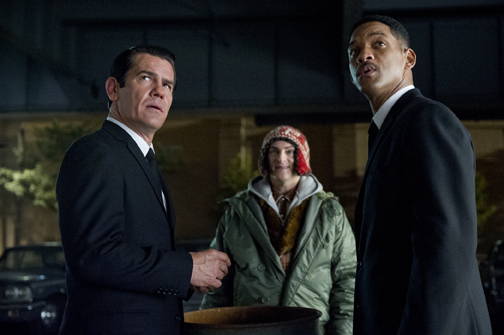
Having time-jumped back to 1969, Agent J (Will Smith, right) finds it hard
enough to persuade his partner Agent K's younger self (James Brolin, left) of the
severity of their mission. Things get even more complicated with the arrival of
Griffin (Michael Stuhlbarg), a hyper-dimensional alien with the ability to see
all outcomes — good and bad — of every possible reality.
Come to think of it, Jones hasn’t changed a jot in a decade. Perhaps he’s actually an alien in disguise?

Men in Black III is a hoot ’n’ a holler, and a welcome return to form after this series’ somewhat disappointing sophomore installment, back in 2002. And while it’s still not possible to recapture the 1997 original’s gleefully warped freshness, this third entry’s writers — Etan Cohen, David Koepp, Jeff Nathanson and Michael Soccio — have done a nifty job with an ingenious premise that stimulates plenty of snarky one-liners.

On top of which, Will Smith’s comic timing remains every bit as reliably droll as Jones’ slow, impassive takes.

The narrative kicks off with a slick jailbreak engineered by Boris The Animal (Jemaine Clement), a truly nasty baddie with a morphology that gets ickier as the film proceeds. Boris — a Boglodite who gets enraged when people add “The Animal” to his name — has been incarcerated on the Moon for the past 40-plus years, where Agent K (Jones) put him after a particularly nasty skirmish at Cape Canaveral, back on July 16, 1969.

If you don’t immediately register the significance of that date, surrender your geek cred card at the door.

With Boris seeking vengeance, Agent J (Smith) tries to pull the file on that old MIB case. Unfortunately, he finds the information restricted: rather mysterious, given his usual security clearance. Attempts to gain access get him nowhere; the new head of MIB, Agent O (Emma Thompson), leaves him with an enigmatic warning: “Don’t ask questions you don’t want the answers to.”

Funny thing, J reflects; that’s precisely what K has said, on numerous occasions.

(Thompson’s Agent O has taken over for Rip Torn’s Agent Zed, from the previous two films. For some reason, Torn opted out of this installment.)