Showing posts with label Lily Collins. Show all posts

Friday, January 8, 2021

Mank: A true dazzler

Mank (2020) • View trailer
Five stars. Rated R, for profanity and sexual candor
By Derrick Bang • Published in The Davis Enterprise, 1.8.21

Director David Fincher’s Mank is a magnificent experience in all manner of ways, starting with Gary Oldman’s mesmerizing portrayal of celebrated journalist, author and screenwriter Herman J. Mankiewicz.


Screenwriter Herman J. Mankiewicz (Gary Oldman) and actress Marion Davies
(Amanda Seyfried) meet over a shared cigarette; they'll soon bond over their
tempestuous fealty to William Randolph Hearst.


It’s also a bravura, often breathtaking display of cinematic art. Fincher, cinematographer Erik Messerschmidt and editor Kirk Baxter have meticulously replicated the style, atmosphere and very essence of the film — Citizen Kane — whose creation drives this narrative. The sharply sculpted screenplay — by Fincher’s late father, Jack — even mimics the non-linear storytelling style that was so innovative in Orson Welles’ classic.


The saga is rigorously period-authentic, and (mostly) historically accurate. Jack Fincher conflates a few key events — and meddles a bit with chronology — to heighten dramatic tension, but his characterization of key players is (often dismayingly) dead-on.


Perhaps Jack Fincher’s most audacious stroke is his revival of a controversy that film scholars have deemed long settled: the question of who actually wrote, and/or contributed the most, to the script of Citizen Kane. Fincher pere et fil clearly imply that Mankiewicz deserves the lion’s share of credit, whereas actual evidence weighs far more heavily in Welles’ favor. 


Ah, but even here, Fincher’s script is cheekily ambiguous … because their Mankiewicz clearly isn’t the most reliable narrator of — or participant in — his own life.


(In the movie world, stubborn skeptics are akin to those who insist that Shakespeare’s plays actually were written by Francis Bacon. For the record, though, Welles and Mankiewicz shared the screenplay Academy Award, the sole victory among Kane’s nine Oscar nominations.)


Fincher opens his film in early 1940, as Mankiewicz is deposited at an isolated ranch in Victorville, California, roughly 90 miles from the hedonistic Hollywood environment that exacerbates his worst tendencies. He’s left with secretary Rita Alexander (Lily Collins), longtime friend and writing associate John Houseman (Sam Troughton), and a nurse (Monika Gossmann) to care for a badly broken leg sustained in a recent driving accident.


Mankiewicz’s assignment from Welles: to come up with the initial draft of a screenplay depicting the imperious career of a combustible newspaper mogul who — wink, wink, nudge, nudge — isn’t really based on William Randolph Hearst. Except that of course it is.

Friday, May 10, 2019

Tolkien: Not entirely Hobbit-forming

Tolkien (2019) • View trailer 
Three stars. Rated PG-13, for war violence

By Derrick Bang • Originally published in The Davis Enterprise, 5.10.19

Aside from outliers such as Ernest Hemingway and Stephen King, most writers lead rather ordinary lives.

And what they do — crafting humble words into mesmerizing stories, generally in isolation — is hardly the stuff of engaging cinema.

Surrounded by the notes and illutrations that he feverishly sketches while playfully
creating entirely new languages, John Tolkien (Nicholas Hoult) nonetheless cannot shake
the feeling of not really belonging in his highbrow Oxford surroundings.
That said, John Ronald Reuel Tolkien’s back-story is more provocative than most.

Director Dome Karukoski’s Tolkien hits the myriad heartbreaking high points of Tolkien’s youth and young adulthood, and star Nicholas Hoult persuasively conveys the curiosity, intelligence, facility with languages, and almost magical gift for storytelling that later would inform his literary career.

David Gleeson and Stephen Beresford’s sensitive script clearly is well-intentioned, and Karukoski’s touch is sincere.

And yet…

The pace is dreadfully slow, and the decision to employ Tolkien’s horrific World War I experiences as a framing device is questionable, to say the least. We’re apparently expected to recognize that this is the devastating Battle of the Somme; context for this portion of the film is utterly absent. Every so often, Karukoski drags us back for another grim interlude, as Tolkien wanders through the body-strewn trenches in a daze, under the watchful gaze of a young private (Craig Roberts) who worries that his companion is about to drop dead.

The apparent point of these sequences is that the disoriented Tolkien — suffering from an acute case of debilitating trench fever — hallucinates the battle carnage into symbolic smoke- and shadow-laden warriors and monsters that later will inform the mythic creatures he concocts for The Hobbit and The Lord of the Rings.

Well … no.

It’s a clumsy, contrived device that simply becomes tedious as the film proceeds. It’s also superfluous; we’ve already seen that young Tolkien was inspired by his mother, Mabel (Laura Donnelly), who — as a means of distracting her two young sons from their “impecunious” existence — excels at spinning fantastical narrative adventures with the aid of a slowly spinning shadow lamp festooned with magical patterns. This sequence is far more magical — and persuasively credible — than the repeated bounces back to the trenches.

Wednesday, November 23, 2016

Rules Don't Apply: Chaos reigns

Rules Don't Apply (2016) • View trailer 
One star. Rated PG-13, for sexual candor and brief profanity

By Derrick Bang

Oh, my.

This may not be Warren Beatty’s worst film — Ishtar and Town & Country still arm-wrestle for that distinction — but it runs a close third.

Marla Mabrey (Lily Collins), hoping to become a Hollywood star, finds herself spending
lots of time with driver Frank Forbes (Alden Ehrenreich), who seems a poor substitute
for potential mentor Howard Huges. Initially, anyway...
Much has been made about the “sudden” appearance of this new Beatty project: the first time he has appeared on screen since 2001 (in the aforementioned Town & Country), and the first film he has written, directed, produced and starred in, since 1998’s Bulworth (also far from a classic).

Warren, you shoulda stayed retired.

Alas, too many artists cannot resist the itch to create, long after common sense should have removed them from the stage.

In fairness, even at its worst — and there’s plenty of “worst” to go around — Beatty’s new film reveals traces of the idiosyncratic sparkle that bloomed to perfection in classics such as Shampoo and Heaven Can Wait. And, at 79 years young, Beatty himself remains a master of the roguish twinkle and droll double-takes that made him such a memorable screen presence, back in the day.

But Rules Don’t Apply remains a mess.

It’s the worst sort of self-indulgent vanity project: a bloated, bewildering, pointless excuse to shovel several dozen high-profile guest stars into meaningless, ill-defined and under-developed parts. The so-called story is a muddle — Beatty sharing scripting credit with Bo Goldman — and the limply executed result commits the entertainment world’s most unpardonable sin: It’s boring.

Turgid, mind-numbingly dull, I’d-rather-endure-root-canal-surgery tedious.

It’s also superfluous. While Beatty is the right age to deliver his interpretation of Howard Hughes’ tragic final years, there’s no reason to do so. This film’s script offers no information, no character analysis, that wasn’t covered far better by Martin Scorsese and Leonardo DiCaprio, in 2004’s The Aviator.

On top of which, the whole Howard Hughes riff apparently is intended as mere framing device for a stuttering courtship between two young lovers caught in the eccentric industrialist’s disintegrating orbit. It’s a clumsy narrative device, and it fails utterly. Those who grimly slog through this film’s interminable 126 minutes still won’t care a whit about any of these characters.

I’m surprised that Goldman returned to this particular well, having won an Academy Award for writing 1980’s far more successful Hughes project, Melvin and Howard. Now, that was a clever, precocious, charming and thoroughly entertaining lark.

All of which are qualities sorely lacking in Beatty’s newest — and undoubtedly final — misfire.

Wednesday, August 21, 2013

The Mortal Instruments: City of Bones — Completely mundane

The Mortal Instruments: City of Bones (2013) • View trailer 
2.5 stars. Rating: PG-13, for intense fantasy violence and action, and mild sensuality
By Derrick Bang


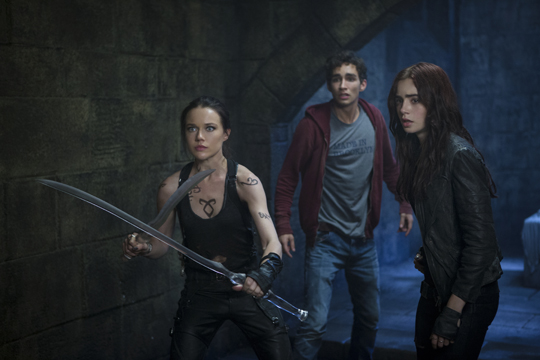
Every time I endure a clumsy fantasy such as this one, I’m reminded of what a rare and wonderful creature television’s Buffy the Vampire Slayer was, during its run from 1997 through 2003.

Our so-called heroine is Clary (Lily Collins), the one cowering at the far right. Despite
some intriguing powers, she's pretty useless in a fight, unlike her new colleague
Isabelle (Jemima West), every inch a gritty warrior. Goodness, even Clary's longtime
— and fully human — friend Simon (Robert Sheehan), despite his constant terror, is
more resourceful.
Which is to say, I’m reminded of the care that Buffy creator Joss Whedon took, with respect to characters, plotlines and — most essential of all — tone. Buffy was droll without being stupid, and Whedon and his fellow writers rigorously obeyed the rules that had been set forth, sometimes years earlier.

And if characters developed a fondness for each other — sometimes pairing off in highly unexpected fashion — they did so reasonably maturely (well, allowing for the crazed parameters of the show’s universe, anyway). They behaved like strong, self-assured and intelligent young adults. Most of the time. When not driven by ill-advised impulses ... but, even then, we rarely rolled our eyes in scorn.

Whedon respected us, as viewers.

In great contrast, director Harald Zwart and scripter Jessica Postigo don’t respect us at all, with their big-screen adaptation of The Mortal Instruments: City of Bones. It’s the epitome of a dumb fantasy, and its core characters — male or female — behave, at all times, like puerile little girls with absolutely no control over their emotions.

Which begs the question: What is this film’s target audience? The violence and monsters are too vicious for 8-year-olds, but the material and tone are too juvenile for older tweens and teens.

I hoped, going in, that this film would be a gender-flipped Harry Potter clone, with a stalwart female lead whom viewers could embrace. Instead, Zwart borrows much more heavily from the long-suffering sighs, pouty expressions and moronic motivations typical of the Twilight series. Our so-called heroine, Clary, simply isn’t worthy. And if our mortal realm honestly depends on her — and her hormones-in-hyperdrive “Scooby gang” — for survival, then we’re all in a lotta trouble.

Zwart’s film is based on the young adult fantasy series by Cassandra Clare (actually a nom de plume for Judith Rumelt), currently up to six books and counting. I’m not familiar with the books, and therefore unsure who to blame for this film’s breathlessly melodramatic tone. Perhaps Postigo made the best of what she was given, in which case Clare’s young readers deserve better.

Friday, March 30, 2012

Mirror Mirror: A shattering disappointment

Mirror Mirror (2012) • View trailer
Two stars. Rating: PG, and needlessly, for fantasy violence and mild rude humor
By Derrick Bang


Ever have one of those days when everything goes wrong?

Tarsem Singh had an entire film’s worth.

Snow White (Lily Collins, right) finds herself quite unwelcome at a lavish ball
given by her evil step-mother (Julia Roberts), who warns the girl — with dire
threats of reprisal — to refrain from crashing any future parties. Alas, we'd have
no story if Snow obeyed this edict, and besides: The next gathering will be
thrown in honor of the handsome prince who just arrived at the castle.
Either that, or the woefully under-prepared director slept through the entire shooting schedule of Mirror Mirror. Rarely has so much gone wrong, in so many obvious ways.

In fairness, there’s plenty of blame to spread among numerous other folks, starting with Melisa Wallack and Jason Keller, and their impressively clumsy script: no more than a “greatest hits” effort to beg, borrow or steal bits, concepts and even atmosphere from far better predecessors.

This is less a screenplay, and more a cynical attempt at formulaic success: the plot-establishing prologue, in a stylized artistic montage, from Disney’s Beauty and the Beast; a queen’s court comprised of decadent, garishly dressed aristocratic grotesques, from Tim Burton’s Alice in Wonderland; the bickering, roughly garbed but technologically adroit dwarfs, from Time Bandits; the occasional exaggerated twinkle of eye or tooth, from Blake Edwards’ The Great Race; and mostly the quirky blend of fairy-tale clichés and contemporary snark, from The Princess Bride.

Heck, I’m pretty sure somebody even says “As you wish,” with the same sort of inflection.

Unfortunately, mimicking so much, from so many earlier sources, is no guarantee of doing it well ... and, indeed, Mirror Mirror merely makes one yearn for all those other, far better films.

In a word, it’s a mess.

A rather boring mess, at that.

Which is a shame, because it’s certainly well-cast. Julia Roberts and Nathan Lane bring the appropriate brio to their ham-on-wry performances as, respectively, the evil queen and her cowering sycophant; Lily Collins deftly matures from fragile, sheltered princess to resolute champion of the kingdom; Armie Hammer is properly virtuous and heroic as the dashing young prince; and the dwarfs — in this case dubbed Grub, Grimm, Wolf, Butcher, Napoleon, Half-Pint and Chuckles (because he never laughs) — are a squabbling hoot.

They give their all, but it’s all for nothing. Because nothing else works.