Showing posts with label Robert Sheehan. Show all posts

Friday, December 14, 2018

Mortal Engines: High-octane thrills

Mortal Engines (2018) • View trailer 
Four stars. Rated PG-13 for dramatic intensity and sci-fi action and violence

By Derrick Bang

This one’s relentless.

Director Christian Rivers’ exhilarating adaptation of Philip Reeve’s Mortal Engines is sci-fi world-building on a scale we’ve not seen since Lord of the Rings and Avatar. This impressively ambitious, post-apocalyptic saga hits the ground running — literally — and doesn’t let up during a bravura 127-minute adventure that barely seems long enough to contain its opulent wonders.

Out of the frying pan, and into the fire? Tom (Robert Sheehan) and Hester (Hera Hilmar,
right) are moments from a fate worse than death, when they're snatched away by the
enigmatic Anna Fang (Jihae). But is this a rescue ... or something more sinister?
Scripters Fran Walsh, Philippa Boyens and Peter Jackson have done an impressive job of condensing Reeve’s 2001 young adult novel into a slam-bang romp that faithfully follows roughly half the book and hits most of the key plot beats. (That said, Walsh & Co. deviate seriously during the climax, likely in the interest of anticipating a sequel.)

These events take place a millennium after what has come to be known as the “Sixty Minute War,” when Western nations unleashed a cataclysmic weapon that destroyed much of civilization, while causing planet-wide geological upheaval. Forced to adapt to earthquakes, volcanoes and other instabilities that continued for hundreds of years, metropolitan centers were retrofitted with massive wheels and engines, in order to become mobile “traction cities”: a steampunk method of survival known as Municipal Darwinism.

Countries have vanished; civilization per se has developed into cooperative bands of peaceful small-town traders, constantly on the alert for fast-moving, scavenger settlements.

Along with the biggest threat of all: the massive predator city of London, which hunts, pursues and dismantles (devours) other cities for resources.

All this by way of back-story, because Rivers opens the film without preamble, as the massive bulk of London chases down a small mining community known as Salthook. Production designer Dan Hennah, cinematographer Simon Raby and a huge visual effects team — Ken McGaugh, Kevin Smith, Luke Millar and Dennis Yoo, take a well-deserved bow — swoop the camera in, around and through London’s jaw-dropping hugeness and complexity, layered with bits and bobs clearly snatched from countless earlier captures.

It’s an absolutely amazing, stunning sequence, particularly as many of London’s thousands of residents gather at their city’s layered edges, cheering the pursuit with the bloodthirsty savagery of heartless nationalists (an allusion to current real-world behavior, in which this film frequently indulges).

Salthook has maneuverability and quick turns in its favor, but it can’t compete with London’s stronger engines. The outcome is inevitable, with one of the smaller community’s residents — a young woman with a red scarf concealing part of her face — watching with (we’re surprised) what appears to be mixed feelings.

Wednesday, August 21, 2013

The Mortal Instruments: City of Bones — Completely mundane

The Mortal Instruments: City of Bones (2013) • View trailer 
2.5 stars. Rating: PG-13, for intense fantasy violence and action, and mild sensuality
By Derrick Bang


Every time I endure a clumsy fantasy such as this one, I’m reminded of what a rare and wonderful creature television’s Buffy the Vampire Slayer was, during its run from 1997 through 2003.

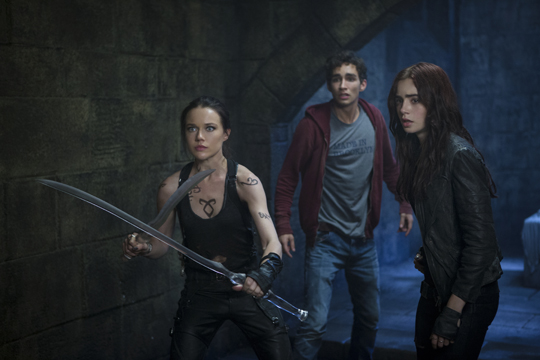
Our so-called heroine is Clary (Lily Collins), the one cowering at the far right. Despite
some intriguing powers, she's pretty useless in a fight, unlike her new colleague
Isabelle (Jemima West), every inch a gritty warrior. Goodness, even Clary's longtime
— and fully human — friend Simon (Robert Sheehan), despite his constant terror, is
more resourceful.
Which is to say, I’m reminded of the care that Buffy creator Joss Whedon took, with respect to characters, plotlines and — most essential of all — tone. Buffy was droll without being stupid, and Whedon and his fellow writers rigorously obeyed the rules that had been set forth, sometimes years earlier.

And if characters developed a fondness for each other — sometimes pairing off in highly unexpected fashion — they did so reasonably maturely (well, allowing for the crazed parameters of the show’s universe, anyway). They behaved like strong, self-assured and intelligent young adults. Most of the time. When not driven by ill-advised impulses ... but, even then, we rarely rolled our eyes in scorn.

Whedon respected us, as viewers.

In great contrast, director Harald Zwart and scripter Jessica Postigo don’t respect us at all, with their big-screen adaptation of The Mortal Instruments: City of Bones. It’s the epitome of a dumb fantasy, and its core characters — male or female — behave, at all times, like puerile little girls with absolutely no control over their emotions.

Which begs the question: What is this film’s target audience? The violence and monsters are too vicious for 8-year-olds, but the material and tone are too juvenile for older tweens and teens.

I hoped, going in, that this film would be a gender-flipped Harry Potter clone, with a stalwart female lead whom viewers could embrace. Instead, Zwart borrows much more heavily from the long-suffering sighs, pouty expressions and moronic motivations typical of the Twilight series. Our so-called heroine, Clary, simply isn’t worthy. And if our mortal realm honestly depends on her — and her hormones-in-hyperdrive “Scooby gang” — for survival, then we’re all in a lotta trouble.

Zwart’s film is based on the young adult fantasy series by Cassandra Clare (actually a nom de plume for Judith Rumelt), currently up to six books and counting. I’m not familiar with the books, and therefore unsure who to blame for this film’s breathlessly melodramatic tone. Perhaps Postigo made the best of what she was given, in which case Clare’s young readers deserve better.