Showing posts with label Ewan McGregor. Show all posts

Friday, December 16, 2022

Guillermo del Toro's Pinocchio: A truly unique vision

Guillermo del Toro's Pinocchio (2022) • View trailer
Four stars (out of five). Rated PG, and much too generously, despite considerable violence, dark thematic elements, peril and rude humor
Available via: Netflix

Although there’s much to admire in this handsomely mounted, stop-motion version of Carlo Collodi’s oft-filmed 1883 children’s novel, I’m reluctant to recommend it … in great part, because the intended target audience is a mystery.
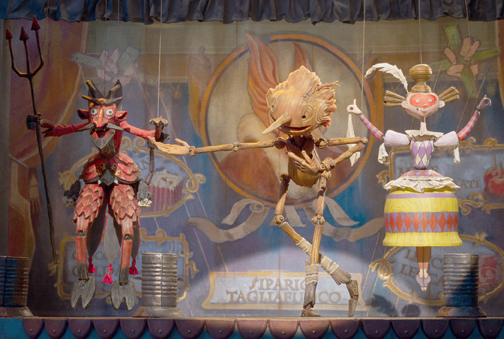
 

Having broken a promise to attend school, Pinocchio is delighted by the acclaim he
receives as the new star of Count Volpe's marionette show.


Del Toro’s relentlessly morbid and very loose adaptation definitely isn’t for children, who certainly won’t understand the updated shift to war-era Fascist Italy, and likely will be terrified by this setting. Nor can I picture mainstream adults wandering into what superficially appears to be a children’s film.

Unsuspecting parents who gather the kiddies for what they assume will be a family-friendly holiday flick, are apt to be horrified.


Even del Toro hedges this particular bet. “It’s not necessarily made for children,” he admitted, in a recent Los Angeles Times interview, “but children can watch it.”


Seriously?


I think not.


(Del Toro is fond of placing his dark fantasies against the backdrop of real-world horrors; both The Devil’s Backboneand Pan’s Labyrinth are set during the Spanish Civil War.)


Granted, the surrealistic writer/director has a legion of fans, and lovers of this painstaking animation style certainly will embrace this outrĂ© fantasy; perhaps, combined, they’ll be sufficient. And, in fairness, co-director Mark Gustafson’s stop-motion work is stunning; whatever else can be said about this film, it exhibits a true sense of wonder.


Pinocchio’s appearance here — rough-hewn, spindly, unfinished (missing one ear), a true marionette — is inspired by artist Gris Grimly’s illustrated 2002 edition of Collodi’s book.


And, backed by fine voice talent, del Toro and Gustafson elicit an impressive range of emotions from these characters.


But my goodness, this film is bleak. And macabre. And sad.


A lengthy prologue introduces wood-carver Geppetto (voiced by David Bradley) and his young son, Carlo (Alfie Tempest). The old man dotes on the boy, who — a model child — is equally devoted to his father: trustworthy, obedient, eager to learn. Alas, his life is cut short by a wartime tragedy.


Geppetto is heartbroken, overwhelmed by grief; his work suffers, leaving unfinished a large wooden effigy of Jesus in the local church, much to the chagrin of the village priest (Burn Gorman). Time passes; finally, in a fit of drunken rage one night, Geppetto makes a “replacement son” and then falls asleep.


A large, feather-winged, luminous blue wood sprite (Tilda Swinton) appears; taking pity on Geppetto, she grants life to the hastily carved little puppet. She then charges his “development” to the erudite and touchingly noble Sebastian J. Cricket (Ewan McGregor, who also narrates this tale).


Friday, February 7, 2020

Birds of Prey: Claws for alarm

Birds of Prey (2020) • View trailer 
Three stars. Rated R, for relentless profanity and violence, gore and brief drug use

By Derrick Bang

Margot Robbie’s mischievous grin, triple-dog-dare-ya gaze and pugnacious insolence are the main attraction in Birds of Prey, an unapologetically vulgar super-villain romp on par with Marvel’s Deadpool entries.

With the odds stacked impossibly against them, Harley Quinn (Margot Robbie, center)
persuades her companions — from left, ex-cop Renee Montoya (Rosie Perez), Mafia
princess Helena Bertinelli (Mary Elizabeth Winstead) and nightclub singer Dinah Lance
(Jurnee Smollett-Bell) — to band together, in order to protext young Cassandra Cain
(Ella Jay Basco, rear).
Fans of the latter will know precisely what they’re getting, with this similarly outrĂ© dip in the DC Comics universe.

During decades of myth-making, both comic book franchises occasionally have introduced villains who — thanks to reader enthusiasm for the character — have “reformed” and become forces of virtue. To a degree. 

Sometimes not much of a degree.

It’s hard to imagine Harley Quinn truly abandoning her bad-ass behavior; the best one could expect is that she becomes a lesser scoundrel while pursuing a much more heinous adversary (for her own reasons, of course, as opposed to anything having to do with the greater good).

Harley is, after all, the Joker’s equally homicidal girlfriend: firmly established, cinematically, in 2016’s Suicide Squad. But things change, and — as related during a droll animated prologue in this new film — Harley and her “Puddin’ ” have parted ways. (He threw her out.) Once past the initial heartbreak stage — Robbie camping it up as a pouting, alcohol-hazed, jilted lover — this “emancipation” initially seems like a good thing.

Ah, but absent the Joker’s protective embrace, Harley has become fair game for every thug and plug-ugly she once humiliated.

And that’s mere sidebar to Christina Hodson’s relentlessly snarky script. Robbie’s Harley narrates this saga in aggressively non-linear fashion, frequently backing up to fill in a key detail, and often breaking the fourth wall to address us directly in her delightfully sing-songy, working-class Brooklyn accent. This approach isn’t as confusing as it sounds, because the story isn’t that deep.

The nefariously narcissistic Roman Sionis (Ewan McGregor), mercurial owner of the popular Black Mask nightclub, is a bloodthirsty villain who has set his sights on the Bertinelli Diamond: not for the gem itself, but because it’s encrypted with essential information about that now-deceased Mafia family’s immense financial estate. Backed by such wealth, Sionis could rule Gotham City’s underworld.

The little bauble has been located, and Sionis sends his ghoulish right-hand-man, Victor Zsasz (Chris Messina), to fetch it. Alas, he falls victim to young pickpocket Cassandra “Cass” Cain (Ella Jay Basco), who — bad luck all around — is caught in the act by Gotham City Police Department Detective Renee Montoya (Rosie Perez). Result: One young felon in a GCPD jail cell.

Not wanting the gem to be found, she quite logically swallows it.

Friday, November 8, 2019

Doctor Sleep: Ultimately a yawn

Doctor Sleep (2019) • View trailer 
2.5 stars. Rated R, for violence, dramatic intensity, profanity, disturbing images and nudity

By Derrick Bang • Originally published in The Davis Enterprise, 11.8.19

When asked how he can stand to have so many of his books and stories ruined by bad movie adaptations, Stephen King is fond of quoting James M. Cain, who faced the same question in the wake of his novels being sanitized — to the point of absurdity — by 1940s and ’50s Hollywood morality standards.

Against his better judgment, but forced by dire circumstance, Dan Torrance (Ewan
McGregor) once again finds himself in the malevolent hallways of the dread Overlook Hotel.
“They’re not ruined,” Cain growled, pointing to his bookshelf. “They’re all right there!”

King can point to a much larger shelf, and it would be overstating to claim that director/scripter Mike Flanagan completely botched his handling of Stephen King’s sequel to 1977’s enormously popular The Shining. The first two acts of this film adaptation are impressively faithful to the 2013 novel.

The third act is something else again. 

It destroys the good will Flanagan has built up to that point, while demonstrating the arrogant hubris of filmmakers who believe that all books — and plays, TV shows, whatever — are ripe for “improvement.”

I’m not referring to the judicious trimming required to condense (in this case) a 528-page novel into a 151-minute film. Flanagan skillfully removed a couple of supporting characters, nipped here and tucked there, and trimmed the extensive attention paid to a hopeless alcoholic not yet ready to become sober (while retaining the issue vividly enough to make its point).

No, I’m much more troubled by Flanagan’s decision to completely re-write the ending, while simultaneously indulging in a mean-spirited viciousness wholly at odds with the tone of King’s book. The result is simply wrong, although intriguing from an analytical point of view: Flanagan’s first two acts honor King’s text, but the ill-advised third act plays more like a clumsy sequel to Stanley Kubrick’s’ 1980 adaptation of The Shining … which also screwed up its source material.

(Flanagan should have learned from previous mistakes, given his equally failed 2017 handling of King’s Gerald’s Game.)

A prologue finds young Danny Torrance and his mother relocated to Florida, only a short time after the events in The Shining: as far removed as possible from the freezing, claustrophobic Colorado snows that surrounded the dread Overlook Hotel. But its phantasms still haunt Danny, until the kindly specter of Dick Hallorann (Carl Lumbly, regal as always) teaches the boy how to deal with such vengeful shades.

Flash-forward several decades. Dan Torrance (Ewan McGregor), long tortured by his “shine,” has succumbed to the alcoholism that helped transform his father into the monster so easily corrupted by the Overlook’s supernatural residents. Constantly fleeing from bad situations, Dan hops a bus and randomly steps out in bucolic Frazier, N.H. He soon encounters Billy Freeman (Cliff Curtis), who senses all is not right with this newcomer. Dan responds to this random act of kindness, late one night, by knocking on Billy’s door and saying the three magic words: “I need help.”

Friday, August 3, 2018

Christopher Robin: Endearing, but uneven

Christopher Robin (2018) • View trailer 
3.5 stars. Rated PG-13, for no particular reason

By Derrick Bang • Originally published in The Davis Enterprise, 8.3.18

I’ve long regarded title credits as a strong indication of quality; a director who cares enough to insist upon clever, stylish or (in some manner) unusual credits, generally can be counted upon to give his film the same attention to detail.

Desperate to prevent passersby from realizing that Pooh is a stuffed bear who nonetheless
walks and talks, Christopher (Ewan McGregor) begs his childhood friend to "play taking
a nap."
In that respect, then, director Marc Forster’s Christopher Robin begins auspiciously. An extended prolog is lovingly and warmly animated from the E.H. Shepard illustrations in A.A. Milne’s original Winnie the Pooh books; the sequence also incorporates flipped pages laden with the correct type font. In all respects, it’s like we viewers jump into the book itself and become part of what follows, much in the manner of Jasper Fforde’s delightful Thursday Next novels.

This lengthy, period-appropriate introduction also establishes the firm bond between young Christopher Robin (Orton O’Brien) and his half-dozen plush animal friends, all seemingly hand-stitched, as if by some doting parent. They’ve organized a party in the Hundred Acre Wood, but the occasion is somber: Christopher Robin is heading off to boarding school. The mood is pure “Puff, the Magic Dragon.”

These sweetly animated characters are voiced sublimely, their note-perfect dialog — here, and throughout the entire film — impeccably crafted to match Milne’s blend of innocence and gentle playfulness (with numerous quotes lifted directly from the page). We can’t help being both charmed and saddened; the sweet sorrow of this impending parting is almost more than can be withstood.

Then the movie proper kicks in, and the mood is ... well, badly compromised, if not completely shattered.

The script — credited, with eyebrow-raising concern, to five different hands — is a patchwork mess stitched together with far less care than that given to its animated stars. The plot is a clumsy mash-up of Steven Spielberg’s Hook and Disney’s Mary Poppins — both centering around an adult who has lost track of his childhood sense of wonder — blended with numerous un-subtle nods to the three Disney Winnie the Pooh cartoon shorts produced between 1966 and ’74.

To make matters even worse, this film’s (mostly) soothing tone often is marred by the destructive slapstick sequences that infected so many of Disney’s insufferably stupid late 1960s and early ’70s live-action comedies. The sudden shift in tone can cause whiplash.

In a nutshell, these characters — human and otherwise — are far better than the derivative, wafer-thin and disappointing story into which they’ve been dumped.

Friday, March 17, 2017

Beauty and the Beast: Stick to the original

Beauty and the Beast (2017) • View trailer 
3.5 stars. Rated PG, for fantasy violence

By Derrick Bang • Originally published in The Davis Enterprise, 3.17.17

This is a curious beast.

Try as she might, Belle (Emma Watson) cannot dissuade Gaston (Luke Evans) from
attempting to win her hand in marriage. Sadly, this dynamic will become quite
uncomfortable, once Gaston becomes vengeful.
Every frame of director Bill Condon’s film looks terrific. Sarah Greenwood’s production design is breathtaking, from the gingerbread quaintness of Belle’s adorable town of Villeneuve; to the Lovecraftian opulence of the Beast’s labyrinthine castle, with all of its brooding corridors and shambling minarets; to the darkly spooky, wintry forest that separates the two.

Visual effects producer Steve Gaub seamlessly integrates the live-action characters with their enchanted comrades, and the voice acting is superlative: Ewan McGregor as the ever-gracious candelabra, Lumière; Emma Thompson as the kindly teapot, Mrs. Potts; Ian McKellen as the blustery mantel clock, Cogsworth; Stanley Tucci as the defiant harpsichord, Maestro Cadenza; Audra McDonald as the operatic, overly enthusiastic wardrobe, Madame de Garderobe; and Gugu Mbatha-Raw as the coquettish feather-duster, Plumette.

The primary characters are equally well cast, their performances admirably suited to the story’s fairy-tale atmosphere. Luke Evans steals the show as the arrogant, boorish Gaston, determined to wed Belle by any means necessary; the always impish Josh Gad — apparently Disney’s new secret weapon — gets all the best lines as Gaston’s snarky sidekick, LeFou.

Kevin Kline is sublime as Belle’s doting father, Maurice: a role that easily could slide into clichĂ©, with all of the aging gentleman’s quirks, eccentricities and easily flustered nature. But Kline surmounts such stereotyping with a persuasive blend of dignity, devotion and vulnerability; he sets a new standard.

It’s difficult to determine how much credit Dan Stevens deserves, as the Beast, given that he’s completely concealed beneath Jenny Shircore’s extraordinary make-up. But we’re seeing plenty of evidence of Stevens’ extensive acting chops, on TV’s Legion, so I’m willing to believe that he deserves plaudits for the credibility of the Beast’s complex emotional swing. And Stevens certainly does a lot with his eyes and voice, giving us the very definition of a tragic, doomed character.

And then there’s Belle, the story’s anchor, played with pluck, sincerity and resourcefulness by Emma Watson. Belle is delightfully bookish and ingenuous as the story begins, and yet bold enough to reject Gaston to his face; Watson’s early scenes with Evans are marvelous, as Belle struggles to remain polite while her eyes convey utter disgust for this boastful creep.

Friday, August 26, 2016

Humpback Whales 3D: Awe-inspiring

Humpback Whales 3D (2015) • View trailer 
Four stars. Suitable for all ages

By Derrick Bang • Originally published in The Davis Enterprise, 8.26.16

In a film laden with captivating facts — an impressive number of them, for a documentary that runs only 40 minutes — none is more unexpected than the revelation that the world’s attitude about whale-hunting was changed, almost overnight, by ... a record album.

Call it the world's most impressive belly-flop: Few things are more breathtaking than the
sight of a 55-foot, 50-ton whale propelling its massive body almost entirely out of the
water, in order to slap back onto the surface, accompanied by a thwomp with the
volume of a sonic boom.
1970’s Songs of the Humpback Whale, produced by biologist and environmentalist Roger Payne, culminated his three-year study of songs and vocalizations among these mighty ocean mammals. It became the best-selling environmental album in history, sharing not only the majestic beauty of these oddly melodic sounds, but proving that they represented a complex means of communication.

The subsequent “Save the Whales” movement, galvanized by this “discovery” of highly evolved whale culture, resulted in the 1972 United Nations Conference on the Human Environment’s global moratorium on commercial whaling (observed to this day by all but three countries: Japan, Iceland and Norway).

That’s an impressive result, for a rather unusual pop LP.

These magnificent creatures are celebrated in the MacGillivray Freeman IMAX documentary, Humpback Whales: a gorgeously filmed production with all the hallmarks of previous efforts such as Grand Canyon Adventure, Dolphins, Coral Reef Adventure and many others. Indeed, MacGillivray Freeman productions have long been the crown jewels of IMAX nature documentaries, and this one’s no exception.

Director Greg MacGillivray and his team of giant-screen cinematographers patiently recorded humpback behavior and migrations in the waters off Alaska, Hawaii and most particularly the remote islands of Tonga, which has enjoyed its own success with a local whale restoration program. Via commentary given just the right degree of reverence and Scottish lilt by off-camera narrator Ewan McGregor, we learn why humpbacks “perform” these diverse and haunting songs, and why they migrate up to 10,000 miles, round-trip, every year.

The always amazing footage is given greater dramatic heft by composer Steve Wood’s exhilarating score, which mixes humpback songs with an orchestral blend of piano, synthesized sounds and the energetic themes of Canadian folk guitarist Calum Graham. Wood also choreographs several sequences to the rousing 2014 pop anthem “Best Day of My Life,” which echoes the irrepressible bliss that we can’t help experiencing, while watching the humpbacks whirl, twirl and leap with abandon.

Needless to say, MacGillivray gives us plenty of “money shots” of these 55-foot, 50-ton, unexpectedly acrobatic animals propelling their massive bodies almost entirely out of the water, in order to slap back onto the surface, accompanied by a thwomp with the volume of a sonic boom.

Such scenes are awe-inspiring, to say the least.

Friday, April 22, 2016

Miles Ahead: A bizarre, self-indulgent cacophony

Miles Ahead (2015) • View trailer 
Three stars. Rated R, for relentless profanity, nudity, drug use and flashes of violence

By Derrick Bang

Following an astonishing prolific decade of studio work — with 32 (!) albums released on Prestige, Blue Note and Columbia during the 1950s — Miles Davis hit mainstream acclaim with 1959’s now-legendary Kind of Blue, followed in quick succession by Sketches of Spain and Someday My Prince Will Come, the latter inspired by his wife Frances, who was pictured on the LP cover.

Don Cheadle's performance as Miles Davis is so spot-on that it's eerie, down to the
smallest details. Alas, the film that surrounds this superb acting isn't nearly as satisfying.
Those forever remained the go-to albums for many of Davis’ most enthusiastic fans, much to the jazz trumpeter/composer’s ongoing annoyance. He hated looking back, and he absolutely hated being “defined” by his 1950s/early ’60s sound; God forbid that one should even pigeonhole his work by calling it “jazz.”

“Jazz is an Uncle Tom word,” he famously said, during a December 1969 Rolling Stone interview. “It’s a white folks word.” When pressed, he insisted that rock and jazz both deserved to be termed “social music.”

Like most truly inquisitive artists, Davis thrived on exploring and challenging music’s very essence and form. His output during the latter 1960s and early ’70s became increasingly outrĂ©, unmelodic and challenging for even the most patient listener: wild, harsh, flamboyant, unrestrained — granted, always technically proficient — dissonant and cacophonous.

As if he were trying to be provocative, and daring people to dislike the result.

The same can be said of Don Cheadle’s aggressively weird “cinematic reflection” on Davis’ life and career ... or, at least, some portions thereof. This project obviously is a labor of love for Cheadle, who directed, stars, co-produced and co-wrote the script (the latter credit shared with Steven Baigelman, Stephen J. Rivele and Christopher Wilkinson).

The result is, by turns, celebratory, random and maddening: as gleefully bizarre and uncompromising as much of Davis’ latter-day music. To be sure, the film is anchored by Cheadle’s flat-out astonishing portrayal of Davis: less an acting challenge and far more some sort of full-immersion experience, as if the actor somehow figured out a way to “wear” Davis, like a suit of clothes.

From the raspy voice to the smug, condescending attitude and flashes of hot-tempered anger; from the often clumsy gait that seemed so unusual, contrasted with the always loving embrace with which Davis handled his horn ... it’s positively spooky.

Whether Cheadle’s riveting performance is sufficient compensation for the bizarre narrative style, though ... that’ll be up to individual viewers.

Friday, January 23, 2015

Mortdecai: Fool's gold

Mortdecai (2015) • View trailer 
Three stars. Rated R, and needless, for fleeting profanity and mild blue humor

By Derrick Bang

I’ve a soft spot for light-hearted caper flicks, and a corresponding tendency to treat them gently, during post-mortem analysis.

It’s therefore with great regret that I pronounce Mortdecai a crushing disappointment.

Intending to rig the art auction on which their fortunes now depend, Mortdecai (Johnny Depp)
and his wife, Johanna (Gwyneth Paltrow) make a public appearance to allay suspicion.
But will the hapless Mortdecai be able to orchestrate his end of this complex swindle?
Although promoted as a caper saga, that’s not quite accurate; the closest our title character gets to a heist is climbing a ladder to enter a second-story window. And while the story does revolve around a rumored Goya masterpiece enhanced by the possibility that its canvas has been defaced with a code that might lead to long-lost Nazi gold, Eric Aronson’s script dwells too heavily on Mortdecai himself.

Preening, foppish, self-centered Charlie Mortdecai, played in full-blown, upper-class-twit mode by Johnny Depp.

Time was, a new Johnny Depp project was cause for celebration; he brought such panache to most everything he did a decade or so ago, in projects as diverse as Chocolat, From Hell, Finding Neverland and even the first Pirates of the Caribbean. More recently, though, his work has tended toward self-indulgent laziness, with Depp apparently coasting on the merits of his own career, and bringing little to each new party.

These days, in the wake of The Rum Diary, Dark Shadows and most particularly The Lone Ranger, we’re more inclined to roll our eyes at the prospect of a new Depp feature ... much the way his Mortdecai sighs theatrically and rolls his eyes at just about everything here.

That’s the major problem with director David Koepp’s approach; he and cinematographer Florian Hoffmeister focus far too much on Depp. Granted, one expects a movie’s star to receive the lion’s share of close-ups, but Depp’s slow, aristocratically condescending line readings — although initially droll — become tiresome, and eventually bring the otherwise fast-paced film to a grinding halt. Every. Time. He. Speaks.

Koepp is trying for a manic, effervescent blend of P.G. Wodehouse and The Pink Panther: a smart choice, since this film is inspired by the charismatic, forever cash-strapped, art-dealer anti-hero in a series of three comic novels by the late British author Kyril Bonfiglioli, and published back in the 1970s. His Mortdecai clearly is based on Wodehouse’s Bertie Wooster, and the resemblance is cemented further by Mortdecai’s far more capable manservant Jock Strapp, an equally obvious nod to Bertie’s Jeeves.

Bonfiglioli’s Mortdecai books are beloved by no less than Stephen Fry, who will be remembered as the pluperfect Jeeves in the 1990 TV series he did with frequent colleague Hugh Laurie. And if this film’s press notes are to be believed, Depp himself is another Bonfiglioli fan. So far, so good.

Friday, January 24, 2014

August: Osage County — A blistering summer

August: Osage County (2013) • View trailer 
Four stars. Rating: R, for frequent profanity and earthy dialogue, and occasional drug content

By Derrick Bang • Originally published in The Davis Enterprise, 1.24.14

Some children dream, worshipfully, of growing up to become just like their parents.

Other children have nightmares about that same possibility.

As Violet (Meryl Streep, left) grows increasingly annoyed by a clumsy before-meal
prayer that stumbles its way from awkward to tedious, daughters Ivy (Julianne
Nicholson, center) and Karen (Juliette Lewis) close their eyes and wait for the
inevitable explosion.
August: Osage County, adapted by Tracy Letts from his Pulitzer Prize-winning play, charts the highs (very few) and lows (too many to tabulate) of the extended Weston family, brought by unexpected tragedy to the Northern Oklahoma town that several of them fled, years ago, in self-defense.

Although Oklahoma isn’t technically a southern state — nor is it one of the plains states, despite an early comment by one of these characters — the tone here is very much in the dysfunctional Southern gothic tradition of Tennessee Williams, Beth Henley and numerous other playwrights who regard this classic American setting as less a geographical place, and more a regional attitude.

Southern families argue in a style all their own, tempers often as high as the mercury-shattering thermometers. And they don’t merely bicker; they dig at each other with rapacious delight, unerringly targeting each victim’s soft underbelly. Characters in such settings turn sniping into an art form, perhaps even an Olympic sport.

It’s impossible to imagine Northern California families quarrelling in such a fashion, no matter how strained the relations. The cadence, rhythm and circumstances are quintessentially rooted south of the Mason-Dixon line. Or thereabouts.

Be advised, then: Despite its mesmerizing script and bravura performances, August: Osage County is an endurance test in the manner of Who’s Afraid of Virginia Woolf. It’s not easy to watch people eviscerate each other for two hours, no matter how crisp the dialogue, or how striking the acting.

Most of the slicing and dicing emanates from family matriarch Violet Weston (Meryl Streep), an embittered, waspish harridan embracing old age with no grace whatsoever. Demonstrating that God does indeed possess a mordant sense of humor, Violet has just been diagnosed with mouth cancer, which has exacerbated her tendency to be a prescription junkie.

But the cancer hasn’t muted Violet’s bark, nor has it diminished her nicotine habit. Nothing is more ghastly — or darkly amusing, in a gallows humor sort of way — than watching Streep gently poke a cigarette into the less painful left corner of her mouth, and then fire it up so she can puff away.

Friday, March 1, 2013

Jack the Giant Slayer: A massive disappointment

Jack the Giant Slayer (2013) • View trailer 
Three stars. Rating: PG-13, for intense fantasy action violence, frightening images and fleeting profanity
By Derrick Bang


We’ve recently had two rounds of Snow White, not to mention re-imagined takes on Red Riding Hood and Hansel and Gretel, and now Warner Bros. has taken a crack at Jack and his beanstalk.

What’s next ... Clever Hans? The Fox and the Geese?

After Jack (Nicholas Hoult, right) comes up with a clever plan to distract a giant that is
blocking their escape, the stalwart lad and his companions — Elmont (Ewan McGregor)
and Isabelle (Eleanor Tomlinson) wait to see if the scheme will work.
Hollywood’s current fascination with fairy tales seems a logical next step after spinning so much box-office gold from comic book superheroes, but one does wish for material that’s more mature, rather than less. Aside from its marvelous CGI giants — and one helluva weed — Jack the Giant Slayer is a curiously clumsy and vacuous affair.

The screenplay — a patchwork affair credited to Darren Lemke, David Dobkin, Christopher McQuarrie and Dan Studney — has no moral whatsoever, which seems an odd way to approach this venerable English folktale. The characters, both good and evil, are handled haphazardly, with little regard for satisfying plot structure. Good guys get dispatched hastily and pointlessly, not even granted a chance to perish in an act of noble self-sacrifice; villains also check out too quickly, at unsatisfying junctures in this protracted narrative.

The whole film feels like a committee affair, as if the four writers squabbled and then grudgingly allowed each contributor’s favorite bit to get stitched into the final result.

The first-act build-up isn’t bad, with farm lad Jack (Nicholas Hoult) chafing over his dull life, as he works the land outside the 12th century fortified English city of Cloister. He seeks escape in the books once read aloud by his father, now dead: particularly the grim legend about the massive creatures who exist in a fearsome realm hovering between Heaven and Earth.

Elsewhere in the kingdom, headstrong Princess Isabelle (Eleanor Tomlinson, perhaps remembered from 2010’s Alice in Wonderland) feels equally confined, thanks to an overly protective father — Ian McShane, as King Brahmwell — who refuses to let her mingle with the common folk. Worse yet, she has been betrothed to the smarmy Roderick (Stanley Tucci), whose frequent sneers suggest far less than a noble heart.

Roderick has come into possession of the magic beans that are capable of growing a massive beanstalk to Gantua, the giants’ realm of lore, these days regarded as little more than a myth. Roderick intends to control said giants and rule the land, but a guardian monk manages to steal back the beans, which in turn are passed along to Jack. He and Isabelle “meet cute” — the second time, actually — during a stormy night when, clandestinely out and about, and seeking shelter from the rain, she happens upon Jack’s rustic house. (Such a coincidence!)

Friday, January 25, 2013

The Impossible: A compelling battle for survival

The Impossible (2012) • View trailer
4.5 stars. Rating: PG-13, for dramatic intensity, horrific mass injury and fleeting nudity
By Derrick Bang • Originally published in The Davis Enterprise, 1.25.13


FĂ©lix BergĂ©s and Pau Costa have been deservedly lauded for their special effects; the replicated tsunami — which killed more than 230,000 people in 14 countries, on Dec. 26, 2004 — is completely terrifying, as depicted here on the screen.

Battered by a wall of water, and injured in ways they haven't yet realized, Maria (Naomi
Watts) and her eldest son, Lucas (Tom Holland), struggle just to keep their heads
above the surface. As for the rest of their family ... they've absolutely no idea.
But these images, although breathtaking and grim, aren’t the strongest element of director Juan Antonio Bayona’s film. That honor belongs to Oriol TarragĂ³ and Marc Bech, who designed and edited the chilling sound effects. Indeed, that’s how The Impossible opens: on a black and silent screen, with a rising, gurgly sort of rumble that intensifies until we scarcely can stand it, wondering precisely what the sound signifies.

We imagine the worst, our minds racing in ghastly directions, this directorial choice far more powerfully placing us “in the moment” than what might be shown.

Then we nearly jump out of our seats as a passenger jet screams into the suddenly illuminated frame, taking our protagonists to what they expect will be an idyllic Christmas holiday in Thailand.

This won’t be the last time Bayona unsettles us with his imaginative application of sound and sound effects. He plays us masterfully, utilizing every element at hand: visual, aural and psychological. The result is impressive, if arduous: often quite difficult to watch.

And it sure makes the star-laden, so-called “disaster flicks” of the 1970s look damn silly and superficial, by comparison.

Sergio G. SĂ¡nchez’s screenplay is based on the events as experienced by MarĂ­a BelĂ³n, Quique Alvarez and their three sons: Lucas, Tomas and Simon. They’re played here, respectively, by Naomi Watts, Ewan McGregor (renamed Henry), Tom Holland, Samuel Joslin and Oaklee Pendergast. The actual family is Spanish; the script’s one major deviation from fact is to re-cast them as British.

This isn’t merely a concession to box-office popularity, Watts and McGregor undoubtedly being perceived as a draw. This cinematic family’s pale skin and clearly privileged manner — Henry’s high-level job in Japan allowing the luxury of their global travel — more visibly shorthands the cultural divide, once tragedy strikes.

And that’s important, because — as recently confirmed by Simon Jenkins, who was 16 when the tsunami hit, and was compelled by this film’s release to write a letter to The Guardian, over in England — this casting decision stirringly amplifies the generous, selfless behavior of the Thai survivors who, in the immediate wake of the catastrophe, did everything they could to offer assistance.

Jenkins’ letter speaks glowingly of the “profound sense of community and unity” that he experienced: “The Thai people had just lost everything — homes, businesses, families — yet their instinct was to help the tourists.”

Friday, March 30, 2012

Salmon Fishing in the Yemen: Quite a catch!

Salmon Fishing in the Yemen (2011) • View trailer
Four stars. Rating: PG-13, for mild sexual content, brief violence and fleeting profanity
By Derrick Bang • Originally published in The Davis Enterprise, 3.30.12


The British film industry’s gift for gentle whimsy is as inherently cultural as French cinema’s way with erotic comedies: in both cases utterly captivating, and absolutely impossible to reproduce on our shores (although, goodness knows, plenty of people have tried).

When Britain's sporting anglers pitch a headline-making fit over the notion of
shipping 50,000 wild salmon to a foreign country, Fred (Ewan McGregor) and
Harriet (Emily Blunt) wonder whether farm-raised substitutes could serve the
same purpose. The problem, Fred fears, is that such commercially bred fish
might not possess the necessary spawning instinct.
Our British cousins have a knack for making fun of themselves in a way that’s both stylish and just barbed enough to demonstrate a level of sophisticated method to the madness. By comparison, American filmmakers inevitably seem crass and adolescent. The Brits give us Four Weddings and a Funeral and Love, Actually; we give them The Hangover and — soon — The Three Stooges.

Hmmm.

Salmon Fishing in the Yemen is a charmer very much in the vein of Four Weddings, Notting Hill, The Closer You Get, Pirate Radio and numerous other examples that leap to mind. Equal parts romantic comedy, environmental fantasy, faith-based parable and shrewd political commentary, scripter Simon Beaufoy’s handling of Paul Torday’s novel — which I absolutely must read — is brought to the screen with unerring precision by director Lasse Hallström.

Hallström, you will recall, is the sharp-eyed observer of human nature who burst on the scene back in 1985, with My Life As a Dog, made in his native Sweden. He followed that hit with What’s Eating Gilbert Grape, The Cider House Rules, Chocolat, The Shipping News and the under-appreciated An Unfinished Life, among others. You’ll note a common theme of misfit characters existing just slightly outside mainstream society, often trying to make their way in a world — or among customs — they’re simply not equipped to understand.

That’s certainly the case with Dr. Alfred “Fred” Jones (Ewan McGregor), an exacting fisheries expert happily ensconced within his own little world, deep in the far-flung bowels of an obscure branch of the British government. You just know that all the pens in his desk drawer face in the same direction, and that’s true ... but he also keeps a collapsible fly rod at hand, which he uses each morning to hurl an inked casting weight, dart-like, toward a picture of his stuffy boss (Conleth Hill). Black smudges attest to frequent bull’s-eyes.

Fred’s comfortable, well-constructed world is interrupted one day by an e-mail from Harriet Chetwode-Talbot (Emily Blunt), acting as a representative for the enormously wealthy Yemeni Sheikh Muhammed (Amr Waked). The sheikh maintains a massive sporting estate in Scotland, specifically so he can indulge his passion for salmon fishing. But that isn’t enough: He wants to work an environmental miracle in his home country, bringing water to the inhospitable desert and jump-starting an agricultural Renaissance, hopefully to promote peace and spiritual reflection in a land ravaged by conflict.

And, along the way, introducing salmon for his own pleasure.

Would “Dr. Alfred” be willing to act as a consultant?

Friday, January 20, 2012

Haywire: Trust nobody

Haywire (2012) • View trailer
3.5 stars. Rating: R, and needlessly, for action violence
By Derrick Bang • Originally published in The Davis Enterprise, 1.20.12


Movies are all about make-believe: our willing suspension of skepticism in exchange for a good time. We tolerate the impossible — varying degrees of the impossible, depending on the genre — because it’s part of the fantasy.
Although her team's human target has been rescued and safely stowed away,
Mallory (Gina Carano) is a consummate professional who hates loose ends. She
therefore pursues the one antagonist who dashes off, even though his escape can't
compromise her efforts. Cue an energetic foot chase with lots of running.

Unfortunately, like a drug addiction that requires an ever-increasing dosage, filmmakers are forever seeking new ways to up the ante and further impress us: to once again deliver a fresh jolt of eyebrow-raising amazement.

Consider the action hero. Back in 1963, the climactic fist-fight between James Bond and Red Grant, in the close confines of a train compartment in From Russia with Love, set a new standard for brutal, claustrophobic mano a mano combat. For the next several decades, film fans and movie stuntmen alike cited that scene as one of the finest ever caught on camera. Indeed, director Terence Young’s work was potent enough to bother British film censors.

Flash-forward to 2007’s The Bourne Ultimatum, when director Paul Greengrass and editor Christopher Rouse staged an even more jaw-dropping skirmish in London’s Waterloo Station: a melee involving Jason Bourne and several antagonists that was so ferociously intense, viewers actually applauded as the scene concluded. It, too, felt real.

That’s the key: credibility.

Trouble is, many directors push the envelope too far, particularly in the action thriller genre. Escalate the violence too much — turn the obligatory fight scenes into cartoons, with heroes and villains somehow enduring bone-crushing punishment — and we simply scoff and roll our eyes over the sheer stupidity of the whole thing. (Exhibit A, with a bullet: last year’s laughably idiotic Sucker Punch.)

Director Steven Soderbergh understands this: recognizes how “inflated thrills” have ruined many otherwise decent pictures. Haywire is his captivating, energized response: a spy drama with action scenes — very much in the mold of From Russia with Love, which he cites in his film’s press notes — rather than a wall-to-wall action flick with minimal story and progressively sillier fight scenes.

Soderbergh wants us to believe that the action elements in this film are punishing but reasonable: not so acrobatic or dangerous that a human being couldn’t possibly handle them.

His secret weapon: mixed martial arts champion Gina Carano, whose fighting styles include Muay Thai, karate, jiu jitsu, judo, wrestling, boxing, sambo, kick-boxing and kung fu ... all in a taut and unexpectedly hot bod. At first glance, during deceptively calm moments, she’s precisely the sort of individual who’d be underestimated right up to the moment she’d flip across the room, slam you to the floor and crush the air out of you — permanently — with a vicious, leg-twisting headlock.