Showing posts with label Chris Messina. Show all posts

Friday, July 24, 2026

Pressure: Fascinating, behind-the-scenes D-Day saga

Pressure (2026) • View trailer
Four stars (out of five); rated PG-13, for war violence, bloody images and brief profanity
Available via: Peacock (free to subscribers) and other paid VOD options

Director Anthony Maras’ fact-based drama opens on a grim scene that evokes 1998’s Saving Private Ryan.


It’s late April 1944. An ashen-faced Gen. Dwight D. Eisenhower (Brendan Fraser) slowly walks along Slapton Sands beach in Devon, horrified by the multitude of dead and wounded soldiers, some floating in the waves lapping at the shore. It’s the ghastly wake of Exercise Tiger, a two-day D-Day rehearsal which, because of miscommunication, resulted in the deaths of at least 750 American servicemen, hundreds due to friendly fire.


Meteorologist James Stagg (Andrew Scott, right) isn't surprised when his forecast for
the impending D-Day invasion — advising against mounting the offensive on the
chosen day — angers Gen. Eisenhower (Brendan Fraser), but he quietly refuses
to change his mind.
That catastrophe remained largely unknown until the 1988 publication of historian Charles B. MacDonald’s Slapton Sands: The “Cover Up” That Never Was.

The prologue amplifies Eisenhower’s determination to make no mistakes on D-Day.


It’s also the first of two “I never knew that” revelations within this film, adapted by Maras and playwright David Haig from the latter’s 2012 play of the same title.


We cut to June 2, inside the London home of eminent Scottish meteorologist James Stagg (Andrew Scott) and his very pregnant wife, Liz (Tamsin Topolski). Just as they finish breakfast, Stagg is collected by a military escort, having been appointed Chief Meteorological Officer for the Supreme Headquarters Allied Expeditionary Force, commanded by Eisenhower.


(In November 1943, Stagg was granted an emergency commission with the rank of group captain in the Royal Air Force Volunteer Reserve, giving him an essential level of authority in a military milieu unaccustomed to outsiders ... a detail that this film’s script should have supplied.)


Stagg arrives at the heavily guarded Southwick House, and is thrown amidst a group of several dozen researchers and meteorologists under the command of American Col. Irving P. Krick (Chris Messina), who accurately supplied weather conditions for Eisenhower’s earlier African and Middle-Eastern campaigns. Krick and this new team have been tasked with selecting the optimal conditions for the Normandy landing: a specific overlap of weather, the tides, the time of day, and the phase of the moon.


They’ve relied on information sent by amateur and professional weather watchers studying conditions, and sending up weather balloons, from hundreds of locations in surrounding countries and bodies of water. Armed with all this data — and one other factor, to be discussed in a moment — Krick confidently assures Eisenhower that conditions will be perfect at 6:30 a.m. Monday, June 5.


(No, that isn’t a typo. It’s the basis of this drama.) 

Friday, January 24, 2025

Juror #2: Motion to find this drama engaging!

Juror #2 (2024) • View trailer
Four stars (out of five). Rated PG-13, for dramatic intensity and occasional profanity
Available via: MAX

Twisty courtroom thrillers have been scarce lately, and this one’s a corker.


Jonathan A. Abrams’ sharp script — an impressive screenwriting debut — is well matched with director Clint Eastwood’s capably measured approach. The first half hour sets up expectations of a feisty battle between prosecutor Faith Killebrew (Toni Collette) and defense attorney Eric Resnick (Chris Messina), possibly moving into 12 Angry Men territory, involving a lone hold-out during jury deliberations.


Justin (Nicholas Hoult, second from left in the front row) soon realizes that he likely knows
more than the rest of his fellow jurors. They include Harold (J.K. Simmons, two seats to
Justin's left.)

But no. Abrams’ plot is more twisty ... and while he does include a nod to that famous 1954 Reginald Rose stage play-turned-film, things move in unexpected directions.

The setting is Savannah, Georgia. Justin Kemp (Nicholas Hoult), a recovering alcoholic four years sober, writes for a regional lifestyle magazine. He’s married to Allison (Zoey Deutch), nine months into a high-risk pregnancy, after previous efforts failed. She’s understandably anxious and clinging, and the last thing she wants is for Justin to get tagged after showing up for a jury summons.


Their initial dynamic feels brittle, which Hoult and Deutch handle persuasively. She’s a fragile mess, and he’s patient and solicitous to an exaggerated degree. It becomes clear that, just as Allison doesn’t want to do anything to screw up her pregnancy, Justin doesn’t want to betray the second chance that she gave him, four years earlier.


Justin does indeed get selected, after an amusing exchange with Judge Thelma Hollub (Amy Aquino, always solid). It’s a murder trial, with James Michael Sythe (Gabriel Basso) accused of killing his girlfriend, Kendall Carter (Francesca Eastwood), after a nasty spat at The Hideaway, their favorite bar. 


As recounted in flashback — by several witnesses — a few details change, Rashomon-style. Even so, the core events seem solid: Sythe and Carter argued, and he broke a bottle; they continued to yell at each other outside, in the pouring rain; she left in a huff, walking down the darkened road; after a brief pause, he got into his car and followed her.


A hiker found Carter’s body the next morning, in a creek channel beneath a bridge along the same road.


Killebrew builds a solid case, based primarily on Sythe’s sketchy history and longtime aggressive behavior. But as Resnick subsequently points out, nobody saw his client kill Carter; the evidence is entirely circumstantial. As a sidebar, Killebrew has tied this case to her election campaign for district attorney; she can’t lose. This adds an unsavory note to Collette’s performance, as we wonder whether Killebrew’s judgment is compromised.

Friday, April 7, 2023

Air: A perfect swish

Air (2023) • View trailer
4.5 stars (out of five). Rated R, for frequent profanity
Available via: Movie theaters
By Derrick Bang • Published in The Davis Enterprise, 4.7.23

Nothing beats a story well told.


Nike’s early effort to partner with basketball’s Michael Jordan seems an unlikely topic for a fact-based mainstream drama, but in director Ben Affleck’s hands, the result is mesmerizing.


The magic moment: Nike creative guru Peter Moore (Matthew Mayer, left) outlines his
innovative shoe design plan for sports scout Sonny Vaccaro (Matt Damon, center) and
marketing VP Rob Strasser (Jason Bateman).
And that remains true, every minute, even though we all know this saga’s outcome.


Credit Affleck’s sublime handling of a cast that dazzles in every scene, along with William Goldenberg’s staccato editing and scripter Alex Convery’s sharp, shrewd and thoroughly absorbing script; it positively roars with captivating, Aaron Sorkin-style dialogue that sizzles when delivered by this roster of accomplished scene-stealers.


Who knew sports endorsements could be so fascinating?


Affleck opens with a lightning-quick montage of iconic early 1980s moments, movies, products, TV commercials and cultural touchstones: the perfect way to establish the struggling effort of distant-third Nike to establish itself as a basketball-branded shoe, running dead last behind Converse and Adidas.


The former had Magic Johnson and Larry Bird; the latter had the “cool” factor that made it the shoe kids wanted to wear. Adidas also had its eyes on draft pick Michael Jordan, a hot-prospect guard from the University of North Carolina.


The problem, as former NBA draft pick-turned-Nike exec Howard White (Chris Tucker) explains to colleague and basketball scout Sonny Vaccaro (Matt Damon), is one of image. In a ferociously funny, rat-a-tat lecture delivered in Tucker’s inimitable style, Howard points out that Nike is “known” for making jogging shoes … and no Black kid would be caught dead jogging.


Up to this point — as the story begins — Sonny hasn’t had much success recruiting top players to the Oregon-based company’s basketball division. The situation has become so dire, the board of directors is threatening to shutter the basketball division. 


“I told you not to take the company public,” Sonny laments, to friend and Nike founder/CEO Phil Knight (Affleck).


Sonny — who lives and breathes basketball, and has an instinct for talent — can’t get enthusiastic about any of the other draft pick candidates; he’s interested solely in Jordan. But the rising young star has eyes solely for Adidas, and doesn’t even want to hear from Nike. Nor will Jordan’s shark-in-the-waters agent, David Falk (Chris Messina) — despite a respectful professional kinship with Sonny — do anything to facilitate such a meeting.


Sonny shares his frustration with longtime friend and Nike marketing VP Rob Strasser (Jason Bateman), who is sympathetic but similarly stymied. And it must be noted that the dynamic between these four men — Sonny, Phil, Howard and Rob — is strained, as is the atmosphere within Nike’s headquarters. 


Even so — even when tempers are so frequently frayed — Affleck and Convery never lose track of the camaraderie, friendship and loyalty that bond these guys.


Friday, March 12, 2021

I Care a Lot: Deviously nasty fun

I Care a Lot (2020) • View trailer
Four stars. Rated R, for profanity and violence

In this Netflix original’s initial 20 minutes, writer/director J Blakeson and star Rosamund Pike craft one of cinema’s all-time, audaciously evil characters.


Dragged from her home by the force of a court order, Jennifer (Dianne Wiest, center)
becomes increasingly suspicious of the "benevolent" attitude displayed by Fran
(Eiza González, left) and Marla (Rosamund Pike).
Pike’s Marla Grayson isn’t merely malevolent; she’s smug, self-satisfied, shark-like and insufferably condescending. Think Louise Fletcher’s Nurse Ratched, from 1975’s One Flew Over the Cuckoo’s Nest, but with naked avarice and ambition added to the mix.


Marla’s plastic smile is so insincere, so unbearably patronizing, that you want to reach into the screen and throttle her.


She’s one of the best-scripted villains ever concocted, and Pike brings her to terrifying life. Every little detail — every nuanced bit of dialogue, every self-righteous smirk — is exquisitely calculated.


Marla’s behavior — her very existence — is nightmarish. We pray never to encounter her like, in real life.


She unapologetically reveals her moral bankruptcy early on, via voice-over. “There are two kinds of people in this world,” she insists, matter-of-factly, “those who take … and those who get took.”


Marla has built an appallingly successful career as a professional, court-appointed guardian for dozens of elderly wards deemed “incapable of caring for themselves,” and therefore railroaded into managed-care facilities. Once barricaded and helpless behind locked glass doors, Marla and her business partner/lover Fran (Eiza González) seize, strip and sell each victim’s assets via dubious but wholly legal means.


As the film begins, the son of one such casualty — Macon Blair, as the hapless and frustrated Feldstrom — understandably goes berserk when he’s refused access to his elderly mother. It’s a disastrous move, which the oh-so-cool-and-collected Marla later references before court Judge Lomax (Isiah Whitlock Jr.), since it proves that Feldstrom poses a “clear and present danger” to his mother.


It only gets worse.


Marla has two additional key players on her corrupt payroll: smarmy Sam Rice (Damian Young), director of her favorite managed-care prison, who’ll adjust meds and treatment to her desires; and chirpy Dr. Amos (Alicia Witt), who proposes likely candidates from her patient roster.


Her newest suggestion is Jennifer Peterson (Dianne Wiest), a wealthy retiree who lives alone and is without family: therefore a “cherry,” in Marla’s cold analysis.

Friday, February 7, 2020

Birds of Prey: Claws for alarm

Birds of Prey (2020) • View trailer 
Three stars. Rated R, for relentless profanity and violence, gore and brief drug use

By Derrick Bang

Margot Robbie’s mischievous grin, triple-dog-dare-ya gaze and pugnacious insolence are the main attraction in Birds of Prey, an unapologetically vulgar super-villain romp on par with Marvel’s Deadpool entries.

With the odds stacked impossibly against them, Harley Quinn (Margot Robbie, center)
persuades her companions — from left, ex-cop Renee Montoya (Rosie Perez), Mafia
princess Helena Bertinelli (Mary Elizabeth Winstead) and nightclub singer Dinah Lance
(Jurnee Smollett-Bell) — to band together, in order to protext young Cassandra Cain
(Ella Jay Basco, rear).
Fans of the latter will know precisely what they’re getting, with this similarly outré dip in the DC Comics universe.

During decades of myth-making, both comic book franchises occasionally have introduced villains who — thanks to reader enthusiasm for the character — have “reformed” and become forces of virtue. To a degree. 

Sometimes not much of a degree.

It’s hard to imagine Harley Quinn truly abandoning her bad-ass behavior; the best one could expect is that she becomes a lesser scoundrel while pursuing a much more heinous adversary (for her own reasons, of course, as opposed to anything having to do with the greater good).

Harley is, after all, the Joker’s equally homicidal girlfriend: firmly established, cinematically, in 2016’s Suicide Squad. But things change, and — as related during a droll animated prologue in this new film — Harley and her “Puddin’ ” have parted ways. (He threw her out.) Once past the initial heartbreak stage — Robbie camping it up as a pouting, alcohol-hazed, jilted lover — this “emancipation” initially seems like a good thing.

Ah, but absent the Joker’s protective embrace, Harley has become fair game for every thug and plug-ugly she once humiliated.

And that’s mere sidebar to Christina Hodson’s relentlessly snarky script. Robbie’s Harley narrates this saga in aggressively non-linear fashion, frequently backing up to fill in a key detail, and often breaking the fourth wall to address us directly in her delightfully sing-songy, working-class Brooklyn accent. This approach isn’t as confusing as it sounds, because the story isn’t that deep.

The nefariously narcissistic Roman Sionis (Ewan McGregor), mercurial owner of the popular Black Mask nightclub, is a bloodthirsty villain who has set his sights on the Bertinelli Diamond: not for the gem itself, but because it’s encrypted with essential information about that now-deceased Mafia family’s immense financial estate. Backed by such wealth, Sionis could rule Gotham City’s underworld.

The little bauble has been located, and Sionis sends his ghoulish right-hand-man, Victor Zsasz (Chris Messina), to fetch it. Alas, he falls victim to young pickpocket Cassandra “Cass” Cain (Ella Jay Basco), who — bad luck all around — is caught in the act by Gotham City Police Department Detective Renee Montoya (Rosie Perez). Result: One young felon in a GCPD jail cell.

Not wanting the gem to be found, she quite logically swallows it.

Friday, January 13, 2017

Live by Night: Not very lively

Live by Night (2016) • View trailer 
2.5 stars. Rated R, for strong violence, profanity and occasional sexuality

By Derrick Bang

Dennis Lehane’s Live By Night is a huge, Prohibition-era crime epic that deservedly won the 2013 Edgar Award for novel of the year, its 432 pages charting mobster Joe Coughlin’s rise to power from Boston to Florida, and ultimately to Cuba.

Filmmaker Ben Affleck’s big-screen adaptation is a maddeningly pale shadow of the book.

Shortly after arriving in Florida's Ybor City, Joe Coughlin (Ben Affleck, center) and his
right-hand man Dion (Chris Messina, left) pay a "courtesy call" on Chief of Police Figgis
(Chris Cooper), who patiently explains what he is — and isn't — willing to turn a
blind eye to.
Affleck clearly bit off more than he could chew, aggressively assuming the roles of not only director and star, but also co-producer and — here’s the problem — screenwriter. His approach to Lehane’s sprawling novel is a series of disconnected sequences linked by voice-over narration: a clumsy abridgment that too frequently feels as if we’re being told the story, rather than experiencing it.

The result plays like 128 minutes of random chunks from a 10-hour miniseries (and, it should be noted, Lehane’s novel probably deserved that sort of long-form treatment). The tragic consequence: Affleck has made Lehane’s enthralling narrative boring.

The story’s moral focus concerns the corruptible power of evil, and whether a larcenous but essentially kind-hearted individual can remain “good” among companions who respect only ruthless behavior. It’s a venerable character arc that dates back to early Hollywood crime dramas, interpreted by scores of film stars ... most of whom did so far more persuasively.

Nuanced acting never has been Affleck’s strong suit, and his character’s handling of what should be a series of soul-deadening, increasingly agonized choices too frequently looks like bland, unsmiling indifference.

Coughlin is this story’s hero — or, more accurately, anti-hero — and we’re clearly intended to feel for the guy. We don’t.

Indeed, Affleck — as director and scripter — makes a fatal mistake: Coughlin is by no means the most interesting character in this story ... but he should be. While it was smart to populate the film with a host of powerful, scene-stealing co-stars, Affleck’s performance pales by comparison.

Friday, August 31, 2012

Celeste and Jesse Forever: Love lies bleeding

Celeste and Jesse Forever (2012) • View trailer
3.5 stars. Rating: R, for profanity, drug use and sexual candor
By Derrick Bang • Originally published in The Davis Enterprise, 8.31.12


If art truly imitates life, then — based on the evidence of recent films such as this one, Lola Versus and Ruby Sparks — today’s self-absorbed thirtysomethings haven’t the faintest idea how to embrace and sustain a relationship.

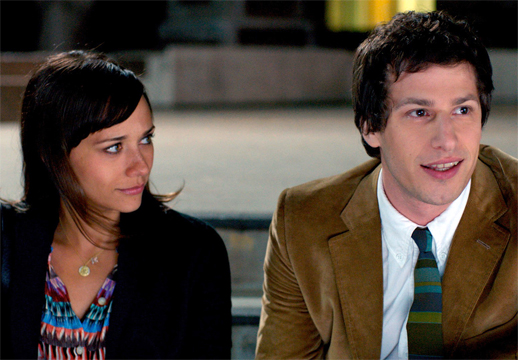
Celeste (Rashida Jones) insists — to anybody willing to listen — that
she wants only the best for ex-hubbie Jesse (Andy Samberg). The
truth, though, is that their separation is strictly on her terms ... and
that little detail is about to get them both in trouble.
At first blush, however, the opposite seems true of the title characters in Celeste and Jesse Forever ... and that’s the clever twist in this arch and perceptive script from Rashida Jones and Will McCormack.

Celeste (Jones) and Jesse (Andy Samberg) are introduced on what seems an average day. They’re bubbly, effervescent and completely at ease with each other. They enjoy many of the same artful pursuits, while cheerfully tolerating each other’s varying tastes. They finish sentences together, dissect restaurant menus in mock German accents, and share little physical rituals, from air-hugs to hilariously vulgar acts with tubes of lip gloss.

In a word, they’re cute enough to be cloying.

Unfortunately, they aren’t a couple. At least ... not really.

Indeed, they’re long separated and in the final stages of divorce. But an inability to stay married hasn’t damaged their friendship, although this dichotomy falls outside the bounds of comfort for their respective best friends, Beth (Ari Graynor) and Tucker (Eric Christian Olsen), coincidentally engaged and soon to be wed.

We deduce that Celeste and Jesse once were perfectly matched, during the younger days that led to their own wedded bliss. But Celeste has matured beyond the giddy rush of carefree twentysomethingness; she has become the ambitious, workaholic co-owner of her own media consulting firm. She’s also a frequently quoted “trend analyzer” and the author of a book on same, provocatively titled Shitegeist.

The passive Jesse, alternatively, prefers the lackadaisical existence of an artist. He’ll blow off deadlines — even on projects for Celeste — in order to watch TV or get stoned with good buddy Skillz (McCormack), a casual pot dealer who is quite vexed by the medical marijuana clinics that are interfering with his business model.

When Beth confronts her best friend and wonders aloud, for the umpteenth time, why she and Jesse don’t get back together, Celeste rather waspishly replies that she can’t spend her life with a guy who won’t even get a checking account.

“The father of my child,” she insists, “will own a car.”

It’s a droll line, one of many in this frequently witty script. But Celeste’s facility for disdainful zingers is a defense mechanism: one that eventually fails to conceal the arrogance of a condescending control freak.

Friday, August 10, 2012

Ruby Sparks: Fantasy with a whimsical glow

Ruby Sparks (2012) • View trailer
Four stars. Rating: R, for profanity, sexual candor and brief drug use
By Derrick Bang
 • Originally published in The Davis Enterprise, 8.17.12


Fresh, provocative concepts are one of cinema’s great treasures: unexpected delights — often in quiet, unassuming packages — that catch our fancy because they deserve to.

Initially, Harry (Chris Messina, right) assumes that his brother Calvin's
(Paul Dano) new girlfriend is nothing more than a figment of his
unbalanced imagination. But when Harry finally agrees to meet Ruby
(Zoe Kazan) — and realizes that she's a genuine, flesh-and-blood
woman — he's both captivated and genuinely amazed ... because he
knows that she first existed only as a character in Calvin's new novel.
They’re usually script-driven, sometimes a debut screenplay by a young actor flying beneath the radar ... but not for long. Think of Sylvester Stallone, stubbornly shepherding 1976’s Rocky to the big screen as a starring vehicle for himself. Matt Damon and Ben Affleck, and 1997’s Good Will Hunting. Sofia Coppola, and 2003’s Lost in Translation (not her first script, but certainly the Academy Award-winning effort that made her career). Michael Arndt, and 2006’s Little Miss Sunshine.

The latter also marked the directorial debut of Jonathan Dayton and Valerie Faris, a filmmaking team who cut their teeth on music videos and the MTV series The Cutting Edge before turning their deliciously quirky sensibilities to full-length features. They’re obviously selective, having waited six years before embarking on their sophomore effort.

And while Ruby Sparks certainly benefits from their capable guidance, this wonderfully idiosyncratic charmer will be immortalized as the film that transformed Zoe Kazan from a little-known young actress — you might remember her from supporting roles in 2008’s Revolutionary Road and 2009’s It’s Complicated — to a multi-hyphenate: star, writer and producer.

Until a few short months ago, Kazan probably was most famous simply because of her family name: She’s the granddaughter of celebrated director Elia Kazan (Gentlemen’s Agreement, On the Waterfront, East of Eden and many more), and the daughter of Academy Award-nominated screenwriters Nicholas Kazan (Reversal of Fortune and Bicentennial Man, among others) and Robin Swicord (The Jane Austen Book Club and The Curious Case of Benjamin Button, among others).

Clearly, talent runs in the family. By the end of summer, we’ll hear the name Kazan and think of Zoe, not her parents or grandfather. And deservedly so.

Ruby Sparks is Zoe Kazan’s tart, unapologetically preposterous update of the ancient Greek Pygmalion myth, which concerned a sculptor who fell in love with a statue he created, after it came to life. George Bernard Shaw turned this concept into a 1912 play that eventually begat the acclaimed 1956 Broadway musical My Fair Lady, which has remained famous — as a film and stage production — ever since.

In Kazan’s hands, the sculptor becomes novelist Calvin Weir-Fields (Paul Dano), a former literary wunderkind who sold his acclaimed first novel while still a teenager. But like other first-time author celebrities before him — Margaret Mitchell, J.D. Salinger and Harper Lee come to mind — the subsequent fame has proved stifling and artistically crippling. Now, a full decade later, Calvin still rides on the fame of his debut book, but he hasn’t been able to write anything new.