Showing posts with label Burn Gorman. Show all posts

Friday, December 16, 2022

Guillermo del Toro's Pinocchio: A truly unique vision

Guillermo del Toro's Pinocchio (2022) • View trailer
Four stars (out of five). Rated PG, and much too generously, despite considerable violence, dark thematic elements, peril and rude humor
Available via: Netflix

Although there’s much to admire in this handsomely mounted, stop-motion version of Carlo Collodi’s oft-filmed 1883 children’s novel, I’m reluctant to recommend it … in great part, because the intended target audience is a mystery.
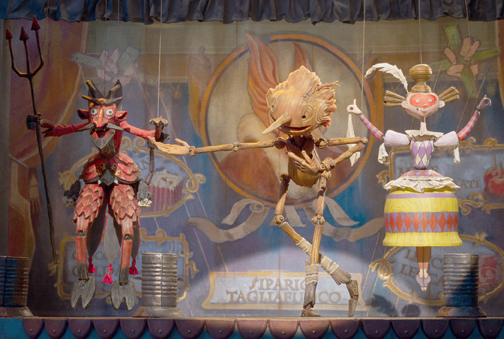
 

Having broken a promise to attend school, Pinocchio is delighted by the acclaim he
receives as the new star of Count Volpe's marionette show.


Del Toro’s relentlessly morbid and very loose adaptation definitely isn’t for children, who certainly won’t understand the updated shift to war-era Fascist Italy, and likely will be terrified by this setting. Nor can I picture mainstream adults wandering into what superficially appears to be a children’s film.

Unsuspecting parents who gather the kiddies for what they assume will be a family-friendly holiday flick, are apt to be horrified.


Even del Toro hedges this particular bet. “It’s not necessarily made for children,” he admitted, in a recent Los Angeles Times interview, “but children can watch it.”


Seriously?


I think not.


(Del Toro is fond of placing his dark fantasies against the backdrop of real-world horrors; both The Devil’s Backboneand Pan’s Labyrinth are set during the Spanish Civil War.)


Granted, the surrealistic writer/director has a legion of fans, and lovers of this painstaking animation style certainly will embrace this outré fantasy; perhaps, combined, they’ll be sufficient. And, in fairness, co-director Mark Gustafson’s stop-motion work is stunning; whatever else can be said about this film, it exhibits a true sense of wonder.


Pinocchio’s appearance here — rough-hewn, spindly, unfinished (missing one ear), a true marionette — is inspired by artist Gris Grimly’s illustrated 2002 edition of Collodi’s book.


And, backed by fine voice talent, del Toro and Gustafson elicit an impressive range of emotions from these characters.


But my goodness, this film is bleak. And macabre. And sad.


A lengthy prologue introduces wood-carver Geppetto (voiced by David Bradley) and his young son, Carlo (Alfie Tempest). The old man dotes on the boy, who — a model child — is equally devoted to his father: trustworthy, obedient, eager to learn. Alas, his life is cut short by a wartime tragedy.


Geppetto is heartbroken, overwhelmed by grief; his work suffers, leaving unfinished a large wooden effigy of Jesus in the local church, much to the chagrin of the village priest (Burn Gorman). Time passes; finally, in a fit of drunken rage one night, Geppetto makes a “replacement son” and then falls asleep.


A large, feather-winged, luminous blue wood sprite (Tilda Swinton) appears; taking pity on Geppetto, she grants life to the hastily carved little puppet. She then charges his “development” to the erudite and touchingly noble Sebastian J. Cricket (Ewan McGregor, who also narrates this tale).


Friday, October 2, 2020

Enola Holmes: The game's afoot!

Enola Holmes (2020) • View trailer
Four stars. Rated PG-13, and ludicrously, for occasional peril
By Derrick Bang • Originally published in The Davis Enterprise, 10.2.20

I love when it’s obvious, mere minutes into a film, that we’re in for a lot of fun.


When her mother vanishes under mysterious circumstances, Enola Holmes (Millie Bobby
Brown) is forced to request help from her older brothers, Sherlock (Henry Cavill, left)
and Mycroft (Sam Claflin) ... who prove to have unacceptable plans for her future.

Enola Holmes — debuting on Netflix — is an absolutely delightful adaptation of The Case of the Missing Marquess, the first book in Nancy Springer’s young adult series about the hitherto unrevealed teenage younger sister of Sherlock and Mycroft Holmes. The setting is London, the year 1884: just as Sherlock is in the process of establishing his credentials, following the successful resolution of “A Study in Scarlet” and “The Adventure of the Speckled Band.”


The literary Enola is plucky, intelligent and resourceful; as depicted here by Millie Bobby Brown — who shot to fame via TV’s Stranger Things — she’s also mischievous, endearing and quite captivating. Director Harry Bradbeer and scripter Jack Thorne don’t merely break the fourth wall; they shatter it completely, with Enola frequently pausing to address us viewers directly, or to shoot us a knowing glance.


That’s a tricky gimmick to employ, as it risks trivializing the story, and/or becoming too “cute.” But Bradbeer and Brown pull it off with élan, thanks in great part to the young actress’ facility with a well-timed line of dialogue. She essentially draws us into Enola’s unfolding adventure, as if we’re well-trusted confidants.


Bradbeer also spices this live-action adventure with occasional Victorian-style “stick figure” graphics, courtesy of animators Luca De Giglio and Lucas Scapim; they’re employed much the way Terry Gilliam’s similarly retro animation bridged the comic sketches in a Monty Python TV episode. They serve here as brief history lessons, character introductions, or depictions of Enola’s deductive reasoning.


She’s clever and physically adept, having been schooled in both book knowledge and jiu-jitsu self-defense skills, courtesy of her free-thinking and rather eccentric mother, Eudoria (Helena Bonham Carter). Although forced to endure the late 19th century laws and social traditions that place so many restrictions on women, Eudoria is a steadfast supporter of the suffrage cause, and wants to help create a world where her daughter can have freedom and power.


Carter is absolutely perfect for the role. She radiates authority, determination and calm resolve, along with a knowing gaze that bespeaks an impressive intellect. (This is, after all, the woman who raised the world’s most famous consulting detective; we have to assume that he got some of that acumen from his mother!)


Friday, March 23, 2018

Pacific Rim Uprising: Deserves to drown

Pacific Rim Uprising (2018) • View trailer 
One star. Rated PG-13, for relentlessly dumb and noisy sci-fi violence, and brief profanity

By Derrick Bang

Godzilla has a lot to answer for.

So does Guillermo del Toro, basking in the reflected glow of the Academy Awards now resting on his mantel.

When an entire squadron of giant robots goes berserk, only a handful of cadets — notably
Amara (Cailee Spaeny, and do note her wind-swept hair) and Jake (John Boyega) — are
in a position to prevent Earth's complete annihilation. Can they succeed, against such
overwhelming odds? Is there really any question?
Because we must remember that he brought us Pacific Rim, back in 2013. And if that film hadn’t happened, we wouldn’t now be suffering through its soulless, brain-dead sequel.

It’s important to note that del Toro always has had an affinity for grandiose monster movies, which he demonstrated with his two Hellboy entries, and even as far back as 1997’s Mimic. (Needless to say, The Shape of Water also is a monster movie.) Del Toro has a knack for finding — and somehow making credible — the emotional center of even the craziest premise; he also knows how to add just the right amount of humor to a formula that requires an equally precise blend of tragedy and triumph.

In short, we care about the characters in del Toro’s films, human or otherwise. We get involved.

Nothing — and nobody — in Pacific Rim Uprising elicits even a shred of interest. This isn’t a film; it’s a global commodity, assembled with calculated coldness by corporate bean-counters ticking all the little boxes.

Multi-national characters? Check. Disillusioned soldier who finds his inner hero? Check. Plucky young girl? Check. Eye-rollingly dumb dialog intended to facilitate bonding? Check. Jealousy in the ranks? Check. The destruction of vast cityscapes? Check.

First-time big-screen director Steven S. DeKnight can demand — and obtain — the most whoppingly, prodigiously colossal beasties and human-powered mechanical warriors that today’s special-effects money can buy, but the result has no more emotional significance than we got from watching two guys in rubber suits bash each other, while striding amid the balsa-wood cities of 1960s Godzilla flicks.

The reason? This film’s script — credited to DeKnight, Emily Carmichael, Kira Snyder and T.S. Nowlin — is strictly from hunger. Not content merely to be a perfect example of the idiot plot — which lurches from one scene to the next, only because each and every character behaves like an idiot at all times — it also boasts some of the clunkiest, most laughably atrocious dialog ever conceived.

With only a few exceptions, the performances are stiff and unpersuasive, the line deliveries so wooden, they warp. And the landscape-devastating battle sequences go on, and on, and on, and on ... as if DeKnight hopes to win us over by sheer brute force.

Friday, October 16, 2015

Crimson Peak: The pinnacle of failure

Crimson Peak (2015) • View trailer 
One star. Rated R, for profanity, sexual candor and gory violence

By Derrick Bang

When the mighty fall, they fall hard.

Steven Spielberg and 1941. Michael Cimino and Heaven’s Gate. George Lucas and Howard the Duck. Warren Beatty and Ishtar, Bruce Willis and Hudson Hawk, Kevin Costner and The Postman.

Even after the already strange Lucille (Jessica Chastain, left) starts behaving in a clearly
menacing manner, Edith (Mia Wasikowska) remains blandly complacent, like a lamb
awaiting slaughter. Obviously, this young woman was absent when common sense
was handed out!
And now, Guillermo del Toro and Crimson Peak.

The deliciously moody writer/director/producer’s career has proceeded smoothly along two parallel and somewhat related paths: extravagantly baroque, comic book-style action sagas, as with Pacific Rim and the two Hellboy entries; and splendidly eerie chillers, as with Mimic, The Devil’s Backbone and his Academy Award darling, Pan’s Labyrinth.

Even at their most outrageous — and Pacific Rim really stretched the credibility envelope — you could be certain of one thing: A Guillermo del Toro film wasn’t boring.

Until now.

Crimson Peak isn’t merely boring. It’s leaden, insufferably slow, wearily overblown, monotonous, humdrum and butt-numbingly, makes-you-want-to-scream dull.

At best, it’s a 25-minute Twilight Zone episode s-t-r-e-t-c-h-e-d into a plodding 119-minute trial by tedium. But even that comparison gives far too much credit to the sluggish script by del Toro and Matthew Robbins, which feels like an unholy love child spawned by Jane Eyre, Wuthering Heights and Friday the 13th.

Yep. It’s that clumsy.

Star Mia Wasikowska has made a career, of late, playing tortured young heroines in period and/or “heightened reality” melodramas, from Madame Bovary and Stoker to, yes, the title character in Jane Eyre. I guess del Toro figured that she was the perfect choice to play this film’s Jane Austen-esque Edith Cushing, heroine of the director’s unabashed attempt to re-create the classic Gothic romances of Hollywood’s Golden Age.

With ghosts thrown in, of course. We are, after all, dealing with Guillermo del Toro.

And yes, Wasikowska certainly looks the part of the naïve and overwhelmed young “spinster” at the heart of this story, which echoes and even name-checks Austin, the Brontë sisters and films such as Rebecca and Great Expectations. But although production designer Tom Sanders and art director Brandt Gordon have a field day with their meticulous re-creation of 1901 New York, and particularly the vast gothic mansion in England’s remote hills, this is a classic case of being all dressed up with nowhere to go.

Because the storyline is pathetic in its stupidity, agape with glaring plot holes, and unable to remain consistent even within its own ludicrous premise. This is a classic example of the idiot plot, which is to say that the narrative lurches from one random contrivance to the next, only because each and every character behaves like a total idiot at all times.

Friday, July 12, 2013

Pacific Rim: Monster Mash

Pacific Rim (2013) • View trailer 
3.5 stars. Rating: PG-13, for intense sci-fi violence and brief profanity
By Derrick Bang • Originally published in The Davis Enterprise, 7.12.13


Guillermo del Toro must have loved Godzilla movies as a kid.

His newest action fantasy, Pacific Rim, is a valentine to the dozen or so romp ’em, stomp ’em features that starred “the big G” during del Toro’s formative years. (Quite a few more have been made since then.) This tip of the hat clearly is deliberate, since the director and fellow scripter Travis Beacham refer to their ginormous critters as kaiju, the Japanese term — literally “strange beast,” but more commonly “giant monster” — coined, back in the day, to describe Godzilla, Mothra, Rodan and their ilk.

Strapped into the high-tech body suits that make them "one" with the giant robot
warriors into which they've been placed, Raleigh (Charlie Hunnam) and Mako (Rinko
Kikuchi) prepare for a battle they already know is unwinnable, against a monstrous
beast with adaptive "enhancements" that have made it far stronger than their
mechanical avatar.
Throw in plenty of 21st century whiz-bang special effects, and the result is a high-tech thrill ride that blends big monsters, equally massive robot-like avatars, and the stubborn pluck of a puny human race unwilling to go quietly into that good night.

During a summer laden with end-of-the-world scenarios — zombie apocalypse and Kryptonian apocalypse, not to mention the biblical Book of Revelations — this one takes the prize for cheeky absurdity. At the same time, del Toro and Beacham pay careful attention to the human element, giving us would-be saviors who are inspiring for their fortitude, and endearing for their flaws.

Not to mention, it’s always nice when a screenplay takes the optimistic view, and shows world powers uniting in an effort to save the planet. Such all-for-one selflessness goes all the way back to H.G. Wells’ War of the Worlds, and the reminder is refreshing in this divisively cynical age.

Audacious fantasy has been del Toro’s stock-in-trade ever since 1997’s under-appreciated and genuinely creepy Mimic. He also was the perfect choice to adapt graphic novelist Mike Mignola’s lunatic Hellboy series, and — as an executive producer — del Toro has chaperoned riveting projects such as 2007’s wonderfully atmospheric The Orphanage.

And let us not forget his masterpiece: 2006’s Pan’s Labyrinth, the Oscar-winning horror film that brought adult sensibilities to a genre too frequently willing to settle for much less, and which demonstrated that human monsters can be much, much worse than anything cooked up by our vivid imaginations.

Pacific Rim doesn’t wade through such high-falutin' waters, though; this is simply del Toro’s first stab at a crowd-pleasing, mega-budget summer blockbuster, and he has done a commendable job.

The film, set in the not-too-distant future, opens with an extended flashback: An unseen narrator recalls the unexpected arrival of the first kaiju, an enormous — and quite savage — amphibious creature bent on death and destruction. It rises from the ocean depths and wreaks considerable havoc before being brought down by conventional military hardware.

Apparently passing this off as an isolated incident — perhaps a lone, Bradbury-esque behemoth, driven by curiosity to the surface world — mankind is similarly unprepared months later, when the next one arrives. And then another. And another, at noticeably shorter intervals. Scientists realize that they’re coming from some sort of dimensional portal deep in the Pacific Ocean.