Showing posts with label Jeremy Irons. Show all posts

Friday, January 12, 2024

The Beekeeper: Buzzes with guilty pleasure

The Beekeeper (2024) • View trailer
3.5 stars (out of five). Rated R, for strong violene, pervasive profanity, sexual references and drug use
Available via: Movie theaters

There’s nothing like starting the new year with a vicarious revenge saga, particularly when the villain has been concocted for maximum audience satisfaction.


Having located the building that houses the illegal phishing call center that victimized
his friend, Adam (Jason Statham, left) promises to burn it to the ground ... which two
security guards find amusing. Until they don't...


Jason Statham continues to kick ass with pizzazz at age 56, with that grim, go-to scowl that always means somebody’s about to suffer well-deserved damage; The Beekeeper clearly has been fashioned around his crowd-pleasing strengths. Although the third act succumbs to excess that only a superhero could endure and survive, his occasional flinty smile and taciturn one-liners will keep viewers happy.

Director David Ayer is a veteran of action-packed thrillers; he and editor Geoffrey O’Brien move things along at a lively clip.


Kurt Wimmer’s screenplay is a long way from Shakespeare, but he sets the stage cleverly, and definitely knows how to punch our buttons.


The story opens quietly, shadowing beekeeper Adam Clay (Statham) as he lovingly cares for his hives, carefully scrapes the raw honey from combs, then processes that into jars of sweet syrup. He works and lives in a large barn rented from elderly Eloise Parker (Phylicia Rashad), who greatly admires the way that Adam and his bees have transformed her once-dilapidated gardens into things of beauty.


Alas, on this particular day, while Adam works outside, Eloise’s computer is hit with what appears to be a security alert. Understandably concerned — and the always regal Rashad is radiant, even when flustered — she calls the number on the screen. 


We see what she doesn’t: The call is routed to a scam center run by slick, slimeball conman Boyd Garnett (David Witts), who overcomes Eloise’s uncertainty — “Yes, you could call your bank first, but you’ll lose all your files” — with the smooth-talking élan of considerable experience.


This credibly written sequence could be extracted as an effective public service announcement: People, don’t do this at home!


The glee with which Boyd reels her in, to the delight of the equally skeevy dozens fleecing their own victims in the call center, is truly appalling. And, sadly, Eloise succumbs.


But she isn’t an average mark; along with several personal accounts, she manages a charity fund of more than $2 million ... all of which vanishes in an electronic heartbeat.


Eloise’s next move is tragic.


Adam’s subsequent reaction is cold fury.


Friday, January 28, 2022

Munich — The Edge of War: Persuasive period espionage

Munich — The Edge of War (2021) • View trailer
Four stars (out of five). Rated PG-13, for profanity, dramatic intensity and brief violence
Available via: Netflix

British journalist-turned-novelist Robert Harris has written numerous works of suspenseful historical fiction, several of which have been transformed into equally tension-laden films; 2001’s Enigma and 2010’s The Ghost Writer immediately come to mind.


British Prime Minister Neville Chamerlain (Jeremy Irons, seated) goes over newspaper
reports of German activities with his aide and translator, Hugh Legat (George MacKay).
Director Christian Schwochow and scripter Ben Power have done an equally fine job with their adaptation of Munich. Their handling of this World War II-based nail-biter, thanks in great part to the way cinematographer Frank Lamm frames many of his shots, has the retro atmosphere of classic 1960s Cold War thrillers such as The Spy Who Came In from the Cold and The Ipcress File.

The result so cunningly blurs the line between fact and fiction, that it’s often difficult to determine which is which.


This story also has extremely disturbing parallels to current real-world events, which evoke Spanish philosopher George Santayana’s timeless quote: “Those who cannot remember the past are condemned to repeat it.”


A brief prologue, set in 1932, introduces reserved Brit Hugh Legat (George MacKay) and passionate German Paul von Hartman (Jannis Niewöhner), who’ve bonded during their university years at Oxford. Both clearly love the impish Lenya (Liv Lisa Fries), although she’s probably too free-spirited for the buttoned-down Hugh.


Events shift to the autumn of 1938. Hugh has become a civil servant attached to British Prime Minister Neville Chamberlain (Jeremy Irons), in offices also occupied by the latter’s principal private secretary, Sir Osmund Cleverly (Mark Lewis Jones); Permanent Under-Secretary for Foreign Affairs Sir Alexander Cadogan (Nicholas Farrell); and senior government official Sir Horace Wilson (Alex Jennings).


(All, with the exception of Legat, are key historical figures.)


Paul has become a German diplomat and clandestine anti-Nazi. He and Hugh haven’t spoken or seen each other during the past several years (for reasons revealed in a later flashback).


Tension is high, because Adolf Hitler has mobilized forces at the Czech border, with the intention of claiming the Sudetenland, a region with 3 million Germans. Should this take place, the British and French will be forced to unite and defend the Czechs, plunging Europe into war.


With the horrors of World War I still fresh in every British citizen’s mind, this is not a desirable outcome.

Wednesday, November 24, 2021

House of Gucci: Dressed to Kill

House of Gucci (2021) • View trailer
4.5 stars (out of five). Rated R, for profanity, sexual content, brief nudity and violence
Available via: Movie theaters
By Derrick Bang • Published in The Davis Enterprise, 11.26.21

These folks would have been right at home in the 15th century, living next door to the Borgias.


Ridley Scott’s cheeky depiction of the Machiavellian treachery, manipulation, avarice and grasping ambition that roiled the fabled Italian fashion empire for two decades, is a showcase of bravura acting chops by five high-wattage stars. The narrative approach is simultaneously giddy, sordid and occasionally laugh-out-loud funny, the latter due to the often arch script by Becky Johnston and Roberto Bentivegna, adapting Sara Gay Forden’s 2000 non-fiction book.


Patrizia (Lady Gaga, second from right) listens intently as Aldo Gucci (Al Pacino, far
right) waxes enthusiastic about his plans for the fashion empire, while — from left —
Paolo Gucci (Jared Leto), his wife Jenny (Florence Andrews) and Maurizio Gucci
(Adam Driver) listen, with varying degrees of interest.

Ah, the obscenely rich. They truly are their own repugnant species.

At its core, this is the saga of two fathers, two sons, and the scheming woman who — with impressive success — maneuvers them against each other. The latter is played by Lady Gaga, with a mesmerizing blend of dramatic intensity and voluptuousness rarely seen on screen since Marilyn Monroe’s reign. We hang on her every word, deed and sinuous shimmy; cinematographer Dariusz Wolski ensures that she’s framed and lighted — and frequently shadowed, within sinister darkness — for maximum carnality.


The setting is the late 1970s. Patrizia Reggiani is introduced working for her adoptive father, Fernando (Vincent Riotta), who runs a successful Italian trucking empire. Scott opens his film as Patrizia saunters to the trailer office on an average morning, in a form-fitting va-va-voom dress, deliberately teasing the drivers hosing down their rigs. It’s an entrance, by Lady Gaga at her most vampish, that tells us everything necessary about this woman.


Her family’s success allows Patrizia to mingle with the jet set; during a discotheque party, she chances to meet Maurizio Gucci (Adam Driver). He’s shy and bookish, clearly uncomfortable in this raucous, libidinous environment; Driver is oddly endearing in this stammering nerd mode.


Patrizia seems unlikely to give him a second glance; indeed, her initial approach is mildly taunting, which embarrasses Maurizio even further. But her attitude abruptly shifts upon hearing his last name; we can practically hear the click of opportunistic hunger behind her eyes.


She subsequently stalks him. He’s surprised and flattered, and succumbs all too quickly. Really, he’s no match for her.


Maurizio takes her to meet his father, Rodolfo (Jeremy Irons), who with his bother Aldo (Al Pacino) controls the Gucci empire. But although Rodolfo carefully safeguards his 50 percent, wholly expecting Maurizio — studying to become a lawyer — to one day take his place, he has little to do with business operations. He’s distant, withdrawn and distracted by ghosts from his past.


Even so, Rodolfo is a shrewd, steely eyed judge of character, and he sizes up Patrizia in a heartbeat. “She is not the girl for you,” he cautions, in a stern tone that matches the gravitas Irons summons for the moment. But Maurizio, hopelessly in love, ignores this counsel.


The aftermath is severe.

Friday, March 2, 2018

Red Sparrow: Flies high

Red Sparrow (2018) • View trailer 
Four stars. Rated R, for strong violence, torture, graphic nudity, profanity and sexual content

By Derrick Bang

Red Sparrow has the crisp, nefarious and extremely nasty verisimilitude of actual spycraft, and with good reason; it’s based on a 2013 novel by Jason Matthews, who spent 33 years with the CIA’s Directorate of Operations, where — as acknowledged in a 2015 New York Times interview — he recruited and managed foreign agents, “often in places where such activity was forbidden.”

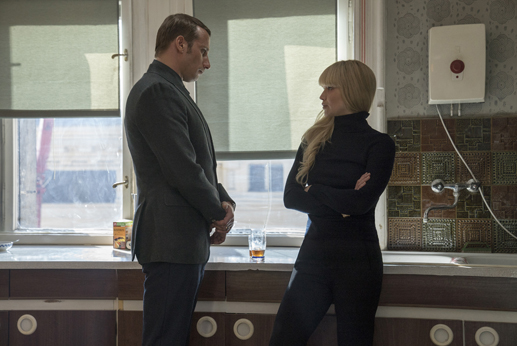
Having endured a regimen of vile and debasing treatment while at a specialized spycraft
school, Dominika (Jennifer Lawrence) now feels nothing but contempt for her
Uncle Vanya (Matthias Schoenaerts), who she once naïvely assumed wanted
only the best for her.
Justin Haythe’s screenplay adaptation has the slow burn of a complex John Le Carré espionage thriller, which must please Matthews, a fan of both that author and Ian Fleming. Frankly, I’m astonished; Haythe has no obvious experience with spy thrillers, and is most recently known for junk such as The Lone Ranger and the execrable A Cure for Wellness. It’s nice to see this significantly more polished side.

Austrian director Francis Lawrence obviously has developed a rapport with star Jennifer Lawrence, having helmed her final three Hunger Games outings. Red Sparrow is far more serious stuff: a thoroughly absorbing saga of regret, duplicity and reprehensible manipulation, set in a clandestine zone of prickly, real-world geopolitics.

Matthews must be congratulating himself for prescience: Such scheming cloak-and-dagger stuff seems even more credible now, at a time when Russia’s destabilizing activities have become daily front-page news.

Lawrence stars as Dominika Egorova, a talented member of the Bolshoi Ballet, introduced as she takes the stage for a standard performance (if anything done by Bolshoi dancers can be considered “standard”). Francis Lawrence cross-cuts from these scenes to others involving the late-night exchange of information between deep-cover CIA operative Nate Nash (Joel Edgerton) and a mole buried deep within upper-level Russian security operations.

Both sequences go awry. Dominika suffers an on-stage accident that destroys her career — an early, horrifying example of this film’s willingness to shock — while Nate’s meeting is exposed by the chance arrival of Russian police officers.

For Dominika, it’s a shattering, end-of-the-world catastrophe, and not merely because she spent her entire childhood training to be a dancer. She’s the only child of an invalided single mother (Joely Richardson) to whom she is devoted, and whose care — and the reasonably nice apartment in which they live — have been funded by her Bolshoi career.

Salvation — if it can be termed thus — comes from Dominika’s Uncle Vanya (Matthias Schoenaerts), who has kept a protective gaze on his deceased brother’s family. But Vanya’s interest is far from benign; his “solution” to Dominika’s plight involves drawing her into his realm of spycraft, with the specific goal of molding his niece into a seductress able to corrupt Westerners into betraying their country.

Hardly a healthy attitude for an uncle to have about his only niece.

Friday, November 17, 2017

Justice League: And so it begins...

Justice League (2017) • View trailer 
3.5 stars. Rated PG-13, for sci-fi action and violence

By Derrick Bang

Seeing director Zack Snyder’s name attached to this film was not happy news, given the degree to which he ruined both 2013’s Man of Steel and last year’s Batman v Superman: Dawn of Justice.

Having responded to the bat-signal illuminated by Police Commissioner Gordon (J.K.
Simmons, far left), the newly formed Justice League — from left, Wonder Woman (Gal
Gadot), Cyborg (Ray Fisher), Batman (Ben Affleck) and The Flash (Ezra Miller) —
learn that Gotham City is, once again, in serious trouble.
Snyder has much in common with director Michael Bay, similarly notorious for the Transformers franchise. Both favor bloated, soulless, humorless slugfests that wreak havoc on landscapes and cityscapes, while casually snuffing hundreds (thousands?) of civilian bystanders. Their films are the very definition of mindless product over art.

On the other hand, I was cheered to note Joss Whedon as co-scripter on Justice League. As the writer/director of 2012’s The Avengers, Whedon established the template for solid, successful superhero epics. Fans have recognized Whedon’s gift since television’s Buffy slayed her first vampire, back in 1996: He has an unerring talent for blending action fantasy with a (frequently droll) human element, which eases our suspension of disbelief.

And is a helluva lot more fun.

It’s easy to spot Whedon’s touch in Justice League, which is most successful during its first and second acts, as the stage is set, and the players assembled. It’s equally easy to see that the third act belongs to Snyder ... but not entirely. Even here, we get the vicarious relief of the unmistakable Whedon touch.

Justice League picks up in the immediate wake of Batman v Superman. The latter is dead, having perished at the hands of a Kryptonian monster genetically engineered by the villainous Lex Luthor. The country (the world?) is sliding quickly into anarchy, humanity apparently having abandoned hope after losing its gallant symbol for truth, justice and the American way.

(Ah ... but is Big Blue really, truly dead?)

Bruce Wayne (Batman) and Diana Prince (the Amazon Wonder Woman) are doing their best to stem the lawless tide, but they operate in the shadows; they’re not “living symbols” in the manner of Superman. Worse yet, Batman has been encountering winged “parademons” — very hard to kill — that seem to be seeking something.

Mindful of the need for additional super-powered allies, in order to hold off whatever comes next, Bruce and Diana reach out to three promising individuals: Barry Allen (Ezra Miller), a twentysomething nerd transformed by a lightning strike into The Flash; Arthur Curry (Jason Momoa), dubbed Aquaman, and heir to the underwater kingdom of Atlantis; and Victor Stone (Ray Fisher), a once-promising college football player nearly killed in a horrific accident, and “saved” when his scientist father Silas (Joe Morton) employed alien tech to transform his son into the biomechanical Cyborg.

Friday, March 25, 2016

Batman V Superman: Clash of titans

Batman V Superman: Dawn of Justice (2016) • View trailer 
Three stars. Rated PG-13, and somewhat generously, for brief sensuality and relentless, soul-crushing violence

By Derrick Bang • Originally published in The Davis Enterprise, 3.25.16


A perceptive philosophical theme serves as this film’s beating heart, a tenet that — quite sadly — reflects these cynical and despondent times: that, just as we worship our heroes, we’re all too eager to tear them down.

Alexander Luthor (Jesse Eisenberg, center) is delighted to discover that the guests at his
high-society event include inquisitive Daily Planet reporter Clark Kent (Henry Cavill, left)
and fellow industrialist Bruce Wayne (Ben Affleck). But why are they present?
Because we’re also jealous, and more than a little fearful. Because such individuals are different than you and I.

The “Big Blue” standing as the moral centerpiece of Batman V Superman: Dawn of Justice couldn’t be more different than the cheerful, easily admired boy scout played by Christopher Reeve in his quartet of films, several decades and a tidal shift of public sentiment ago. This 21st century Superman exists in a mutinous, resentful America that mirrors our own today, with a populous eager to be suspicious of any “alien” floating amongst us.

The resulting film is grim, its tone unrelentingly melancholy, its subtext downright depressing: We clearly don’t deserve a Superman.

For longtime comic book fans, the irony is palpable. Back in the early 1960s, DC Comics’ stable of heroes — Superman, Batman, Wonder Woman et al — were colorful but simplistic champions who routinely, almost casually, defeated equally flamboyant villains in self-contained storylines that mirrored popular TV dramas that did the same: all problems solved in one quick read (or one quick hour), and then on to the next adventure, perhaps with a quip or two. Nobody ever changed, because nobody had anything approaching an actual personality.

Upstart Marvel Comics upended this one-dimensional formula with its eye-opening roster of angst-laden superheroes. When out of their costumes, Spiderman, Iron Man, the Fantastic Four and their brethren felt like the folks next door, complete with anxieties and ground-level responsibilities. Their clashes with bad guys often occurred over multiple-issue story arcs: the outcomes less definitive, and often tinged with regret.

How interesting, then, that these two companies have switched roles en route to big-screen domination. Even at their most dire, Marvel movies are fun, their cataclysmic events leavened with an engaging layer of droll humor: a wink and nudge established the first time Robert Downey Jr. donned his Iron Man togs.

Friday, February 19, 2016

Race: Gold medal material, bronze execution

Race (2016) • View trailer 
3.5 stars. Rated PG-13, for thematic material and brief profanity

By Derrick Bang


When it comes to true-life sports sagas, few can match the triumphant power of Jesse Owens’ amazing feats at the 1936 Olympics.

Having demonstrated his incredible speed on the track, Jesse Owens (Stephan James,
center) is congratulated by his coach, Larry Snyder (Jason Sudeikis, far right). Both
have their eyes on the bigger prize: qualifying for the 1936 Berlin Olympics.
His few days in Berlin, striking a glorious blow against Adolf Hitler’s racist vision of Aryan supremacy, resonated to a degree that can’t really be calculated. Certainly the Nazi despot was humiliated before the world, and one can’t help speculating whether the subsequent timetable of German events was influenced by such embarrassment.

Such a story.

So sad — and so puzzling — that the better part of a century has passed, before it was brought to the big screen.

Director Stephen Hopkins has made up for this oversight, with the family-friendly Race — great title, just in passing — which displays a degree of heart and dignity that Owens likely would have appreciated.

Despite the existence of numerous published biographies and Owens’ own memoir, writers Joe Shrapnel and Anna Waterhouse have fashioned an original script that focuses solely on the two years leading up to the 1936 Olympics. That’s a shrewd decision, as it allows this 134-minute film to concentrate on these key events without feeling rushed.

We catch up with Owens (Stephan James) in 1934, just as he’s about to begin his college career at Ohio State University. He leaves behind a girlfriend, Ruth (Shanice Banton), and their young daughter, promising to send money whenever possible. Sadly, and despite being mentored by head track coach Larry Snyder (Jason Sudeikis), Jesse finds the locker room environment unpleasantly racist.

No doubt the reality was much worse than what is depicted here. We certainly get the point, but Hopkins chooses a restrained approach more akin to 2013’s Jackie Robinson biopic, 42, than the often grim brutality of Selma (which also featured James).

Friday, February 15, 2013

Beautiful Creatures: A sumptuous charmer

Beautiful Creatures (2013) • View trailer 
3.5 stars. Rating: PG-13, for carnal behavior, violence and mild profanity
By Derrick Bang • Originally published in The Davis Enterprise, 2.15.13


Fantasy fans mourning the departure of the Harry Potter and Twilight series will find plenty to enjoy in director/scripter Richard LaGravenese’s lush, well-mounted adaptation of Beautiful Creatures, the first novel in Kami Garcia and Margaret Stohl’s Caster Chronicles tetralogy.

Macon Ravenwood (Jeremy Irons, left) doesn't like the fact that his niece, Lena (Alice
Englert), seems to be falling in love with Ethan (Alden Ehrenreich). For a time, Macon
won't explain why this is such a bad idea, but that doesn't really matter; not even the
older man's unusual powers will prevent Ethan from pursuing the girl of his dreams.
The contemporary Southern Gothic setting is irresistible, right from the start, and production designer Richard Sherman has a ball with Ravenwood Manor, the mysterious estate that looms at the fringes of this small South Carolina town. The atmosphere borrows slightly from both Stephenie Meyer (Twilight) and Charlaine Harris (the Sookie Stackhouse novels that led to HBO’s True Blood), but you’ll also detect elements of Dark Shadows and The Addams Family.

Along with, I’m delighted to report, a fairly strong echo of Ray Bradbury’s various tales of the supernatural Elliot family, introduced in the 1945 short story “The Traveler” and, ultimately, earning a novel, From the Dust Returned, in 2001.

Quite a delectable collection of ingredients.

As we’re informed by 17-year-old Ethan Wate (Alden Ehrenreich), his home town of Gatlin never quite made it to the 21st century, and many of the town’s small-minded, Bible-quoting citizens seem unwilling to embrace the modern world.

“There are only two kinds of people in our town,” Ethan cheerfully tells us, as off-camera narrator, “the stupid and the stuck. The ones who are bound to stay or too dumb to go. Everyone else finds a way out.”

Ethan endears himself to us immediately, thanks to his fondness for reading everything on the community’s copious banned books list. The film begins at the advent of a new school year, with Ethan plainly having outgrown the holier-than-thou conceit of former girlfriend Emily (Zoey Deutch). He’s much more intrigued by new student Lena Duchannes (Alice Englert), whose presence immediately scandalizes Emily and her equally stuck-up, self-righteous best friend Savannah (Tiffany Boone).

Because, as everybody knows, Lena lives in Ravenwood Manor.

Friday, September 7, 2012

The Words: They fail

The Words (2012) • View trailer
Two stars. Rating: PG-13, for profanity
By Derrick Bang 


I cannot imagine why anybody ever thought this thuddingly dull script could have made an interesting film.

When Rory (Bradley Cooper) finds a battered — but somehow
dignified — old briefcase in a cluttered Parisian shop, his wife (Zoe
Saldana, as Dora) insists that it's just the sort of thing that he needs
to have. Rory is, after all, a would-be writer; surely a briefcase like
this would be a good-luck charm? Alas ... maybe not.
Writer/directors Brian Klugman and Lee Sternthal have concocted the sort of pretentious twaddle that snooty English department college professors publish for each other in stuffy academic journals. The first miracle is that they secured the interest of a mid-size film studio; the second miracle is the involvement of A-list actors such as Jeremy Irons, Bradley Cooper and Dennis Quaid.

Utterly astonishing.

You’d think the result would be worth viewing, with those folks on board. You’d be mistaken. This tedious study of morality — as it pertains to literary cheating — keeps dangling the promise of some “great revelation” in the final act, but the conclusion is frustrating, anticlimactic and ambiguous to the point of inciting a riot among viewers.

The tone was quite evident among the unhappy audience members at Tuesday evening’s preview screening: All that purple prose and soap opera-style build-up ... for this?

Indeed.

The narrative occupies three timelines, each with different sets of characters, all nested within themselves like Russian dolls ... or, if you prefer cinematic comparisons, like the layered dreams within Inception. We spend the most time with Rory Jansen (Cooper), a young writer introduced on the eve of a posh awards reception for his critically acclaimed first novel.

Rory and his wife, Dora (Zoe Saldana), are very much in love. Rory seems overwhelmed by the suddenness with which he has been thrust into the spotlight ... at least, that’s our assumption. In truth, Rory’s emotions are a great deal more complicated.

We slide back five years, to the moment when Rory and Dora, as a freshly minted couple, move into an impossibly small New York studio apartment. He writes constantly, hoping to impress the world with his narrative panache; we never get a sense of what Dora does outside the apartment. Does she have a job? A career? Plans for same? Beats me.

But they adore each other, and make do with occasional financial infusions from Rory’s father (J.K. Simmons, obviously snagged for a single day’s worth of quick scenes).

Friday, October 21, 2011

Margin Call: Grim tidings

Margin Call (2011) • View trailer for Margin Call
Four stars. Rating: R, for profanity
By Derrick Bang

Moving into the third act of writer/director J.C. Chandor’s Margin Call, I was reminded of the war room discussions in Stanley Kubrick’s 1964 adaptation of Dr. Strangelove, particularly when Peter Sellers’ U.S. President Merkin Muffley and George C. Scott’s Gen. Buck Turgidson argue over “collateral damage.”
Having survived a devastating company layoff, Peter Sullivan (Zachary Quinto)
attempts to settle down for a "normal" day's work. But a financial time bomb is
ticking away in his pocket: the parting gift from a veteran risk analyst who was
escorted out of the building that same morning. Eventually, as day turns to night,
Peter will examine the files on that flash drive ... and then nothing will be the same.

“Mr. President,” Turgidson finally insists, “I’m not saying we wouldn’t get our hair mussed. But I do say no more than 10 to 20 million killed, tops. Uh, depending on the breaks.”

The point, of course — delivered with every possible ounce of chilling satire — is that nobody in this room, filled as it is with people responsible for the safety of the entire United States, has the faintest idea what would happen during an all-out nuclear war. And yet they still argue over “acceptable losses.”

Just as everybody in the board room of the fictitious investment firm in Margin Call debates the acceptable losses certain to arise in the wake of a proposed we’re-first-into-the-lifeboat desperation ploy.

Hell, it’s worse than that. They’re not simply commandeering the first lifeboat; they’re scuttling all the others.

I’m not sure the public is ready for this suggestion of how the 2008 financial crisis kicked off; my own interest was guarded, upon entering the theater. It’s simply too soon: The real-world wound remains too fresh, the resulting carnage still plain in every drawn and desperate face, every freshly foreclosed and empty home that once contained a family that still believed in the American dream.

I worried that Chandor would trivialize actual history, or — worse yet — attempt to build sympathy for the greedy, soulless bastards who fiddled while Wall Street burned.

But, as it turns out, Chandor is much smarter and shrewder than that. He’s also a sharp scripter and a damn fine director, and Margin Call is an extremely impressive feature debut for a fellow whose sole previous credit was a short back in 2004.

Granted, Chandor also had the good sense to assemble an impressive cast ... but a director still needs to know how to encourage excellent work. And he draws fine performances from all concerned.

Chandor’s most brilliant stroke, however, was to resist the temptation to imagine what truly occurred in the late summer of 2008. We can assume that his script evokes Lehman Brothers, and that the two days depicted here offer a guess as to what may have gone down behind closed doors, before that august firm filed for bankruptcy on Sept. 15, 2008.

But it doesn’t really matter. Chandor’s build-up is absorbing, and the subsequent character interactions generate the intensity of a solid, well-acted stage play. We eventually share the horror of those who recognize a catastrophe only after it’s too late to attempt a recovery.