Showing posts with label Pierce Brosnan. Show all posts

Friday, September 12, 2025

The Thursday Murder Club: Totally delightful!

The Thursday Murder Club (2025) • View trailer
Four stars (out of five). Rated PG-13, and too harshly, for occasional violent content, fleeting profanity and mild sexual candor
Available via: Netflix
By Derrick Bang • Published in The Davis Enterprise, 9.14.25

The talent involved here certainly is impressive.


Bringing British author Richard Osman’s 2020 debut novel to the big screen was one of the occasional “third rails” of cinema. The book is enormously popular: the UK’s best-selling title of the decade, and translated into 46 languages. Somewhat akin to the challenge of adapting J.K. Rowling’s Harry Potter series, Osman’s fans weren’t about to tolerate anything less than reverential.


With their new colleague PC Donna de Freitas (Naomi Ackie, center) leading the way,
she and the members of the Thursday Murder Club — from left, Joyce (Celia Imrie),
Elizabeth (Helen Mirren), Ron (Pierce Brosnan) and Ibrahim (Ben Kingsley) — confront
a rather nasty surprise.

They have nothing to worry about.

Director Chris Columbus and co-scripters Katy Brand and Suzanne Heathcote deftly retained Osman’s essential tone, atmosphere and mildly whimsical, British-dry wit. Of necessity, the labyrinthine twists within the book’s 400 pages have been condensed, with some minor sidebar individuals and distractions left behind, but the core plot and characters are solid.


The result is equal parts Agatha Christie and Downton Abbey, with a soupçon of Jane Austen thrown into the mix.


On top of which, you simply cannot beat a leading cast that features Helen Mirren, Pierce Brosnan, Ben Kingsley, Celia Imrie and Naomi Ackie. They’re all note-perfect.


The setting is the sumptuous Cooper’s Chase retirement village, plunked in the midst of Kent’s (fictitious) seaside village of Fairhaven. The well-to-do residents include Elizabeth Best (Mirren), psychiatrist Ibrahim Arif (Kingsley) and former trade union leader Ron Ritchie (Brosnan), who meet weekly — on Thursdays — to discuss long-dormant cold cases.


How they settle on a given case is left somewhat vague, as is Elizabeth’s background; this film deliberately leaves that detail unrevealed until late in the third act. That said, she clearly has “connections” of some sort.


The trio quickly is drawn to new resident Joyce Meadowcroft, (Imrie) a retired nurse and compulsive baker, whose facility for lavish cakes immediately endears her to Ron.


As the story begins, they decide to investigate the unsolved murder of a young woman named Angela Hughes: a case originally handled by Detective Inspector Penny Gray (Susan Kirkby), now comatose in hospice care, attended constantly by her devoted husband, John (Paul Freeman).


Coincidentally, the local police force headed by DCI Chris Hudson (Daniel Mays) has just been augmented by PC Donna De Freitas (Ackie), recently transferred from London. Given that Fairhaven’s police force is “provincial” (read: mostly male), she’s initially relegated to trivial duties. A chance encounter with the Cooper’s Chase quartet prompts a much more interesting collaboration, which in turn grants the retirees access to police intel.

Friday, June 7, 2024

The Great Lillian Hall: Sublime character study

The Great Lillian Hall (2024) • View trailer
4.5 stars (out of five). Rated TV-14, for dramatic intensity
Available via: HBO MAX
By Derrick Bang • Published in The Davis Enterprise, 6.9.24

Julianne Moore won a well-deserved Academy Award for her performance in 2014’s Still Alice, as a linguistics professor doing her best to cope with a slide into Alzheimer’s.


Jessica Lange deserves the same reward, for her richly nuanced work in this film.


Edith (Kathy Bataes, left) loses her patience — but not her compassion — when longtime
best friend Lillian (Jessica Lange) refuses to believe that anything is truly wrong with her.


The similarities are cruelly ironic. Just as Moore’s Alice Howland was horrified by her failing connection with the language career central to her very being, Lange’s Lillian Hall cannot conceive of a future without her ability to command a stage in front of an admiring, sell-out audience. It’s who she is...

...to the almost total exclusion of her adult daughter, to that poor woman’s dismay. But that’s getting ahead of things.


Scripter Elisabeth Seldes Annacone was inspired by her aunt, Tony Award-winning stage and film actress Marian Hall Seldes, whose busy career included every one of the 1,809 performances of Ira Levin’s play Deathtrap, which earned her mention in the Guinness Book of World Records. She worked tirelessly until 2011, at which point — sadly — she spiraled into dementia during the final three years of her life.


Annacone’s sensitive script is handled with assurance by director Michael Cristofer, best known for theater works that include his Pulitzer Prize-winning play, The Shadow Box. His approach here feels very much like a stage play, which focuses on the crucial few days when veteran stage actress Lillian Hall (Lange) — proud of the fact that she’s never missed a performance during her long and celebrated career — realizes that she no longer can conceal her worsening condition from the world.


Or from herself.


Annacone and Cristofer split their narrative into three parallel elements: rehearsals of Lillia ‘s next starring role, in a production of Anton Chekhov’s The Cherry Orchard; intimate glimpses of her personal life, whether alone at home or in the company of family and colleagues; and B&W “interview footage” of various individuals filmed for the electronic press kit that’ll accompany the play’s opening.


On stage, it becomes increasing clear that Lillian has trouble remembering her lines, to the dismay of play director David Flemming (Jesse Williams). He has long admired her, and has been making allowances ... and excuses to the other cast members. 


Producer Jane Stone (Cindy Hogan) is more pragmatic; she’s horrified by the possibility that the star who attracted this production’s financial backers, may prove incapable of making it to opening night.

Friday, January 19, 2024

Fast Charlie: A briskly paced crime saga

Fast Charlie (2023) • View trailer
3.5 stars (out of five). Rated 18+, for strong bloody violence, gore and frequent profanity
Available via: Amazon Prime and other video-on-demand options

Phillip Noyce’s résumé as a thriller director runs hot and cold; for every Quiet American and The Bone Collector, he has bottomed out with swill such as Sliver and The Desperate Hour


Marcie (Morena Baccarin) is completely surprised by an unexpected double-cross,
although Charlie (Pierce Brosnan) had his suspicions. But what will they do about it?


Fast Charlie falls somewhere in between, with Pierce Brosnan’s laconic charm giving Richard Wenk’s bare-bones script more juice than it deserves. The film is adapted loosely from Victor Gischler’s 2001 crime novel, Gun Monkeys, retaining the core plot beats while abandoning the dark humor that finds the author sharing territory with Elmore Leonard and Carl Hiaasen.

Wenk — undoubtedly with input from Brosnan — also has softened the title character. He’s still a ruthless killer, but solely in the service of restoring honor; most notably, the film’s Charlie Swift doesn’t take out cops.


The story settles into well-worn territory, with Charlie a career “concierge” — please, don’t call him an “enforcer” — for elderly crime boss Stan Mullen (James Caan, genuinely touching in his final film role). Stan has long controlled Mob operations in Biloxi, Miss., with a well-honed crew that oversees various profitable enterprises. But his memory has been failing with age; Charlie spends every possible moment helping the man he has called a friend for decades.


Stan and his crew are family.


But the times, they are a-changing. Beggar Johnson (Gbebga Akinnagbe), an ambitious up-and-comer not inclined to patience with The Way Things Have Been Done, has his eye on Stan’s territory.


Charlie — an accomplished chef on the side, who loves Italian food — has been contemplating retirement. Under ideal circumstances, he’ll succumb to his long-nurtured dream of buying and restoring an Italian villa. (This is a real thing: One can purchase a property for just 1 euro, with the understanding that it’ll be properly renovated within a specific deadline.)


But — wouldn’t you know it — circumstances swiftly cease to be ideal, and Charlie suddenly is faced with scores to settle: the ol’ “one last time” scenario.


Friday, July 20, 2018

Mamma Mia: Here We Go Again — Another treat for ABBA fans

Mamma Mia: Here We Go Again (2018) • View trailer 
3.5 stars. Rated PG-13, for playful sensuality

By Derrick Bang

Playful summer sensuality couldn’t possibly look more enticing than it does in this delightful musical.

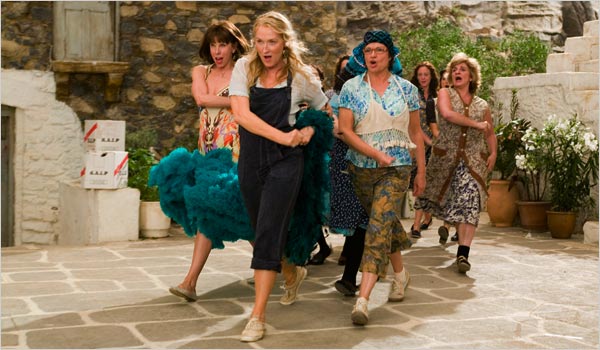
When Donna (Lily James, right) asks if she can get a job singing at a Greek café/bar, she's
challenged to prove her vocal chops, much to the delight of best friends Rosie (Alexa
Davies, left) and Tanya (Jessica Keenan Wynn).
The entire gang returns for another romantic roundelay in this sparkling sequel, which adds a few casting surprises to an ensemble already rich with tuneful joie de vivre. The story is typical “musical lite” — just enough plot on which to hang a bunch of song and dance numbers — but writers Ol Parker, Richard Curtis and Catherine Johnson add enough flirty banter and droll double entendres to keep everybody amused.

And yet, since we’re dealing with a finite songbook, one can’t help feeling that all the “good stuff” was used up during the first film. Reprises of the title song and “Dancing Queen” are inevitable, but many of the other tunes here — no matter how cleverly placed — are less familiar, and therefore don’t resonate nearly as much.

This sequel definitely suffers the comparative lack of power ballads that gave its predecessor so much effervescent momentum. No doubt recognizing this, the writers have shaped a more emotional story better suited to the quieter, more poignant songs at work here.

Even so, the first act is rather slow, and we get a sense that Parker — who also directs — is having trouble warming up.

Fortunately, things improve as the film proceeds.

Many years have passed, during which Sophie (Amanda Seyfried) and her maybe-father Sam (Pierce Brosnan), happily ensconced on the magical Greek island of Kalokairi, have worked hard to renovate the taverna that her mother Donna (Meryl Streep) always wished to transform into a luxury hotel. The grand opening is set for the following day: an occasion that has brought Donna’s lifelong friends Tanya (Christine Baranski) and Rosie (Julie Walters) to the island.

Alas, Sophie’s other maybe-dads — Harry (Colin Firth) and Bill (Stellan Skarsgård) — are tied up elsewhere in the world, and boyfriend Sky (Dominic Cooper) is in New York, learning the ins and outs of the hotel trade.

Worse yet — and there’s simply no getting around this, since the bomb drops almost immediately — Donna is absent, having died a year earlier. (What? I hear you scream. No kidding.) Not having her mother on hand to share this moment, is almost more than Sophie can bear.

This melancholia prompts Sophie to reflect on the circumstances that brought her mother to Kalokairi, so long ago: our entry to the extended flashback subsequently intercut with the present-day activities.

Friday, October 13, 2017

The Foreigner: Not to be ignored

The Foreigner (2017) • View trailer 
Four stars. Rated R, for violence, profanity and some sensuality

By Derrick Bang • Originally published in The Davis Enterprise, 10.13.17

This film likely isn’t on your radar.

It should be.

Irish Deputy Minister Liam Hennessy (Pierce Brosnan, right) is kind enough to grant some
time to Quan Ngoc Minh (Jackie Chan), who hopes to learn the identity of the terrorists
who killed his daughter, back in London. The meeting ... does not go well.
Director Martin Campbell and scripter David Marconi have transformed prolific British thriller author Stephen Leather’s 1992 novel, The Chinaman, into a crackerjack espionage drama: an absolutely perfect vehicle for star Jackie Chan, shrewdly playing a character his actual age (63 years young).

And while it’s true that the beloved martial arts sensation no longer hurls himself out of trees, or through multiple plate-glass windows, he still has moves. Plenty of them.

Marconi’s script is a clever update of Leather’s novel, which was written while the Provisional Irish Republican Army’s brutal bombing campaign was climaxing (and which, mercifully, would conclude with a cease-fire in 1997). This big-screen adaptation benefits from taut direction, crisp editing and a devious narrative laden with twists and double-crosses.

And, most of all, from Chan’s captivating portrayal of a character who completely wins our hearts and minds.

The contemporary setting introduces Quan Ngoc Minh (Chan) as a quiet London restaurateur, who dotes on his teenage daughter, Fan (Katie Leung): the sole family member left after a couple of earlier tragedies. Campbell and Marconi deftly sketch their loving relationship during a prologue that feels ominous because of its mundane normality.

Our fears prove justified, when Fan’s enthusiastic dive into a dress shop turns tragic as a terrorist bomb goes off. Credit for the heinous act is claimed by a group calling itself The Authentic IRA.

Although swept into in a maelstrom of grief that threatens to drown him — Chan’s expression and body language are heartbreaking, during these early scenes — Quan patiently, doggedly navigates “proper channels” in an effort to secure a piece of information that he deems naïvely simple: the name, or names, of the bombers.

He finally gains a chat with Commander Richard Bromley (Ray Fearon), head of the British anti-terrorist task force charged with investigating the attack. Although sympathetic, Bromley assures Quan that his team is doing everything possible, and sends him home. But Quan cannot let it rest, much to the mounting concern of his restaurant partner, Lam (Tao Liu), who clearly loves him.

Friday, August 29, 2014

The November Man: Who can be trusted?

The November Man (2014) • View trailer 
3.5 stars. Rated R, for violence, rape, profanity, sexuality and brief drug use

By Derrick Bang • Originally published in The Davis Enterprise, 8.29.14

I always enjoy a well-crafted spy thriller, and this one’s a romp.

Australian director Roger Donaldson knows the territory, having delivered a twisty espionage thriller back in 1987, with his adaptation of Kenneth Fearing’s No Way Out. It remains one of star Kevin Costner’s best early films, thanks in great part to its didn’t-see-that-coming finale.

Devereaux (Pierce Brosnan, left) delights in setting up fight-or-flight "scenarios" for junior
partner Mason (Luke Bracey), which the latter finds a bit tiresome. And insulting. Which
rather misses the point, because the cocky Mason definitely needs to enhance his ability
to analyze a situation before it whirls out of control.
Donaldson’s handling of The November Man is cut from similar cloth, with scripters Michael Finch and Karl Gajdusek delivering an engaging spin on a cherry-picked entry in the late journalist-turned-novelist Bill Granger’s 13-book Devereaux series, which began with 1979’s The November Man and concluded with 1993’s Burning the Apostle. This film’s title notwithstanding, however, it’s based not on Granger’s first Deveraux book, but on the seventh, There Are No Spies.

That said, Finch and Gajdusek’s screenplay more honestly is “flavored” by Granger’s book, with numerous changes obviously intended to satisfy action-oriented audiences. The result is reasonably entertaining in a fast-paced “airplane movie” sort of way, with star Pierce Brosnan ideally cast as a cynical, world-weary spy dragged out of semi-retirement to fix another mess involving the CIA, a corrupt Russian presidential candidate, a lethal assassin, and a possible traitor within the CIA’s highest echelons.

Although obviously aiming for the cerebral atmosphere of 1960s cold-war movie classics such as The Ipcress File and The Spy Who Came In from the Cold, Donaldson doesn’t hit that target too often; he more frequently mines the who-can-be-trusted territory of 1975’s Three Days of the Condor, with a strong nod toward the mentor/protégé relationship at the heart of 2001’s Spy Game.

And heck, we’ve got a cast that include a former James Bond (Brosnan) and a former Bond babe (Olga Kurylenko, from Quantum of Solace). How can it miss?

Mostly, it doesn’t. With a few stiff caveats.

Devereaux and junior partner David Mason (Australian up-and-comer Luke Bracey) are introduced in a 2008 prologue, working a mission that goes pear-shaped when the younger operative fails to heed his mentor’s stern instructions. The anguish and disappointment are clear on Devereaux’s face; the kid has blown it, obviously dashing the older agent’s faith in him.

Friday, August 23, 2013

The World's End: What a way to go!

The World's End (2013) • View trailer 
Four stars. Rating: R, for violence, pervasive profanity and sexual candor
By Derrick Bang


This is, without question, the funniest pub crawl ever brought to the big screen.

Another pub, and still only the same single flavor of beer. By now, our heroes — from
left, Andy (Nick Frost), Peter (Eddie Marsan), Gary (Simon Pegg), Steven (Paddy
Considine) and Oliver (Martin Freeman) — are startng to wonder if something other
than franchise blandness might be to blame...
It’s also a cheeky delight that gets much of its fizz from the slow, tantalizing unveiling of What’s Really Going On: a reveal that deserves to remain a surprise for every viewer, much in the manner of 1998’s The Truman Show. That’s unlikely — which is a true shame — in an era when media outlets scramble over each other in an effort to unleash mega-spoilers.

Because The World’s End is best viewed the way my companions and I did last night: with an advance preview audience that hadn’t the faintest idea what would come next.

So if this review remains elliptical and vague in spots, blame my desire not to spoil any of the fun.

Life hasn’t been kind to Gary King (Simon Pegg). Twenty years ago, his compulsory secondary education at an end, he was on top of his world: young, free-spirited and popular with the lads and lasses. By way of celebrating their impending release from school, Gary and his four mates vowed to drink their way through the 12 pubs dotting the “golden mile” of their bucolic UK community of Newton Haven.

They didn’t quite make it, but that’s immaterial; the camaraderie was key.

This introductory flashback unfolds, like a series of video snapshots, to Pegg’s sassy off-camera narration. But his enthusiasm fades as we’re brought to the present day, to discover that Gary is sharing this saga during a group therapy session.

Time has moved on; Gary hasn’t. He’s still a self-absorbed layabout: a poster child for arrested adolescents who failed to launch. A 40-year-old man (to quote this film’s equally droll press notes) “trapped at the cigarette end of his teens.” And it eats at him.

His former best buds, long estranged, have done better. More or less. Andy (Nick Frost) is a corporate attorney; Oliver (Martin Freeman) is a buttoned-down real-estate agent who shifts seven-figure properties. Steven (Paddy Considine) founded a successful start-up, sold out when the time was right, and now enjoys the companionship of a personal trainer half his age.

Peter (Eddie Marsan), the meekest member of the one-time gang, got stuck with the family business — selling cars — and seems little more than an afterthought to his wife and two children.

No surprise, then, that Gary first broaches his “inspired” plan with Peter: to re-visit that tempestuous night two decades back, but this time to succeed ... starting with The First Post and concluding with The World’s End. (Just in passing, all 12 of these Newton Haven ale houses are named for actual English pubs.)

Thursday, March 18, 2010

Ghost Writer: Clearly risky

The Ghost Writer (2010) • View trailer for The Ghost Writer
Four stars (out of five). Rating: PG-13, for brief violence, profanity and mild sensuality
By Derrick Bang • Originally published in The Davis Enterprise, 3.18.10
Buy DVD: The Ghost Writer • Buy Blu-Ray: The Ghost Writer (Single-Disc Blu-ray/DVD Combo)

This one's more Hitchcock than many Hitchcock films.

The Ghost Writer looks, sounds and feels like the thrillers Hitch made back in the 1950s, when the Master of Suspense was at his prime. Director Roman Polanski's new drama must be deliberate homage, because it includes many of the same elements: unsettling production design, an isolated setting that gives the story an oddly timeless aspect  despite plot elements that are as contemporary as last month's newspaper headlines  and a moody orchestral score, by Alexandre Desplat (The Queen, The Curious Case of Benjamin Button), which sounds like the work Bernard Herrmann did for Hitchcock in (for example) North by Northwest.
After accepting an assignment to edit and enhance the ghosted memoirs of a
controversial former British prime minister, our somewhat guileless hero
(Ewan McGregor) is dismayed to discover that all work must be done within
the locked and heavily guarded confines of his subject's isolated home.
Before long, the job takes on even more sinister overtones...

Best of all, The Ghost Writer is slickly adapted from a thriller by Robert Harris  who worked on the screenplay with Polanski  a journalist-turned-novelist who also wrote Enigma, which became an intelligent and vastly under-appreciated film in 2001. I've not yet read The Ghost, but after seeing this film, the book just hit the top of my pending pile.

The premise is beguiling: A successful British writer (Ewan McGregor) is offered the job of ghosting the memoirs of Adam Lang (Pierce Brosnan), a controversial former British prime minister. Initially, the assignment isn't all that appealing to our protagonist ... who, true to his profession, never is named in this film. He's more than a little disturbed by the knowledge that his predecessor wound up dead, apparently having fallen off a ferry and drowned.

Such concerns are eased by the impressively huge salary.

Or maybe not. Our "ghost" discovers that he's expected to complete the work within four quick weeks, and that he must fly across the Atlantic that very night, in order to spend as much time as possible with Lang, currently staying at an isolated, heavily guarded compound on an island off the Eastern seaboard. Worse yet, the huge typed manuscript cannot leave the office in Lang's home, where our hero is expected to do all his work.

Things get even murkier once we meet Lang and his wife, Ruth (Olivia Williams), and staff, notably the former prime minister's come-hither personal assistant, Amelia (Kim Cattrall). Marital discord and sexual tension hover over this home like a shroud, and the oddly idiosyncratic cook and gardener just add to the overall tension.

Thursday, July 17, 2008

Mamma Mia: Irresistible

Mamma Mia (2008) • View trailer for Mamma Mia
3.5 stars (out of five). Rating: PG-13, for playfully smutty dialogue
By Derrick Bang • Originally published in The Davis Enterprise, 7.17.08
Buy DVD: Mamma Mia • Buy Blu-Ray: Mamma Mia! The Movie [Blu-ray]


As musicals come and go, Mamma Mia is perhaps the most deliberately frivolous ever concocted, its postage-stamp plot no more than a tissue-thin excuse to deliver a few dozen classic ABBA hits.
While leading her friends — Tanya (Christine Baranski, left) and Rosie (Julie
Walters, right) — on a tour of her villa, Donna (Meryl Streep, center) uncorks
the song "Money, Money, Money" to explain  her precarious finances ... and,
of course, the entire Greek island community joins in the ever-expanding
production number, merely one of many in this energetic musical.

Nine years, 20 productions and 30 million tickets later, the fans obviously don't care, and with good reason: The show is a high-spirited, colorful hoot. Even now, more than 17,000 people see one of the nine current productions (worldwide) every night, generating $8 million per week in ticket sales. The word "phenomenon" would not be out of place.

Mamma Mia demands strong singers, reasonably agile dancers and very little else. The narrative does not include — indeed, actively ignores — sweeping dramatic arcs.

Naturally, then, this film adaptation is filled with actors. Whose singing abilities are uneven, at best.

Sigh.

In fairness, star Meryl Streep throws herself into the central role of Donna with every irrepressible atom in her energized body, and she makes the part her own through sheer force of will. And, yes, Streep sings reasonably well, as proven a few years ago with the film adaptation of A Prairie Home Companion.

Co-star Julie Walters is equally memorable as the feisty, wisecracking Rosie, one of Donna's two best friends. Walters handles her one dynamic song with reasonably aplomb, substituting similar passion — and, by the time this particular number arrives, plenty of audience good will — for actual vocal chops.

Colin Firth gets off lucky; his character, Harry, need only navigate his way through a ballad, which arrives with its wistful tone more or less intact. Stellan Skarsgård's Bill, thankfully, isn't required to sing. Much.

But Pierce Brosnan?

Oh, dear.

Brosnan's Sam has two key numbers, both typical ABBA power ballads, and the picture grinds to an uncomfortable halt when he rasps his way through his first song's prologue. I haven't been this embarrassed for an actor-turned-reluctant-singer since Clint Eastwood talked to the trees back in the 1969 adaptation of Paint Your Wagon.

Mind you, I've always — always — liked Brosnan, and in all other respects he makes a great Sam. But Brosnan can't sing a lick, and Tuesday's preview audience breathed an audible sigh of relief when the backing orchestra became loud enough to better camouflage the actor's wincingly limited range.

What was everybody thinking?

Thursday, April 3, 2008

Married Life: Rather unhappy

Married Life (2008) • View trailer for Married Life
Three stars (out of five). Rating: PG-13, and rather harshly, for disquieting plot elements
By Derrick Bang • Originally published in The Davis Enterprise, 4.3.08
Buy DVD: Married Life • Buy Blu-Ray: Married Life (+ BD Live) [Blu-ray]

Married Life isn't tastelessly whimsical enough to be taken as a black comedy, but it's also too arch to be regarded as a serious psychological drama.

Blame director/co-writer Ira Sachs, who can't seem to make up his mind.
Having been introduced to Kay (Rachel McAdams), his very married best
friend's lover on the side, the swinish Richard (Pierce Brosnan) decides that he
wants this enchanting creature for himself. He thus begins taking her out on
the town; Kay's enjoyment of this new attention naturally calls her intentions
into question. Ultimately, though, these characters — and all the others in
this film — are too blasé for us to care one way or the other.

The problem also can be traced to Pierce Brosnan, whose raised-eyebrow performance and mordant off-camera narration belong in another film. (Let's face it: Nobody smirks like Brosnan.) Every appearance of his deviously roguish character hints at snarky behavior to come, but he's the only one operating in that realm.

Co-stars Chris Cooper, Patricia Clarkson and Rachel McAdams remain resolutely straight, and we wait in vain for some ingenious plot twists to erupt in the third act.

But they never come.

Indeed, enduring this increasingly dull and dour film to its bitter conclusion produces nothing but disappointment: We slogged through all that for this?

Sachs and co-writer Oren Moverman, adapting a little-known novel by John Bingham — whose major claim to fame, these days, was to have served as the real-life model for John Le Carre's George Smiley — apparently wish to establish a premise and then build a level of playful suspense that Alfred Hitchcock would have admired. They never quite succeed; these characters are too staid to generate any tension.

And despite ample directorial inferences, they're ultimately revealed to have no hidden depths whatsoever: They're merely what they seem ... which isn't all that interesting.

The setting is the late 1940s; the tale is told by Richard (Brosnan), whose off-stage observations are an immediate clue that he's relating the story after the fact. His tone is mildly irreverent; our curiosity is piqued.

Richard's best friend, Harry (Cooper), has been happily married to Pat (Clarkson) for years. They've built a home, a family and a life together. He's some sort of unspecified executive: successful if colorless. She's a housewife: perhaps too intelligent to be content sitting around a house all day, but she accepts her lot uncomplainingly.

The era and general atmosphere seem to have been lifted from a John Cheever story: Everybody dresses too well (even under casual circumstances) and smokes too much, and cocktails are de rigueur after a day at the office, or when friends come over for dinner. Production designer Hugo Luczyc-Wyhowski really nails the oppressively whitebread, Leave It to Beaver ambiance: that exaggeration of "normal" intended to conceal darker behavior.