Showing posts with label Ben Kingsley. Show all posts

Friday, September 12, 2025

The Thursday Murder Club: Totally delightful!

The Thursday Murder Club (2025) • View trailer
Four stars (out of five). Rated PG-13, and too harshly, for occasional violent content, fleeting profanity and mild sexual candor
Available via: Netflix
By Derrick Bang • Published in The Davis Enterprise, 9.14.25

The talent involved here certainly is impressive.


Bringing British author Richard Osman’s 2020 debut novel to the big screen was one of the occasional “third rails” of cinema. The book is enormously popular: the UK’s best-selling title of the decade, and translated into 46 languages. Somewhat akin to the challenge of adapting J.K. Rowling’s Harry Potter series, Osman’s fans weren’t about to tolerate anything less than reverential.


With their new colleague PC Donna de Freitas (Naomi Ackie, center) leading the way,
she and the members of the Thursday Murder Club — from left, Joyce (Celia Imrie),
Elizabeth (Helen Mirren), Ron (Pierce Brosnan) and Ibrahim (Ben Kingsley) — confront
a rather nasty surprise.

They have nothing to worry about.

Director Chris Columbus and co-scripters Katy Brand and Suzanne Heathcote deftly retained Osman’s essential tone, atmosphere and mildly whimsical, British-dry wit. Of necessity, the labyrinthine twists within the book’s 400 pages have been condensed, with some minor sidebar individuals and distractions left behind, but the core plot and characters are solid.


The result is equal parts Agatha Christie and Downton Abbey, with a soupçon of Jane Austen thrown into the mix.


On top of which, you simply cannot beat a leading cast that features Helen Mirren, Pierce Brosnan, Ben Kingsley, Celia Imrie and Naomi Ackie. They’re all note-perfect.


The setting is the sumptuous Cooper’s Chase retirement village, plunked in the midst of Kent’s (fictitious) seaside village of Fairhaven. The well-to-do residents include Elizabeth Best (Mirren), psychiatrist Ibrahim Arif (Kingsley) and former trade union leader Ron Ritchie (Brosnan), who meet weekly — on Thursdays — to discuss long-dormant cold cases.


How they settle on a given case is left somewhat vague, as is Elizabeth’s background; this film deliberately leaves that detail unrevealed until late in the third act. That said, she clearly has “connections” of some sort.


The trio quickly is drawn to new resident Joyce Meadowcroft, (Imrie) a retired nurse and compulsive baker, whose facility for lavish cakes immediately endears her to Ron.


As the story begins, they decide to investigate the unsolved murder of a young woman named Angela Hughes: a case originally handled by Detective Inspector Penny Gray (Susan Kirkby), now comatose in hospice care, attended constantly by her devoted husband, John (Paul Freeman).


Coincidentally, the local police force headed by DCI Chris Hudson (Daniel Mays) has just been augmented by PC Donna De Freitas (Ackie), recently transferred from London. Given that Fairhaven’s police force is “provincial” (read: mostly male), she’s initially relegated to trivial duties. A chance encounter with the Cooper’s Chase quartet prompts a much more interesting collaboration, which in turn grants the retirees access to police intel.

Friday, October 6, 2023

The Wonderful Story of Henry Sugar, and other Roald Dahl Tales: Sadly uneven

The Wonderful Story of Henry Sugar, and other Roald Dahl Tales (2023) • View trailer
3.5 stars (out of five). Rated PG, and much too generously, for creepy images and concepts
Available via: Netflix

I cannot imagine a more perfect artistic collaboration, and blend of sensibilities, than Wes Anderson and Roald Dahl.


The fact that this joint effort by filmmaker and author has long been posthumous — Dahl died in 1990 — matters not a jot.


While Henry Sugar (Benedict Cumberbatch) relates part of his tale to a policeman
(Ralph Fiennes), both men briefly "break the fourth wall" and stare at the viewer, in
order to emphasize a point.


Dahl certainly has been well-loved on the big screen, with adaptations — sometimes more than once — of Charlie and the Chocolate Factory, The Witches, James and the Giant Peach and Matilda. Anderson also delivered a terrific stop-motion version of Fantastic Mr. Fox in 2009.

Dahl was a highly visible presence of television during his lifetime, mostly due to the UK’s Tales of the Unexpected. This series adapted 26 of his short stories over the course of its nine-season run from 1979 to ’87; these morbid little tales — patently adult, and often with twist endings — blended dark humor with murder, infidelity, blackmail and all manner of other beastly behavior.


Few people remember the first TV series Dahl hosted, the U.S.-produced Way Out, which ran a mere half-season in 1961, following Rod Serling’s Twilight Zone in CBS’ 10 p.m. Friday slot. Dahl’s unapologetically macabre horror series was far too gruesome for that era’s viewers, and was canceled shortly after airing its 13th episode, “Soft Focus,” the notorious climax of which scared the hell out of everybody (and still packs a punch to this day).


The current quartet of adaptations — “The Wonderful Story of Henry Sugar,” “The Swan,” “The Rat Catcher” and “Poison” — debuted on Netflix one per day, late last week. They also draw from Dahl’s adult-oriented short stories.


As is Anderson’s habit, his approach is — shall we say — unusual.


Recognizing that Dahl’s precise and marvelous prose style is responsible for much of the atmospheric magic in his stories, Anderson has these stories narrated — retaining as much text as possible — by Dahl himself (played with appropriate eccentricity by Ralph Fiennes), and also by the characters within the tale.


Fiennes’ surroundings are impressively authentic: seated within a nook of Dahl’s re-created “Gipsy House,” his desk laden with many of the totems and ephemera that were part of the author’s actual working environment. (One must marvel at Anderson’s rigorous attention to detail.)


“Henry Sugar,” starring Benedict Cumberbatch as the title character, is the longest of these pieces, at 37 minutes. It concerns a bored and self-centered aristocrat who, as a result of a book he steals, painstakingly develops the talent to see through objects. What he ultimately does with this gift proves unexpected.


Thursday, August 30, 2018

Operation Finale: A taut, fact-based espionage drama

Operation Finale (2018) • View trailer 
Four stars. Rated PG-13, for dramatic intensity, violence, highly disturbing content and occasional profanity

By Derrick Bang

The scariest monsters are the ones who look and act completely normal.

Say, like the kindly retired gentleman who lives next door, and often can be found in his garage, putting the finishing touches on a wood-working project. When it turns out that he’s a serial killer living under an alias, wanted in seven other states for the murders of at least 15 people, his neighbors shake their heads and — if interviewed for the local news — say “We had no idea.”

Peter Malkin (Oscar Isaac, left) believes that he can manipulate Adolf Eichmann
(Ben Kingsley) into cooperating with the Mossad abduction team ... but they're likely
underestimating their captive's guile.
And then lie awake at night, eyes wide open, shivering over the possibility that he might have come in their window.

Ben Kingsley plays just such an individual in Operation Finale, and his performance is just as chilling — just as rationally, seductively evil — as Anthony Hopkins’ Dr. Hannibal Lecter, in 1991’s The Silence of the Lambs.

The difference — which makes Kingsley’s performance even more frightening — is that he plays an actual historical figure: Adolf Eichmann, one of the chief architects of the Holocaust.

Operation Finale is director Chris Weitz’s thoroughly absorbing depiction of the clandestine 1960 Mossad mission that tracked Eichmann to an industrial community in Buenos Aires, where he had been living under the alias “Ricardo Klement” since 1950. Because Argentina had a well-established history of refusing extradition requests for Nazi war criminals — which had enabled a sizable community of expat Nazis to continue espousing their genocidal Aryan philosophies — the decision was made to kidnap Eichmann, in order to bring him to trial in Israel.

Scripter Matthew Orton’s narrative focuses on Peter Malkin (Oscar Isaac), one of the eight operatives sent to snatch Eichmann, under the supervision of Mossad director Isser Harel (Lior Raz). Thanks to the Mossad’s 2012 decision to finally reveal details of the operation — and with access to Malkin’s 1990 memoir, Eichmann in My Hands — Orton’s script is able to depict details accurately, while also identifying many of the actual Israeli participants.

The result is a riveting espionage drama with the immediacy of a documentary, and the edge-of-the-seat suspense of a Hollywood thriller.

Isaac’s Peter, in his early 30s and already a veteran Mossad agent, is an outwardly affable individual who’s quick with a wry quip. But the ready smile on Peter’s face does not rise to his eyes, which often are dark with grief. He suffers frequent nightmares — we view them as flashbacks, each revealing a bit more than its predecessor — of precisely how his beloved sister Fruma and her three children perished during the Holocaust. Not knowing is almost worse than the loss itself.

He therefore protests, at least initially, when he’s asked to join the Argentinean assignment by good friend and fellow Mossad agent Rafi Eitan (Nick Kroll). Peter would rather execute the man and be done with it; Harel and Israeli Prime Minister David Ben-Gurion (Simon Russell Beale) insist that putting Eichmann through a very public trial would be far, far better.

Peter therefore spends most of the film in a deeply troubled state, Isaac deftly conveying the turmoil that digs at the man’s soul. It’s a persuasive performance, given the degree to which Isaac is able to put us into Peter’s head, and allow us to understand his motivations. And fears.

Friday, April 15, 2016

The Jungle Book: Family-friendly adventure

The Jungle Book (2016) • View trailer 
Four stars. Rated PG, for dramatic intensity

By Derrick Bang • Originally published in The Davis Enterprise, 4.15.16

The CGI tiger in 2012’s big-screen adaptation of Life of Pi was quite impressive.

This one is better.

Although Mowgli (Neel Sethi) often is puzzled by the rule-laden lectures he constantly
receives from Bagheera, the boy is about to discover precisely why some of these
lessons are so important.
Indeed, the myriad faux animals in Disney’s fresh take on Rudyard Kipling’s The Jungle Book are rendered with jaw-dropping authenticity. Many viewers likely will spend much of the first act trying to decide which (if any) of the critters are real — either in close-up or distant group shots — and which are genius computer animation.

I was convinced that a darling little tree frog was real, as it hopped out of some water, until it brushed itself in an adorable — but decidedly unfroglike — manner. At which point, I simply abandoned the exercise and settled comfortably into an exhilarating experience that Kipling himself never could have imagined.

Justin Marks’ screenplay owes more to Disney’s animated 1967 adaptation than Kipling’s nine short stories about the “man cub” Mowgli, and his adventures with the various creatures — benign and dangerous — that make their home in the Indian jungle. Fans of the earlier animated film will be pleased to see Marks hit all the narrative and character high points, most notably those concerning the fatherly panther Bagheera, the free-spirited bear Baloo, and the utterly malevolent tiger Shere Khan.

Mowgli is played to impressionable, young-kid perfection by 12-year-old newcomer Neel Sethi, introduced during a bravura chase through the jungle, which is choreographed for maximum breathtaking excitement by director Jon Favreau and editor Mark Livolsi. It’s an impressive prologue: a pell-mell blend of running, jumping and tumbling through jungle undergrowth, up and down trees, and across small canyons.

I can’t imagine how Sethi and Favreau did it, and — of course — that’s the magic of movies. (For starters, the kid must have the world’s toughest feet.)

Back-story eventually reveals that a toddler-age Mowgli was found by Bagheera (voiced by Ben Kingsley), who brought the child to Raksha (Lupita Nyong’o), one of many wolves belonging to a pack led by alpha male Akela (Giancarlo Esposito). Although subsequently raised in the way of the wolves — most particularly the chanted law, “The strength of the pack is the wolf, and the strength of the wolf is the pack” — Mowgli cannot help the blossoming human ingenuity that enables him to “do tricks” (Bagheera’s term) that simplify certain tasks.

Such “tricks,” alas, are met with suspicion by the jungle’s many other creatures.

Wednesday, September 30, 2015

The Walk: Nary a misstep

The Walk (2015) • View trailer 
4.5 stars. Rated PG, for minor profanity and chaste nudity

By Derrick Bang • Originally published in The Davis Enterprise, 10.2.15

And I worried that this film might be dull.

The saga of Philippe Petit’s high-wire walk between the World Trade Center’s Twin Towers, in the summer of 1974? OK, granted; it was an amazingly audacious stunt, and an impressive display of awesome dexterity and physical prowess. But how in the world could that sustain a two-hour film?

Once they've become an item, Philippe Petit (Joseph Gordon-Levitt) shares his impossible,
idealistic scheme with Annie (Charlotte Le Bon): to somehow run a cable between the two
closest corners of New York's fabled Twin Towers, and then to embark on the most
incredible — and dangerous — wire walk ever attempted.
Silly me.

Director Robert Zemeckis’ exhilarating depiction of Petit’s bold feat is almost as exciting as the historic walk itself. Cinematographer Dariusz Wolski’s breathtaking, crystal-clear camera angles blend seamlessly with Kevin Baillie’s visual effects, to put us “right there” at virtually impossible moments.

I haven’t been this dazzled by a film’s visuals since Claudio Miranda’s Academy Award-winning work in 2012’s Life of Pi.

Wolski and Baillie also make excellent use of their 3D effects, for which this film clearly was designed. The dimensionality is integrated smoothly, often to enhance the sense of vertigo — particularly during the third act — as we peer down from the top of one of the towers. 3D cinematography hasn’t been used this well since Martin Scorsese’s marvelous handling of the technology, in 2011’s Hugo.

Inevitably, whether at a circus or elsewhere, we always watch wire-walkers from below; it simply isn’t possible to do otherwise. But that’s precisely what Zemeckis and his team pull off: We often experience Petit’s work from above — disorienting enough — or even as if we’re standing alongside him.

Our rational minds insist that what we’re watching couldn’t possibly be real, just as our hearts suggest otherwise.

Which is a reaction that Petit, an impudent showman through and through, would both understand and encourage.

The riveting screenplay — by Zemeckis and co-scripter Christopher Browne, based on Petit’s memoir To Reach the Clouds — also contributes greatly to this film’s enthralling allure. Zemeckis and Browne don’t treat this as “mere” build-up to a fleeting display of athletic grace; it is, instead, one of cinema’s ultimate, clenched-knuckle heist flicks, told with the panache and verbal flamboyance of a circus barker.

Friday, July 10, 2015

self/less: Absorbing sci-fi analysis of identity

self/less (2015) • View trailer 
3.5 stars. Rated PG-13, for violence, dramatic intensity and mild sensuality

By Derrick Bang

It’s an old, old lesson: When something seems too good to be true ... it is.

At first blush, scripters David and Àlex Pastor have concocted what feels like a sinister medical thriller, of the sort that put physician-turned-novelist Robin Cook on the map back in the late 1970s. Director Tarsem Singh keeps the tone atmospheric during a first act that raises all sorts of intriguing questions, with the New Orleans setting adding an unsettling, almost-but-not-quite indiscernible layer of tension.

Having finally discovered that the woman (Natalie Martinez) and little girl (Jaynee-Lynne
Kinchen) in his odd visions are actual people, Damian (Ryan Reynolds) tries to make
sense of an already fantastic situation that has gotten even stranger. Trouble is, plenty
of people have no interest in allowing him the luxury of such answers...
Then — also much like a novel by Cook or Michael Crichton — things shift into a different gear, and suddenly we’re in pure Hitchcock territory: our hearts engaged with a protagonist pursued by shadowy unknowns, who cannot — for reasons related to his plight — turn to official authorities.

All of which is even more interesting because we’re not sure we should like our not-so-innocent hero.

The result is an economical thriller that benefits from the Pastor brothers’ carefully crafted narrative. They avoid serious mistakes, and everything holds together pretty well. And if we’re able to anticipate a conclusion which, in the third act, seems increasingly inevitable ... well, that’s okay. It’s the proper way to end this story, and we exit the theater quite satisfied.

Billionaire New York City-based industrialist Damian Hale (Ben Kingsley) has made no allies on his way to the top, and he still enjoys crushing anybody who gets in his way. He’s a selfish, arrogant man with no family connections, having long ago lost touch with his activist daughter, Claire (Michelle Dockery), even though her volunteer-staffed office is only a few blocks away in the same city.

Damian’s only real connection is with lifelong friend and right-hand man Martin O’Neil (Victor Garber): also the only person who knows that his boss is close to losing the one battle he cannot win, against the cancer that is eating him alive.

But an unexpected option exists, courtesy of a clandestine organization led by Albright (Matthew Goode), who offers a radical form of immortality to hand-picked clients with the wealth and resources to make it practical. Albright has developed the technology to transfer an individual’s mind into a new, lab-cloned body. The process, dubbed “shedding” — in a nod to the way reptiles shed their skin — can put Damian into the body of a healthy male at the prime of life.

He jumps at the opportunity.

But the process is illegal, of course, and the catch is that Damian Hale cannot return to his old life. As far as the world is concerned, he has died; Albright supplies a new identity, carefully funded by Damian’s fortune, and “Edward” begins his new existence in New Orleans. The transition is euphoric: a fast car, faster women and the casual vigor that comes from a well-toned body in excellent condition.

Friday, November 1, 2013

Ender's Game: Well played

Ender's Game (2013) • View trailer 
Four stars. Rating: PG-13, for violence and dramatic intensity

By Derrick Bang • Originally published in The Davis Enterprise, 11.1.13

Celebrated sci-fi author Orson Scott Card was 26 when his first work, a novella titled “Ender’s Game,” was published in the August 1977 issue of Analog. In 1985, with much more ambitious plans for that tale’s young protagonist — and with the security of a rapidly blossoming literary career — Card expanded his debut effort into a novel that won both the Hugo and Nebula awards.

While Petra (Hailee Steinfeld) watches warily, the thuggish Bonzo (Moises Arias) angrily
warns Ender (Asa Butterfield) to stay out of his way. But Ender isn't one to remain on
the sidelines, which Petra senses immediately; things are destined to get quite ugly
between these two boys.
Today, the so-called “Ender series” encompasses — are you sitting down? — a dozen novels, a dozen short stories and roughly four dozen comic books (some adapting existing novels, some with entirely new material).

Obviously, fans can’t get enough.

More significantly, for our purposes, those same fans — and the general public — will thoroughly enjoy director/scripter Gavin Hood’s big-screen adaptation of the novel that started it all.

The South African-born filmmaker is an impressively shrewd choice for this material, having burst onto the scene with 2005’s Tsotsi, which traces a week in the life of a young Johannesburg street thug who wrestles with his conscience after finding a baby in the back seat of a car he steals. The grim drama won that year’s Academy Award for Best Foreign Film, and Hood — a USC film school grad — went on to an eclectic career as a director, writer and actor.

Ender’s Game also focuses strongly on the warring conscience of a boy, while contemplating several big-ticket philosophical issues that include state-sanctioned child abuse, planetary resource depletion and the novel’s most controversial theme: the notion of meeting a bully’s brutality with a savage response designed to prevent ALL subsequent attacks.

The setting is a futuristic Earth, decades after our planet just barely repelled an invasion by an insectoid alien race dubbed the “Formics.” Expecting that these swarming monstrosities have returned to their home world in order to mount an even larger assault fleet, Earth’s united military force has pinned its hopes on a multi-national “Battle School” designed to train our best and brightest military tacticians:

Carefully selected children.

Young minds are much more agile and adaptable; we know this in our own real world. It therefore stands to reason that young minds weaned on a diet of strategy-laced computer games might be nurtured into becoming the next Patton, Napoleon or Hannibal.

(Needless to say, this rather disturbing notion — and the possibility that modern nations might be acting on it — is a helluva lot more timely today, than it was back in 1977. Among his many other talents, Card deserves credit for scary prescience.)

Friday, May 3, 2013

Iron Man 3: Ol' Shell-head triumphs again

Iron Man 3 (2013) • View trailer 
Four stars. Rating: PG-13, for intense sci-fi action and violence, and mild sensuality
By Derrick Bang • Originally published in The Davis Enterprise, 5.3.13


Most people eventually develop the wisdom to learn this lesson: Never poke the bear.

Robert Downey Jr.’s Tony Stark is quick-witted, ferociously smart and impressively resourceful ... but he also seems to view arrogance and recklessness as virtues. As we’ve seen in this series’ first two installments, such behavior inevitably gets him into trouble.

Stuck in small-town Nowheresville, Tony Stark (Robert Downey Jr.) sadly regards the
remnants of his Iron Man outfit, and wonders how he'll handle repairs in a community
that has nothing more than a big-box hardware store. Ah, but Tony is a clever genius,
donchaknow, and he's bound to figure something out. Besides, he's just made a
new young friend (currently off-camera, sent to fetch a tuna sandwich).
As is the case this time.

Giving his home address to a scary terrorist, and then challenging the maniac to do his worst?

Definitely not something Tony could mention when filing the subsequent insurance claims.

But it sets up a rollicking retribution storyline courtesy of director/co-scripter Shane Black, who hasn’t lost the touch he established so well back in 1987, with his debut screenplay for Lethal Weapon. Black clearly understands the formula that has worked so well for the Iron Man franchise: plenty of action, laced with equal opportunities for Downey to get his snark on.

When it comes to cracking wise in the face of serious adversity, Downey’s Tony Stark could give James Bond lessons in well-timed one-liners. Veteran comic book fans may show up for the landscape-shattering punch-outs, but Downey’s the glue that holds these films together.

He persuasively conveys the impatience and frustration of a genius scientist whose ideas come more rapidly than he can act upon them. Downey can weave a tapestry of emotional conflict from a simple sigh of exasperation. He’s the ultimate obsessive/compulsive, and for that reason he’s an improbably endearing character: seriously flawed emotionally, and desperately in need of a keeper.

Too frequently, in times of stress, he turns to his A-I helpmate Jarvis — voiced with mellifluous irony by Paul Bettany — rather than Pepper (Gwyneth Paltrow), the woman who loves him. And puts up with him. (No small thing.)

Three films into this series, Downey and Paltrow positively bubble with playful erotic tension. They’re one of very few on-screen couples able to honor the deft rat-a-tat banter that hearkens all the way back to William Powell and Myrna Loy, in the 1930s and ’40s Thin Man series. In a word, Downey and Paltrow are fun together, even as we wonder if his self-centered attitude finally has gone too far for her to endure.

Let’s hope that never happens. And while this film does put poor Pepper through seriously unpleasant plot contrivances, romantic doubt isn’t even a blip on the radar.

Indeed, the core of this storyline — Black shares scripting credit with Drew Pearce — involves Tony’s realization that he must always protect the one thing that’s dearest to him. With his back to the wall, with all the chips down, he’s surprised to discover that the choice is obvious: Pepper means far more than all the gadgets his unparalleled wealth can allow him to build.

It must be said, however, that this film gets a bit egregious with respect to Tony’s wealth. He doesn’t just have more money than God; he has more money than God’s banker.

But that’s getting ahead of things.

Friday, November 25, 2011

Hugo: A true sense of wonder

Hugo (2011) • View trailer for Hugo
4.5 stars. Rating: PG, and too harshly, for mild peril and dramatic intensity
By Derrick Bang • Originally published in The Davis Enterprise, 11.25.11


This Thanksgiving weekend is impressively stuffed with family films, and the best is the one you’ve heard the least about.

Hugo isn’t merely a great film; it’s a spellbinding experience: one of the most loving, heartfelt valentines to the art of movie-making since 1988’s Cinema Paradiso.
After Hugo (Asa Butterfield, left) finally wins the grudging tolerance of the train
station toy shop owner (Ben Kingsley), the older man delights the boy with
sleight-of-hand card tricks. As Hugo soon is to discover, this gruff gentleman
possesses a wealth of hidden talent.

It’s also stunningly gorgeous, from cinematographer Robert Richardson’s first sweeping pan of France’s Gare Montparnasse train station — the story’s primary setting — to the luxurious vistas of a postcard-perfect Paris. It’s the sort of heightened-reality Paris that never really existed, except in the minds of those who adore the city ... and in on-screen fantasies such as An American in Paris, Amélie and this year’s Midnight in Paris.

Indeed, director Martin Scorsese’s sparkling approach here strongly evokes the playful, exquisite oeuvre of Jean-Pierre Jeunet, who has granted us access to his creatively whimsical dreams in films such as Amélie, City of Lost Children and Micmacs.

I hesitate to explain too much about Hugo, because much of its charm derives from not knowing where John Logan’s captivating screenplay will go next. Those familiar with Brian Selznick’s 2007 Caldecott Medal-winning children’s book, The Invention of Hugo Cabret — on which Logan based his script — will know, but everybody else deserves an opportunity to be swept along for a truly enthralling ride.

Hugo is one of those rare films that truly exploits the medium. This isn’t merely radio with pictures; you’ll want to savor every frame, every inch of production designer Dante Ferretti’s opulent sets. Too few movies deliver a true sense of wonder; this one does.

The year is 1931: a time of euphoria for those who believed that “the Great War” had put an end to conflict between nations. The year also is significant as the last gasp of silent filmmaking, before talkies would take over: a fact central to this story.

The Gare Montparnasse hustles and bustles with arrivals and departures, the waves of humanity tempted to linger at the little shops, stalls and cafés deposited, almost capriciously, within the cavernous building’s maze-like corners and hallways.

High overhead, unobserved by all those below, young Hugo (Asa Butterfield) tends the station’s many clocks, making his way along a concealed rabbit warren of tiny corridors, narrow stairways and dangerous ladders in order to oil, wind and repair — as necessary — all the magnificently detailed clockwork mechanisms that help travelers reach their destinations on time.

Hugo has the scruffy, ill-kempt appearance of a boy on his own: a life to which he has become accustomed, for reasons we’ll eventually learn. He has the station’s rhythm down to a science, and has become proficient at the art of snatching warm croissants and the occasional bottle of milk.

Thursday, February 25, 2010

Shutter Island: Cast adrift

Shutter Island (2010) • View trailer for Shutter Island
3.5 stars (out of five). Rating: R, for profanity, violence, nudity and dramatic intensity
By Derrick Bang • Originally published in The Davis Enterprise, 2.25.10
Buy DVD: Shutter Island • Buy Blu-Ray: Shutter Island [Blu-ray]


Shutter Island is a jittery, nerve-jangling riff on Alfred Hitchcock's Spellbound, by way of novelist Dennis Lehane's signature brand of menace and human depravity.

And when Lehane is involved — he also wrote the novels on which Mystic River and Gone Baby Gone were based — you can bet that children will be involved.
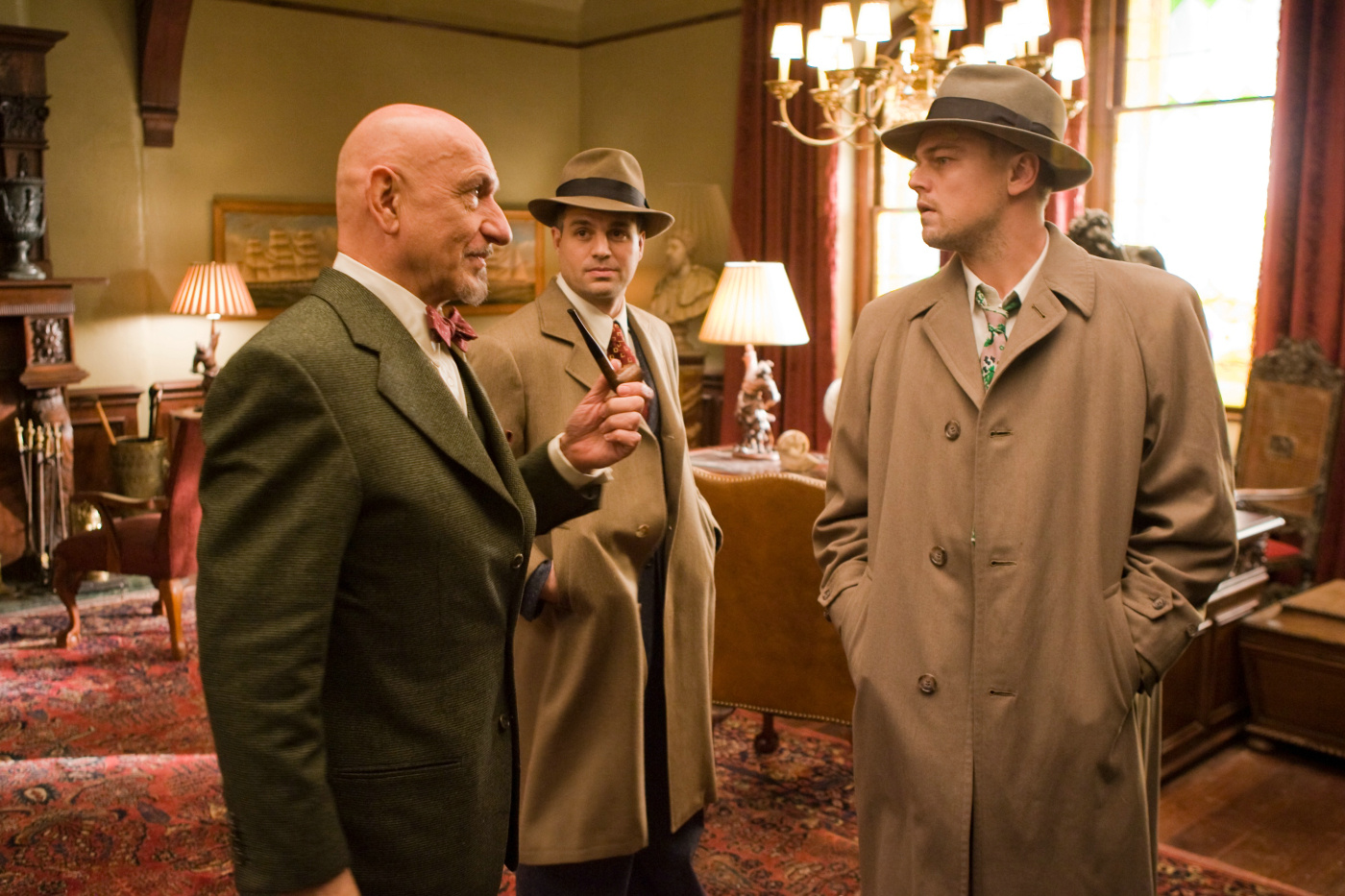
U.S. Marshal Teddy Daniels (Leonardo DiCaprio, right) and new partner
Chuck Aule (Mark Ruffalo, center) are immediately dissatisfied with the
information supplied by Dr. Cawley (Ben Kingsley); both detectives find the
psychiatrist too slick and much too condescending. The question, then,
revolves around what this unnaturally calm clinic head is hiding.

And not pleasantly.

Shutter Island is a period piece, set in 1954, and very much a product of its era. World War II remains a recent and highly disturbing memory, with reflexive suspicion directed toward German immigrants. Sen. Joseph McCarthy's red-baiting witch hunt and the House Un-American Activities Committee are uppermost on everybody's minds, as are fears about being vaporized by hydrogen bombs.

Against the paranoia of this Cold War backdrop, U.S. Marshal Teddy Daniels (Leonardo DiCaprio) and new partner Chuck Aule (Mark Ruffalo) are summoned to Ashecliffe Hospital, an isolated facility for the criminally insane located on Shutter Island, a rocky hiccup of land off the New England coast. (Filming actually took place on Peddocks Island, roughly 100 miles off Boston.)

The facility's directors, Dr. Cawley (Ben Kingsley) and Dr. Nauhring (Max von Sydow), have a disturbing problem: One of their patients — Rachel Solando (Emily Mortimer), a deranged woman who quietly drowned her three children, but even now believes that she and they are continuing their bucolic suburban lives — has disappeared from her cell. It's a classic locked room mystery: no way to get out, no way to get past several staffing and guard stations, and certainly no way to get off the island.

And yet she's gone.

Daniels, blessed with the sharpened awareness of a keen investigator, along with an intuitive ability to read people, senses hostility from the moment he and Chuck step off the only ferry that runs between Shutter Island and the mainland. The facility's armed guards are watchful and suspicious; the staff members, when gathered for interviews, are condescending and tolerantly amused.

Daniels knows they're lying to him, just as he knows that Rachel couldn't possibly have escaped ... at least, not without help.

Friday, September 5, 2008

Elegy: Love among the ruins

Elegy (2008) • View trailer for Elegy
Four stars (out of five). Rating: R, for nudity, sexual content and profanity
By Derrick Bang • Originally published in The Davis Enterprise, 9.5.08
Buy DVD: Elegy


His 1997 Pulitzer Prize and 2001 American Academy of Arts and Letters Gold Medal notwithstanding, Philip Roth seems doomed — in certain circles, anyway — to be remembered for his scandalous third novel, 1969's Portnoy's Complaint, and for his ongoing obsessions with promiscuity and Jewish angst.
Mindful of sexual harassment issues, college professor David Kepesh (Ben
Kingsley) always waits until the end of term before throwing a party for his
students. He always hopes to find at least one who will be properly intoxicated
by his worldly presence, but gets more than he bargained for with Consuela
Castillo (Penélope Cruz), who, during their initial conversation, reduces him to
schoolboy clumsiness. Fortunately, things will improve from here...

And, more recently, for succumbing to a perfectly natural desire to explore tales of aging men indulging in affairs with much younger women, which puts Roth in the equally excellent literary company of, say, John Updike. One cannot really fault a male literary lion who, upon reaching "a certain age," worries about his increasing obsolescence. Eventually (with luck), we all will.

Elegy, exquisitely adapted by screenwriter Nicholas Meyer from Roth's short novel, 2001's The Dying Animal, is the saga of a celebrated man of letters and cultural observer who, thanks to the proximity to young people granted by his day job as a college professor, embarks on a passionate affair with a former student.

The encounter proves revealing in many respects: some anticipated, others quite surprising.

But branding this film as nothing more than an "old guy beds Penélope Cruz" fantasy is an unjust snub that overlooks some phenomenal acting, the core truths of Roth's story and director Isabel Coixet's obviously sincere desire to respect both halves of this May/December romance.

David Kepesh (Ben Kingsley) is, as he constantly reminds Consuela Castillo (Cruz), 30 years her senior. This seems all the explanation required to describe the apparent folly of allowing a pleasant one-night encounter to blossom into a relationship, but he's merely lying to himself; the truth of the matter — and we see this in Cruz's luminously expressive gaze — is that Consuela loves him and couldn't care less about the age gap.

He's the one with the hang-up, but the whole "age thing" is just an excuse.

Following an unsuccessful youthful marriage, Kepesh has spent the rest of his life trolling for deliberately short-term affairs, due — we're quickly led to believe — to his desire to live according to the sybaritic lifestyle that he believes is mankind's "normal" predilection. He repeatedly espouses this theory when interviewed, and during debates with his longtime best friend, poet George O'Hearn (Dennis Hopper).

In a film laden with revealing exchanges of dialogue, by the way, none are better than these comradely encounters between David and George. Kingsley and Hopper share a relaxed comfort that feels completely natural; we can't help wondering if this scripted familiarity is equally strong off-camera.

George obviously has David's number, and David knows it ... but puts up with it.

David fears intimacy and actual human contact, and believes himself incapable of both, because he intellectually insists mankind isn't wired for it. He admires early American hedonist Thomas Morton and has, in fact, over-analyzed the art of lovemaking to such an absurd degree that he has stripped love itself from the equation.