Showing posts with label Leonardo DiCaprio. Show all posts

Friday, October 27, 2023

Killers of the Flower Moon: Unforgettable

Killers of the Flower Moon (2023) • View trailer
Five stars (out of five). Rated R, for violence, grisly images and profanity
Available via: Movie theaters
By Derrick Bang • Published in The Davis Enterprise, 10.27.23

This is a masterpiece. 


It’s the pinnacle of director Martin Scorsese’s career … which, obviously, needed no further burnishing. But there you go: 81 years old, and more visionary than ever.


William Hale (Robert De Niro, center) beams on the day his nephew, Ernest Burkhart
(Leonardo DiCaprio) marries Osage woman Mollie Kyle (Lily Gladstone) ... but
Hale's delight has very little to do with genuine affection.


I was reminded, while thoroughly engaged during this film’s (admittedly intimidating) 206-minute running time, of Roger Ebert’s Second Law of Motion Pictures: “No good movie is too long.”

True that. (But an intermission would have been nice.)


In adapting journalist David Grann’s 2017 nonfiction book of the same title, Scorsese and co-scripter Eric Roth have aimed a much-needed spotlight — particularly during these tempestuous times of revisionist classroom instruction — on a mostly forgotten slice of American history every bit as heinous as the two-day 1921 race massacre in the Greenwood district of Tulsa, Okla. (which this film briefly references).


Scorsese’s film is bookended by Osage cultural rituals, the first a melancholy “pipe ceremony” as the elders mourn the forced assimilation of their children into white American society. It’s the early 20th century, and a sudden silver lining erupts against this sad tableau: Oil is discovered on the Oklahoma reservation, located northwest of Tulsa. (Yep, Tulsa. Again.)


Within half a generation, members of the Osage community are, per capita, the world’s wealthiest individuals. They have automobiles, fancy clothes, plenty of glam … and servants. White servants. (Imagine how well that goes down.)


Even so, as per U.S. government-mandated reservation law, white “guardians” must manage each individual’s money. (Imagine how well that goes down.)


The story proper begins in 1919, as Ernest Burkhart (Leonardo DiCaprio) returns from WWI service, where he’s reunited with his brother Byron (Scott Shepherd) and uncle William Hale (Robert De Niro). The latter has an extensive cattle ranch on reservation land — no oil operations — and has, over time, been embraced as a staunch friend and benefactor to the Osage, speaking their language and participating in all important rituals.


Ernest’s initial “interview” with his uncle is revealing. Under Hale’s cheerful, fatherly probing, the younger man bashfully acknowledges his primary interests in money, whiskey and women. DiCaprio is sublime here, as Ernest radiates embarrassment over his limited intelligence; he’s quite unsophisticated, lacking the worldly wisdom that should have resulted from his war service. Unable to handle heavy labor due to a war injury, he gratefully agrees to serve as a chauffeur.


Friday, December 31, 2021

Don't Look Up: Profoundly unsettling, despite trying too hard

Don't Look Up (2021) • View trailer
3.5 stars (out of five). Rated R, for frequent profanity, sexual candor, graphic nudity and drug use
Available via: Netflix
By Derrick Bang • Published in The Davis Enterprise, 1.7.22

Ouch.


This is about as scathing an indictment of modern American behavior as can be imagined.


Hoping to share their dire and tremendously important discovery on national television,
Randall (Leonardo DiCaprio, center right) and Kate (Jennifer Lawrence, far right) little
realize they're about to be trivialized by hosts Brie (Cate Blanchett) and Jack (Tyler Perry).


Back in 2015, writer/director Adam McKay stunned us with The Big Short, a wildly entertaining and ferociously mocking blend of drama, quasi-documentary and break-the-fourth-wall cinéma vérité, in service of an economic crash course that brilliantly explained the upper-echelon machinations that drove our country off a financial cliff in 2007.

This time, McKay and co-scripter David Sirota set their sights much higher: the cognitive dissonance and blind stupidity that prompt so many Americans to deny the existence of climate change, safe covid vaccines, the results of the 2020 election, and a great deal more.


Willful ignorance runs rampant these days, which gives McKay and Sirota plenty to scream about. While quite a few of this film’s sarcastic bombs hit their target, Don’t Look Up isn’t as artistically tight as The Big Short, and I also miss that earlier film’s inventively cheeky directorial flourishes. Sarcasm and snark once again are in abundance, but McKay’s approach here is more dramatically conventional.


Perhaps that’s because the operative metaphor — and its real-world counterpart — are too sobering, too horrifying, for gleeful frivolity.


The Big Short was fun, whereas this one is deeply unsettling: mad-as-hell, take-no-prisoners storytelling.


Events kick off quietly, as university astronomy professor Randall Mindy (Leonardo DiCaprio) and grad student Kate Dibiasky (Jennifer Lawrence) discover a new comet orbiting our solar system. Their initial excitement dwindles when Kate and a gaggle of fellow grad students watch Randall compute the comet’s trajectory on a white board, to determine whether it’ll be visible when it passes Earth.


The film’s most grimly impactful wallop occurs right here, as Randall — fully absorbed by complex mathematical equations — initially fails to register the implication of the zero he has just written on the board. DiCaprio sells this moment: Randall hesitates, starts to shake his head, knows he hasn’t made a mistake … but nonetheless erases the zero and empties the room. Except for Kate.


Computing the dimensions of the comet is similarly easy. It’s the size of Mount Everest … and if — when — it strikes Earth, in just over six months, it’ll be a planetary extinction event.


Well.


Saturday, February 27, 2016

2015 Oscar predictions: The envelope, please...

Let’s deal with the elephant in the room.

As of a few weeks ago, the Academy of Motion Picture Arts and Sciences had 6,261 voting members. All of them submit nominations for best picture.

Alejandro González Iñárritu, left, and Leonardo DiCaprio are certain to win Oscars for
Best Director and Best Actor. But will their film, The Revenant, also take Best Picture?
Nominees in most of the remaining categories are selected via balloting by various Academy branches: editors for editing, cinematographers for cinematography, and so forth. The same is true of the four acting categories, where — again, as of this year’s balloting — 1,138 Academy members, all actors, determined the nominees.

So: 6,261 overall voting members, 1,138 of whom are in the actors branch. And all of whom are limited by one incontrovertible fact: They’re only able to consider the product booked into U.S. movie theaters during the previous calendar year. To put it another way, not one of those Academy actor members is, was, or ever will be in a position to determine which movies get made and/or released, in order to be voted upon.

Those decisions come from a couple dozen different studio heads: almost all male, and white, and young, and guided entirely by bean counters, focus groups and the panicked certainty that more than one flop in a row likely will cost them their jobs. Ergo, they all too frequently stick to the tried and true.

So why — why — is everybody so upset with the Academy, when an absence of diversity clearly isn’t their fault?

If people are unhappy about racial diversity in any category — and yes, I share their absolutely legitimate frustration — then the anger needs to be channeled toward Hollywood’s studio board rooms, and nowhere else. It’s a separate conversation.

The Oscars, one hopes, are presented to honor the best work in the best movies available during a given year. Anything else would be quota pandering, which would make a mockery of an institution celebrating its 88th anniversary this year.

So let’s embrace the tradition for what it is, and what it does — and should — represent. And let’s also enjoy the time-honored pastime of trying to predict what’ll win this year.

But before we get down to cases, some fun facts:

The Revenant and Mad Max: Fury Road are only the fourth and fifth films ever to receive nods in all seven technical categories — cinematography, costume design, editing, production design, sound editing, sound mixing and visual effects — after Titanic, Master and Commander: The Far Side of the World and Hugo.

Bridge of Spies brought Steven Spielberg his 11th nomination for best director, a category he won twice, for Schindler’s List and Saving Private Ryan. Director William Wyler still holds the record, at 13 nominations and three wins: Mrs. Miniver, The Best Years of Our Lives and Ben-Hur. (But Spielberg still has plenty of time!)

• On the other hand, the total number of nominations accrued by Spielberg’s various films now sits at 128 ... to Wyler’s 127. That makes Spielberg the top nomination-gathering director of all time.

• All six of director Alejandro González Iñárritu’s films have earned at least one Oscar nomination.

• Jennifer Lawrence has become the youngest actress to earn four Oscar nominations, having snatched that honor from Kate Winslet.

• With a span of 39 years between Sylvester Stallone’s Oscar nod for 1976’s Rocky and last year’s Creed, he has broken the previous record of 38 years, held by Helen Hayes, Jack Palance and Alan Arkin. Stallone also has become only the sixth actor to be nominated twice for playing the same character, after Bing Crosby (Father O’Malley), Peter O’Toole (King Henry II), Paul Newman (“Fast Eddie” Felson), Al Pacino (Michael Corleone) and Cate Blanchett (Queen Elizabeth II).

Friday, January 8, 2016

The Revenant: Grim survival drama

The Revenant (2015) • View trailer 
3.5 stars. Rated R, for strong gory violence, dramatic intensity, sexual assault and profanity

By Derrick Bang • Originally published in The Davis Enterprise, 1.8.16


Rarely has the rugged American West been portrayed with such grim, unforgiving brutality.

Hollywood seems to view the holiday season as the time for historical sagas of astonishing survival. Unbroken opened on Christmas Day 2014; In the Heart of the Sea occupied movie theaters during much of this past December. To their company we now add The Revenant, based in part on the gruesome event that defined the life — and legend — of early 19th century American fur trapper and frontiersman Hugh Glass.

Seasoned frontiersman Hugh Glass (Leonardo DiCaprio) understands that he can't
necessarily trust some of his human companions. He also understands that far more
dangerous creatures roam the wilderness ... and none more volatile than an enraged
mother bear trying to protect her cubs.
This incident, and its aftermath, first hit the big screen in 1971’s Man in the Wilderness, with Richard Harris starring as “Zachary Bass” (the sort of dumb name-shift that made eyes roll, back in the day). Author Michael Punke subsequently employed Glass’ experiences as the backdrop for his fictional 2002 “augmentation” of the trapper’s life, The Revenant; director Alejandro González Iñárritu and co-scripter Mark L. Smith have based this new film on that novel.

While the bloodthirstier elements of Glass’ saga have been heightened here (and in Punke’s novel) for greater melodramatic impact, that isn’t as unreasonable as it might seem. Glass was guilty of exaggerating his exploits during his own lifetime, so we really aren’t able to separate fact from fancy ... except with respect to the seminal incident.

As the film begins, Glass (Leonardo DiCaprio) is guiding a fur-trapping expedition led by Capt. Andrew Henry (Domhnall Gleeson), commander of the trading outpost Fort Kiowa, located on the Missouri River in South Dakota. The group is ambushed by an Arikara war party — once-peaceful Native Americans who, at this point in their history, are thoroughly fed up with having been repeatedly displaced by white settlers — that decimates Henry’s company.

The fleeing survivors regroup, with Henry accepting Glass’ suggestion of the safest — but hardest — route back to the fort. This decision doesn’t sit well with the outspoken John Fitzgerald (Tom Hardy), mostly because he neither likes nor trusts Glass. The latter doesn’t regard Fitzgerald as worthy of concern, which of course enrages our de facto villain even further.

Fitzgerald also is a vicious racist who despises the presence of Glass’ half-Native teenage son, Hawk (Forrest Goodluck). Although father and son are devoted to each other, the boy is withdrawn and fearful: forever traumatized by a childhood event that claimed his mother’s life (and which we experience, in brief chunks, via flashback).

The remaining trappers also include young Jim Bridger (Will Poulter), a name that should be familiar to those who remember their grade-school American history; Bridger would become one of our foremost mountain men and guides.

Tuesday, December 31, 2013

The Wolf of Wall Street: A howling disappointment

The Wolf of Wall Street (2013) • View trailer 
Two stars. Rating: R, for strong sexual content, graphic nudity, pervasive profanity and drug use, and some violence

By Derrick Bang • Originally published in The Davis Enterprise, 12.31.13


Boobs, blow and bad language.

That’s my takeaway, from the 180 minutes I wasted — nay, endured — while watching The Wolf of Wall Street.

This is where Jordan Belfort (Leonardo DiCaprio) feels the most comfortable, and the
most powerful: at the microphone in front of his troops at Stratton Oakmont, preparing
to deliver another do-or-die speech designed to encourage everybody to hit the
phones and fleece ever more working-class suckers out of their hard-earned savings.
Root-canal surgery would have been less painful.

Director Martin Scorsese and star Leonardo DiCaprio have made beautiful music on numerous occasions, but this symphony of wretched excess plays more like a botched rehearsal.

There isn’t more than 20 minutes’ worth of actual narrative in Terence Winter’s sloppy excuse for a screenplay. Indeed, this plays like the parody sketch Saturday Night Live might have made of a much better movie ... or, perhaps, the Mad Magazine take on far superior material.

Great, expansive chunks of this bewildering project could have come from the improvisational, goof-laden antics of a Seth Rogen/Judd Apatow farce. Pointless exchanges of inane, profanity-laden, frat boy “dialogue” go on and on and on and on. Our stars seem to make stuff up from one scene to the next, pretending that frenzied hysteria is some reasonable substitute for actual acting, with Scorsese apparently content to let the camera roll.

That sort of babbling slapstick nonsense wears thin very quickly ... and yet it continues for what seems an eternity.

I want those three hours of my life back.

Winter’s script is adapted from Jordan Belfort’s 2007 “memoir” of the same title, a book that can be called laughably unreliable at best, perniciously self-aggrandizing at worst. Belfort was yet another opportunistic Wall Street swindler who made the most of the high-flying 1990s, largely by defrauding investors with penny stocks via the “prestigious” brokerage firm front of Stratton Oakmont.

He was indicted for securities fraud and money laundering in 1998, investors having lost somewhere north of $200 million. Belfort served just shy of two years in federal prison, then re-invented himself as a “motivational speaker” and wrote the aforementioned book — and a sequel, Catching the Wolf of Wall Street — mostly to revel in the notoriously bad behavior he and his colleagues enjoyed while fleecing the unwary.

Actually, he’s the perfect egotistical show-off for the share-all Facebook generation.

Friday, May 10, 2013

The Great Gatsby: Not mere hyperbole

The Great Gatsby (2013) • View trailer 
Four stars. Rating: PG-13, for sexual candor, violence and brief profanity
By Derrick Bang • Originally published in The Davis Enterprise, 5.10.13


Teachers have been aggravated for generations, when Hollywood brings a classic novel to the big screen; too many lazy students then seek answers from the film, rather than reading the book.

The pomp and splash of a fancy nightclub cannot prevent Tom (Joel Edgerton, far
right) from noticing that his wife, Daisy (Carey Mulligan), is being wooed shamelessly
by Gatsby (Leonardo DiCaprio, far left). Nick (Tobey Maguire), growing accustomed to
the emotional chaos that inevitably erupts when in the company of his new friends,
adopts his favorite means of retreat: another stiff drink.
Well, here’s a twist: Director Baz Luhrmann’s vibrant, mesmerizing adaptation of The Great Gatsby likely will encourage people to buy and read F. Scott Fitzgerald’s 1925 novel. Rarely has a movie so successfully breathed fresh excitement into a literary work which, no matter how well regarded by scholars, often is regarded as a yawn by readers.

It’s like struggling through Shakespeare’s prose on the printed page, absorbing very little along the way, and then seeing the play come to energetic life when staged with a cast of articulate and charismatic actors.

Yep, Luhrmann’s accomplishment is that impressive.

For openers, the film is a visual masterpiece; it’s literally breathtaking. (Cinematographer Simon Duggan, take a bow.) Never has 3-D cinematography been used so cleverly, or so successfully; the dimensionality opens up the narrative’s symbolic settings, thus lending greater emotional weight to the class-burdened archetypes represented by the five primary characters.

At the same time, Luhrmann and co-scripter Craig Pearce are impressively faithful to Fitzgerald’s original prose, at times bringing large chunks of text to life via the hyper-realism that Luhrmann employed so well in Moulin Rouge.

You’ll not soon forget production designer Catherine Martin’s grandiosely ghastly realization of Fitzgerald’s so-called “Valley of Ashes,” the desolate, begrimed region that separates the decadence of both New York City and the outlying aristocratic enclave of West Egg. (Fitzgerald was inspired by the hellish trash-burning zone along the road from Great Neck to Manhattan, the sole transit in an era before the Long Island Expressway or the Grand Central Parkway.)

Given Luhrmann’s sensibilities and visual pizzazz, it’s easy to imagine him particularly captivated by one element in Fitzgerald’s description of this site: the huge “eyes of Doctor T.J. Eckleburg” that stare out from the remnants of an oculist’s long-discarded billboard. Almost more than Gatsby’s palatial estate — also a spectacular setting — these giant eyes become one of the film’s driving images: the blank stare of an omniscient being who catalogues but does not interfere with the events that take place in the gas station located in a small settlement — not even a town — perched on one edge of this stygian, lung-fouling inferno.

Friday, December 28, 2012

Django Unchained: The West as it should have been?

Django Unchained (2012) • View trailer
3.5 stars. Rating: R, for relentless violence and gore, profanity, nudity and considerable ghastly behavior
By Derrick Bang • Originally published in The Davis Enterprise, 12.28.12


Since Jews were given the vicarious opportunity to blow up Hitler and his high-ranking Nazi goons in 2009’s alternate-history Inglourious Basterds, we shouldn’t be surprised that cinematic bad boy Quentin Tarantino would grant African Americans similar cheap thrills, by scolding the pre-Civil War, slave-holding South in the same cheeky manner.

Django (Jamie Foxx, left) believes that he and his partner have successfully tricked
Calvin Candie (Leonardo DiCaprio) into accepting their feigned roles as slave traders.
Alas, Candie isn't quite as dense as he seems, and his fury builds to fearsome
proportions when the ruse is exposed. As for what happens next ... well, let's just say
that it's vintage Tarantino.
If Mel Brooks’ Blazing Saddles made you wince, by milking broad comedy from racism, this one will freeze your blood.

But make no mistake: Although Django Unchained definitely scores points in the ongoing debate about American race relations, at its heart this film is gleefully exploitative trash: giddily violent, gratuitously blood-soaked and unapologetically self-indulgent.

And yet ... undoubtedly a guilty pleasure. You just can’t help admiring Tarantino’s chutzpah.

He remains a walking film encyclopedia, with a particular fondness for the campy, low-budget sleaze of the late 1960s and ’70s, which ranged from the Clint Eastwood/Sergio Leone spaghetti westerns, to the blaxploitation flicks that made minor-league stars of Fred Williamson, Pam Grier, Richard Roundtree, Tamara Dobson and others.

Tarantino evokes them all in Django Unchained, a revisionist western that takes its title from a 1966 Sergio Corbucci rip-off of Leone’s A Fistful of Dollars — which, in turn, ripped off Akira Kurosawa’s Yojimbo — and starred Franco Nero as a coffin-carrying pistolero who blows into a town-turned-battle zone by feuding Mexican bandits and (you gotta love it) KKK members.

No surprise, then, that Nero himself pops up in a small part here; Tarantino loves to honor his predecessors. He also gets a kick out of “rescuing” familiar film and TV B-actors, and so you’ll spot the likes of Don Johnson, Tom Wopat, Don Stroud, Bruce Dern, Lee Horsley and Michael Parks.

And you’ve gotta love the parts assigned other visiting day players: Russ Tamblyn pops up as Son of a Gunfighter — a nod to the title of his own 1966 Spanish oater — which allows Amber Tamblyn an eyeblink appearance as “Daughter of a Son of a Gunfighter.” And speaking of the KKK, Jonah Hill is cast as “Bag Head #2” in a sequence played for high comedy, which mercilessly depicts clan members as the dim-bulb morons they undoubtedly were.

But all this comes later. As was the case with Leone’s similarly sprawling 1966 epic, The Good, the Bad and the Ugly, Tarantino — both writer and director here — takes his time setting up this narrative. It’s two years prior to the opening shot of the Civil War, and the story begins as Dr. King Schultz (Christoph Waltz), a traveling dentist of questionable repute, encounters a couple of horse-riding toughs leading a small line of chained slaves, one of them Django (Jamie Foxx).

Friday, November 11, 2011

J. Edgar: Too contrived an agenda

J. Edgar (2011) • View trailer for J. Edgar
2.5 stars. Rating: R, and rather stupidly, for brief profanity
By Derrick Bang • Originally published in The Davis Enterprise, 11.11.11


A fascinating film could be made about the life of notorious FBI autocrat J. Edgar Hoover.

J. Edgar, sadly, is not that film.
As Clyde Tolson (Armie Hammer, background left) and J. Edgar Hoover
(Leonardo DiCaprio, background center) look on, FBI "wood expert" Arthur
Koehler (Stephen Root) carefully examines bits of the ladder used when the
Lindbergh baby was kidnapper. Koehler insists that he can match the ladder to
the plant where the wood was milled, and therefore confine the kidnapper's
movements to a specific geographic area.

Scripter Dustin Lance Black’s approach to this seminal 20th century figure is boring. Yawningly, crushingly boring.

I expected much better from Black, who won an Academy Award for his screenplay to 2008’s Milk. Unfortunately, in this case he focuses far too much on the clandestine affair between Hoover and longtime associate/companion Clyde Tolson.

Yes, we can lament the fact that Hoover and Tolson lived during unenlightened times, when “the love that dare not speak its name” was something to be concealed, particularly by men in power. And Black certainly intends that we consider the irony that one of the country’s most powerful men, a trader in dirty secrets himself, kept a whopper of his own.

But that would presuppose that Hoover is a man worthy of our sympathy, which isn’t the case. His intelligence, determination and maniacal patriotism notwithstanding, Hoover was — and is, as portrayed here by Leonardo DiCaprio — a venal, arrogant control freak, blackmailer and political kingpin every bit as corrupt as the headline-making gangsters his nascent Federal Bureau of Investigation helped bring down in the 1930s.

Hoover does not deserve our compassion, nor does he deserve the strawberry-lensed portrait that director Clint Eastwood grants him. And this Hoover certainly doesn’t merit the gentle keyboard theme that dominates the soundtrack: a lyrical eulogy that sounds much like the poignant piano ballads Eastwood composed for The Bridges of Madison County or Million Dollar Baby, but is completely out of place here.

The leaden pacing aside, this film’s other major problem is tone and focus: Both are completely wrong. Black suggests that the complicated relationship with Tolson was the single most important element of Hoover’s character, closely followed by his equally troubled relationship with a domineering mother (Judi Dench, at her waspish best) who’d rather have a “dead son than a daffodil.”

This is one view, and certainly a contributing factor to the elements that stoked Hoover’s growing paranoia, desperation and thirst for control. But Hoover obviously was far more than that, and Black utterly fails in his depiction of the man’s professional career: his genius for organization, his sharp political savvy, his quite accurate insistence that agents of law enforcement need investigative resources superior to the criminals they hope to apprehend.

What emerges is no more than a truncated, Readers Digest Condensed Books version of a very complex life: little more than surface gloss given minimal depth by DiCaprio’s performance.

Friday, July 16, 2010

Inception: Bad dream

Inception (2010) • View trailer for Inception
Three stars (out of five). Rating: Pg-13, for unrelenting action violence
By Derrick Bang • Originally published in The Davis Enterprise, 7.16.10
Buy DVD: Inception • Buy Blu-Ray: Inception (Two-Disc Blu-ray/DVD Combo + Digital Copy)

This overcooked flick is a lot of fuss and bother, just to learn the identity of Rosebud.

Writer/director Christopher Nolan's brain-bending fantasy boasts a genuinely fascinating premise, but the execution is wanting; the self-indulgent running time (148 minutes) can't be justified by a storyline that isn't nearly as complex  or coherent  as Nolan would like us to believe.
"Draw me a maze in two minutes," Dom (Leonardo DiCaprio) tells Ariadne
(Ellen Page), shortly after meeting her, "that takes me at least a minute to
solve." After a couple of blown attempts, Ariadne adjusts to the complexity of
the test, at which point Dom acknowledges that she might be the perfect
"architect" for his team of dream-thieves. Goodie, goodie...!

Inception is the sort of film that results when an inventive and financially successful filmmaker, armed with a few box-office hits  in this case, Batman Begins and The Dark Knight  is let off the company leash for a long-gestating "dream project" (no pun intended) and granted unfettered access to the studio bank account. Inevitably, the outcome is runaway hubris.

We've seen it happen time and again, with talents as stellar as James Cameron (The Abyss) and Barry Levinson (Toys). The most famous example remains Michael Cimino, whose bloated production of Heaven's Gate literally bankrupted United Artists, back in 1980.

Inception won't bankrupt Warner Bros., but it also won't be the summer blockbuster we've been hoping for, given the film's ultra-top-secret production and tantalizingly vague advance publicity. The rewards remain few in this visually bombastic but emotionally barren drama.

I'm halfway persuaded that Nolan set out to create a film with a climax  running the entire final hour  that out-weirds the LSD-esque sequence that concluded 1968's 2001: A Space Odyssey. That sci-fi classic had its devoted acolytes at the time (and still does), but I can't help remembering, with a whimsical smile, that many (most?) of the warm bodies filling theater seats during the waning days of that hippy-dippy decade were, ah, chemically altered.

That stargate sequence was the ultimate head-trip, man.

So's the entire second half of Inception. And it'll definitely impress a lot of viewers.

An intriguing idea? Absolutely. Quite thought-provoking, at times. But only at times.

We hit the ground running, as Nolan introduces us to Dom Cobb (Leonardo DiCaprio) and his unusual team of professional "dream thieves," as they try to extract a closely guarded secret while having invaded the sleeping mind of Saito (Ken Watanabe), a rich and powerful business magnate.

Dreamtime landscapes have their own logical illogic, and Dom is close to emptying the contents of Saito's mental safe when the mission goes awry, thanks to the intervention of Mal (Marion Cotillard), a mysterious woman able to interfere with Dom's subconscious sleuthing.

Once back in the waking world, Saito is unbothered by this most personal incursion, choosing to view the experience as an odd sort of audition. He offers Dom and longtime dream-thief partner Arthur (Joseph Gordon-Levitt) a rich assignment with a fresh target: Robert Fischer (Cillian Murphy), who's about to inherit control of his dying father's multibillion-dollar empire. The Fischer family is the sole obstacle to Saito's desire to control the entire world's energy market, and he wants that obstacle removed.

The tantalizing solution: Invade Robert Fischer's mind and plant a suggestion  an "inception"  that he should break up his father's corporate monolith.

Ah, but uncovering deeply buried secrets is easy, Arthur objects, when compared to embedding a foreign idea. Apparently the host mind is quick to perceive the introduction of an alien thought, and will create mental defenses to repel and even destroy the invader, much the way white blood cells will overwhelm an infection site.

OK, fine, whatever...

Dom and Arthur assemble a team, much the way Peter Graves' Jim Phelps cherry-picked associates for each Mission: Impossible caper. Eames (Tom Hardy) can "forge" another identity in somebody else's dream, effectively becoming a trusted friend or family member. Yusuf (Dileep Rao) is an unorthodox pharmacologist who devises the drug cocktails that keep subjects  and invaders  in dream sleep, while allowing a means for controlled waking.

Saito insists on coming along for the ride, to protect his investment.

Ariadne (Ellen Page), finally, is a university architectural student given the opportunity to "build" the dream landscapes. It's necessary for such realms to appear real to the dreaming subject, again to maintain the necessary level of verisimilitude. As the team's token newbie, Ariadne is our conduit to all this crazy stuff: the person who asks the questions that force explanations from Dom, so that she  and we  can make sense of all this twaddle.

Funny thing, though: Ariadne also is a savvy psychologist, since she quickly perceives that bad things are rattling around in Dom's subconscious ... and that such distractions could have deadly consequences once the dream thieves infiltrate a host mind in order to do their thing.

About those deadly consequences: Dying in a dream can be a quick way to regain consciousness in the real world, but only in a surface dream. But Dom and his crew are planning to "incept" Robert Fischer by layering several levels of dreams within dreams, and dying within a deeper level results in the invading dreamer's banishment to a limbo-like purgatory, where years can pass during single minutes in the actual waking world.

Mostly, though, all this mumbo-jumbo is Nolan's excuse to populate these dream worlds with nifty visuals  buildings erupting like flowers from a barren landscape, or crashing down in noisy shards; city streets folding over on themselves, becoming Escher-like environments with cars traveling at vertical perpendiculars to each others  and gun-toting, car-chasing assassins.

Indeed, the deepest level of Ariadne's faux constructs resembles the ski-chasing battles from the James Bond film On Her Majesty's Secret Service: a pretty thin excuse for inserting action violence into the rarefied premise of dream sleep.

And in so doing, Nolan falls into the same trap that snared director/scripter Peter Jackson, when he recently adapted Alice Sebold's The Lovely Bones. Jackson became so fixated by the dead Saoirse Ronan's afterlife landscape, in all its colorful weirdness, that he failed to pay sufficient attention to the necessary drama involving the living characters, most notably how a mother would react to the death of her daughter.

Nolan similarly glosses over the human element in this story, and spends far too much time with gunfire and chaotic vehicular pursuits. (It would seem that dreamscape bad guys can't hit a damn thing they shoot at, much like their waking-world counterparts in countless dumb action flicks.)

It's therefore impossible to care a jot about any of these characters  none of whom has a back-story, aside from Dom  or be concerned over their potential peril. Actual danger? In a dream? Where all rules of movement and behavior change from one moment to the next?

Page is a remarkably intelligent and gifted actress, and she does her best to give Ariadne legitimate reasons for caring about Dom, and for wanting to help him root out his psychoses. But it's an uphill struggle, and DiCaprio doesn't help much; his default handling of Dom is as a morose, exhausted, gaunt-eyed automaton whose extensive activities in the dream state have left him unable to properly process real-world concerns. As we're repeatedly told.

Similarly, it's difficult to get a bead on the complicated relationship between Dom and Mal. DiCaprio and Cotillard speak their lines with reasonable conviction, but the dynamic uniting these two simply doesn't resonate. (It doesn't help that we recently watched DiCaprio deal with similar mental phantasms earlier this year, in Martin Scorsese's Shutter Island.)

Gordon-Levitt and Hardy inject flickering moments of mordant humor, and Michael Caine does his usual commendable work at Dom's father-in-law, Miles. I'm hard-pressed to understand why Miles would be so sympathetic toward Dom, however, once necessary details are revealed to us.

Nolan apparently is striving for the sort of dual universe that made the first Matrix film such a marvelous gotcha, particularly when Keanu Reeves first tumbled out of his (our) humdrum illusory world, and woke in the gloppy brain scan chamber monitored by the sophisticated man-made computers and machines that had taken over the Earth and enslaved humanity. Now that was a head-trip.

It also made sense, to a point (much less so, in the two sequels).

Inception really doesn't make sense. Too many questions abound, starting with where all this dream-invasive tech came from in the first place. Who hired Dom to invade Saito's mind, and why? Who invented these suitcase-size mechanisms? Does anybody else have them except Dom and his team? Knowing of the existence of such tech, could anybody ever trust that any experience is real?

For that matter, what bloody year is it?

And the biggie: Why would anybody, for any length of time, knowingly place his or her vulnerable, unconscious body at the mercy of anybody wandering into the room ... not to mention trusting his or her mind to an unpredictable dream state manipulated by somebody with glaringly obvious but undiagnosed psychoses?

We're to swallow the notion that Page's Ariadne, an obviously intelligent young woman, would do this capriciously, with scarcely a second thought?

Only in your dreams, Christopher.

Friday, April 23, 2010

Hubble 3D: The final frontier

Hubble 3D (2010) • View trailer for Hubble 3D
Five stars (out of five). Rating: G, and suitable for all ages
By Derrick Bang • Originally published in The Davis Enterprise, 4.23.10


For sheer mind-boggling spectacle, the IMAX space films always have taken the best advantage of the giant-format screen and sound system.

While not wanting to snub the many other IMAX documentaries  most particularly 1998's Everest, which set the bar pretty high more than a decade ago  the various undersea efforts, freighted as they often are with reproachful environmental messages, have started to suffer from a serious case of same-old, same-old.
Neither words nor this flat image can begin to do justice to the overwhelming
majesty of Hubble 3D; it's true sensory overload. This experience won't ever
be reproduced in a home theater environment; only the size, sound, scope and
jaw-dropping dimensionality of an IMAX house can do it justice. Repeat
viewings are inevitable.

Not so the space films.

Never the space films.

And the newest, Hubble 3D, is simply breathtaking. Amazing. Astonishing.

If James Cameron's Avatar has become the benchmark by which all future 3D sci-fi epics will be judged, then Hubble 3D certainly does the same for documentaries. Never before has James T. Kirk's "space ... the final frontier" been depicted with such stunning camerawork, or with such dramatic heft.

Yep, drama. No other word describes the emotional impact afforded by this up-close-and-personal glimpse of God's heavens.

Writer/director Toni Myers' film has a story, of sorts: the evolution and initial 1990 orbital placement of the massive Hubble space telescope, followed by the immediate need to fine-tune its innards during subsequent shuttle missions. I'm not sure what's more impressive: the fact that we got that beast up there in the first place, or the fact that space-walking astronauts were able to repair and improve its functions as necessary.

And then the situation hits an eye-widening crisis, as recounted by narrator Leonardo DiCaprio (and his line readings are superb). Due to budgetary concerns and yet another glitch in the Hubble's performance  a warped lens had severely compromised the massive telescope's abilities  NASA and Congress came within a hair's breadth of allowing this technological marvel to reach the point of no return via orbital decay, after which it would have become who knows how many chunks of flaming space junk during atmospheric re-entry.

The mind doth boggle.

Thursday, February 25, 2010

Shutter Island: Cast adrift

Shutter Island (2010) • View trailer for Shutter Island
3.5 stars (out of five). Rating: R, for profanity, violence, nudity and dramatic intensity
By Derrick Bang • Originally published in The Davis Enterprise, 2.25.10
Buy DVD: Shutter Island • Buy Blu-Ray: Shutter Island [Blu-ray]


Shutter Island is a jittery, nerve-jangling riff on Alfred Hitchcock's Spellbound, by way of novelist Dennis Lehane's signature brand of menace and human depravity.

And when Lehane is involved  he also wrote the novels on which Mystic River and Gone Baby Gone were based  you can bet that children will be involved.
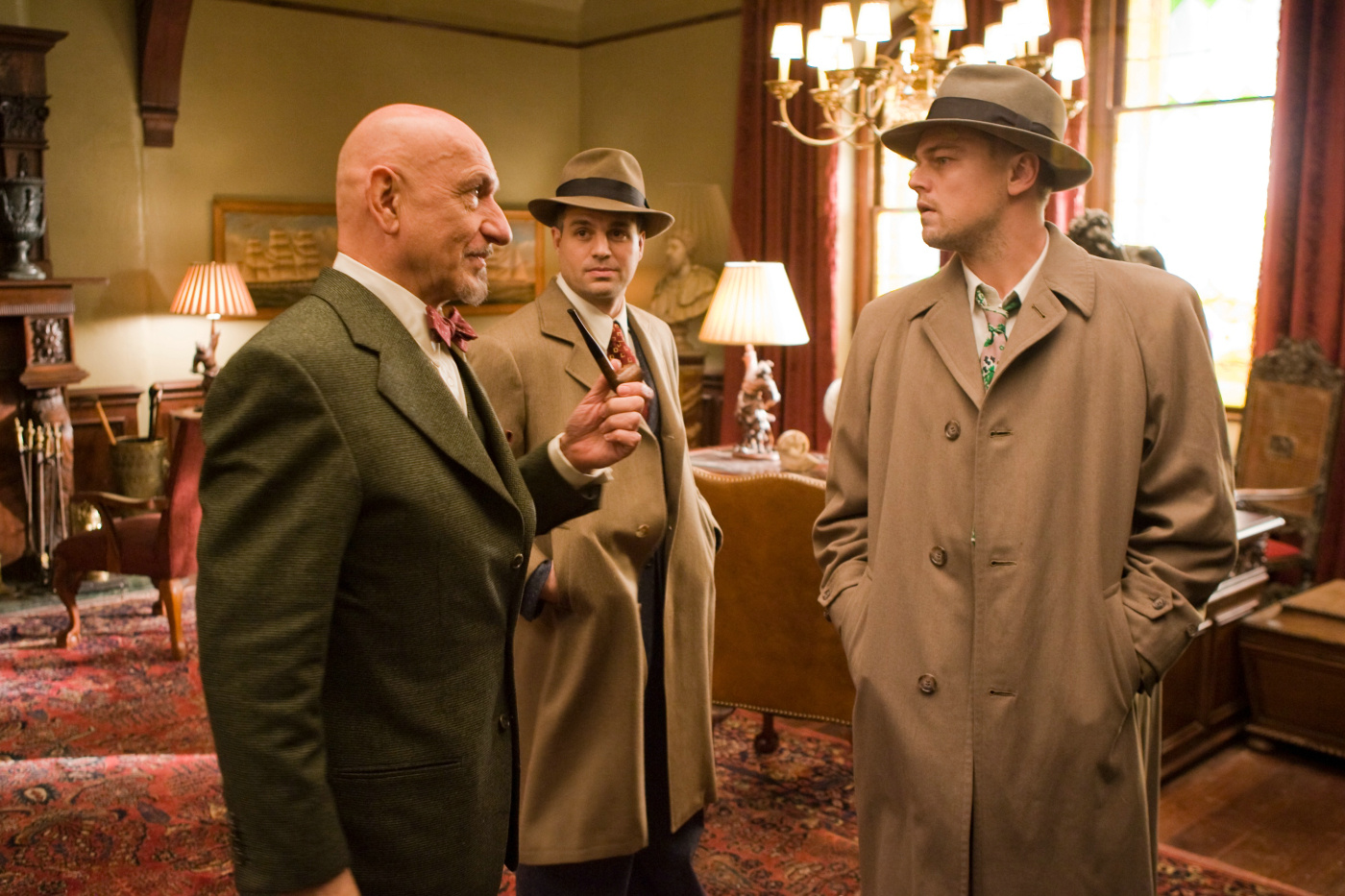
U.S. Marshal Teddy Daniels (Leonardo DiCaprio, right) and new partner
Chuck Aule (Mark Ruffalo, center) are immediately dissatisfied with the
information supplied by Dr. Cawley (Ben Kingsley); both detectives find the
psychiatrist too slick and much too condescending. The question, then,
revolves around what this unnaturally calm clinic head is hiding.

And not pleasantly.

Shutter Island is a period piece, set in 1954, and very much a product of its era. World War II remains a recent and highly disturbing memory, with reflexive suspicion directed toward German immigrants. Sen. Joseph McCarthy's red-baiting witch hunt and the House Un-American Activities Committee are uppermost on everybody's minds, as are fears about being vaporized by hydrogen bombs.

Against the paranoia of this Cold War backdrop, U.S. Marshal Teddy Daniels (Leonardo DiCaprio) and new partner Chuck Aule (Mark Ruffalo) are summoned to Ashecliffe Hospital, an isolated facility for the criminally insane located on Shutter Island, a rocky hiccup of land off the New England coast. (Filming actually took place on Peddocks Island, roughly 100 miles off Boston.)

The facility's directors, Dr. Cawley (Ben Kingsley) and Dr. Nauhring (Max von Sydow), have a disturbing problem: One of their patients  Rachel Solando (Emily Mortimer), a deranged woman who quietly drowned her three children, but even now believes that she and they are continuing their bucolic suburban lives  has disappeared from her cell. It's a classic locked room mystery: no way to get out, no way to get past several staffing and guard stations, and certainly no way to get off the island.

And yet she's gone.

Daniels, blessed with the sharpened awareness of a keen investigator, along with an intuitive ability to read people, senses hostility from the moment he and Chuck step off the only ferry that runs between Shutter Island and the mainland. The facility's armed guards are watchful and suspicious; the staff members, when gathered for interviews, are condescending and tolerantly amused.

Daniels knows they're lying to him, just as he knows that Rachel couldn't possibly have escaped ... at least, not without help.