Friday, July 26, 2019

The Farewell: An unsatisfying send-off

The Farewell (2019) • View trailer 
Three stars. Rated PG, for no particular reason

By Derrick Bang • Originally published in The Davis Enterprise, 7.26.19

Is there such a thing as a “good” lie?

Or are they merely lies of convenience?

Billi (Awkwafina, center right), burdened by a secret she cannot reveal, has no appetite
for the lavish meal prepared by her beloved grandmother (Shuzhen Zhao, center left)
and great-aunt (Hong Lu, far left).
Bear in mind, as well, that the answer depends on cultural origins and expectations.

Indie writer/director Lulu Wang addresses such complexities in her second feature film, The Farewell, which she cheekily admits — up front — is “based on an actual lie.” Her story’s core relationship is the strong bond between Chinese-born, U.S.-raised Billi (Awkwafina) and her grandmother, Nai-Nai (Shuzhen Zhao), who has spent her entire life in Changchun.

The introverted Billi, an aspiring New York writer, struggles to make ends meet; to her vexation, she still relies on her parents — Haiyan (Tzi Ma) and Jian (Diana Lin), who live nearby — for occasional meals, their washing machine, and similar small favors. Despite recalling little of China, there’s a suggestion that Billi feels displaced: a soul perhaps not fully at ease with either half of her identity.

She enjoys frequent phone chats with Nai-Nai, which is how the film opens: on a typical call punctuated by Billi’s curiosity over the background sounds supplementing her grandmother’s voice. It’s nothing, Nai-Nai insists, when in fact she sits amid the hustle, bustle and background PA announcements of a busy hospital, where she has gone for some tests. A lingering cold and cough.

The test results are shared not with Nai-Nai, but with her doting younger sister, Little Nai-Nai (Hong Lu). The news is grim: terminal cancer, with death likely imminent.

Little Nai-Nai — with full support from the rest of the family — chooses not to share this information with her sibling. Better, everybody feels, to let Nai-Nai enjoy her final days in blissful ignorance.

(Also — and here’s our first brush with the cultural element — because the Chinese believe that the mere word “cancer” causes one so afflicted to give up and die.)

Well, not quite everybody; Billi, after extracting the truth from her parents, is appalled.

Friday, July 19, 2019

Maiden: A fantastic voyage

Maiden (2018) • View trailer 
Four stars. Rated PG, and needlessly, for mildly salty language

By Derrick Bang • Originally published in The Davis Enterprise, 7.19.19

The only thing better than a captivating underdog drama is a captivating underdog documentary.

Although her capable and resourceful crew members handle their various tasks with
skill, skipper Tracy Edwards (left) is equally involved with every aspect of the yacht
she has dubbed Maiden.
Director Alex Holmes’ Maiden is mesmerizing: an absorbing depiction of one person’s determination to triumph despite odds and obstacles that the word “overwhelming” cannot adequately convey. And — even more important — this is a thoroughly satisfying empowerment saga, which traces a young woman’s resolve to penetrate a rather unusual (but still insufferable) gender barrier.

Let it be said: Tracy Edwards is an extraordinary individual.

Seventeen yachts and 167 crew members participated in 1973’s debut Whitbread Round the World Race. This highly competitive event subsequently has taken place roughly every three years (and since 2001, with a change of sponsorship, has been known as the Volvo Ocean Race).

For more than a decade, women played almost no role: not as crew, and certainly not as skippers. Indeed, the very concept of a woman participating was greeted with sexist, dismissively jeering smirks that bordered on the superstitious: like sailors who regarded the killing of an albatross as bad luck.

At first blush — as the opening chapter of Holmes’ film makes clear — Edwards seems an unlikely champion to go up against the yachting world’s impregnable gender barrier. Unlike most who participate in the annual race, she didn’t grow up in a sailing family; she also had a troubled childhood, dropping out of school and running away at 16, in order to flee an antagonistic, alcoholic stepfather.

But she finds a new family, of sorts, when she joins a hard-partying tribe of boat crew gypsies, working as a cook and stewardess on private vessels and for-hire yachts that ferry tourists between island resorts. All these years later, a blaze of excitement illuminates Edwards’ gaze, as she thinks back to how quickly this new, exhilarating lifestyle became an epiphany moment.

Holmes and editor Katie Bryer blend intimate, on-camera recollections by Edwards, and other participants, with an impressively diverse assortment of archival footage (some of it obviously obtained under quite hazardous conditions, as the story proceeds). Holmes was blessed by the availability of so much video; it’s almost as if somebody knew, so many decades ago, that Edwards was destined to become a “chosen one.”

The Lion King: More of a whimper than a roar

The Lion King (2019) • View trailer 
Three stars. Rated PG, for dramatic intensity

By Derrick Bang

It’s difficult to view this film as anything but a cynical cash grab.

Cruelly tricked into believing that he has committed an unspeakable act, the forlorn
lion cub Simba's spirits are lifted when he unexpectedly befriends a warthog (Pumbaa)
and a meerkat (Timon).
Disney has been cannibalizing its legacy of late, and the results are increasingly deplorable. Bad enough that we had to endure (mostly) live-action remakes of Dumbo and Aladdin earlier this year; at least they’re populated mostly by human characters who could be given fresh interpretations by flesh-and-blood actors (as will be the case with a live-action Mulan, arriving next year).

But The Lion King is different: nothing more than “trading up” an entirely non-human cast from (more or less) traditional animation to CGI. To what end? Animation is animation. The opulent, Tony Award-winning Broadway production was highlighted by Julie Taymor’s costume design and inventive direction, Richard Hudson’s scenic design, and Garth Fagan’s choreography … none of which translates to this animated retread.

And, as was the case with Aladdin, this Lion King has been expanded from the 1994 original’s just-right 88 minutes, to a bloated and often insufferable 118 minutes. That additional half-hour adds nothing to the story, aside from granting director Jon Favreau more space for portentously long takes apparently intended to amplify the drama.

In fact, such lengthy pauses make the film seem like more of a drag.

In fairness, the animation is stunning:  a collaborative effort by visual effects supervisor Rob Legato, animation supervisor Andrew R. Jones, and MPC Film VFX supervisors Adam Valdez and Elliot Newman. It’s not merely a pride of lions looking and moving in a lifelike manner; this story has a massive cast of four-legged and winged characters, not to mention sidebar insects, reptiles and all manner of other critters.

The verisimilitude is breathtaking … and that’s part of the problem. Because it frankly looks weird when these creatures break into song. The talking is disorienting enough, but at least that’s subtle; watching the mouths of a lifelike lion, warthog and meerkat wrap their lips around the lyrics of “Hakuna Matata” utterly destroys the illusion.

Friday, July 12, 2019

Stuber: Stoo-pid

Stuber (2019) • View trailer 
Two stars. Rated R, for relentless violence and profanity, sexual candor, and fleeting nudity

By Derrick Bang • Originally published in The Davis Enterprise, 7.12.19


Good grief.

I haven’t seen this much contrived, gratuitous and pointless destruction of property since the inane Disney comedies of the 1960s, when a bear would “accidentally” stumble into somebody’s garage and wreak havoc with scores of spilled paint cans.

Stu (Kumail Nanjiani, right) objects strongly when Vic (Dave Bautista) insists on giving a
ride to a dog they've just rescued. Stu should be more tolerant; this pooch is far more
entertaining than most of the rest of the film.
The bear in this case is Dave Bautista’s Vic Manning, a rogue cop with serious anger issues, thanks to a violent, over-the-top prologue dominated by his protracted, dog-nuts fight with gleefully sadistic bad guy Oka Tedjo (Iko Uwais). Alas, the villain gets away, fueling Vic’s rage during six subsequent months of frustrating, futile investigations.

Director Michael Dowse’s Stuber is one of the most uneven action flicks ever unleashed by Hollywood: at times genuinely funny — mostly when Bautista’s hulking Vic trades verbal barbs with Kumail Nanjiani’s meek and mild Stu — and then atrociously violent and/or needlessly vulgar. 

Dowse doesn’t have the faintest idea what sort of movie he’s making, which is no surprise; Tripper Clancy’s clumsy excuse for a script doesn’t give anybody much to work with. Absent Bautista and Nanjiani’s inherent timing and camera presence, this flick would be a total bomb.

Which is a shame. Bautista and Nanjiani aside, Dowse’s lame effort also wastes the time and talent of solid co-stars Natalie Morales, Karen Gillan and Mira Sorvino. This is an abysmally stupid movie, and Clancy’s script is strictly from hunger.

The result is the sort of tasteless, mean-spirited mess that delights in introducing innocent civilians who hang around long enough to make an impression, before being needlessly snuffed.

On top of which, the publicity campaign is quite misleading. The lovably slobbering dog featured so prominently on the poster art has two fleeting scenes, and plays no part in the action.

Friday, July 5, 2019

Spider-Man: Far from Home — Sticky situations

Spider-Man: Far from Home (2019) • View trailer 
3.5 stars. Rated PG-13, for sci-fi action violence and mild profanity

By Derrick Bang • Originally published in The Davis Enterprise, 7.5.19

Life goes on, even for superheroes.

Particularly for superheroes.

Having helped defeat a massive elemental monster, Spider-Man (Tom Holland, left) is
gratefully surprised when his assistance is acknowledged with sincere respect by the
more flamboyantly super-heroic Mysterio (Jake Gyllenhaal).
In the wake of early spring’s Avengers: Endgame, fans have been curious about the direction subsequent Marvel Universe films would take. Spider-Man: Far from Home provides some answers, but mostly stands on its own as Tom Holland’s second starring outing in the iconic web-slinging costume (in addition to his co-starring appearances with Captain American and the Avengers).

At its best, the Chris McKenna/Erik Sommers script successfully evokes the geeky, angst-ridden vibe of the early 1960s Stan Lee/Steve Ditko comic books, when Peter Parker was a reluctant costumed hero, and mostly a nerdy, misfit high school teen forever questioning the slightest thought, word or deed. He epitomized the early Marvel archetype: a hero laden with insecurities.

Holland’s Peter Parker isn’t exactly burdened by doubt, nor is he the shy introvert that Lee and Ditko created. This Peter also isn’t completely friendless; he’s blessed by constant support from best bud Ned (Jacob Batalon), and the relationship with his Aunt May (Marisa Tomei) is much more a closeness of equals, than the comic books’ doddering parent/guilty child dynamic.

In this film continuity, both Ned and Aunt May know of Peter’s web-slinging activities, which allows for playful banter.

But Holland’s Peter is flustered in the presence of über-cool, tart-tongued Michelle Jones (Zendaya), the girl he has long worshiped from afar. (She more commonly goes by the initials MJ, evoking fond memories of the comics’ original Mary Jane Watson.) Holland is endearing as he spins increasingly silly scenarios about “the perfect moment” to confess his love for MJ, while Ned shakes his head in disbelief.

As the story begins, everybody in Peter’s high school continues to grapple with the disorienting aftermath of “the blip,” which returned half the world’s population following a five-year absence. Trouble is, that half — including Peter, MJ and Ned — came back at the same age as when they left, whereas those left behind are five years older.

The latter include Peter’s new nemesis, the arrogant Brad (Remy Hii), who has transitioned from a similarly uncool nerd into a heartthrob determined to make MJ his own. The perfect opportunity arises when a small group of students earn a European vacation, under the close (?) supervision of two clueless teachers (Martin Starr and J.B. Smoove, perhaps hitting the dweeb key a little too hard). First stop: Venice.

Friday, June 28, 2019

Yesterday: Got to get it into our lives!

Yesterday (2019) • View trailer 
Four stars. Rated PG-13, and too harshly, for fleeting profanity and mildly suggestive content

By Derrick Bang

Richard Curtis isn’t just wildly imaginative; he writes the sharpest flirty and snarky dialog going these days.

Having agreed to meet hyper-aggressive Hollywood agent Debra Hammer (Kate
McKinnon), Jack (Himesh Patel) is overwhelmed by the ambitious plans that she has for
a career he hasn't yet realized is within his grasp.
He’s one of very few modern film scripters who understands precisely how to replicate the rat-a-tat banter that characterized classic Hollywood romantic comedies of the late 1930s and ’40s, while also acknowledging modern touches. He has an uncanny ear for the boisterous chatter of a group dynamic, and — most crucially — he shapes even the most minor throwaway characters with equal care.

Nobody is superfluous in a Curtis screenplay; everybody has a significant part to play. Compare this to what we get from far too many of today’s lazy scripters, who focus exclusively on a given film’s stars, leaving the supporting players hanging uselessly, like clothes on a closet rack.

I hope Great Britain appreciates Curtis as a treasure — much like Hollywood’s Aaron Sorkin — because he certainly deserves such recognition.

(I also find it quite droll that one of Curtis’ most celebrated earlier assignments — given his flair for cunning discourse — was concocting escapades for Rowan Atkinson’s essentially mute Mr. Bean.)

Partnered with the equally astute Danny Boyle in the director’s chair, Curtis and co-writer Jack Barth have spun a truly delectable fantasy out of the irresistible premise that fuels Yesterday:

What if you woke up one morning, and discovered you were the only person on Earth who remembered The Beatles, and their superlative catalog of songs?

What would you do?

But that comes a bit later. Jack Malik (Himesh Patel) is introduced as a struggling singer/songwriter in the tiny seaside town of Suffolk: a guy whose enthusiasm and guitar chops can’t quite compensate for mediocre lyrics and an uninspiring, working-class image. He’s just about ready to give it up, despite the fierce devotion and support of childhood best friend and de facto manager Ellie Appleton (Lily James).

Ellie also has been carrying a one-sided torch for 20 years, a blindingly obvious detail that has eluded Jack for the same period. (The notion that anybody could fail to recognize such affection from somebody who looks like Lily James stretches credibility, but we must roll with it.)

Friday, June 21, 2019

Toy Story 4: Shopworn

Toy Story 4 (2019) • View trailer 
3.5 stars. Rated G, despite some scary sequences

By Derrick Bang • Originally published in The Davis Enterprise, 6.21.19

The familiar faces are as welcome as longtime friends; the new characters are both adorable and — in some cases — shiveringly disturbing; the dialog remains witty and funny; the incidental encounters are amusing, clever and well-paced; the voice talent is as sharp as ever.

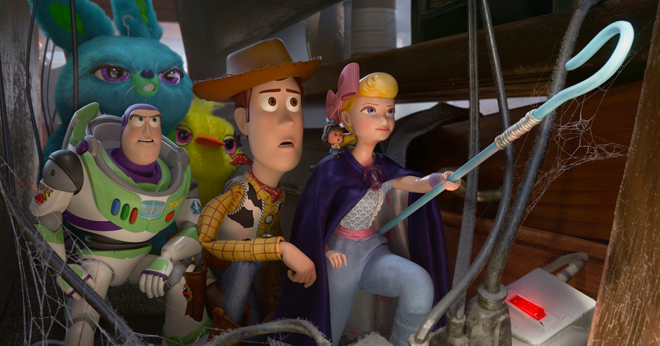
Bo Peep, aware of the dangers awaiting those who unwisely venture into the antique
store's main aisles, carefully leads her friends — Buzz Lightyear, Woody, Bunny, Ducky
and (on her shoulder) Giggle McDimples — behind dusty cabinets, as they try to rescue
a captured comrade.
But the driving plotline for Toy Story 4 — arguably, the reason for the film’s existence — isn’t nearly as satisfying as those of its predecessors. It feels contrived, rather than organic. The whole remains less than the sum of its well-crafted parts.

One can’t help feeling that this is a case of Slinky Dog’s tail wagging the rest of its body: a film dictated more by crass commerce than artistic justification.

2010’s Toy Story 3 gave the franchise a warm sense of closure, with now-grown Andy passing his beloved plaything companions to preschool-age Bonnie. As we’ve constantly been reminded, a toy’s noblest endeavor is to bring comfort and enchantment to an imaginative child: a mission that cannot be accomplished if tucked into a box that gets stored in an attic, like Puff the Magic Dragon sadly slipping into his cave.

Toy Story 4 similarly concludes with a different sort of torch-passing, which — depending on one’s emotional involvement with these characters — will prompt tears, bewilderment, snorts of displeasure, or a feeling of outright betrayal.

Full disclosure: I don’t approve of what scripters Andrew Stanton and Stephany Folsom — working from a story by eight (!) credited writers, including John Lasseter and Rashida Jones — have wrought.

But that comes much later.

The film begins with a prologue dating back to Andy’s era, which explains why Bo Peep (voiced by Annie Potts) was MIA in Toy Story 3. She, her three sheep — Billy, Goat and Gruff — and matching lamp were tumbled into a box with other items to be donated elsewhere, much to the dismay of Woody (Tom Hanks). Turns out he’s long nurtured a crush for Bo Peep, likely to the surprise of those who figured he and feisty Jessie (Joan Cusack) were an unspoken item.

Back in the present day, Woody is enduring insult on top of injury, since little Bonnie prefers to pin his sheriff’s badge on Jessie. Woody, in turn, has been relegated to the back reaches of a closet laden with other neglected toys: among them Melephant Brooks (Mel Brooks), Carl Reineroceros (Carl Reiner) and Chairol Burnett (Carol Burnett).

That’s a cute bit of stunt casting, but their appearances are so brief, you’ll scarcely notice.