Showing posts with label Tom Hanks. Show all posts

Wednesday, June 11, 2025

The Phoenician Scheme: Droll lunacy

The Phoenician Scheme (2025) • View trailer
3.5 stars (out of five). Rated PG-13, for violence, bloody images and mild sexual material
Available via: Movie theaters

Whether working with actors or animation, writer/director Wes Anderson is his own unique brand of crazy.


When everything clicks — as with The Grand Budapest HotelIsle of DogsMoonrise Kingdom and Fantastic Mr. Fox— the results are imaginatively marvelous.


Yet another in-flight assassination attempt forces Zsa-Zsa Korda (Benicio Del Toro, left) to
take control of the plane, while Liesl (Mia Threapleton) and Bjorn (Michael Cera) watch
with mounting horror.

But when Anderson’s signature tics and mannerisms overwhelm the material — see Asteroid CityThe French Dispatch and The Darjeeling Limited — we’re left with something dire and (for many viewers) utterly unwatchable.

This one’s somewhere in between.


For starters, it’s refreshing to see that Anderson and co-writer Roman Coppola have delivered an actual plot that drives the wacky action (something sorely missed in Asteroid City). Granted, it’s a dog-nuts plot, but it makes sense, and gives the primary characters genuine motivation. 


Anderson also tackles some weighty concepts along the way: legacy, mortality and the final reckoning that results from one’s confrontation with God.


God, of course, is played by Bill Murray. Who else?


The art direction and production design — by Stephan O. Gessler and Adam Stockhausen, respectively — are spectacular. The latter has worked on every Anderson film since 2012’s Moonrise Kingdom, and he won a well-deserved Academy Award for The Grand Budapest Hotel.


The wildly distinctive look of an Anderson film has become legendary. His characters inhabit often static environments that sometimes feel like gigantic doll houses, with theatrical-style backdrops and finely tuned details that don’t quite exist in our workaday world: more like hyper-reality. Anderson favors color schemes in earth tones and soft pastels, which — in this case — occasionally are interrupted by Heaven’s blindingly white monochrome.


Cinematographer Bruno Delbonnel constantly plays with cockeyed camera angles and forced perspective; one early sequence is entirely a ceiling’s-eye view.


All of this establishes another of Anderson’s highly mannered, theater-of-the-absurd narratives: a style you’ll either embrace as cheerfully silly ... or dismiss as ludicrous.


The time is the 1950s. Zsa-Zsa Korda (a hilariously deadpan Benicio del Toro), a notorious plutocrat industrialist loathed throughout the world, is introduced mid-flight, as a bomb explodes in the rear of his private plane. He survives the subsequent crash: the sixth recent attempt on his life by unknown parties.


His gargantuan business empire also is under threat via financial scrutiny and political pressure, most particularly — at the moment — his complex “Phoenician Scheme”: an interlocking series of railway, shipping, mining and agricultural ventures designed to dominate a (fictitious) Middle Eastern country. This venture has been jeopardized by the U.S. government’s market-manipulating act to exponentially increase the cost of the “bashable rivets” necessary for all elements of Korda’s complicated plan.


He therefore must persuade each of his investors to accept less profit than contractually promised; each meeting becomes its own distinctive chapter.

Friday, June 23, 2023

Asteroid City: A heaping helping of peculiar

Asteroid City (2023) • View trailer
Three stars (out of five). Rated PG-13, for suggestive material and fleeting nudity
Available via: Movie theaters
By Derrick Bang • Published in The Davis Enterprise, 7.7.23

Calling filmmaker Wes Anderson “eccentric” is like saying the Pope is slightly Catholic. The word doesn’t begin to convey the vast scope of Anderson’s outré sensibilities.


The motel manager (Steve Carell, left) is distracted by another atomic bomb test,
when J.J. Kellogg (Liev Schreiber, right) and his son Clifford (Aristou Meehan) arrive
in Asteroid City.


As one would expect, the results have been mixed. ranging from dazzling hits (The Grand Budapest HotelFantastic Mr. Fox) to, shall we say, lesser efforts (The Darjeeling LimitedThe French Dispatch).

But Anderson — a true artiste — remains undaunted, which is just fine; even his bizarre films are interesting … and everything he does is visually fascinating.


That’s certainly the case with Asteroid City, which is a dazzling display of architectural whimsy by Anderson, production designer Adam Stockhausen, and the art direction team headed by Stéphane Cressend. I mean, like wow; you’ve never seen so many pastels. They’ve gotta be Oscar-nominated.


Whether this colorful setting is supported by an equally compelling story … is another matter. Anderson and co-writer Roman Coppola’s script is, ah, really Out There.


The film begins in standard-ratio black and white, as a host (Bryan Cranston) presents the back-story to the newest production by celebrated playwright Conrad Earp (Edward Norton). We subsequently become the “audience,” as a huge cast of actors present the play in three acts (plus an epilogue). These dominant portions of the film are in stylized wide-screen pastels, sumptuously staged by cinematographer Robert D. Yeoman.


The actors occasionally break character in between scenes, which adds yet another (often confusing) layer to the story-within-a-story.


The year is 1955, the setting Asteroid City, a dot-on-the-map desert community — population 87 — in the American Southwest. The enclave includes a luncheonette, a gas station, a phone booth, an unfinished highway ramp, and a motel comprising a dozen or so cute little bungalows.


The city is named for its regional monument: a massive crater created by the grapefruit-size Arid Plains Meteorite, also on display. Small radio telescopes and an observatory can be seen not far away.


The occasion is Asteroid Day, a celebration which has gathered five junior scientists and their families; master of ceremonies Gen. Grif Gibson (Jeffrey Wright) acknowledges each teen’s fabulous invention with an award, followed by the presentation of the annual Hickenlooper Scholarship to one of the quintet.


Friday, September 9, 2022

Pinocchio: Could use a few more strings

Pinocchio (2022) • View trailer
Three stars (out of five). Rated PG, for dramatic intensity and mild rude humor
Available via: Disney+
By Derrick Bang • Published in The Davis Enterprise, 9.9.22

Filmmakers are reading each other’s mail again.


The memory of Italian director Matteo Garrone’s live-action 2019 version of Pinocchio remains fresh — in part because it didn’t reach our shores until spring 2021 — and now we have Disney’s sorta-kinda live-action reboot of its 1940 animated classic.


Geppetto (Tom Hanks) has no idea that the wooden puppet, which he so lovingly
crafted, is about to be brought to life by a magical blue fairy.


And, come December 9, it’ll be joined by director Guillermo del Toro’s handling of the same story, which is guaranteed to be much darker and scarier (and, therefore, much closer to the spirit of Carlo Collodi’s 1883 novel).

But back to the present…


Of late, the current Disney regime has been hell-bent on putting a live-action spin on all of Uncle Walt’s animated classics, along with many of the studio’s more recent hits. The results have been mixed, to say the least; for every successful Alice in Wonderland (2010) and Jungle Book (2016), we’ve suffered through misfires such as the bloated Beauty and the Beast (2017), the excessively distressing Dumbo (2019) and the blink-and-you-missed it — trust me, not a bad thing — Lady and the Tramp, a streaming debut that same year.


The obvious question arises: Why bother?


Inclusion and political correctness can be a factor, and — in theory — there’s nothing wrong with reviving a beloved chestnut. After all, how many local theater productions of (as just a couple of examples) The Music Man and My Fair Lady get mounted every year, to the delight of packed audiences?


Uncle Walt’s Pinocchio is eight decades old, which certainly seems far enough back to justify a fresh take. And, in fairness, director Robert Zemeckis’ new film has much to offer: Doug Chiang and Stefan Dechant’s sumptuously colorful production design is amazing — gotta love all the cuckoo clocks in Geppetto’s workshop — and Don Burgess’ equally lush cinematography gives the saga a lovely fairy tale glow.


But the film fails on the most crucial level. Despite the CGI trickery with which this version’s title character is brought to life, and even despite young Benjamin Evan Ainsworth’s earnest voice performance, this Pinocchio doesn’t have anywhere near the warmth, vulnerability, poignant curiosity, chastened regret or beingness of his hand-drawn predecessor.


In short, 1940’s Pinocchio felt like a real boy, even while still a marionette. This CGI Pinocchio is a cartoon character.


And everything crumbles from that misstep.


Tom Hanks’ Geppetto is an exercise in mumbled absent-mindedness, as if he’s constantly on the verge of forgetting his lines, or where to stand. He’s also much too calm when initially confronted with the miracle of his wooden puppet come to life, as if this is somehow a routine occurrence. 


Indeed, Pinocchio’s very existence similarly is taken for granted by all the villagers and schoolchildren; the schoolmaster banishes Pinocchio from the classroom because he’s “just a puppet,” but seems unfazed by the fact that he is a puppet brought to life.

Friday, November 12, 2021

Finch: Post-apocalyptic sentimentality

Finch (2021) • View trailer
Four stars (out of five). Rated PG-13, for violent images and dramatic intensity
Available via: Apple TV+
By Derrick Bang • Published in The Davis Enterprise, 11.12.21

Tom Hanks apparently wasn’t satisfied with spending the majority of a film interacting solely with a volleyball, even if that coup did bring him an Oscar nomination. After all, 2000’s Cast Away did involve other people during the prologue and conclusion.


Ready for just about anything: Finch (Tom Hanks, left) and his humanoid robot companion
pack abundant supplies into a waiting RV, while the four-legged Goodyear leads the way.


Finch, on the other hand, is solely a one-man show.


Except that it isn’t … not really. Nor am I certain Hanks is the stand-out actor here; that honor arguably belongs to Seamus, co-starring as the four-legged Goodyear.


Since movies often reflect the times in which they’re made, the world clearly has been in a highly anxious state for awhile now, given the number of post-apocalyptic projects we’ve gotten during the past several years. This is yet another one, and scripters Craig Luck and Ivor Powell quickly establish as bleak a scenario as could be imagined.


For once (happily?), the cause is beyond human control.


The time is roughly 15 years in the future; the barren, heat-blasted St. Louis cityscape is beset by swirling sand and dust. Finch Weinberg (Hanks) appears amidst this inhospitable environment, unrecognized within a protective radiation suit, accompanied by a modified lunar rover possessing the ability to see and respond to spoken commands, while using its single extendable clawed appendage as needed.


(Given this ’bot’s appearance, and the fact that it’s named Dewey, the homage to 1972’s Silent Running clearly is intentional.)


They’re scavenging as-yet unsearched stores for anything useful, carefully avoiding the occasional skeletized body.


As we gradually learn, a massive solar flare destroyed Earth’s ozone layer a decade earlier. Temperatures rose to 150 degrees; ultraviolet radiation became instantly deadly. The resourceful Finch, one of few survivors, built himself a well-equipped bunker in the basement of the robotics lab where he once worked. He has lived there ever since, accompanied solely by his faithful dog, Goodyear.


Finch has kept busy — and maintained his sanity — with a variety of projects, including his most ambitious yet: a humanoid robot “fed” the scanned contents of the hundreds of reference books found during foraging expeditions. Once sentient, this new companion also is versed in Isaac Asimov’s Three Laws of Robotics, along with a new fourth law.


Although it draws a smile, when spoken, it’s equally serious: “In Finch’s absence, robot must protect the welfare of dog, This directive supersedes all other directives.”

Friday, December 25, 2020

News of the World: Deserves banner headlines

News of the World (2020) • View trailer
4.5 stars. Rated PG-13, for violence, occasional profanity, disturbing images and dramatic intensity
By Derrick Bang • Published in The Davis Enterprise, 12.31.20

Paul Greengrass always makes thoughtful, emotionally engaging films, whether crowd-pleasing thrillers — three entries in the Jason Bourne series — or ripped-from-the-headlines dramas, such as Bloody SundayUnited 93 and 22 July.


Having been stopped on the road by a gang of questionable intent, Jefferson Kidd
(Tom Hanks) and his young companion (Helena Zengel) are "escorted" into the
nearby community of Durand, their fate most definitely uncertain.
His newest, based on poet/author Paulette Jiles’ 2016 novel of the same title, is a bit of both … due to current events that weren’t as obvious when she wrote her book.


News of the World — opening today in operational movie theaters — is set in early 1870, in the untamed and dangerous border between South Texas and Indian territory. Although the Civil War is five years gone, the nation remains bitterly divided; that’s particularly true in this state. Texas has yet to be readmitted to the Union, having refused thus far to ratify the 13th amendment banning slavery.


Patrols of Union soldiers maintain an uneasy peace in towns, and on the roads linking them; their presence is just as likely to inflame tension, as prevent it. Half of the population passionately fought for a vision of the country that was defeated; it’s unclear whether America — as a unified entity — can heal itself. Information itself is suspect, depending on its source.


Sound familiar?


Capt. Jefferson Kyle Kidd (Tom Hanks), a veteran of three wars, leads a peripatetic life within this environment. He travels from town to town, armed with newspapers and broadsheets, and draws crowds as a non-fiction storyteller who shares the news of presidents and queens, glorious feuds, devastating catastrophes and gripping incidents involving individual people.


He’s no Charles Dickens, with a thunderous and well-acted performance; he hunches over and squints through a magnifying glass while reading the tiny print aloud. But his delivery is no less captivating, thanks to Hanks’ warmth and sincerity; Kidd has a dignified bearing that grants him authority. People hang on his words, and he fills the house at 10 cents a head, thereby earning a meager but reliable living.


He’s wary and careful, when on the road with his humble wagon; roving bands of Union soldiers aren’t necessarily any safer than thieves and cutthroats.


One day he chances upon a frightened 10-year-old girl (Helena Zengel). Papers recovered from her demolished wagon — her adult companion having been lynched, due to his skin color — reveal that she’s Johanna Leonberger, whose family was killed six years earlier by the Kiowa tribe, who then raised her as one of their own. She’s now being returned to her biological aunt and uncle against her will, after her Kiowa home was burned by the soldiers who “rescued” her. In effect, she has been kidnapped twice.


Kidd hasn’t the faintest idea what to do with her. He tries first to enlist official Union aid; when that fails, he attempts to temporarily leave the girl in the care of friends in the nearest town. But she’s wild, speaks only Kiowa, and is hostile to this “civilized” world she never has experienced. Kidd ultimately decides to deliver her himself, to where the law insists she belongs.


Friday, August 14, 2020

Greyhound: A suspenseful sprint

Greyhound (2020) • View trailer 
Four stars. Rated PG-13, for war-related action, dramatic intensity and fleeting profanity
By Derrick Bang • Originally published in The Davis Enterprise, 8.14.20

It’s a shame grim, real-world events kept this film from traditional theatrical release, because it would’ve been a breath-held, edge-of-the-seat nail-biter.

Krause (Tom Hanks) constantly worries that his inexperience as a wartime
 commander may not be up to the challenge of safeguarding the 37 convoy ships
 under his care.

Although certainly just as suspenseful when viewed at home — via its sole release on Apple TV — director Aaron Schneider’s Greyhound definitely isn’t as intense. Agitated viewers might even hit “pause” on occasion, to quell racing hearts, and you certainly can’t get such relief in a movie theater (which is as it should be).


Schneider’s approach is a clever blend of old-school “dire odds” war drama — in the mold of 1961’s The Guns of Navarone and 1968’s Where Eagles Dare — augmented by up-to-the-minute CGI effects. The pacing is taut; Schneider and editors Mark Czyzewski and Sidney Wolinsky don’t waste a second of this crisp 91-minute thriller, which gets the job done and then gets off the stage.


Schneider, a veteran cinematographer-turned-director, also has an unerring sense of camera placement, and the careful use of tight close-ups to heighten the drama. Star Tom Hanks has long been adept at taking advantage of such moments; he’s far better than most, at the nuance of wordless concern, flashes of doubt, and grim resolve.


Hanks also chooses his projects with care; he’s even more prudent with the ones he elects to script. This is only his third feature writing credit — after 1996’s That Thing You Do and 2011’s Larry Crowne — and his first adaptation. Greyhound is based on popular nautical author C.S. Forester’s 1955 naval thriller, The Good Shepherd, and Hanks’ approach is quite faithful (if unable to match, in such condensed form, the character depth found within the 322-page novel).


At the risk of stating the obvious, Forester’s title is far superior — and symbolically apt — than Greyhound. I cannot imagine what Hanks and Sony were thinking.


The year is early 1942, a few months after the United States has officially entered World War II. Allied UK forces and the Soviet Union are in constant need of supplies, which must be delivered by sea convoys via the Atlantic Ocean. But the route is patrolled constantly by German U-boats; the most dangerous region is the mid-Atlantic gap dubbed the “black pit,” where ships are out of range of protective air cover.


Friday, November 22, 2019

A Beautiful Day in the Neighborhood: A bold, but failed experiment

A Beautiful Day in the Neighborhood (2019) • View trailer 
Three stars. Rated PG, for dramatic intensity

By Derrick Bang

This is so not the movie most folks likely are expecting.

Not even 10 minutes in, it feels like we’ve stumbled into the Twilight Zone.

When cynical journalist Lloyd Vogel (Matthew Rhys, right) arrives at the Pittsburgh studio
where Mr. Rogers' Neighborhood is filmed, he's surprised to be greeted effusively by
Fred Rogers (Tom Hanks), as if they were longtime friends.
A couple of clues signal this not-quite-rightness. The film’s aspect ratio is 4:3, as with old television set images (as opposed to any sort of wide-screen format). The visuals appear slightly out of focus, as if we’re watching a VHS tape; director of photography Jody Lee Lipes has re-created 20-year-old television-style cinematography. The result seems “blurry” because we’ve become so accustomed to pristine HD camerawork.

Lipes pans slowly over the familiar, scale-model neighborhood set, complete with toy vehicles — notably the Neighborhood Trolley — moving jerkily among the rows of houses, in the low-budget, pre-CGI fashion. The gentle, equally memorable piano melody rises — Nate Heller’s soundtrack sublimely mimicking the iconic Johnny Costa, whose improvised keyboard work was such an integral part of the show — and Mr. Rogers (Tom Hanks) enters in ritual fashion.

The jacket comes off, replaced by a red cardigan: zipped all the way up — and then halfway down — with a snap. He sits; the formal shoes yield to canvas boat sneakers. All the while, he softly croons the iconic opening song — “Won’t You Be My Neighbor?” — without ever losing that gentle, inviting smile.

The replication is almost spooky: the stance, the voice, the welcoming expression. More than that, the aura that always radiated from Fred Rogers. The latter must’ve been a challenge: Either that, or Hanks has discovered a way to channel the dear departed.

Right about now, we wonder: Where the heck are we going?

At which point, the merely puzzling sails into the positively weird.

Mr. Rogers shares a picture-board, opening each of the little doors to reveal a photograph beneath. Some are familiar, as with the puppet King Friday the 13th. But the next door conceals a head shot — practically a police booking photo — of Mr. Rogers’ “good friend,” Lloyd Vogel. He looks quite worse for wear, with a black eye and bloodied nose.

Mr. Rogers softly laments the plight of those consumed by anger, unable to forgive the trespasses of others. Whereupon we slide into Lloyd’s life, to witness the events that brought him to this sorry state.

Friday, June 21, 2019

Toy Story 4: Shopworn

Toy Story 4 (2019) • View trailer 
3.5 stars. Rated G, despite some scary sequences

By Derrick Bang • Originally published in The Davis Enterprise, 6.21.19

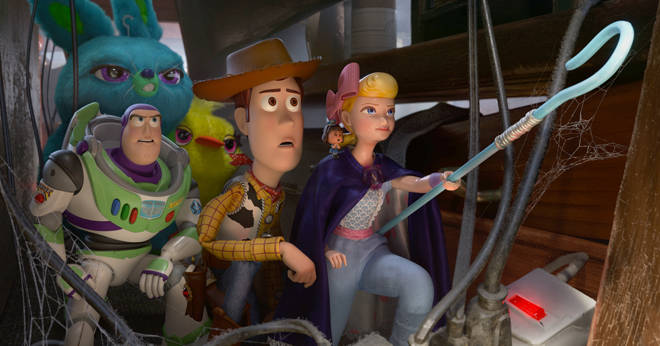
The familiar faces are as welcome as longtime friends; the new characters are both adorable and — in some cases — shiveringly disturbing; the dialog remains witty and funny; the incidental encounters are amusing, clever and well-paced; the voice talent is as sharp as ever.

Bo Peep, aware of the dangers awaiting those who unwisely venture into the antique
store's main aisles, carefully leads her friends — Buzz Lightyear, Woody, Bunny, Ducky
and (on her shoulder) Giggle McDimples — behind dusty cabinets, as they try to rescue
a captured comrade.
But the driving plotline for Toy Story 4 — arguably, the reason for the film’s existence — isn’t nearly as satisfying as those of its predecessors. It feels contrived, rather than organic. The whole remains less than the sum of its well-crafted parts.

One can’t help feeling that this is a case of Slinky Dog’s tail wagging the rest of its body: a film dictated more by crass commerce than artistic justification.

2010’s Toy Story 3 gave the franchise a warm sense of closure, with now-grown Andy passing his beloved plaything companions to preschool-age Bonnie. As we’ve constantly been reminded, a toy’s noblest endeavor is to bring comfort and enchantment to an imaginative child: a mission that cannot be accomplished if tucked into a box that gets stored in an attic, like Puff the Magic Dragon sadly slipping into his cave.

Toy Story 4 similarly concludes with a different sort of torch-passing, which — depending on one’s emotional involvement with these characters — will prompt tears, bewilderment, snorts of displeasure, or a feeling of outright betrayal.

Full disclosure: I don’t approve of what scripters Andrew Stanton and Stephany Folsom — working from a story by eight (!) credited writers, including John Lasseter and Rashida Jones — have wrought.

But that comes much later.

The film begins with a prologue dating back to Andy’s era, which explains why Bo Peep (voiced by Annie Potts) was MIA in Toy Story 3. She, her three sheep — Billy, Goat and Gruff — and matching lamp were tumbled into a box with other items to be donated elsewhere, much to the dismay of Woody (Tom Hanks). Turns out he’s long nurtured a crush for Bo Peep, likely to the surprise of those who figured he and feisty Jessie (Joan Cusack) were an unspoken item.

Back in the present day, Woody is enduring insult on top of injury, since little Bonnie prefers to pin his sheriff’s badge on Jessie. Woody, in turn, has been relegated to the back reaches of a closet laden with other neglected toys: among them Melephant Brooks (Mel Brooks), Carl Reineroceros (Carl Reiner) and Chairol Burnett (Carol Burnett).

That’s a cute bit of stunt casting, but their appearances are so brief, you’ll scarcely notice.

Friday, January 19, 2018

The Post: Fast-breaking drama

The Post (2017) • View trailer 
Four stars. Rated PG-13, and too harshly, for profanity and brief war violence

By Derrick Bang • Originally published in The Davis Enterprise, 1.19.18

Although Steven Spielberg’s riveting new film gets most of its dramatic heft from the democracy-threatening events that swirled around the release of the Pentagon Papers in June of 1971, we’re most emotionally involved with the plight of Washington Post publisher Katherine Graham: at the time, the only woman in a position of power at a major national newspaper.

The entire Washington Post editorial staff — including executive editor Ben Bradlee and
publisher Katharine Graham (Tom Hanks and Meryl Streep, third and fourth from left) —
reacts with stunned silence after learning that The New York Times has been forced, by
a federal injunction, to cease reporting on the Pentagon Papers.
As the film begins, and as we’re introduced to Graham via Meryl Streep’s thoroughly engaging performance, the poor woman is hopelessly — helplessly — out of her depth.

We spend almost the entire film waiting for her epiphany, and for the “Meryl Streep moment” when the actress — Graham finally having found her spine — verbally eviscerates one of her patronizing male colleagues.

It’s a long wait ... and well worth the anticipation.

The Post isn’t opportune merely as a reminder — at a time when the White House is occupied by an infantile gadfly who defends his lies by screaming “Fake news!” — of the crucial role played by our Fourth Estate. Scripters Liz Hannah and Josh Singer couldn’t have known, as their film was being shaped, that its parallel focus on Graham would resonate so well at a moment when American women have risen en masse to challenge male hegemony.

The resulting drama serves both mindsets, while also taking its place alongside top-drawer journalism dramas such as All the President’s Men and Spotlight (the latter having brought Singer — also a veteran of TV’s West Wing — an Academy Award).

The sequence of events taking place during just a few days in the early summer of 1971 almost defy credibility. The film opens on a sidebar issue, as Graham prepares for a presentation to The Washington Post Company board of directors, in anticipation of raising badly needed capital via a stock offering when the paper goes public, on June 15.

Streep’s Graham is nervous and flustered, despite having solid notes prepared with the assistance of longtime friend and confidant Fritz Beebe (Tracy Letts, nicely understated), a former Wall Street lawyer and chairman of the board. Even before knowing anything about this woman, we feel for her; Streep makes her anxiety palpable.

We therefore groan inwardly, when — her moment having come — she’s too tongue-tied even to speak, and her carefully prepared details are introduced by Fritz.

This is before Graham learns, a few days later, that the stock offering could be scuttled by her paper’s growing involvement in the nation-shattering spat between Richard Nixon and The New York Times: the first time, in the history of the republic, that a U.S. president has attempted to silence a national newspaper.

Friday, October 28, 2016

Inferno: Flickers and dies

Inferno (2016) • View trailer 
Two stars. Rated PG-13, for action violence, dramatic intensity and brief profanity

By Derrick Bang

I’ve no idea why this series continues to be popular; each entry is sillier than the one before.

Dan Brown may be able to maintain reader credibility in a lengthy novel — Inferno runs a self-indulgent 609 pages — but director Ron Howard’s film adaptations are no more sensible than the old Perils of Pauline silent movie serial.

A series of arcane, art-related clues eventually lead Robert Langdon (Tom Hanks) and
Dr. Sienna Brooks (Felicity Jones) to the fabled "death mask" of Italian poet Dante
Alighieri. But what has this to do with a potential world-wide plague? And do we care?
David Koepp’s screenplay for Inferno reduces the plot to little more than a race-race-race against time, occasionally alleviated when famed university symbologist Robert Langdon (Tom Hanks) pauses for breath in order to solve another arcane riddle locked within a famed piece of artwork.

On top of which, attempting to make sense of the conspiracy-laden supporting characters is beyond the ability of mere mortals. “Duplicitous” doesn’t begin to cover the crosses, double-crosses and triple-crosses in this ludicrous plot, which quickly devolves into a tiresome guessing game.

Lessee ... first they’re all bad guys. Then some of the bad guys become good guys. Oh, wait, no; that one was bad all along. And that one was good. Until turning bad again.

All with poor Langdon caught in the middle.

It quickly becomes impossible to believe — or care about — any of these people. All we can do is wait for the murk to clear, accompanied by tediously complicated explanations, so matters can build to a staggeringly inept climax, and we can go home.

Brown may have sold all this meandering nonsense to his readers — full disclosure prompts acknowledging that I’m not among the faithful — but Koepp can’t begin to distill it into a two-hour film. We can’t help wondering, as loyalties finally become apparent in the third act, why Certain Parties didn’t simply ask for Langdon’s help, rather than concocting such an elaborate means of “forcing” his assistance.

What makes Howard’s Dan Brown adaptations even more exasperating is their insistence on taking such stuff and nonsense so seriously. Robert Langdon’s profession and expertise make him a close cousin to Harrison Ford’s Indiana Jones, but director Steven Spielberg wisely turns those chapter-play adventures into larkish thrill rides, with plenty of winking and nudging.

Brown’s style, on the other hand — reproduced here by Howard and Koepp — always collapses under the weight of its own pomposity.

Friday, September 9, 2016

Sully: Flies high

Sully (2016) • View trailer 
Four stars. Rated PG-13, and much too harshly for dramatic intensity and fleeting profanity

By Derrick Bang • Originally published in The Davis Enterprise, 9.9.16


Coulda-woulda-shoulda.

We are a species of second-guessers.

With precious seconds ticking away, after losing both engines to a bird strike, Capt. Chesley
"Sully" Sullenberger (Tom Hanks, right) and co-pilot Jeff Skiles (Aaron Eckhart) contemplate
several equally unpleasant options, every one of which carries the risk of killing
hundreds of people.
Even when something has been done properly, with the desired outcome, we often wonder: Might things have concluded even better, with a different set of actions?

Far worse, of course, is when an optimal result is challenged by others who question our judgment. Armchair quarterbacks who insist that, really, it should have gone down this way.

Human nature. Quite infuriating.

At first blush, Capt. Chesley “Sully” Sullenberger would seem to be the last man on Earth to be confronted in such a manner; he is, after all, the hero who glided the disabled US Airways Flight 1549 Airbus A320 into a flat-out miraculous pancake landing on the Hudson River, on Jan. 15, 2009, saving the lives of all 155 passengers and crew. As any pilot can verify, water landings aren’t nearly as “soft” as a dive into a swimming pool; depending on speed and angle of impact, it’s more like slamming into a brick wall.

Who, then, could argue with Sully’s actions, given the results?

Ah, but that’s the hook behind director Clint Eastwood’s new film, which gains its dramatic tension from a crackerjack script by Todd Komarnicki, based on Sullenberger’s best-selling book, Highest Duty. Komarnicki and Eastwood manage a seemingly impossible feat, by injecting suspense into a narrative whose outcome we already know.

But that’s the point: Most folks don’t know the full story. Granted, everybody watched the amazing events on that January afternoon in 2009, many of us glued to TV sets. But while it’s true Sully saved all 155 people, he wasn’t able to save the plane itself ... and — sad to say — neither Airbus nor its insurance underwriters were going to take the loss of a $70 million aircraft lightly.

Ergo, the second-guessing, and this film’s suspense, as Sully — played with gravitas by Tom Hanks — and co-pilot Jeff Skiles (Aaron Eckhart) are grilled, after the fact, by National Transportation Safety Board (NTSB) investigators who insist, armed with computer simulation test data, that the plane could have returned safely to the nearest La Guardia runway, or one at New Jersey’s Teterboro Airport.

And we can’t help wondering: Could it be true?

At which point, Komarnicki and Eastwood have us hooked.