Showing posts with label Anthony Mackie. Show all posts

Wednesday, February 19, 2025

Captain America: Brave New World — Oh, really?

Captain America: Brave New World (2025) • View trailer
2.5 stars (out of five). Rated PG-13, for intense action violence and mild profanity
Available via: Movie theaters

The bloom definitely has worn off the Marvel Cinematic Universe rose.


More than most, this new Captain America outing relies too heavily on details from previous MCU entries. Keeping a score card isn’t enough; nothing short of an annotated spread sheet would suffice.


When two American fighter pilots inexplicabgly go rogue, and start firing on Japanese
military vessels, Captain America (Anthony Mackie, right) and Falcon (Danny Ramirez)
know they must act quickly, to prevent a war.


The result here is something of a mess, with one engaging sub-plot overwhelmed by a far too complicated set of fresh crises. But that’s to be expected from a film with five (!) credited scripters, who seem to have competed with each other, in a contest to resurrect the most obscure MCU nugget.

That said, Anthony Mackie deserves ample credit for navigating the herculean task of holding this mess together as well as possible, and for capably replacing Chris Evans’ Steve Rogers as the new red, white and blue Captain America. Mackie’s Sam Wilson isn’t quite the same shield-slinger, though; he’s more a Cap 2.0.


Lacking Rogers’ super soldier serum-enhanced strength and agility, Sam has compensated with a set of vibranium and gadget-laden wings that would be the envy of Iron Man. Sam also has a fresh-faced partner: Joaquin Torres (Danny Ramirez, as playful as a puppy), a “Falcon-in-training,” last seen in 2021’s The Falcon and the Winter Soldier TV miniseries.


As this overcooked saga begins, former military hawk Thaddeus Ross (Harrison Ford) has just been elected President of the United States. Elsewhere, Sam and Joaquin are tasked with retrieving a cannister of the metal alloy adamantium, stolen by the mercenary Sidewinder (Giancarlo Esposito) from Japanese scientists who’ve extracted it from the massive “Celestial Island.” 


(This “island” actually is the dead body of a celestial named Tiamut, now floating in the Indian Ocean, who was defeated by the Eternals in their eponymous 2021 film, which many of today’s viewers won’t know, because that film was a notorious flop.)


Cap and Falcon are successful, although Sidewinder survives to fight another day. Sam also gets an unexpected “attaboy” from the newly installed President Ross, who has long held a love/hate relationship with superheroes. At this moment, though, Ross insists that his views have changed, and he even floats the notion of re-establishing The Avengers.


(In the MCU, Ross’ behavior dates back to 2008’s The Incredible Hulk, when — then played by William Hurt — he oversaw a project with his daughter Betty’s boyfriend, scientist Bruce Banner, which went awry and transformed him into the not-so-jolly green giant. Ross went on a vengeful tear that ultimately disbanded and divided the Avengers in 2016’s Captain America: Civil War, which left Earth more vulnerable when Thanos subsequently wreaked havoc in Avengers: Infinity War and Avengers: Endgame. And, much to Ross’ dismay, drove Betty into estrangement from her father.)

Friday, May 21, 2021

The Woman in the Window: Draw the curtains

The Woman in the Window (2021) • View trailer
2.5 stars. Rated R, for violence and profanity

This one should have been a slam-dunk, because the premise is irresistible.


And classic.


(Alfred Hitchcock certainly thought so, back in the day.)


Jane (Julianne Moore, right) proudly shows Anna (Amy Adams) a photo of her son,
which she keeps in a locket.


Consider the elements: Author A.J. Finn’s best-selling 2018 thriller, adapted for the screen by Tony- and Pulitzer-winning playwright Tracy Letts; a top-flight cast headed by Amy Adams, Gary Oldman, Julianne Moore and Jennifer Jason Leigh; and director Joe Wright, whose striking visual sense has propelled terrific films such as Pride & PrejudiceAtonement and Darkest Hour.


Trouble is, we’ll likely never see the film this team created.


The Woman in the Window became an orphan when its studio parent, Fox 2000, was absorbed by Disney in March 2019. (In a demonstration of childish behavior akin to Nature at her cruelest, takeover studios rarely embrace projects birthed by the vanquished “parent.”) Bowing to unfavorable test screenings, Disney demanded re-shoots and new material scripted by an uncredited Tony Gilroy.


What now has hit the screen is awkward, to say the least. And I can’t imagine this version is superior to what Wright and Letts delivered the first time.


New York City-based child psychologist Anna Fox (Adams), crippled by a severe case of agoraphobia, has been unable to leave her Manhattan brownstone for nearly a year. She’s trying to work this out via frequent sessions with her visiting psychiatrist, Dr. Landy (Letts, in a solid cameo).


He has put her through an ongoing cocktail of prescription drugs; the most recent, Elevan, comes with a strict warning not to mix it with alcohol. Which doesn’t stop Anna from drinking a lot of wine.


She’s estranged from her husband Ed (Anthony Mackie) and their daughter Olivia (Mariah Bozeman), although they chat daily on the phone. Anna also has the company of a tenant: aspiring musician David Winter (Wyatt Russell), who lives in the basement, runs errands for her, and handles odd jobs throughout the house.


Anna passes the time by watching classic film noirs — a brief clip from Hitchcock’s Spellbound is a bit on the nose — and observing the comings and goings in the buildings across the street, from the safety of her front windows. She therefore notices when a new family, the Russells, moves in directly opposite her brownstown. She’s charmed when 15-year-old Ethan (Fred Hechinger) pays a visit, to give Anna a “hello” gift from his mother.


Anna immediately senses that Ethan is oddly uncomfortable, perhaps distracted, for some reason he’s much too shy to share. They nonetheless part as friends.

Friday, January 29, 2021

Outside the Wire: And let's leave it there

Outside the Wire (2021) • View trailer
Two stars. Rated R, for relentless profanity and violence
By Derrick Bang • Published in The Davis Enterprise, 2.12.21  

Lazy science-fiction is truly annoying.


Actually, Netflix’s Outside the Wire barely qualifies; it’s really just a testosterone-fueled, shoot-’em-up war flick with superficial sci-fi trimmings. Scripters Rowan Athale and Rob Yescombe rely on attitude rather than the slightest hint of character depth, or the philosophical issues of their clichéd scenario.


Given that they're pinned down by enemy fire, Harp (Damson Idris, right) has good
reason to be concerned. He needn't be, because Leo (Anthony Mackie) is about to
demonstrate his enhanced fighting skills.
Their grunt-level sensibilities become obvious immediately — two minutes in! — when everybody onscreen relentlessly employs F-bombs as adjectives, adverbs, prepositions, conjunctions, verbs and interjections. That’s just tiresome.


Mikael Håfström helms this mess with the subtlety of a charging rhinoceros. No surprise, given a résumé of similarly undistinguished thrillers and horror flicks (Drowning GhostDerailedEscape Plan, etc.). Ergo, we shouldn’t expect anything better here.


So.


The year is 2036, and Eastern Europe has become a relentless war zone; the Russians once again are the villains of choice. Good-guy Americans fight alongside lumbering robot soldiers pejoratively dubbed “Gumps” (presumably after Forrest Gump, which is pretty damn insulting). This isn’t any sort of advantage, because the bad-guy soldiers have their own Gumps.


We pause, for a moment, to explore this a bit. No mention ever is made, regarding how Gumps receive and execute their orders; no indication of who programs and controls them; no contemplation of whether they could be hacked by the opposition; and so forth. They’re just part of the noisy wallpaper. (Like I said, lazy writing.)


The ground troops are supported by drones controlled from afar by pilot teams such as Harp (Damson Idris) and Bale (Kristina Tonteri-Young). When a nasty firefight threatens to become catastrophic, Harp makes a needs-of-the-many choice that saves dozens of soldiers, at the expense of two who perish. Trouble is, that decision disobeys a direct order.


Rather than being court-martialed and sent home in disgrace, Harp is assigned to accompany Capt. Leo (Anthony Mackie) on a covert ground mission beyond the fenced American compound (ergo, “outside the wire”). Intel reports that a lunatic named Victor Koval (Pilou Asbaek) intends to obtain the launch codes for a handful of nukes, with which to terrorize the world (we assume); Leo wants Harp along because he “thinks outside the box.”


Ah, but — as Harp soon learns — Leo isn’t just any black-ops specialist; he’s “fourth-generation biotech.” (Again, questions: Where did he come from? Does this mean first-, second- and third-generation biotechs are wandering around? Answers come there none.)


Friday, August 4, 2017

Detroit: City in flames

Detroit (2017) • View trailer 
Four stars. Rated R, for strong violence, dramatic intensity, pervasive profanity and fleeting nudity

By Derrick Bang • Originally published in The Davis Enterprise, 8.4.17

Very few dramatic films — as distinguished from documentaries — have left me feeling nauseous, in response to the monstrous behavior of human beings.

Schindler’s List is one; that was a quarter-century ago.

Racist cop Philip Krauss (Will Poulter, center left) gleefully takes charge of the lit-fuse
"interrogation" of half a dozen wholly innocent Algiers Motel residents, using the greater
Detroit riot as an excuse to terrorize and torture them.
Detroit is the most recent; that was a few nights ago.

Director Kathryn Bigelow and journalist-turned-screenwriter Mark Boal both took home well-deserved Academy Awards for 2009’s The Hurt Locker; they re-teamed for 2012’s Zero Dark Thirty, their equally mesmerizing portrayal of the decade-long hunt for Osama bin Laden, which concluded with his death during a Navy SEAL raid in May 2011.

The latter film lost some of its luster — and probably a few Oscars — due to political sniping over the accuracy of the CIA’s depicted use of torture (an accusation that still seems specious, given that relevant documents remain classified). That controversy tainted a film that deserves better recognition both as a nail-biting drama, and for having gotten “the important stuff” right.

Bigelow and Boal may run into the same problem with Detroit, which would be an even greater tragedy. Although their riveting new film shines a necessary spotlight on a grievously under-remembered tragedy in American history — the so-called 12th Street Riot, which consumed Detroit, Mich., from July 23-27, 1967 — Boal’s script suffers somewhat from tunnel vision, differs at times from long-established eyewitness accounts, and in one conspicuous case succumbs to flat-out speculation.

We experienced this problem with 2000’s The Perfect Storm, which detailed the real-world fate of the fishing vessel Andrea Gail, lost at sea during the nor’easter that developed in late October 1991. The paradox was obvious: Since everybody on board died, nobody could possibly know what actually happened during the boat’s final hours. That didn’t diminish the film’s impact, but one had to acknowledge the contrivance of its entire third act.

Bigelow and Boal obviously are aware of the liberties taken here, and concerned enough to conclude their film with a text block that acknowledges “necessary” extrapolation.

I hope that’s good enough, because it would be awful if Detroit were caught up in petty arguments over detail, thereby obscuring the incontrovertible, big-picture degree to which clearly innocent, mostly black civilians were brutalized by blatantly racist, thuggish white cops during a particularly ghastly incident triggered during the riot.

Friday, May 6, 2016

Captain America: Civil War — The Marvel universe turns (sorta) serious

Captain America: Civil War (2016) • View trailer 
Four stars. Rated PG-13, for intense action violence

By Derrick Bang • Originally published in The Davis Enterprise, 5.6.16

Official title notwithstanding, truth in advertising suggests that this film should have been called The Avengers: Civil War.

Much as it pains him, Captain America (Chris Evans, second from right) and his like-minded
allies — from left, Hawkeye (Jeremy Renner), the Scarlet Witch (Elizabeth Olsen) and Bucky
Barnes (Sebastian Stan) — realize that the only way to complete their mission, is to wade
through Iron Man and his comrades.
Although Steve Rogers’ Captain America (Chris Evans) endures a fair amount of angsty indecision in this rather busy chapter of the Marvel Universe saga, it’s nothing compared to the emotional battering suffered by poor Tony Stark’s Iron Man (Robert Downey Jr.). We’ve definitely left the larkish adventuring behind; although this mash-up is far more palatable than last month’s unpleasantly grim Batman V Superman: Dawn of Justice, the core storyline borrows from the same somber, real-world textbook.

Which is to say, superhero/supervillain battles — even those that conclude successfully — result in considerable collateral damage and civilian casualties. Where, then, does responsibility lie ... and does the end always justify the means? Should superheroes be subject to national or international oversight?

Popular comic book writer Mark Millar’s Civil War storyline, which occupied numerous Marvel titles during 2006 and ’07, was a direct response to U.S. government overreach with respect to post-9/11 citizen surveillance. (And some people still dismiss comics as being trivial?) The argument divided Marvel’s characters, with Iron Man leading a faction that supported a “Superhero Registration Act,” and Captain America and various followers refusing to submit to what they regarded as a dangerous police state.

Scripters Christopher Markus and Stephen McFeely have modified this premise slightly, in keeping with events in recent Marvel movies.

This cinematic Civil War opens as Captain America and a few colleagues — Natasha Romanoff, the Black Widow (Scarlett Johansson); Sam Wilson, the Falcon (Anthony Mackie); and Wanda Maximoff, the Scarlet Witch (Elizabeth Olsen) — track a terrorist to Lagos, Nigeria. It’s a crackerjack prologue, crisply choreographed by directors Anthony Russo and Joe Russo, and editors Jeffrey Ford and Matthew Schmidt.

But although our heroes successfully prevent a bio-weapon from being unleashed, Wanda’s powers unintentionally backfire, resulting in numerous civilian deaths. Back home, this proves one calamity too many for U.S. Secretary of State Thaddeus Ross (William Hurt), who convenes an emergency meeting of the available Avengers, forcing them to watch video footage of the city-leveling events from earlier conflicts (lifted from both Avengers films and the previous Captain America entry).

If this feels similar to the way Batman V Superman opened, it’s only because imitation is the sincerest form of flattery. (In fairness, Marvel’s comics struck first.)

Friday, October 30, 2015

Our Brand Is Crisis: The result is distasteful

Our Brand Is Crisis (2015) • View trailer 
Two stars. Rated R, for profanity and sexual candor

By Derrick Bang

This seems to be the season for transforming well-regarded documentaries into starring vehicles for Hollywood A-listers.

Jane (Sandra Bullock) watches smugly as her candidate picks up steam in the upcoming
Bolivian presidential election, which prompts rival campaign "fixer" Pat Candy (Billy Bob
Thornton) to whisper another round of Sun Tzu-esque imprecations in her ear.
But whereas Freeheld mostly retains the soul and warmth of its 2007 nonfiction predecessor, while highlighting sensitive work from stars Julianne Moore and Ellen Page, Our Brand Is Crisis is an awkward, bewildering mess that benefits not at all from Sandra Bullock’s presence.

She barely tries, falling back incessantly on the half-amused sidelong glance that has become her go-to expression in far better projects. Much of the time, in fact, Bullock appears to have forgotten her lines, and instead attempts to “cover” by flailing aimlessly.

This doesn’t speak well of director David Gordon Green, apparently unable to handle his leading lady. Or maybe Bullock didn’t like him. Whatever the reason, she just isn’t present ... even when lovingly framed, front and center — and too frequently in tight close-up — by cinematographer Tim Orr.

Bullock is far from this film’s only problem. Peter Straughan’s script is a mess: His effort to transform this serious premise into a satire is half-assed at best, but most often just clumsy. And when satire fails — particularly if the topic is based on actual events — the result becomes tasteless. And offensive.

Rachel Boynton’s 2005 documentary of the same title tracks the jaw-dropping degree to which the American consulting firm of Greenberg, Carville and Strum (GCS) did its best to rig the 2003 Bolivian presidential election on behalf of its client, Gonzalo “Goni” Sanchez de Lozada, who’d held that top spot from 1993-97, but had come to be seen as arrogant and out of touch with the common people.

Yep, you read that correctly: American political consultants plying their dirty tricks to affect the outcome of a presidential election in a foreign country. Clandestine U.S. involvement in foreign politics is nothing new, of course; what made this particular case so egregious was the degree to which GCS made little or no effort to conceal its activities. Hell, these guys were proud of their work.

The charismatic James Carville was the beaming public face of GCS; that’s the role assigned here to Bullock, playing burned-out campaign fixer “Calamity” Jane Bodine. Anxiety and a series of high-profile failures sent her into isolated retirement; as this film begins, she’s tempted back into the game by the opportunity for one more match against her longtime professional nemesis, Pat Candy (Billy Bob Thornton, who apparently based his look on Carville).

Friday, April 4, 2014

Captain America — The Winter Soldier: Another Marvel-ous hit!

Captain America: The Winter Soldier (2014) • View trailer 
Four stars. Rated PG-13, for intense action violence

By Derrick Bang • Originally published in The Davis Enterprise, 4.4.14

This one’s a lot more thought-provoking that I was expecting.

Confronting an enemy strong enough to catch his shield — and hurl it back, with deadly
force — Captain America (Chris Evans) and the Black Widow (Scarlett Johansson)
consider their rapidly dwindling options. Much as they hate to admit it, retreat might be
the better part of valor...
It’s safe to acknowledge, after so many rip-snorting predecessors involving so many characters — whether individually, or in groups — that Marvel Studios has the formula down to a science. Captain America’s second solo outing once more offers a welcome blend of familiar faces, superbly choreographed action scenes and just enough witty banter to prevent things from getting too grim.

Rest assured: No sophomore slump here.

And, yes, Marvel’s production team continues to navigate the all-essential fine line: offering insider nods to fans who’ve read these comic books for decades, while nonetheless ensuring that newcomers won’t be left out. That’s a remarkable feat by itself; still more impressive is the degree to which all of these films, this one included, continue to build on an ever-expanding tapestry that now includes a weekly TV series.

All well and good, and guaranteed to result in a crowd-pleasing popcorn flick.

But scripters Christopher Markus and Stephen McFeely make this film much more than a popcorn flick, thanks to a deeply unsettling plot that’s ripped from today’s paranoia-laden headlines. It’s a very clever touch, because Cap — Steve Rogers — is precisely the right character to confront this crisis.

It’s not easy, in our increasingly cynical times, to work with a character whose moral compass feels too good to be true. Putting such an individual on the big screen is even more difficult, demanding a perfect marriage of talent and material. Christopher Reeve’s Superman was just such an iconic good guy: a genuinely virtuous hero who could speak of “truth, justice and the American way” without prompting snickers from the audience.

Chris Evans makes Steve Rogers just as true-blue, with just the right balance between old-fashioned ethics and resourceful savvy. We must recall that he’s a man out of time: a World War II hero who — in his previous film — sacrificed himself for what he believed would be certain death, but instead wound up in suspended animation, revived decades later in our modern era.

Fish-out-of-water stories, when done correctly, can’t help being entertaining. Markus, McFeely and co-directors Anthony and Joe Russo do it correctly.

Friday, October 4, 2013

Runner Runner: A fouled hand

Runner Runner (2013) • View trailer 
2.5 stars. Rating: R, for profanity and occasional blunt sexual candor

By Derrick Bang


Some movies defiantly wear their movie-ness like an ill-advised badge of honor.

The premise is so contrived, the characters so ill-defined, their behavior so random, that all we can do is shake our heads in resignation, thinking, What can we expect? It’s only a movie.

It's every teenage boy's dream come true: Richie (Justin Timberlake, left) couldn't be
happier when Internet gambling tycoon Ivan Block (Ben Affleck) accepts him as a
protégé. Of course, Richie fails to heed the slightest trace of common sense, branding
himself as the biggest sucker of all time: an attitude without which we wouldn't have
this film. Which might have been a good thing.
Runner, Runner fits that bill.

The script, credited to Brian Koppelman and David Levien, is absolutely ludicrous. It opens with a behavioral howler and just gets worse, its central character — our de facto hero — ignoring common sense to a degree that makes it impossible to sympathize with him. Frankly, he fully deserves the consequences that he eventually struggles so hard to escape.

Let him hang, and move on.

But no, that would defy the revenge scenario that Koppelman and Levien so clumsily stitch together, from one bewildering moment to the next. Director Brad Furman, perhaps recognizing the weak hand he has been dealt, does his best to dazzle us with Costa Rican scenery and the wretched excess of an opulent casino gaming community.

Indeed, cinematographer Mauro Fiore lingers so long on such a setting, when our young hero initially enters this hedonistic realm, that I began to wonder if Furman had forgotten what to do next.

Runner, Runner, set in the world of Internet gambling, is an echo for Koppelman and Levien. They made their bones back in 1998 with Rounders, a slick suspense thriller also involving high-stakes poker and a protagonist — in that case, Matt Damon — who gets in over his head. Clearly obsessed with gamblers and intricate stings, Koppelman and Levien subsequently created the short-lived TV series Tilt and brought the Danny Ocean series to a satisfying conclusion with Ocean’s Thirteen.

Things since then haven’t been nearly as satisfying, with two failures — The Girlfriend Experience and Solitary Man, both in 2009 — that were outside their comfort zone. No doubt Koppelman and Levien viewed Runner, Runner as a means of returning to what they know best.

Well guys, they say you can’t go home again ... and that’s certainly the case here.

Richie Furst (Justin Timberlake), a Wall Street up-and-comer who lost everything when the market crashed, has started over as a Princeton grad student. Lacking a respectable means to fund his education, he has been earning a commission as a shill for Midnight Black, an enormously successful Internet gambling site.

Alas, Princeton’s dean (a small but well-played role by Bob Gunton) thinks little of Richie’s clandestine operation, and orders it shut down. With no other means of earning tuition money, Richie goes “all in” one night by yielding to the very temptation that he has professed, during his smart-alecky narration, to be smart enough to avoid: playing online poker at Midnight Black. Naturally, he loses everything.

But suspiciously.

Friday, April 26, 2013

Pain & Gain: A brawny farce

Pain & Gain (2013) • View trailer 
Four stars. Rating: R, for strong violence, gore, profanity, nudity, crude sexual content and drug use
By Derrick Bang • Originally published in The Davis Enterprise, 4.26.13


Truth really is stranger than fiction.

And sometimes quite a bit more deranged.

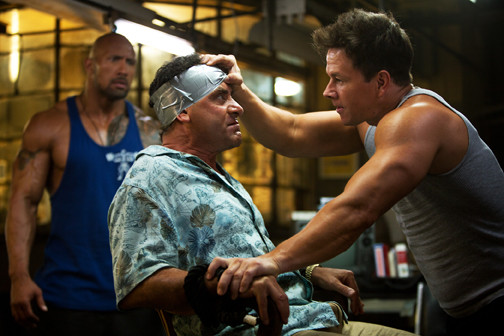
Having finally kidnapped Victor Kershaw (Tony Shalhoub, center) after several bumbling
failures, Daniel Lugo (Mark Wahlberg, right) orders the wealthy businessman to start
signing over his assets, while a nervous Paul Doyle (Dwayne Johnson) hopes that
things won't spiral out of control. That turns out to be a vain hope...
In late 1994, a group of bodybuilders based at Miami’s Sun Gym went on a crime, kidnapping, torture and murder spree that was both audacious and utterly beyond belief. Because the gang didn’t collectively share enough brain cells to pass third grade, they were, of course, eventually caught ... thus proving another old adage: We can be grateful that most criminals are so bone-stupid.

The whole gory mess — and I do mean gory — eventually landed in court in early 1998, resulting in the most expensive criminal trial in Dade County history. The case was covered for the Miami New Times by journalist Pete Collins, who also scoured court documents and investigative reports, and interviewed the principal characters, for an extensive three-part series that ran in late December 1999 and early January 2000.

The story is readily available at the New Times website, and makes a jaw-dropping read. Check it out, and I’ll wait for you to get back.

All set? Eyebrows raised to a degree you wouldn’t have thought possible?

Moving on, then...

Director Michael Bay and scripters Christopher Markus and Stephen McFeely have transformed this vicious circus into a hilariously warped dark comedy that signals its intentions with an opening on-screen crawl that reads: “The following story is based on actual events. Unfortunately.”

Yes, several characters and events have been excised for the sake of expediency, and a 10-minute chase toward the end is pure Hollywood nonsense. But the salient details, and the major players, are 100 percent authentic. Unfortunately.

The farcical tone isn’t merely perfect for the material; it’s also a necessary self-defense mechanism, particularly when third-act events stray into the wood-chipper territory of 1996’s Fargo. As these meat-headed lunatics become ever more desperate, this increasingly grim saga remains palatable only because stars Mark Wahlberg, Dwayne Johnson and Anthony Mackie are so deliciously, delightfully dumb.

Some viewers will find this tone quite tasteless — making fun of brutal psychopaths, no matter how stupid they are — particularly in the wake of recent events in Boston and Sandy Hook. And several of the actual people victimized by the gang are particularly incensed that their ordeal has been transformed into a jocular burlesque.

Honestly, I’m sympathetic to that view; quite a few of my chuckles were followed by wincing pangs of guilt. But I can’t help admiring the outcome; Bay has delivered an indictment of modern, American-style violence that — to me, at least — makes a much stronger (and far more entertaining) social statement than Oliver Stone’s Natural Born Killers.

Friday, January 11, 2013

Gangster Squad: Cheeky, audacious portrait of 1950s Los Angeles

Gangster Squad (2013) • View trailer
3.5 stars. Rating: R, for nonstop violence, gore and profanity
By Derrick Bang


It’s a can’t-miss formula that goes back to the days of vintage Hollywood Westerns: the few against the many, particularly in a righteous cause.

Electronics nerd Conwell Keeler (Giovanni Ribisi, center) overhears some delectable
information from the bug he planted in mobster Mickey Cohen's home, while squad
members John O'Mara (Josh Brolin, left) and Jerry Wooters (Ryan Gosling) determine
how best to use this revelation.
This already engaging dynamic was enhanced by turning the underdog heroes into rag-tag misfits, with the genre expanding to include war and crime (or the war on crime). Some of the best examples have become cinema classics, such as The Magnificent Seven — and its forbearer, The Seven Samurai — and The Dirty Dozen. My own list of personal favorites includes Where Eagles Dare.

Director Brian De Palma upgraded an early 1960s TV show and brought Sean Connery an Academy Award as the moral center of 1987’s The Untouchables. A decade later, that film’s 1930s Chicago setting shifted to 1950s Los Angeles with director Lee Tamahori’s stylish handling of Mulholland Falls. Even post-WWII crime thrillers weren’t quite this noir.

All of which brings us to director Ruben Fleischer’s energetic Gangster Squad, based on Paul Lieberman’s book of the same title, and adapted with snap by Will Beall, who employs the same crisp sparkle he has brought to several episodes of television’s Castle. The dialogue sizzles, the dames are delectable, the actors chew their lines with the snarling fury of a hungry lion tearing into a steak, and the action has the rat-a-tat ferocity of the Tommy guns wielded on both sides.

Although Lieberman brought veteran journalistic skills to his well-researched account of gangster Mickey Cohen’s attempt to seize control of Los Angeles during the 1950s, this film probably bears no more relation to actual history than Quentin Tarantino’s Django Unchained. Some of the names will be recognized, but the execution here feels more like Mission: Impossible and L.A. Confidential, with a soupçon of 21st century sass.

And — sad to say — plenty of violence and some unnecessary gore. The story may demand a vicious streak, but must we really watch a man torn in half after being chained to two cars accelerating in opposite directions? Surely that image could have been left to our imaginations, rather than splattered across the screen ... along with the yummy glimpse of wild dogs tearing into the remains.

But then, Fleischer also is the gleeful maniac who upped the snark count in walking dead flicks, with 2009’s Zombieland, so I guess it’s in his genes. And, in fairness, everything that follows the aforementioned dismemberment — a prologue, of sorts, to set the mood — involves somewhat more palatable gunplay. And a few knives. And some acid. And ... well, you get the idea.