Friday, July 18, 2008

The Dark Knight: Pitch black

The Dark Knight (2008) • View trailer for The Dark Knight
4.5 stars (out of five). Rating: PG-13, for action violence and a relentlessly grim tone
By Derrick Bang • Originally published in The Davis Enterprise, 7.18.08
Buy DVD: The Dark Knight • Buy Blu-Ray: The Dark Knight (+ BD Live) [Blu-ray]


This one has teeth.

Sharp teeth.
Determined to extract some information from the jailed Joker (Heath Ledger),
Batman (Christian Bale) unexpectedly appears in the criminal's cell, hoping
to startle him into a confession. But the Joker doesn't startle easily — indeed,
not at all — and this battle of wits is only beginning.

Patrons accustomed to a certain frivolous atmosphere from superhero movies — a larger-than-life approach to both characterization and storyline, with elements so fantastic that emotional engagement remains difficult, if even superfluous — are in for a nasty surprise with The Dark Knight.

This newest, exceedingly well-named entry in the Batman franchise is extremely dark indeed, not to mention uncomfortably realistic, its story an acutely perceptive dissection of humanity's frailties and failings. Longtime comic book fans who've hungered for a cinematic re-boot to match the grim tone of Frank Miller's graphic novels can rejoice: This is, without question, the way Batman was intended to be presented.

Director/co-writer Christopher Nolan and star Christian Bale made a serious step in the proper direction with 2005's Batman Begins, although that film suffered a bit from the need to trace the character's origins and develop fresh exposition. With that foundation sufficiently established, though, they've now unleashed — and that really is the proper word — a macabre, brooding and at times agonizingly suspenseful sequel that deserves to be called a serious drama.

Comic book storylines undergo a metamorphosis every decade or so, as new writers struggle to inject fresh issues into franchise characters who, to a certain degree, cannot change all that much. It's an intriguing challenge, and one current permutation involves trying to confront the real-world social implications of having a superhero in town. (Will Smith's Hancock also covers this territory, albeit quite badly.)

The current and quite seductive concept can be viewed as a corollary to the frustrating economic truism that expenditures always rise to meet income: Because Nature abhors a vacuum, a metropolis systematically cleansed of crime by a powerful vigilante will, as an inevitable side effect, produce ever-more-determined villains. In other words, supervillains rise up to wage war against superheroes ... not the other way around.

And so The Dark Knight begins — its methodical and psychologically astute script by Nolan, Jonathan Nolan and David S. Goyer — as Bruce Wayne's dour alter-ego joins dedicated Gotham City cop Jim Gordon (Gary Oldman) and forthright new District Attorney Harvey Dent (Aaron Eckhart) in an ambitious plan to bring the local mob to its knees, once and for all.

Their efforts are effective, to a degree, and the various mob bosses — the most frequent face being Salvatore Maroni (Eric Roberts, at his smarmy best) — find themselves backed into a corner and perhaps more willing to consider a previously unthinkable option:

The enthusiastic, if unpredictable, involvement of a vicious and deranged madman who has dubbed himself The Joker (Heath Ledger).

Thursday, July 17, 2008

Mamma Mia: Irresistible

Mamma Mia (2008) • View trailer for Mamma Mia
3.5 stars (out of five). Rating: PG-13, for playfully smutty dialogue
By Derrick Bang • Originally published in The Davis Enterprise, 7.17.08
Buy DVD: Mamma Mia • Buy Blu-Ray: Mamma Mia! The Movie [Blu-ray]


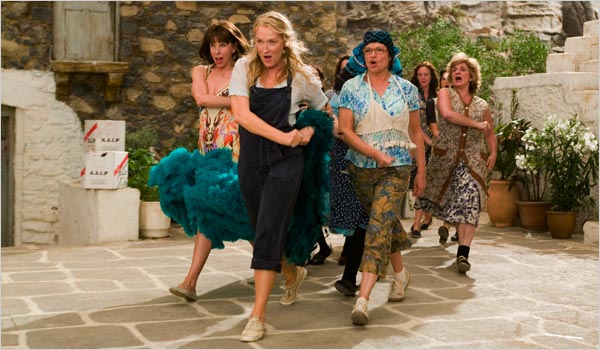
As musicals come and go, Mamma Mia is perhaps the most deliberately frivolous ever concocted, its postage-stamp plot no more than a tissue-thin excuse to deliver a few dozen classic ABBA hits.
While leading her friends — Tanya (Christine Baranski, left) and Rosie (Julie
Walters, right) — on a tour of her villa, Donna (Meryl Streep, center) uncorks
the song "Money, Money, Money" to explain  her precarious finances ... and,
of course, the entire Greek island community joins in the ever-expanding
production number, merely one of many in this energetic musical.

Nine years, 20 productions and 30 million tickets later, the fans obviously don't care, and with good reason: The show is a high-spirited, colorful hoot. Even now, more than 17,000 people see one of the nine current productions (worldwide) every night, generating $8 million per week in ticket sales. The word "phenomenon" would not be out of place.

Mamma Mia demands strong singers, reasonably agile dancers and very little else. The narrative does not include — indeed, actively ignores — sweeping dramatic arcs.

Naturally, then, this film adaptation is filled with actors. Whose singing abilities are uneven, at best.

Sigh.

In fairness, star Meryl Streep throws herself into the central role of Donna with every irrepressible atom in her energized body, and she makes the part her own through sheer force of will. And, yes, Streep sings reasonably well, as proven a few years ago with the film adaptation of A Prairie Home Companion.

Co-star Julie Walters is equally memorable as the feisty, wisecracking Rosie, one of Donna's two best friends. Walters handles her one dynamic song with reasonably aplomb, substituting similar passion — and, by the time this particular number arrives, plenty of audience good will — for actual vocal chops.

Colin Firth gets off lucky; his character, Harry, need only navigate his way through a ballad, which arrives with its wistful tone more or less intact. Stellan SkarsgÄrd's Bill, thankfully, isn't required to sing. Much.

But Pierce Brosnan?

Oh, dear.

Brosnan's Sam has two key numbers, both typical ABBA power ballads, and the picture grinds to an uncomfortable halt when he rasps his way through his first song's prologue. I haven't been this embarrassed for an actor-turned-reluctant-singer since Clint Eastwood talked to the trees back in the 1969 adaptation of Paint Your Wagon.

Mind you, I've always — always — liked Brosnan, and in all other respects he makes a great Sam. But Brosnan can't sing a lick, and Tuesday's preview audience breathed an audible sigh of relief when the backing orchestra became loud enough to better camouflage the actor's wincingly limited range.

What was everybody thinking?

Friday, July 11, 2008

Journey to the Center of the Earth: Rollicking trip

Journey to the Center of the Earth (2008) • View trailer for Journey to the Center of the Earth
3.5 stars (out of five). Rating: PG, for fantasy peril
By Derrick Bang • Originally published in The Davis Enterprise, 7.11.08
Buy DVD: Journey to the Center of the Earth • Buy Blu-Ray: Journey to the Center of the Earth [Blu-ray]

This is the best Walt Disney film that Uncle Walt never made.

Director Eric Brevig's Journey to the Center of the Earth is unapologetically retro: an old-style, family-friendly adventure highlighted by contemporary set design and creature technology. More than once, this film strongly echoes Disney's 1962 adaptation of In Search of the Castaways — another Jules Verne tale, it should be mentioned — most notably during a roaring sequence as our heroes tear down a hillside on a roundish "vehicle" of sorts.
The calm before all heck breaks loose: Our intrepid explorers — from left,
Trevor (Brendan Fraser), Sean (Josh Hutcherson) and Hannah (Anita Briem) —
make their way through a mysteriious cave, unaware that the ground is about to
give way and plunge them into an exciting adventure.

The script — by Michael Weiss, Jennifer Flackett and Mark Levin — is simple and superficial, but I don't mean that in a bad way; the film simply avoids angst and complicated interpersonal dynamics. We're quickly and economically introduced to our three main characters, who begin with mildly prickly relationships with each other — the better for mostly gentle one-liners — and then they pretty much carry the film on their own.

In a rather clever nod toward Verne's classic novel, which scientist Trevor Anderson (Brendan Fraser) insists remains a "good read," our heroes use the book as a blueprint for their own incredible saga. They eventually treat the book's chapters less as a whopping tall tale, and more as an early "rough guide" to life beneath the surface.

What we 21st century citizens know of actual science must be ignored, of course ... but this film is so good- natured about its casual disregard for basic laws of physics and temperature dynamics, that we cheerfully go along for the ride.

I must bow to the continuing savvy of Walden Media, which has delivered yet another delightfully earnest adaptation of an established book, following in the recent footsteps of Holes, Hoot, Charlotte's Web, Bridge to Terabithia and both Chronicles of Narnia entries, among others. Every one of these films can be enjoyed by all ages, without pandering to children or annoying their adult companions.

My earlier nod to Uncle Walt is equally earnest; I'm certain he would have loved Walden Media's films, since the production company strives for the same elements typical of late 1950s and early '60s Disney live-action entries such as Old Yeller, Polyanna, The Swiss Family Robinson, The Incredible Journey and, as mentioned, Castaways.

Or let's put it this way: If some cranky relative of a certain age complains about how "movies aren't made like they used to be," bring said individual along when you catch this Journey to the Center of the Earth.

In quick order, we're introduced to Trevor, a university-based scientist about to lose his lab due to an absence of publishable data, and his young nephew, Sean (Josh Hutcherson, from Bridge to Terabithia). Both have holes in their souls, due to the long-ago loss of Max, Trevor's brother and Sean's father. Indeed, Trevor's subsequent career has been an effort to defend the theories of his brother, who went missing a decade ago while on field work.

Now, thanks to fresh seismic activity in a region long believed dormant, Trevor hares off to Iceland, rather irresponsibly allowing Sean to tag along. (Hey, it's that kind of story. Go with the flow.) They meet a gorgeous but impressively resourceful local guide, Hannah (Anita Briem, perhaps recognized as Jane Seymour in TV's The Tudors), who leads them to the site of Trevor's newly actived seismic whatzis.

Thursday, July 10, 2008

Hellboy II: The Golden Army -- A bit tarnished

Hellboy II: The Golden Army (2008) • View trailer for Hellboy II: The Golden Army
Three stars (out of five). Rating: PG-13, for profanity and considerable action violence
By Derrick Bang • Originally published in The Davis Enterprise, 7.10.08
Buy DVD: Hellboy II: The Golden Army • Buy Blu-Ray: Hellboy II: The Golden Army [Blu-ray]


Back when he made 2004's Hellboy, Mexican director Guillermo del Toro was a star on the rise, known primarily in this country for an obscure (but quite imaginative) 1997 horror flick, Mimic, and 2002's stylish but otherwise forgettable second entry in Wesley Snipes' Blade series.
And you think you're having a bad day? Our misfit heroes — from left,
protoplasmic mystic Johann Krauss, aquatic empath Abe Sapien (Doug Jones),
reformed demon Hellboy (Ron Perlman) and pyrokinetic Liz Sherman (Selma
Blair) — reluctantly prepare for a last stand against 4,900 massive robot
warriors of death.

Arthouse patrons also had some exposure to del Toro, thanks to 2001's wonderfully moody ghosts-in-an-orphanage saga, The Devil's Backbone.

What a difference four years makes.

Today, deservedly riding the enormous success of Pan's Labyrinth, del Toro has used his enhanced prestige to rebound with — no, not another adult chiller in the mold of his Academy Award darling — a second crack at one of his favorite comic book characters.

Yep, Hellboy is back, in Hellboy II: The Golden Army ... but as far as del Toro's career is concerned, this sequel is a backwards step.

I don't fault the intent: Unlike too many stuffy Americans, del Toro is an unapologetic pop culture junkie, and that's commendable. (Del Toro's movie and comic book collection has grown so huge that he had to purchase a second house just to store it.)

And, like some of the more talented writers and artists toiling in the comic book medium these days, del Toro understands that these four-color adventures can be tailored for older audiences. I just wish del Toro had matched this new film's rich, imaginative and eye-popping visuals with a similarly strong and engaging script.

Granted, comic book writer/artist Mike Mignola's Hellboy — Mignola co-wrote this film's script with del Toro — remains a singularly fascinating protagonist.

Actually a demon spawned in hell and brought to Earth as an infant by WWII-era Nazis seeking any means to defeat the Allies — honestly, you gotta love this character's backstory — Hellboy was rescued by the good guys and raised to protect mankind from the occasional paranormal assault or underworld invasion.

His efforts remain under the radar, thanks to the belief by his government "handlers" that ordinary folks might have trouble getting cuddly with a horned red creature sporting a tail, a (literally) sledgehammer right hand and a snarky attitude ... even if he does adore kittens.

By necessity, then, Hellboy's good deed-doing has remained clandestine, as the head bad-ass for the top-top-secret Bureau for Paranormal Research and Defense, where he's joined by several other misfit agents. All are "chaperoned" by long-suffering government wonk Tom Manning (Jeffrey Tambor, always a hoot as a fussy bureaucrat).

Think Men in Black, but with a so-ugly-he's-cute hero instead of handsome fellas in three-piece suits.

Thursday, July 3, 2008

Hancock: Identity crisis

Hancock (2008) • View trailer for Hancock
Three stars (out of five). Rating: PG-13, for vulgarity and action violence
By Derrick Bang • Originally published in The Davis Enterprise, 7.3.08
Buy DVD: Hancock • Buy Blu-Ray: Hellboy II: The Golden Army [Blu-ray]

Movies don't surprise me very often — and I mean really surprise me — but Hancock isn't at all what I expected.
When it looks as if Ray (Jason Bateman, up in the air) and his car are about to
get squashed by an approaching train, Los Angeles' randomly helpful superhero,
Hancock (Will Smith), does a good deed but still destroys too much public
property in the process. Ray's challenge, which he subsequently embraces, is to
get the city to like its resident champion ... despite his flaws.

We can be forgiven for believing, thanks to the misleading publicity campaign, that Will Smith's summer entry is a lowbrow comedy about a homeless, disenfranchised superhero with a bad attitude and no concern for his public image. It's a reasonably clever concept; nowhere is it written that all superheroes should (or will) possess Superman's moral integrity and flag-waving belief in truth, justice and the American way.

But the previews made this flick look like a monumentally unfunny echo of My Super Ex-Girlfriend, the 2006 debacle that did nothing to assist Uma Thurman's already sagging career. It appeared as though even Smith's considerable charm — and box-office clout — might not be up to the challenge of selling Hancock.

Now that the film has arrived ... well, I'm still not sure.

During its first act, director Peter Berg's film is every bit as clumsy and forced as the coming attractions suggested. But something unexpected happens about halfway in, at which point Vincent Ngo and Vince Gilligan's script veers into territory that I can't discuss here, at the risk of giving too much away.

And the film, up to this point an uneasy blend of low comedy and social conscience, becomes a poignant drama.

This shift, alas, creates fresh problems.

At an economical 95 minutes, Hancock would have been a zippy little summer comedy with so-so special effects and a modestly engaging premise. We approach such films with minimal expectations and are willing to forgive lapses in continuity or plot logic.

But when the mood turns serious, and the details regarding the title character's backstory finally emerge, it's a whole new ballgame ... and one that must withstand the numerous new questions that erupt. Ngo and Gilligan's script — which apparently kicked around Hollywood for quite a few years — isn't up to the challenge.

Or Berg wasn't.

Either way, Hancock emerges as a compromised product. It feels as if some studio wonk, bothered by the tonal shift, came along with a chainsaw and hacked away chunks of exposition. This story apparently has some key villains, aside from the criminal riff-raff Hancock dispatches without breaking into a sweat; we definitely need to know more about these major baddies, but answers there are none.

It's an intriguing paradox: Just as Hancock becomes much more interesting, it also becomes more frustrating.

Wednesday, July 2, 2008

Mongol: The Rise of Genghis Khan -- Shaping the myth

Mongol: The Rise of Genghis Khan (2007) • View trailer for Mongol: The Rise of Genghis Khan
Four stars (out of five). Rating: R, for considerable violence
By Derrick Bang • Originally published in The Davis Enterprise, 7.2.08
Buy DVD: Mongol: The Rise of Genghis Khan • Buy Blu-Ray: Mongol: The Rise of Genghis Khan [Blu-ray]

His eventual world-conquering prowess notwithstanding, Russian filmmaker Sergei Bodrov's sumptuous Mongol suggests that Genghis Khan never would have survived into seasoned adulthood without frequent divine intervention and considerable help from his wife.
Temudgin (Tadanobu Asano, left) and his beloved Börte (Khulan Chuluun)
snatch a moment to themselves before the arrival of yet another crisis, when the
future nation-builder once again will be forced to battle for his life.

None of which makes this story any less powerful, of course, although the delivery smacks more of myth-making than any scholarly attempt at historical accuracy.

I can't really blame Bodrov, who directed this handsomely mounted film and co-wrote the script with Arif Aliyev. One cannot check textbooks for events that took place in the late 12th century, and thus we're forced to accept Bodrov's interpretation of legend. This is annoying only a few times, specifically when the young warrior's certain death seems assured ... until the next moment, when "the Gods" effect a nifty rescue.

Indeed, the first time this happens — when young Temudgin, not yet khan of anything, crashes through thin ice and plunges into the chilly waters of a massive frozen lake — we can't help wondering if this is merely some sort of oddly symbolic dream ... because, in the next scene, the boy is prostrate on the frozen tundra, somehow having a) not sunk to the bottom due to the weight of his heavy protective clothing; b) gotten himself out of the lake; and c) avoided freezing to death once his sodden body was exposed to the frigid air above.

Bodrov doesn't show any of the details that a reasonable viewer might deem essential: The boy crashes through the ice and into the water, and then — poof! — he's back on land, nowhere near the lake, and rescued by a helpful young shepherd.

Hey, I'm willing to accept our hero being a "chosen one," but it'd be nice to have a little more clarity!

We modern Western viewers, in particular, are much more likely to be impressed by Bodrov's characterization of Börte, Temudgin's faithful, loving and impressively resourceful wife. Now, this is a woman to cherish: She saves her husband's bacon more times than I can count, and is willing to do anything — including selling herself — in order to remain at his side.

Temudgin, for his part, is progressive enough to heed her counsel on matters of importance; he also quite generously accepts as "his" the two children that Börte bears by other men, during the course of this story.

Indeed, you'll be hard-pressed to detect any disagreeable flaws in this characterization of Temudgin. Even as a nascent nation-builder, he's brutal but fair: the sort of leader who first ensures that his men and their families want for nothing, before taking his share of any plunder. Small wonder he attracts followers by the bushel.

But that's getting ahead of things.