Showing posts with label Greta Gerwig. Show all posts

Friday, December 12, 2025

Jay Kelly: A sublime character study

Jay Kelly (2025) • View trailer
Five stars (out of five). Rated R, for profanity
Available via: Netflix
By Derrick Bang • Published in The Davis Enterprise, 12.14.25

The opening Sylvia Plath quote says it all:


“It’s a hell of a responsibility to be yourself. It’s much easier to be somebody else, or nobody at all.”


Flanked by publicist Liz (Laura Dern, center left) and best friend/handler Ron (Adam
Sandler, center right), Jay Kelly (George Clooney) cheerful interrupts his morning to
sign autographs for adoring fans.


Jay Kelly (George Clooney) has it all: a long and successful film career; a devoted entourage, including best friend and handler Ron Sukenick (Adam Sandler); and the admiration and respect of fans, friends and professional colleagues.


He is one with Gary Cooper, Cary Grant and Robert De Niro: shapeshifters and chameleons of identity, with faces that represent something personal to millions.


But.


Jay’s nature, even when the cameras are off, remains a pose; he has no sense of self. His relationship with daughters Jessica (Riley Keough) and Daisy (Grace Edwards) is strained at best, estranged at worst. They’ve grown up seeing him repeatedly forsake them for the work: another movie, another months-long absence. Their mother and Jay’s other exes are distant memories.


He takes Ron for granted, failing to recognize the strain this keeps putting on his family.


Jay is selfish … and he’s so far gone, he’s incapable of recognizing this.


To be sure, he’s affable, suave and generous with the public; he’s also wheedling and persuasive, and knows how to get his way. After all, he has been doing it for decades. (This is George Clooney, after all; the man exudes charm and savoir faire the way the rest of us breathe.)


And yet …


Of late, Jay has begun to relive past choices: confronted by ghosts from his past, awakened to the shallowness of his present. And with this rising awareness comes a feeling he can’t quite identify:


Regret.


This plays out in director Noah Baumbach’s masterfully composed film, which enchants from its initial scene: cinematographer Linus Sandgren’s stunning, single-take tracking shot that follows the set-up and shooting of Jay’s final scene in his new movie, Eight Men from Now. Baumbach’s script, co-written with Emily Mortimer, is a masterful blend of drama, gentle humor, angst and character dynamics, brought to life by richly nuanced performances from Clooney and Sandler. Both are sure bets for Academy Award nominations.


(I understand the eyebrow lift. Adam Sandler, in a subtly shaded straight role? Hey, watch this film, then get back to me.)

Friday, March 23, 2018

Isle of Dogs: A tail-wagging triumph

Isle of Dogs (2018) • View trailer 
Five stars. Rated PG-13, for dramatic intensity and some violent images

By Derrick Bang • Originally published in The Davis Enterprise, 3.23.18

This one is a treasure.

Wes Anderson’s films are eccentric — to say the least — but, over time, his unique brand of quirk has become ever more beguiling. Recall that 2014’s The Grand Budapest Hotel won four of its nine Academy Award nominations, and that Anderson has earned six nominations himself, dating back to a scripting nod for 2002’s The Royal Tennenbaums.

Twelve-year-old Atari, in an act of defiance against his guardian, the mayor of Megasaki
City, isn't about to let his beloved pet remain quarantined with all the other dogs on an
outlying "trash island."
One of the other six was earned when he helmed 2010’s Fantastic Mr. Fox, an engagingly warped adaptation of Roald Dahl’s droll little tale, presented via an insane amount of painstakingly detailed stop-motion puppet animation.

Anderson has returned to that form with Isle of Dogs, and it’s a work of even more incandescent brilliance: a thoroughly enchanting underdog fable for our time, and a similarly stunning achievement in puppet animation, and the jaw-droppingly detailed micro-sets they inhabit.

The only applicable descriptor — a term not to be used lightly — is awesome.

But the film isn’t merely fun to watch; it’s also powered by a genius storyline co-written by Anderson, Roman Coppola, Jason Schwartzman and Kunichi Nomura (the latter a Japanese writer, DJ, radio personality and occasional actor who made brief appearances in Lost in Translation and, yes, The Grand Budapest Hotel).

As often is the case with animated films, it’s difficult to praise the “acting” per se, since the characters aren’t flesh and blood. And yet there’s no doubt that Anderson — alongside animation director Mark Waring, and puppet master Andy Gent — has coaxed impressively sensitive performances from his many stars. Line readings perfectly match facial expressions and body language; double-takes and comic timing are delivered with the impeccable mastery of a stand-up veteran.

In short, we couldn’t be more engaged if these were “real” performers ... which would be impossible, of course, since dogs don’t talk.

But you may come away from this film thinking they do.

Thursday, November 30, 2017

Lady Bird: Truly soars

Lady Bird (2017) • View trailer 
Four stars. Rated R, for profanity and sexual candor

By Derrick Bang

Well into writer/director Greta Gerwig’s accomplished filmmaking debut, the story’s protagonist is complimented — by her high school counselor — on the depth of feeling she expresses, in a college application essay, for the city in which she has grown up: a city from which she’s eager to escape.

As the high school senior prom approaches, Lady Bird (Saoirse Ronan, left) brings her
mother (Laurie Metcalf) along when she tries out a series of dresses: an excursion that
takes place amid the organized clutter of Sacramento's massive Thrift Town store.
The city is Sacramento, where Gerwig herself grew up, and her film exhibits the same reverence. Indeed, I doubt Sacramento ever again will be the subject of such a heartfelt cinematic valentine.

Lady Bird can’t help feeling semi-autobiographical; Gerwig’s characteristic personality shines throughout, easily recognized from her starring roles in quirky indie dramedies such as Lola Versus, Frances Ha and Mistress America. Her filmmaking debut is both an engaging and painfully raw coming-of-age saga, and a respectful appreciation for the environment that shaped her as an artist.

A kiss on Sacramento’s cheek, and an earnest Thank You.

But that’s merely the narrative portion of Gerwig’s film. She also deserves credit for coaxing persuasively intimate performances from her stars: most notably Saoirse Ronan and Laurie Metcalf, who deliver one of the most tempestuous, complicated and deeply loving mother/daughter relationships ever depicted on camera.

The year is 2002, as the United States enters a new national mindset in the wake of 9/11. We meet Ronan’s Christine McPherson on the eve of her senior year in high school, which she’s horrified to discover will be spent at a Catholic school. She’s a rebellious young adult, with strikingly dyed hair and an insistence that everybody — even family members — refer to her as “Lady Bird”: a name she has given herself, as opposed to the one that was thrust upon her.

She has little use for her post-college brother Miguel (Jordan Rodrigues) and his girlfriend Shelly (Marielle Scott), both of whom share the small, cramped house which is all that Lady Bird’s parents — Marion (Laurie Metcalf) and Larry (Tracy Letts) — can afford. Lady Bird is deeply ashamed of living on “the wrong side of the tracks”; it’s one of the innumerable “slights” that she takes personally, and for which she — unjustly, and immaturely — blames her parents.

She’s a teenager, in every horrific sense of the term: stubborn, selfish, shallow, spiteful and short-tempered.

Friday, December 16, 2016

Jackie: A fascinating character portrait undone by directorial excess

Jackie (2016) • View trailer 
3.5 stars. Rated R, for profanity and brief strong violence

By Derrick Bang

A few iconic women have become popular staples in Hollywood dramas; consider the number of actresses, over the years, who’ve portrayed Cleopatra, Queen Elizabeth I and Marilyn Monroe.

Having decided upon a lavish funeral procession that she feels will suitably honor her
late husband, Jackie Kennedy (Natalie Portman) suddenly has last-minute doubts,
which she shares with brother-in-law Bobby Kennedy (Peter Sarsgaard).
And, more recently, Jacqueline Bouvier Kennedy.

Previous Jackies have been played by Blair Brown, Jacqueline Bisset and Katie Holmes, none of whom comes close to the ferocious intensity and shattered vulnerability depicted here by Natalie Portman. Her performance is so painfully raw that, more than once, we feel like uncomfortable voyeurs, intruding on a grief-stricken woman’s privacy during the worst few days of her life.

Portman’s starring role is by far the best part of Jackie, which marks the mainstream American debut of famed Chilean filmmaker Pablo Larraín. His approach is known to be uncompromising, with a grim, take-no-prisoners approach certain to raise eyebrows ... or, in some cases, unapologetically offend.

Many viewers will feel that he has done the latter here.

Noah Oppenheim’s script is unusual, even challenging, in its depiction of Jackie Kennedy during the turbulent few days immediately following her husband’s death: specifically, from the assassination on Nov. 22, 1963, to the massive funeral and procession that took place the following Monday morning. The details in between unfold in a blur of flashbacks and cross-cutting, Larraín and Oppenheim deftly conveying the confusion and shock that followed this national tragedy.

Jackie essentially tells her own story via a series of narrative devices: during a lengthy — and at times quite brittle — interview with a never-named journalist (Billy Crudup), who does his best to suss out the “real” Jackie; during a confessional conversation with a priest (John Hurt) just prior to the state funeral; and during anguished conversations with the only two people she trusts, U.S. Attorney General Bobby Kennedy (Peter Sarsgaard) and White House social secretary Nancy Tuckerman (Greta Gerwig).

These revelatory exchanges are blended further with re-created clips from the TV special A Tour of the White House, with Mrs. John F. Kennedy, hosted by CBS News correspondent Charles Collingwood, and broadcast on Feb. 14, 1962: the first-ever First Lady-led, televised tour of the White House — Jackie recently having renovated and restored the mansion — which was seen by 80 million viewers in 50 countries.

The latter sequences — given fuzzy, black-and-white authenticity by cinematographer Stépane Fontaine — show an entirely different Jackie: nervous, stiff, camera shy but determined to share (and justify) the $2 million spent to bring this presidential palace back to its original luster.

It’s also the narrative touch that establishes the film’s theme. Jackie clearly viewed that TV special as emblematic of her legacy as First Lady, just as she obsesses over details — immediately following the President’s assassination — in order to  properly preserve his legacy.

Friday, June 17, 2016

Maggie's Plan: The best-laid schemes...

Maggie's Plan (2015) • View trailer 
Four stars. Rated R, for profanity, sexual candor and brief nudity

By Derrick Bang

God must chuckle over how we mortals keep screwing up our own lives.

We fret, we fuss; we second-guess ourselves; we concoct absurdly elaborate schemes designed to accomplish this or that, but which invariably fail; we rebound with even more ludicrous counter-schemes.

When Maggie (Greta Gerwig, left) realizes that she has made a mistake by marrying John,
she concocts an unlikely scheme to re-unite him with ex-wife Georgette (Julianne Moore).
That's assuming, of course, that Georgette even wants him back...
If we’d simply relax and get out of our own way, letting nature take its course, we’d likely be much more pleased with the results.

Writer/director Rebecca Miller’s Maggie’s Plan has great fun with this notion. The indie filmmaker’s endearing romantic comedy — based on a story by Karen Rinaldi — also is another fine showcase for steadily rising star Greta Gerwig. The angst-riddled characters and New York setting make comparisons to Woody Allen inevitable, although Miller’s focus is female-centric; she’s also better — more organic — at skewering the pretentious affectations that make her characters so frequently sound like recently arrived visitors from Jupiter.

I’ve often felt that Allen’s gibes at Manhattan pomposity are made at the expense of his characters; the tone feels snooty. Miller, in great contrast, clearly sympathizes with her protagonists, even as she exposes their narcissism; it feels more like Miller is ruefully shaking her head, hoping that we’ll learn by this gentler — but still quite funny — example.

Maggie Hardin (Gerwig) wants to have a baby. Desperately. But she’s unwilling to take the conventional approach, given a track record of relationships that have lasted no more than six months. Artificial insemination therefore seems the best route, and Maggie has selected a slightly off-kilter, former college acquaintance (Travis Fimmel, as Guy) who abandoned a mathematics degree in favor of becoming a pickle entrepreneur.

Despite the decision having been made, Maggie remains conflicted. She shares her doubts with a personal Greek chorus: longtime best friend Tony (Bill Hader) and his wife, Felicia (Maya Rudolph). He’s a lawyer; she and Maggie are work colleagues at The New School, in Greenwich Village. Although Tony and Felicia are a bit crusty with each other, theirs is a loving and successful relationship, and they also care deeply about Maggie ... even if they frequently fail to understand her.

Maggie’s chance encounter with New School part-time teacher John Harding (Ethan Hawke) leads to a fast friendship. They spark: He’s a frustrated debut novelist trying to find his voice; she’s an eager and sympathetic reader. The bond deepens, and that’s a problem; John is married to Georgette (Julianne Moore), and they have two children.

Friday, August 28, 2015

Mistress America: Lunatics in charge

Mistress America (2015) • View trailer 
2.5 stars. Rated R, for profanity

By Derrick Bang • Originally published in The Davis Enterprise, 8.28.15

Noah Baumbach’s films are like Off-Broadway plays.

The settings are stage-y, the atmosphere mannered and theatrical; all conversations are forced and confrontational; people rarely speak calmly, instead gesticulating wildly and declaiming to an invisible back row. The dialog is florid and far wittier than anything we’d hear in actual life, the characters at times waiting on each other, in the manner of actors not entirely certain of their cues.

At first blush, life with Brooke (Greta Gerwig, right) is a romantic, big-city lark: the sort of
Manhattan-based adventure that Tracy (Lola Kirke) never expected to experience. But
as time passes, Brooke proves to be less an effervescent role model, and more a
narcissistic train wreck.
We eagerly await each retort, certain it will be particularly clever or scathing.

In the context of a true stage experience, we expect — even admire — such heightened reality. We appreciate the embroidered performances, smile knowingly during verbal duels designed to convey implied or blatant messages, pleased when we “get” the playwright’s intended moral.

Off-Broadway, we’re inclined to forgive the artifice.

In a movie theater, I find it exhausting.

The character played by Greta Gerwig in Mistress America is artificial: a vehicle designed solely to showcase her thespic skills. She sighs, smiles, chatters nervously, flutters about and behaves like a cattle-call actress trying much too hard to impress. Which is, I acknowledge, the nature of her character ... but that’s not a sufficient excuse for performance overkill.

To be sure, Gerwig is fun to watch. She delights and dazzles, even — sometimes particularly — when her character’s behavior slides into wretched excess. But it’s hard to wrap a conventional storyline around such a deliberately flamboyant scene-stealer.

Knowing that Gerwig co-wrote the script, with Baumbach, makes this film a rather blatant vanity project. That Baumbach, as director, so blithely tolerates his leading lady’s excesses, can be attributed to their having been an off-camera item since 2011, while making Frances Ha. (They also worked together on 2010’s Greenberg.)

And I dearly hope they’ve gotten this big-screen Mutual Admiration Society out of their systems.

That said, Mistress America opens well, its first act a credible and painfully accurate indictment of the college scene, as experienced by the disenfranchised. Tracy (Lola Kirke) begins her freshman year at a Manhattan college with expectation and enthusiasm, both of which are smooshed during a brief montage that catalogs every indignity and beat-down endured by those not quite certain of their place in life.

The hostile roommate. The boring and pretentious classes. The ghastly dining commons food. The miasma of quiet desperation that filters through the dorm hallway. The tentative crush who, a few days later, pops up with a new girlfriend.

The loneliness.

The PTSD flashback was almost enough to send me screaming from the theater.

Tuesday, June 18, 2013

Frances Ha: Engaging portrait of an unfinished soul

Frances Ha (2013) • View trailer 
Four stars. Rating: R, for profanity and sexual candor
By Derrick Bang


Slowly but steadily, Greta Gerwig has been crafting wry and thoughtful portraits of today’s self-absorbed millennials ... and, more specifically, those who suffer from what has been branded Failure to Launch.

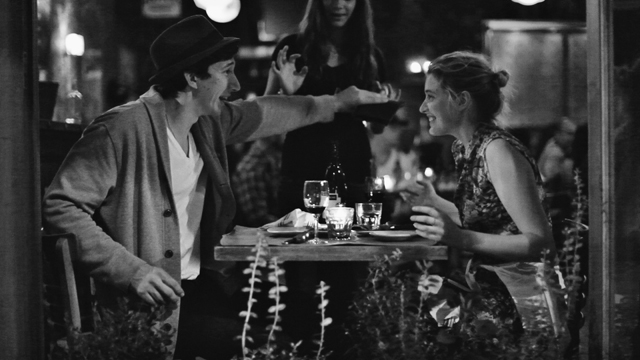
Mourning the apparent loss of her long-time best friend, Frances (Greta Gerwig) drowns
her sorrows in a good meal with Lev (Adam Driver), a sympathetic guy-pal who offers
the sort of superficial warmth that can obscure emotional pain ... if only briefly. What
Frances hasn't yet learned, though, is that true healing must come from within.
We’ve seen hints in her stand-out supporting roles in the remake of Arthur and Woody Allen’s To Rome with Love. Despite having (I assume) minimal creative control over those projects, and being limited to what those directors and scripts allowed, Gerwig nonetheless delivered an irresistible blend of quirky charm and wary vulnerability. The classic Greta Gerwig character — assuming it’s not too early to brand her in such a manner — always seems slightly out of phase with our world, her expression of cautious bewilderment suggesting that, to her, society and interpersonal relationships always are mildly out of focus.

Gerwig delivered a richer example of such a young woman in last year’s Lola Versus, but her often amiable performance was undone by a frequently cruel and tin-eared script that forced too much self-destructive behavior on a title character who clearly should have known better.

Cue the arrival of Frances Ha, a much more satisfying character study of a wayward New Yorker who — despite good intentions and often painful sincerity — just can’t get her act together. Gerwig had a strong hand in this 27-year-old woman’s development, having shared scripting credit with director Noah Baumbach. (They also worked together on 2010’s unsatisfying Greenberg.) The result feels far more credibly authentic than the erratic nitwit in Lola Versus.

Frances is the sort of forever flustered individual who will promise to do something, and then let the opportunity slip by; or will insist that she won’t do something, but then will. She’s simultaneously endearing and deeply frustrating, and numerous scenes in this film are uncomfortable and unsettling, as we worry over whether she’ll miss another promising opportunity, or yield to another impetuous, ill-advised decision.

She’s tone-deaf during social occasions, forever saying the wrong thing to the wrong people: not because she’s cruel or thoughtless, but mostly because she simply doesn’t pay attention to relationship cues, whether casual or formal. She’s much too self-absorbed: but, again, not in an unpleasant manner. She’s just ... well ... unfinished, somehow. And helpless to do anything about it.

But Gerwig’s performance is so endearing, and so genuinely sweet, that we can’t help forgiving Frances her many shortcomings (even as we groan over them). Watching her flail during an effort to describe wanting that “magic moment” between two soul mates — when eyes lock from opposite ends of a room, and a quick smile of acknowledgment cements the sort of bond that neither time nor God could disrupt — is poetry in motion. It’s a breathtaking, all-in scene: utterly mesmerizing, for Gerwig’s intensity. Watch how she works every square millimeter of her expressive face, from lips and chin to eyebrows.

Thursday, July 12, 2012

To Rome with Love: Woody Lite

To Rome with Love (2012) • View trailer
3.5 stars. Rating: R, and much too harshly, for some sexual candor and fleeting profanity
By Derrick Bang


Having conquered France — and re-ignited his career, not to mention securing yet another Academy Award, for scripting last year’s Midnight in Paris — Woody Allen continues his European tour with an intermittently charming visit to Italy.

To the mounting horror of Antonio (Alessandro Tiberi, far left), his
stuffy older relatives mistakenly assume that professional call girl
Anna (Penélope Cruz) is his new wife .. and then he's forced to
continue the charade — with Anna's amused assistance — lest the
cat be let out of the bag.
The good news is that, while nowhere near as fresh and clever as Midnight in Paris, To Rome with Love nonetheless continues Allen’s pleasantly droll examinations of continental love, and the pursuit of same. His goal isn’t nearly as lofty this time; one gets the sense that these four vignettes — connected solely by location — are modest little pieces that Allen knew couldn’t be expanded into full-length films.

As a result, we have a quartet of short stories, much like his piece (“Oedipus Wrecks”) in the 1989 anthology film, New York Stories. The results here are a bit uneven, ranging from hilarious and sharply observed, to overly talky and mannered in the way that sounds so uniquely “Woody Allen” ... the latter an affectation that may have been extended beyond its sell-by date.

At 112 minutes, To Rome with Love also feels overlong, with two of the segments suffering from visible bloat: not terribly so, but enough to prompt viewer restlessness.

Allen signals his disparate intentions by having the film introduced by a somewhat careless traffic policeman (Pierluigi Marchionne), who proudly extols the virtues of his city, and its many stories. We then meet four different sets of characters, each faced with a crisis of circumstance, existential angst or celestial manipulation.

Newlyweds Antonio (Alessandro Tiberi) and Milly (Alessandra Mastronardi) have arrived in Rome to begin life together, and so that he can impress his boorish, straight-laced relatives and — through their contacts — secure an upscale job in the big city. But with only hours to spare, Milly sets off to get her hair done, and becomes lost; meanwhile, Antonio is confronted by a prostitute (Penélope Cruz) who shows up at his hotel room by mistake, and then is forced to play his wife when the condescending relations arrive.

To make matters worse, the impressionable Milly wanders onto a film set and finds herself the target of a legendary movie star (Antonio Albanese), who hopes to enjoy her as afternoon delight. And she’s not wholly adverse to the notion; is it so awful, to want to bed a famous film actor?

Friday, June 15, 2012

Lola Versus: Undone by a bogus script

Lola Versus (2012) • View trailer
Three stars. Rating: R, for profanity, sexual candor and drug use
By Derrick Bang


Lola (Greta Gerwig) wanders aimlessly during the year following her 29th birthday, her fickle and frequently self-destructive behavior often destroying any good will she establishes during brief flashes of actual maturity.

When best friend Alice (Zoe Lister-Jones, left) encourages Lola (Greta
Gerwig) to jump back into the dating pool, the waters suddenly seem
full of sharks and minnows ... neither of which is good news for a
mildly desperate woman on the rebound.
The same can be said of the film she inhabits.

Lola Versus opens with promise, but rapidly devolves into an overly talky quagmire that feels (and sounds) like a bad Woody Allen film. Co-scripters Zoe Lister-Jones and Daryl Wein introduce Lola as a self-assured and obviously intelligent woman — not everybody has the smarts to be inches away from a Ph.D. — but then subject her to an escalating series of bad decisions and stupid choices, not to mention enough drug and alcohol binging to send the next half-dozen people into rehab.

In short, it becomes impossible to retain our sympathy for Lola, despite Gerwig’s heroic effort to showcase her character’s quirky charm.

Then, too, the dialogue exchanges concocted by Lister-Jones and Wein are too arch, too contrived, too knowingly earthy and too faux trendy. Granted, nobody in real life talks like the folks on the big screen, but — best-case scenario — we viewers at least can delight in witty, sophisticated banter when it’s delivered with well-timed snap. Too much of the conversational chatter here is ostentatiously smutty, as if Lister-Jones and Wein are taking their cues from the gals in Sex and the City.

Sorry, but talking like Kim Cattrall’s Samantha is not the height of chic refinement. Not even close.

We meet Lola on her aforementioned 29th birthday, an event celebrated in the arms of longtime boyfriend Luke (Joel Kinnaman), who climaxes the milestone by proposing. Cue several weeks (months?) of excited wedding planning, with some decisions second-guessed by Lola’s fashionably cool parents, Robin and Lenny (Debra Winger and Bill Pullman).

Pullman is a hoot: one of the film’s stronger elements, actually, and I wish we could have spent more time with him. Lenny is recently retired and loving this opportunity to hang loose and embrace social media and all the other “with it” joys of the early 21st century; he and Lola also enjoy a frank and loving relationship.

Winger’s Robin is perhaps somewhat controlling, but Lola is strong enough — and savvy enough — to maintain the necessary barriers.

Friday, April 8, 2011

Arthur: Poor little rich remake

Arthur (2011) • View trailer for Arthur
Three stars (out of five). Rating: PG-13, for sensuality, profanity, drug references and relentless alcohol abuse
By Derrick Bang • Originally published in The Davis Enterprise, 4.8.11


Director Jason Winer's most impressive accomplishment, in his remake of 1981's Arthur, is keeping a lid on his star's aggressively flamboyant tendencies.

A little bit of Russell Brand goes a very long way.
Breakfast time in the Bach household often is conducted well after the noon
hour, as Hobson (Helen Mirren) patiently prepares a meal for the utterly
helpless Arthur (Russell Brand), who couldn't boil water without destroying
half the kitchen.

Indeed, I'd argue that Brand is best used as a supporting player, where his shenanigans can provide an ostentatious counterpoint to calmer leading players; in just such a capacity, he was one of the brighter spots in the mostly forgettable Forgetting Sarah Marshall. Alternatively, Brand completely overwhelmed last year's Get Him to the Greek ... which, I've no doubt, delighted both his fans and anybody who enjoys the similarly overplayed antics of, say, Will Ferrell or Steve Coogan. Larger-than-life comic personalities rarely "act" in their films, as opposed to simply playing unvarying versions of their successful stage personas.

In which case, let the viewer beware.

But Brand manages to be occasionally endearing here, as Arthur Bach: a spoiled-rotten, super-rich, arrested adolescent who never refuses an opportunity to make headlines while concocting new ways to embarrass his mother. Vivienne (Geraldine James) runs the family corporate empire, her husband — Arthur's father — having (wisely?) passed on when his only son was 3. Subsequently raised in a sheltered environment by an absentee single parent too frequently in the boardroom, Arthur has turned unrestrained hedonism into an Olympic-caliber sport, believing that one cannot have too much wine, too many women (often simultaneously) or too much song.

All this is a constant source of irritation to Hobson (Helen Mirren), Arthur's patient, long-suffering but mordantly prickly nanny. Hobson tirelessly cleans up after her charge, having done so for decades. And if this is motivated at least in part by affection, as opposed to a regular paycheck, that's difficult to discern ... initially, anyway.

Oh, yes: Arthur also drinks. Constantly. Excessively. With the intention of humorous effect.

Therein lies a problem.

The original Arthur, brilliantly written and directed by Steve Gordon — who died, tragically, just after the release of this, his big-screen debut — was designed as an homage to 1930s Hollywood screwball comedies, which existed in the same sort of rarefied, fantasyland atmosphere populated by Fred Astaire and Ginger Rogers dance flicks. This was an era of archetypes rarely seen in our more cynical, obnoxiously politically correct 21st century: dumb blondes, honorable cowboys, hookers with a heart of gold, and — most crucially, for our purposes — lovable drunks. Gordon's "Arthur" was a hit not just because of star Dudley Moore's spot-on performance, but also because the entire film so perfectly imitated this bygone era, while ostensibly being set in the present day.

Even as Arthur fell in love with the plain, working-class woman who taught him about the value of self-reliance — an improbably cast Liza Minnelli, but hey, she made it work — Gordon was careful not to slide too far into the real world. The bubble would have burst.

Winer and screenwriter Peter Baynham, in their remake, exercise no such caution ... and more's the pity.

Friday, January 21, 2011

No Strings Attached: Make a date

No Strings Attached (2011) • View trailer for No Strings Attached
3.5 stars (out of five). Rating: R, for profanity, sexual candor, vulgar humor, brief nudity and minor drug use
By Derrick Bang • Originally published in The Davis Enterprise, 1.21.11


Once it settles down and turns into the film we all paid to see, No Strings Attached is an alternately hilarious and touching romantic comedy, positioned nicely a few weeks ahead of Valentine’s Day.

Rather earthy, as well.
When Emma (Natalie Portman, on the couch) and her roommates -- Shira
(Mindy Kaling, standing) and Patrice (Greta Gerwig) -- retreat into their
apartment because it's "that time of the month," Adam (Ashton Kutcher)
surprises them all by arriving with cupcakes and a rather unusual mix CD.

And therein lies the initial problem. For about the first 15 minutes, writers Elizabeth Meriwether and Michael Samonek try much too hard to enter smutty Judd Apatow territory, and the results are cringe-worthy. The first eye-poppingly vulgar one-liner, exchanged between a boy and girl at a summer camp, delivers a galvanic shock: Did we really just hear that?

(A more apt question: Would a boy that age ever say such a thing to a girl that age? Not for a heartbeat, which is precisely the problem. It ain’t funny.)

Similar raunchy comments flow during the next few sequences, which might be veteran director Ivan Reitman’s version of fair warning, and an effort to clear the theater of patrons too easily offended. But then an odd thing happens: The banter turns measurably milder – if still quite randy – and Reitman manages the deft trick so frequently attempted, without success, by American filmmakers.

He gets very close to the playfully erotic tone of a French sex farce.

Never a bad thing.

All the elements are in play, starting with nice guy Adam (Ashton Kutcher), a mid-level TV production company flunky forever standing in the shadow of his more flamboyant father, Alvin (Kevin Kline), an aging celeb still milking the signature line (“Great Scott!”) that netted him so much willing female companionship back when he starred on a hit sitcom. Not long into this tale, Adam suddenly discovers that his recent ex, Vanessa (Ophelia Lovibond, appropriately sultry) is boinking dear ol’ dad ... which leads to all sorts of uncomfortable questions. (“When did this start, exactly?!”)

After losing himself in an alcohol-fueled effort to find somebody – anybody – to bed that night, Adam wakes the next morning in an apartment shared by Emma (Natalie Portman) and her three med student friends, Patrice (Greta Gerwig), Shira (Mindy Kaling) and Guy (stand-up comic Guy Branum). Rather embarrassingly, Adam is starkers and stretched out on the living room couch; even worse, he has no recollection of the previous evening ... and the teasing descriptions supplied by Emma and the others do little to help him regain any composure.

Kutcher, it should be mentioned, does marvelous work in this scene. His confused, hooded, sidelong glances are priceless, his deft efforts to shield his dangly bits a masterpiece of towel manipulation. (Choreographing this scene, and getting it precisely right, must have been hilarious. Goodness knows, the results are suitably funny.)

Thursday, April 1, 2010

Greenberg: Sheer torture

Greenberg (2010) • View trailer for Greenberg
Two stars (out of five). Rating: R, for profanity, strong sexual content, nudity and drug use
By Derrick Bang • Originally published in The Davis Enterprise, 4.1.10
Buy DVD: Greenberg • Buy Blu-Ray: Greenberg [Blu-ray]


Filmmaker Noah Baumbach opens and closes Greenberg with tight close-ups on Greta Gerwig's expressive face, and in both cases we're overwhelmed by a painfully raw display of naked emotion: hope, uncertainty, frustration and uncomplicated compassion.

Particularly the latter: Gerwig's Florence Marr is the best part of this film, and Baumbach does well to highlight this talented young actress  born and raised in Sacramento -— as much as possible.
After another of their "romantic" encounters goes horribly awry, Florence
(Greta Gerwig) can't wait to abandon the mean-spirited Roger (Ben Stiller) for
the rest of the evening. Too bad she doesn't run him over with a bus; now,
that would be worth watching.

Unhappily, Ben Stiller's title character is the worst part, which makes this tightly wound relationship drama rather difficult to endure.

I'll be more blunt: We're sometimes forced, by circumstance of employment or casual encounter, to spend excruciating hours with people we can't stand. Why the heck should we endure a similar jerk in a movie?

Although we're obviously intended to sympathize with Roger Greenberg  to tolerate and be patient with this lost soul, as he struggles at the mid-life crossroads  Stiller's character doesn't earn such respect, nor is there reason to cut him any slack. He's an abusive, misanthropic, misogynistic, self-centered cretin who doesn't deserve the kindness shown by several of the other characters in this story, and particularly not by Gerwig's Florence.

Watching Roger turn nasty and emotionally belittle Florence is stomach-clutching the first time. Enduring it the second time, the third time, the fourth time ... is inexcusable. Gerwig's performance is so credibly, painfully shaded  Florence is so vulnerable, so willing to suffer the abuse  that it's like watching somebody drown kittens in a barrel.

And to what purpose?

That's the key question about Baumbach's film, which he directed and co-wrote with occasional collaborator Jennifer Jason Leigh. (They worked together on 2007's Margot at the Wedding.) Why are we wasting time with this intellectual thug?