Showing posts with label Ellen Page. Show all posts

Friday, October 9, 2015

Freeheld: Sentiment over substance

Freeheld (2015) • View trailer 
3.5 stars. Rated PG-13, for dramatic intensity, mild profanity and discreet sensuality

By Derrick Bang


It seems such a reasonable request.

You work a job for 23 years, building up a respectable pension, and then — tragically — a health crisis strikes. Death now will come much sooner, as opposed to the “later” we all hope for. One therefore assumes that you’d be allowed to assign your pension funds to any loved one of choice: spouse, parent, child. Why should it matter?

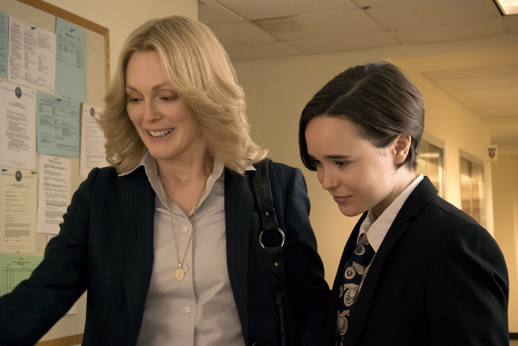
Having made the brave decision to "out" herself and publicly acknowledge her relationship,
Laurel (Jullianne Moore, left) happily completes and registers the paperwork so that she
and Stacie (Ellen Page) can become official "domestic partners."
It mattered in New Jersey in 2005 — one short decade ago — when the requested recipient was a “domestic partner.”

Freeheld, director Peter Sollett’s heartfelt adaptation of those events, is anchored by compelling and deeply nuanced performances from Julianne Moore and Ellen Page. Ron Nyswaner’s script deftly compresses the key events, while focusing on the touching interpersonal dynamic between the two principal characters.

The result is something in the way of social commentary and advocacy cinema: a narrative model with which Nyswaner is quite familiar, having been Oscar-nominated for his script to 1993’s AIDS drama, Philadelphia.

Moore, whose Hollywood career has been impressively varied, stars as Laurel Hester, a well-respected veteran of New Jersey’s Ocean County police force. She takes her job seriously, and — thanks to Moore’s carefully shaded performance — we detect a slight chip on Laurel’s shoulder, likely the hardened perseverance of a woman who has had to work twice as hard as her male colleagues, probably for half as much recognition.

It’s also clear that her private life is very private, her sexual preference having been concealed even from longtime partner Dane Wells (Michael Shannon). But Laurel isn’t a hermit. Most recently, while participating in a volleyball league across town, she meets the much younger Stacie Andree (Page), who confidently acts on what she perceives as a possible shared attraction.

Stacie isn’t wrong; the spark is genuine, even if Laurel takes awhile to lower a career’s worth of defenses. The embryonic relationship is sweet, although not without setbacks; Laurel finds it difficult to be as openly expressive as her new partner. That’d be the age difference, at least in part; Stacie belongs to a generation that doesn’t feel quite the same need to hide.

Friday, May 23, 2014

X-Men: Days of Future Past — One for the ages

X-Men: Days of Future Past (2014) • View trailer 
Four stars. Rated PG-13, for nonstop action violence, considerable grim content and brief profanity

By Derrick Bang • Originally published in The Davis Enterprise, 5.23.14

This one cooks.

The X-Men film series has earned high marks from its debut back in 2000, notwithstanding the frustrating rival studio issues that prevent these characters from operating within the larger tapestry of the “Marvel Universe” project that includes Iron Man, Thor, Captain America and the Avengers.

After learning that black-ops types plan to conduct dangerous — even lethal — medical
experiments on some helpless mutants, a furious Raven (Jennifer Lawrence, second
from right) gets quite irate with the goons responsible, while helping the others escape.
Director Bryan Singer got Marvel’s “merry mutants” off to an excellent start with the first two films, and he returns here, batteries fully charged, for a rip-snortin’ adventure that satisfies on every level.

Longtime comic book fans, who’ve followed these characters since their debut back in September 1963, can point to three periods of writer/artist genius during the series’ half-century history. Old-timers still cite the Roy Thomas/Neal Adams run, despite its brevity, as the highlight of 1969 and early ’70. The subsequent generation scoffs at that choice, pointing instead to the bravura Chris Claremont/Jim Lee run from 1989 through ’91.

In between, though, we enjoyed four years of greatness from late 1977 through early ’81, thanks to Claremont’s imaginative stories and artist/co-author John Byrne’s artwork. And that run produced a two-parter, “Days of Future Past,” which remains one of the all-time best comic book stories, anywhere ... not to mention one of the most ingenious time-travel narratives ever concocted (and cited as such in a recent issue of the British pop culture magazine SFX).

Fan reaction was guarded, when word broke that this new X-Men film would adapt that classic tale. Doing it justice would be difficult enough; carefully sliding it into the big-screen mythos already established by the first three films and 2011’s X-Men: First Class, even harder. Screenwriters Simon Kinberg, Jane Goldman and Matthew Vaughn therefore deserve considerable credit, because they pulled it off. And then some.

Failing to give Claremont and Byrne a “story by” acknowledgment, however, is utterly indefensible. And I rather doubt that Claremont was mollified by his eyeblink cameo.

To a degree, this film also has been shaped by the wattage of its primary stars, most notably Jennifer Lawrence, who has become huge since first playing the shape-shifting Raven/Mystique in First Class. Hugh Jackman’s ultra-cool Wolverine also is front and center, as are James McAvoy’s angst-ridden Charlie Xavier and Michael Fassbender’s smoothly malevolent Erik Lehnsherr/Magneto.

But wait, I hear you cry. Patrick Stewart and Ian McKellen also appear in this adventure ... and aren’t they also Xavier and Magneto?

Well, yes ... and that’s the nature of time-travel stories. Done properly, we get to eat our cake, and have it, too. And this is one tasty treat.

Thursday, July 12, 2012

To Rome with Love: Woody Lite

To Rome with Love (2012) • View trailer
3.5 stars. Rating: R, and much too harshly, for some sexual candor and fleeting profanity
By Derrick Bang


Having conquered France — and re-ignited his career, not to mention securing yet another Academy Award, for scripting last year’s Midnight in Paris — Woody Allen continues his European tour with an intermittently charming visit to Italy.

To the mounting horror of Antonio (Alessandro Tiberi, far left), his
stuffy older relatives mistakenly assume that professional call girl
Anna (Penélope Cruz) is his new wife .. and then he's forced to
continue the charade — with Anna's amused assistance — lest the
cat be let out of the bag.
The good news is that, while nowhere near as fresh and clever as Midnight in Paris, To Rome with Love nonetheless continues Allen’s pleasantly droll examinations of continental love, and the pursuit of same. His goal isn’t nearly as lofty this time; one gets the sense that these four vignettes — connected solely by location — are modest little pieces that Allen knew couldn’t be expanded into full-length films.

As a result, we have a quartet of short stories, much like his piece (“Oedipus Wrecks”) in the 1989 anthology film, New York Stories. The results here are a bit uneven, ranging from hilarious and sharply observed, to overly talky and mannered in the way that sounds so uniquely “Woody Allen” ... the latter an affectation that may have been extended beyond its sell-by date.

At 112 minutes, To Rome with Love also feels overlong, with two of the segments suffering from visible bloat: not terribly so, but enough to prompt viewer restlessness.

Allen signals his disparate intentions by having the film introduced by a somewhat careless traffic policeman (Pierluigi Marchionne), who proudly extols the virtues of his city, and its many stories. We then meet four different sets of characters, each faced with a crisis of circumstance, existential angst or celestial manipulation.

Newlyweds Antonio (Alessandro Tiberi) and Milly (Alessandra Mastronardi) have arrived in Rome to begin life together, and so that he can impress his boorish, straight-laced relatives and — through their contacts — secure an upscale job in the big city. But with only hours to spare, Milly sets off to get her hair done, and becomes lost; meanwhile, Antonio is confronted by a prostitute (Penélope Cruz) who shows up at his hotel room by mistake, and then is forced to play his wife when the condescending relations arrive.

To make matters worse, the impressionable Milly wanders onto a film set and finds herself the target of a legendary movie star (Antonio Albanese), who hopes to enjoy her as afternoon delight. And she’s not wholly adverse to the notion; is it so awful, to want to bed a famous film actor?

Friday, July 16, 2010

Inception: Bad dream

Inception (2010) • View trailer for Inception
Three stars (out of five). Rating: Pg-13, for unrelenting action violence
By Derrick Bang • Originally published in The Davis Enterprise, 7.16.10
Buy DVD: Inception • Buy Blu-Ray: Inception (Two-Disc Blu-ray/DVD Combo + Digital Copy)

This overcooked flick is a lot of fuss and bother, just to learn the identity of Rosebud.

Writer/director Christopher Nolan's brain-bending fantasy boasts a genuinely fascinating premise, but the execution is wanting; the self-indulgent running time (148 minutes) can't be justified by a storyline that isn't nearly as complex  or coherent  as Nolan would like us to believe.
"Draw me a maze in two minutes," Dom (Leonardo DiCaprio) tells Ariadne
(Ellen Page), shortly after meeting her, "that takes me at least a minute to
solve." After a couple of blown attempts, Ariadne adjusts to the complexity of
the test, at which point Dom acknowledges that she might be the perfect
"architect" for his team of dream-thieves. Goodie, goodie...!

Inception is the sort of film that results when an inventive and financially successful filmmaker, armed with a few box-office hits  in this case, Batman Begins and The Dark Knight  is let off the company leash for a long-gestating "dream project" (no pun intended) and granted unfettered access to the studio bank account. Inevitably, the outcome is runaway hubris.

We've seen it happen time and again, with talents as stellar as James Cameron (The Abyss) and Barry Levinson (Toys). The most famous example remains Michael Cimino, whose bloated production of Heaven's Gate literally bankrupted United Artists, back in 1980.

Inception won't bankrupt Warner Bros., but it also won't be the summer blockbuster we've been hoping for, given the film's ultra-top-secret production and tantalizingly vague advance publicity. The rewards remain few in this visually bombastic but emotionally barren drama.

I'm halfway persuaded that Nolan set out to create a film with a climax  running the entire final hour  that out-weirds the LSD-esque sequence that concluded 1968's 2001: A Space Odyssey. That sci-fi classic had its devoted acolytes at the time (and still does), but I can't help remembering, with a whimsical smile, that many (most?) of the warm bodies filling theater seats during the waning days of that hippy-dippy decade were, ah, chemically altered.

That stargate sequence was the ultimate head-trip, man.

So's the entire second half of Inception. And it'll definitely impress a lot of viewers.

An intriguing idea? Absolutely. Quite thought-provoking, at times. But only at times.

We hit the ground running, as Nolan introduces us to Dom Cobb (Leonardo DiCaprio) and his unusual team of professional "dream thieves," as they try to extract a closely guarded secret while having invaded the sleeping mind of Saito (Ken Watanabe), a rich and powerful business magnate.

Dreamtime landscapes have their own logical illogic, and Dom is close to emptying the contents of Saito's mental safe when the mission goes awry, thanks to the intervention of Mal (Marion Cotillard), a mysterious woman able to interfere with Dom's subconscious sleuthing.

Once back in the waking world, Saito is unbothered by this most personal incursion, choosing to view the experience as an odd sort of audition. He offers Dom and longtime dream-thief partner Arthur (Joseph Gordon-Levitt) a rich assignment with a fresh target: Robert Fischer (Cillian Murphy), who's about to inherit control of his dying father's multibillion-dollar empire. The Fischer family is the sole obstacle to Saito's desire to control the entire world's energy market, and he wants that obstacle removed.

The tantalizing solution: Invade Robert Fischer's mind and plant a suggestion  an "inception"  that he should break up his father's corporate monolith.

Ah, but uncovering deeply buried secrets is easy, Arthur objects, when compared to embedding a foreign idea. Apparently the host mind is quick to perceive the introduction of an alien thought, and will create mental defenses to repel and even destroy the invader, much the way white blood cells will overwhelm an infection site.

OK, fine, whatever...

Dom and Arthur assemble a team, much the way Peter Graves' Jim Phelps cherry-picked associates for each Mission: Impossible caper. Eames (Tom Hardy) can "forge" another identity in somebody else's dream, effectively becoming a trusted friend or family member. Yusuf (Dileep Rao) is an unorthodox pharmacologist who devises the drug cocktails that keep subjects  and invaders  in dream sleep, while allowing a means for controlled waking.

Saito insists on coming along for the ride, to protect his investment.

Ariadne (Ellen Page), finally, is a university architectural student given the opportunity to "build" the dream landscapes. It's necessary for such realms to appear real to the dreaming subject, again to maintain the necessary level of verisimilitude. As the team's token newbie, Ariadne is our conduit to all this crazy stuff: the person who asks the questions that force explanations from Dom, so that she  and we  can make sense of all this twaddle.

Funny thing, though: Ariadne also is a savvy psychologist, since she quickly perceives that bad things are rattling around in Dom's subconscious ... and that such distractions could have deadly consequences once the dream thieves infiltrate a host mind in order to do their thing.

About those deadly consequences: Dying in a dream can be a quick way to regain consciousness in the real world, but only in a surface dream. But Dom and his crew are planning to "incept" Robert Fischer by layering several levels of dreams within dreams, and dying within a deeper level results in the invading dreamer's banishment to a limbo-like purgatory, where years can pass during single minutes in the actual waking world.

Mostly, though, all this mumbo-jumbo is Nolan's excuse to populate these dream worlds with nifty visuals  buildings erupting like flowers from a barren landscape, or crashing down in noisy shards; city streets folding over on themselves, becoming Escher-like environments with cars traveling at vertical perpendiculars to each others  and gun-toting, car-chasing assassins.

Indeed, the deepest level of Ariadne's faux constructs resembles the ski-chasing battles from the James Bond film On Her Majesty's Secret Service: a pretty thin excuse for inserting action violence into the rarefied premise of dream sleep.

And in so doing, Nolan falls into the same trap that snared director/scripter Peter Jackson, when he recently adapted Alice Sebold's The Lovely Bones. Jackson became so fixated by the dead Saoirse Ronan's afterlife landscape, in all its colorful weirdness, that he failed to pay sufficient attention to the necessary drama involving the living characters, most notably how a mother would react to the death of her daughter.

Nolan similarly glosses over the human element in this story, and spends far too much time with gunfire and chaotic vehicular pursuits. (It would seem that dreamscape bad guys can't hit a damn thing they shoot at, much like their waking-world counterparts in countless dumb action flicks.)

It's therefore impossible to care a jot about any of these characters  none of whom has a back-story, aside from Dom  or be concerned over their potential peril. Actual danger? In a dream? Where all rules of movement and behavior change from one moment to the next?

Page is a remarkably intelligent and gifted actress, and she does her best to give Ariadne legitimate reasons for caring about Dom, and for wanting to help him root out his psychoses. But it's an uphill struggle, and DiCaprio doesn't help much; his default handling of Dom is as a morose, exhausted, gaunt-eyed automaton whose extensive activities in the dream state have left him unable to properly process real-world concerns. As we're repeatedly told.

Similarly, it's difficult to get a bead on the complicated relationship between Dom and Mal. DiCaprio and Cotillard speak their lines with reasonable conviction, but the dynamic uniting these two simply doesn't resonate. (It doesn't help that we recently watched DiCaprio deal with similar mental phantasms earlier this year, in Martin Scorsese's Shutter Island.)

Gordon-Levitt and Hardy inject flickering moments of mordant humor, and Michael Caine does his usual commendable work at Dom's father-in-law, Miles. I'm hard-pressed to understand why Miles would be so sympathetic toward Dom, however, once necessary details are revealed to us.

Nolan apparently is striving for the sort of dual universe that made the first Matrix film such a marvelous gotcha, particularly when Keanu Reeves first tumbled out of his (our) humdrum illusory world, and woke in the gloppy brain scan chamber monitored by the sophisticated man-made computers and machines that had taken over the Earth and enslaved humanity. Now that was a head-trip.

It also made sense, to a point (much less so, in the two sequels).

Inception really doesn't make sense. Too many questions abound, starting with where all this dream-invasive tech came from in the first place. Who hired Dom to invade Saito's mind, and why? Who invented these suitcase-size mechanisms? Does anybody else have them except Dom and his team? Knowing of the existence of such tech, could anybody ever trust that any experience is real?

For that matter, what bloody year is it?

And the biggie: Why would anybody, for any length of time, knowingly place his or her vulnerable, unconscious body at the mercy of anybody wandering into the room ... not to mention trusting his or her mind to an unpredictable dream state manipulated by somebody with glaringly obvious but undiagnosed psychoses?

We're to swallow the notion that Page's Ariadne, an obviously intelligent young woman, would do this capriciously, with scarcely a second thought?

Only in your dreams, Christopher.
Thursday, October 1, 2009

Whip It: A true whip-snorter

Whip It (2009) • View trailer for Whip It
Four stars (out of five). Rating: PG-13, for profanity, drug references and sensuality
By Derrick Bang • Originally published in The Davis Enterprise, 10.1.09
Buy DVD: Whip It• Buy Blu-Ray: Capitalism: Whip It [Blu-ray]


OK, this is the most fun you can have on eight wheels.

Drew Barrymore makes a smashing directorial debut with Whip It, one of the best misfit underdog sagas in recent memory ... and mind you, we've seen quite a few lately.
Having earned a nickname -- Babe Ruthless -- and a place on the Hurl Scouts
roller derby team, Bliss (Ellen Page, center) prepares for a competitive move
with the assistance of teammates Smashley Simpson (Drew Barrymore, left)
and Maggie Mayhem (Kristen Wiig).

The highly entertaining roller derby-oriented drama is deftly adapted by author and former Los Angeles Derby Doll Shauna Cross from her own novel, which just landed on my must-read pile. The reason: Given the pains Cross takes to flesh out every character in this script, her book must be even better.

In fairness, Barrymore and the cast also deserve a lot of credit. Rarely will you find so many parts filled so perfectly, and casting directors Justine Baddeley and Kim Davis-Wagner deserve a standing ovation of their own. Consider: Once our mousy young heroine decides to re-invent herself as a roller-skating, bad-ass wannabe, who else but Juliette Lewis should play the snarling skate-babe who causes the most grief?

More than anything else, though, Barrymore and star Ellen Page  delivering even more on the promise she showed in Hard Candy and Juno  are to be congratulated for playing straight with a subject that invites the same reflexive howls of derision usually reserved for TV wrestling bouts. The "sport" of roller derby, generally little more than a punchline, certainly didn't gain any respect in the wake of the only other high-profile Hollywood production that leaps to mind, 1972's hilariously inept Kansas City Bomber. (Raquel Welch on skates. What more need be said?)

Barrymore and Cross obviously intended to change that perception, and they succeed with a heart-tugging first act that makes us embrace all the key players before roller skates are even seen, let alone worn.

Page stars as 17-year-old Bliss Cavendar, a shy and introverted girl whose life in the truck-stop town of Bodeen, Texas, swings between two ghastly extremes: waitressing at the Oink Joint, home of "The Squealer"  a massive sandwich that remains free of charge for any diner able to consume it in less than 3 minutes  and dressing up in cotillion-style gowns to please her beauty pageant-obsessed mother, Brooke (Marcia Gay Harden), who dreams of seeing the Miss Blue Bonnet Pageant crown on her elder daughter's head.

No doubt about it: Life is hell.

There are compensations. Bliss' easy-going father (Daniel Stern, as Earl) is the laid-back yin to her mother's uptight yang, and he has a few surprises buried within his still waters. In a film laden with sweet moments, one of the best is a father/daughter chat that occurs after Bliss discovers one of Earl's best-kept secrets: a revelation that is sweet in its own right.