Friday, April 30, 2021

Without Remorse: Without quality

Without Remorse (2021) • View trailer
Three stars. Rated R, for violence
By Derrick Bang • Published in The Davis Enterprise, 4.30.21

We’ve not had a high-profile, Tom Clancy-esque espionage thriller since the COVID lockdown began last year, and they’ve been missed.


Too bad this one — debuting on Amazon Prime — isn’t more promising.


After learning more about CIA agent Robert Ritter's (Jamie Bell, left) duplicity,
John Kelly (Michael B. Jordan) gets understandably hot under the collar.


No blame can be assigned star Michael B. Jordan; he’s a solid presence and physically adept action hero, clearly in the mold of Jason Bourne. But that’s actually a problem, because memories of the far superior Bourne films make this one look even worse.


It’s not merely that the clumsy, muddled Taylor Sheridan/Will Stapes script has virtually nothing to do with Clancy’s 1993 thriller, beyond swiping its title. Director Stefano Sollima and cinematographer Philippe Rousselot compound the problem by staging many of the melees and action sequences in dark-dark-dark settings, so it’s often difficult to discern good guys from bad guys, and who’s doing what to whom.


I’ve always regarded that as a lazy affectation; it’s also irritating.


And a shame, because this film does offer solid acting talent and — in fairness to Sheridan and Stapes — reasonably engaging supporting players.


Events begin in war-torn Syria, where John Kelly (Jordan) leads a team of Navy SEALs on a covert mission to rescue a captured CIA operative. But the CIA spook calling the shots — Jamie Bell, as Robert Ritter — has been less than candid; to Kelly’s dismay, he realizes they’ve invaded a nest of Russian mercenaries.


Later, back in the States, revenge comes swiftly; several members of Kelly’s team are murdered by masked Russian assassins, and he barely escapes with his own life.


While he convalesces and re-builds his strength via intense physical therapy, Kelly’s friend and former SEAL team member, Lt. Commander Karen Greer (Jodie Turner-Smith) meets with Ritter and U.S. Secretary of Defense Thomas Clay (Guy Pearce), for what she expects will be a discussion of response options. To her dismay, Ritter insists that nothing be done; the situation now is “tit for tat,” which is where it should be left.


Raise your hand, if you think Kelly won’t settle for that.


(He doesn’t.)

My Salinger Year: Book it!

My Salinger Year (2020) • View trailer
3.5 stars. Rated R, for profanity and sexual candor
By Derrick Bang • Published in The Davis Enterprise, 5.7.21

This is a valentine to writers.


Director/scripter Philippe Falardeau’s gentle drama — adapted from Joanna Rakoff’s 2014 memoir, and available via Amazon Prime — is as delightful as her book. Imagine a less acerbic take on The Devil Wears Prada, set instead in New York’s mid-1990s literary world, and boasting a truly droll (mostly) off-camera supporting character.


Finding it increasingly difficult not to empathize with so many of the adoring fans who
write passionate letters to J.D. Salinger, Joanna (Margaret Qualley) grieves over
the way this correspondence is treated by the author's literary agency.

The charm of Rakoff’s memoir derives from her witty, often self-deprecating glimpse back at her impulsive, fresh-faced younger self. Falardeau maintains this authorial presence by granting star Margaret Qualley (as Joanna) plenty of narration: both off-camera voice-over and, rather cheekily, with occasional break-the-fourth-wall glances at us viewers. Cinematographer Sara Mishara frames her in a lot of tight close-ups.


In most cases, so much narration would become a tiresome gimmick, but not here: Qualley is so endearing, so wide-eyed and ingenuous, that we can’t spend enough time with her.


The story begins as Joanna impulsively abandons UC Berkeley’s graduate school, without a formal farewell to her musician boyfriend (Hamza Haq, as Karl), and moves to Manhattan with dreams of becoming a poet (having placed two pieces in the Paris Review). Lacking a job or place to live, she moves in with tolerant best friend Jenny (Seána Kerslake).


Joanna makes the rounds, and eventually sits across from Margaret (Sigourney Weaver), who heads her own modest literary agency. It’s a stubborn remnant of the mid-century publishing world, with plush, wood-paneled offices occupied by professionally dressed staffers who still rely on typewriters and Dictaphones, and where agents doze after three-martini lunches.


Margaret, needing an assistant, is impressed by Joanna’s enthusiasm. “Be prepared for long hours,” Margaret archly warns. “A lot of college graduates would love this job.”


The work load does prove grueling, particularly when Joanna — wholly unfamiliar with Dictaphones — initially can’t transcribe more than two or three words at a time. (I’ve been there; I recall how gawdawful that process was.) But while Margaret is stoic and old-fashioned, her work-related demands aren’t unreasonable; she’s far from the savage martinet Meryl Streep made Miranda Priestly, in The Devil Wears Prada.


The “surprise” lands when it turns out that Margaret has long represented J.D. Salinger, whom she — and everybody else in the office — refers to as Jerry. Joanna is tasked with processing his voluminous fan mail, all of which must be answered via decades-old form letters. 


All the fan mail then is shredded: which is to say, Salinger never sees it. As he wishes.


Margaret therefore is less the reclusive Salinger’s literary agent — he hasn’t published anything since a short story in 1965 (!) — and more his protector. “Never, ever give out his address,” she cautions.


Friday, April 23, 2021

Pinocchio: Enchanting chip off a magical block

Pinocchio (2019) • View trailer
Four stars. Rated PG-13, for disturbing images and fantasy peril
By Derrick Bang • Published in The Davis Enterprise, 5.7.21

Disney has a lot to answer for.


Any knowledge of Pinocchio that American viewers possess is based entirely on Uncle Walt’s 1940 animated version, which — while admittedly a family-friendly classic —  took serious liberties with Italian author Carlo Collodi’s 1883 novel (a book which, alas, I’m sure very few members of the previous several generations have read).


Much to the amusement of the Blue Fairy (Alida Baldari Calabria), every lie told by
Pinocchio (Federico Ielapi) — each one a desperate attempt to undo a previous fib —
makes his nose grow even longer.


Granted, Disney’s writers retained the essential plot beats, but the major shift concerns tone and atmosphere; 1940’s Pinocchio is a cheerful, song-laden frolic, which is wholly at odds with the darker, moodier and subtly subversive elements of Collodi’s novel.


Director/co-scripter Matteo Garrone’s new live-action adaptation is much closer to its source. That’s merely one (massive) point in its favor; Garrone’s film also is gorgeously lensed by cinematographer Nicolai Brüel, and further blessed with truly astonishing work by makeup artist Dalia Colli, prosthetic makeup designer Mark Coulier, and hair designer Francesco Pegoretti.


The latter trio absolutely deserve their Academy Award nomination, and — if they don’t win — there is no justice in the world.


It’s almost impossible to distinguish where human characters yield to animals and puppet work; the blend is flawless. And breathtaking.


Don’t for a moment assume that their cinematic magic solely concerns the stringless wooden puppet carved by Geppetto (Roberto Benigni) from a magical chunk of wood. This saga is laden with all manner of human-size creatures: a canine coachman resplendent in regal white; a quartet of grim, black-clad rabbit undertakers; a brooding, cranky gorilla judge; bickering owl and crow doctors; and a green-skinned grasshopper.


And a snail. With a massive shell, and a tendency to leave a truly disgusting trail of slime in her wake.


Garrone and his makeup team painstakingly based all these individuals on Enrico Mazzanti’s illustrations in Collodi’s book, and the accuracy is stunning. The result is a film that displays a dazzling sense of wonder: movie magic in the true sense of the term.


To be sure, the story focuses on — and is driven by — 9-year-old Federico Ielapi’s performance as the title character, his dazzling, oak-grained makeup meticulous applied by hand. As Pinocchio’s saga proceeds, his face and limbs begin to look worn, even chipped in spots. Indeed, we tend to forget that he is being played by a human boy, so persuasive is his (deliberately) clumsy and lopsided movements, as if he’s never quite able to manage limbs joined by pins at knees, elbows and shoulders.


With very few exceptions, most of what we watch is produced “in camera,” as opposed to CGI trickery. That’s also quite impressive, particularly these days.

Concrete Cowboy: Hard-knock life

Concrete Cowboy (2020) • View trailer
3.5 stars. Rated R, from drug use, violence and relentless profanity
By Derrick Bang • Published in The Davis Enterprise, 5.14.21

Now, this is tough love.


Director/co-scripter Ricky Staub’s impressive feature debut is a gritty, poignant study of father/son bonding, set against a fascinating real-world backdrop that adds even more pathos to the emotionally charged narrative.


Fifteen-year-old Cole (Caleb McLaughlin, right) can't begin to understand the horse
culture that absorbs his long-estranged father (Idris Elba), particularly with respect to
the funny hats everybody wears.

The story is fictitious, adapted from Greg Neri’s 2011 young adult novel, Ghetto Cowboy. But the setting is completely authentic, its anti-gentrification message more timely now than ever. Staub and co-scripter Dan Walser make this issue organic to their film, without strident preaching; we understand what’s in danger of being lost here, and — frankly — the threat is repugnant.


The story opens on a grim note as Amahle (Liz Priestley), a hard-working Detroit single mother, receives word that her rebellious teenage son, Cole (Caleb McLaughlin, of Strangers Things), has been expelled from yet another school. It’s the final straw, and Amahle is at wit’s end; she knows that Cole is just a heartbeat away from a life on the crime-laden streets.


She therefore packs all of Cole’s clothes in two trash bags, drives him to North Philadelphia, and (literally!) dumps him on the doorstep of Harp (Idris Elba), the long-estranged father that the boy barely remembers. And Harp isn’t even home to answer the knock at the door.


Nessie (Lorraine Toussaint), a sympathetic neighbor, explains that Harp can be found around the corner, at the Fletcher Street Stables. “You’ll smell it when you get close.”


Indeed.


Alongside a hard-scrabble collection of similar horse lovers, Harp is a member of the Fletcher Street Urban Riding Club (an actual 100-year-old organization, whose modern identity dates from 2004, with a tax-exempt status granted in 2015). The horses are purchased at auction, saving them from likely being killed; the loosely monitored program provides a positive — and rigorous — working experience for local youth who otherwise might succumb to the temptations of the streets.


And it’s absolutely the last thing Cole wants any part of. Particularly since his father seems far more concerned about the horses’ welfare, than his son’s. Indeed, Harp even lives with a horse, having built a makeshift stall in his apartment (a thoroughly ludicrous notion, but hey: roll with it).


Cole would much rather spend time with Smush (Jharrel Jerome), a ne’er-do-well cousin who acts as a low-level gopher for a local crime baron who’s clearly Very Bad News. This prompts Harp to lay down the law: Cole won’t be welcome — at home, or at the stables — if he dallies with Smush.


Friday, April 16, 2021

Minari: An unfinished symphony

Minari (2020) • View trailer
3.5 stars. Rated PG-13, and too harshly, for thematic elements and a fleeting rude gesture

At its core, writer/director Lee Isaac Chung’s gentle drama is the classic saga of one man’s pursuit of the American dream.


It’s also a study of fitting in: finding peace as a family, and as immigrants coming to terms with their place in an unfamiliar land.


Jacob (Steven Yeun, left) and his family — clockwise from left, grandmother Soonja
(Yuh-Jung Youn), wife Monica (Yeri Han) and their children Anne (Noel Kate Cho) and
Davis (Alan S. Kim) —contemplate the challenge of transforming native Arkansas
landscape into an operational fruit and vegetable farm.

The setting is the 1980s. Jacob Yi (Steven Yeun) has just moved his family from California to a 50-acre plot of farmland in rural Arkansas, purchased with all the money that he made during 10 years as a chicken sexer. Mindful of the ever-increasing arrival of Korean immigrants to this part of the United States, Jacob envisions a soon-to-be-thriving business growing and selling fresh Korean fruits and vegetables.


His wife Monica (Yeri Han) thinks he has lost his mind.


Chung opens his film as Jacob slowly leads his family down a country road; Monica is behind him, driving the truck with all their belongings. Jacob turns into an open field, and parks in front of a large mobile home where they’re now to live. Monica makes no effort to conceal her dismay. Her reaction is magnified by the absence of steps leading to the front door that stands four feet above the ground: a droll touch that deftly amplifies the insanity of what Jacob has gotten them into.


(The place does have electricity, although this detail is glossed over. Chung is occasionally sloppy that way.)


Worse yet — as they discover a few days later, during a torrential rain — a mobile home isn’t the smartest dwelling in a region known for tornadoes.


This cuts to the heart of Jacob’s personality, and his determination to By God Make This Work, despite being wholly ignorant of the region and so many other things. He’s also heedless of the fact that the land’s previous tenant — presumably a better-informed local — went bankrupt trying. 


Ergo, as but one example, Jacob refuses to spend money on a dowser, insisting that he can find a well on his own.


There’s a certain nobility to Jacob’s stubbornness, and Yeun exudes an aura of quiet dignity and unyielding persistence. Han’s performance, in turn, is richly nuanced: On the one hand, she admires and loves her husband, and clearly wants to have faith in his grand plan … but, on the other hand, she feels it’s foolish, reckless and possibly even hazardous to their children. She’s also anxious about their isolation, and where her own life and marriage go, moving forward.


Conversely, Jacob holds firm to the notion that ultimately their children will benefit from his dream. 


Eventually. Once the dust settles.

LUNAFest 2021: Women take the spotlight

LUNAFest 2021 (2021) • View trailer
Four stars. Not rated, with content not suitable for young viewers
By Derrick Bang • Published in The Davis Enterprise, 4.16.21

In a refreshing example of serendipity, this year’s LUNAFest — an annual collection of short films by women, and about women — arrives during a ground-breaking year when, for the first time, two women are nominated for the Best Director Academy Award: Emerald Fennell (Promising Young Woman) and Chloé Zhao (Nomadland).


But don’t break out the cake and ice cream yet; during the past 13 years, only 4.8 percent of film directors have been women. Hardly a statistic to celebrate, and it makes programs such as LUNAFest invaluable. 


This 21st annual package features seven short documentaries. Each is introduced by its director, and all are passionate about their work.


Meg Shutzer’s Knocking Down the Fences is a captivating profile of professional softball player A.J. Andrews, whose jaw-dropping back-field catches are the stuff of sports legend. She’s also a terrific on-camera presence: a well-spoken advocate for her sport, and deservedly enthusiastic about her place within it.


Merely watching the clips of her grueling daily training/exercise regimen left me breathless and exhausted.


In 2016, she became the first woman to win a Rawlings Gold Glove, presented since 1957 to the best fielders in professional baseball. Despite this, in addition to her busy team activity, she attends university classes and gives private sports instruction, because she needs the money. 


“Being a professional softball player,” she explains, “you qualify for food stamps.”


This film’s takeaway statistic: On average, Major League Baseball players make more than 650 times what professional softball players earn. And this is half a century after Title IX raised awareness.


Clearly, awareness needs to be raised further.


Christine Turner’s Betye Saar: Taking Care of Business is a charming study of the (now) 94-year-old African-American assemblage artist, printmaker and storyteller, who clearly deserves her status as a legend in the world of contemporary art. Her shift to “art activism” kicked into high gear following the assassination of Dr. Martin Luther King Jr.


Her best-known work, 1972’s “The Liberation of Aunt Jemima,” arms that “mammy” caricature with a rifle and a hand grenade, transforming her into a warrior who battles the aggression of derogatory stereotypes and imagery, and the physical violence imposed on Black Americans.


She’s also a hoot on camera, blessed with wit and a dry sense of humor. “What do I have now, that’s new,” she muses, while scanning her colorfully chaotic workshop, with its laden tables and sagging shelves. “Antlers. That’s my latest thing. It’s always a puzzlement, when I start collecting things, like ‘What can I do with this?’ ”

Friday, April 9, 2021

The U.S. vs. Billie Holiday: A missed opportunity

The U.S. vs. Billie Holiday (2020) • View trailer
Three stars. Rated R, for strong drug content, nudity, sexual candor, violence, lynching images and considerable profanity

J. Edgar Hoover has a lot to answer for.


He’s name-checked but never actually seen in director Lee Daniels’ harrowing study of jazz chanteuse Billie Holiday’s final tempestuous decade, available via Hulu. But Hoover’s spirit hovers over an early back-room meeting that includes Sen. Joseph McCarthy (Randy Davison), Roy Cohn (Damian Joseph Quinn), Congressman John E. Rankin (Robert Alan Beuth), Congressman J. Parnell Thomas (Jeff Corbett) and a gaggle of other sclerotic, racist martinets determined to make America safe for their wealthy white friends and colleagues.


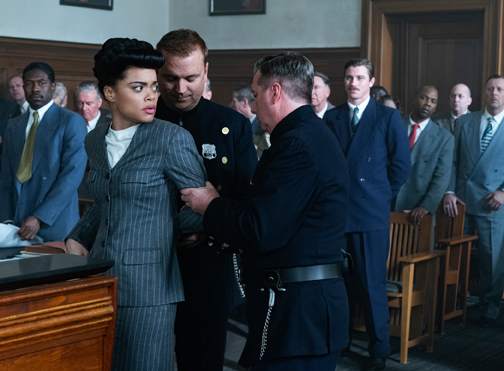
Despite having been assured by her attorney that she'll be sent to a rehab hospital,
Billie Holiday (Andra Day) is horrified to hear the judge sentence her to "a year and a day"
at West Virginia's Alderson Federal Prison Camp.
By — in this case — removing Holiday from the equation.


Not a difficult task, given that her well-publicized heroin habit dovetails nicely with the “war on drugs” championed ruthlessly by U.S. Federal Bureau of Narcotics Commissioner Harry J. Anslinger (Garrett Hedlund, much too young for this key role).


The concern — a primary focus of Pulitzer Prize-winning playwright Suzan-Lori Parks’ screenplay, adapted from a chapter in journalist Johann Hari’s non-fiction dissection of the war on drugs, Chasing the Scream — is that Holiday’s signature song, “Strange Fruit,” is “stirring up the masses” (Black and white, it should be mentioned).


And, Lord knows, we can’t have that.


Daniels’ film is anchored by star Andra Day’s all-in, absolutely mesmerizing portrayal of Holiday: as astonishing an impersonation as could be imagined, even more so given that this is Day’s starring debut. And yes, to anticipate the obvious question: She does all of her own singing … and her replication of Holiday’s ragged, whiskey-soaked, gravel-on-grit delivery is equally impressive.


That said, Day isn’t similarly well served by Daniels’ slow, clumsy film, or by some of the odd narrative choices in Parks’ script: most notably a weird framing device involving flamboyantly gay radio journalist Reginald Lord Devine (Leslie Jordan, as a wholly fictitious character), which sets up the flashback that bounces us to February 1947. 


It’s a celebratory evening, with Holiday performing before an enthusiastic sell-out crowd at New York’s Café Society, the country’s first racially integrated nightclub. The audience includes Holiday’s friend and occasional lover, Tallulah Bankhead (Natasha Lyonne); her husband Jimmy Monroe (Erik LaRay Harvey); and worshipful ex-soldier Jimmy Fletcher (Trevante Rhodes).


Backstage, we meet Holiday’s loyal family unit: stylist Miss Freddy (Miss Lawrence); hairdresser Roslyn (Da’Vine Joy Randolph), also charged with caring for Billie’s beloved dogs; trumpeter — and frequent heroin partner — Joe Guy (Melvin Gregg); and saxophonist Lester “Prez” Young (Tyler James Williams, all grown up from his TV days in Everybody Hates Chris).


The care and attention they pay each other is genuinely touching, throughout the entire film. They’re far more attentive and compassionate than husband Jimmy: merely one of many examples, as we’ll see, of Holiday’s lamentable taste in men.