Showing posts with label Trevante Rhodes. Show all posts

Friday, April 9, 2021

The U.S. vs. Billie Holiday: A missed opportunity

The U.S. vs. Billie Holiday (2020) • View trailer
Three stars. Rated R, for strong drug content, nudity, sexual candor, violence, lynching images and considerable profanity

J. Edgar Hoover has a lot to answer for.


He’s name-checked but never actually seen in director Lee Daniels’ harrowing study of jazz chanteuse Billie Holiday’s final tempestuous decade, available via Hulu. But Hoover’s spirit hovers over an early back-room meeting that includes Sen. Joseph McCarthy (Randy Davison), Roy Cohn (Damian Joseph Quinn), Congressman John E. Rankin (Robert Alan Beuth), Congressman J. Parnell Thomas (Jeff Corbett) and a gaggle of other sclerotic, racist martinets determined to make America safe for their wealthy white friends and colleagues.


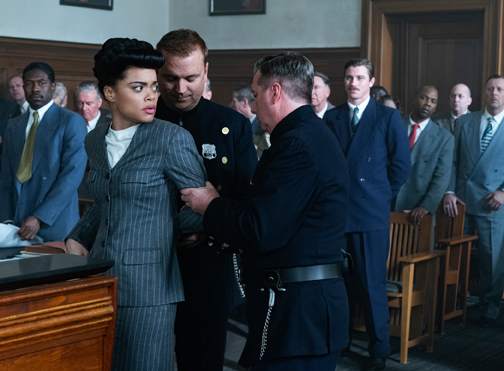
Despite having been assured by her attorney that she'll be sent to a rehab hospital,
Billie Holiday (Andra Day) is horrified to hear the judge sentence her to "a year and a day"
at West Virginia's Alderson Federal Prison Camp.
By — in this case — removing Holiday from the equation.
 

Not a difficult task, given that her well-publicized heroin habit dovetails nicely with the “war on drugs” championed ruthlessly by U.S. Federal Bureau of Narcotics Commissioner Harry J. Anslinger (Garrett Hedlund, much too young for this key role).


The concern — a primary focus of Pulitzer Prize-winning playwright Suzan-Lori Parks’ screenplay, adapted from a chapter in journalist Johann Hari’s non-fiction dissection of the war on drugs, Chasing the Scream — is that Holiday’s signature song, “Strange Fruit,” is “stirring up the masses” (Black and white, it should be mentioned).


And, Lord knows, we can’t have that.


Daniels’ film is anchored by star Andra Day’s all-in, absolutely mesmerizing portrayal of Holiday: as astonishing an impersonation as could be imagined, even more so given that this is Day’s starring debut. And yes, to anticipate the obvious question: She does all of her own singing … and her replication of Holiday’s ragged, whiskey-soaked, gravel-on-grit delivery is equally impressive.


That said, Day isn’t similarly well served by Daniels’ slow, clumsy film, or by some of the odd narrative choices in Parks’ script: most notably a weird framing device involving flamboyantly gay radio journalist Reginald Lord Devine (Leslie Jordan, as a wholly fictitious character), which sets up the flashback that bounces us to February 1947. 


It’s a celebratory evening, with Holiday performing before an enthusiastic sell-out crowd at New York’s CafĂ© Society, the country’s first racially integrated nightclub. The audience includes Holiday’s friend and occasional lover, Tallulah Bankhead (Natasha Lyonne); her husband Jimmy Monroe (Erik LaRay Harvey); and worshipful ex-soldier Jimmy Fletcher (Trevante Rhodes).


Backstage, we meet Holiday’s loyal family unit: stylist Miss Freddy (Miss Lawrence); hairdresser Roslyn (Da’Vine Joy Randolph), also charged with caring for Billie’s beloved dogs; trumpeter — and frequent heroin partner — Joe Guy (Melvin Gregg); and saxophonist Lester “Prez” Young (Tyler James Williams, all grown up from his TV days in Everybody Hates Chris).


The care and attention they pay each other is genuinely touching, throughout the entire film. They’re far more attentive and compassionate than husband Jimmy: merely one of many examples, as we’ll see, of Holiday’s lamentable taste in men.

Friday, September 14, 2018

The Predator: A bloody good time

The Predator (2018) • View trailer 
3.5 stars. Rated R, for strong bloody violence, gore, relentless profanity and vulgar sexual references

By Derrick Bang • Originally published in The Davis Enterprise, 9.14.18

Revived sci-fi action franchises have done pretty well lately.

Chris Pratt and a fresh team breathed welcome new life into the Jurassic Park series, and now director/co-scripter Shane Black has done the same with an updated Predator. He and co-writer Fred Dekker acknowledge the 1987 original, while cleverly welding their story to a can’t-miss formula that hearkens back to 1967’s The Dirty Dozen.

When a captured Predator regains consciousness and realizes that it's about to become a
laboratory experiment, it reacts with understandable fury. (Unfortunately, our heroes
won't get their act together for several more scenes.)
The result is 107 minutes of skillfully paced suspense, divided into distinct “chapters” that involve audience-pleasing characters, all played well by an ensemble cast that blends familiar faces with several newcomers. The dialogue is sharp, the action frequently laden with droll banter: no surprise, coming from the guy (Black) who made his mark with 1987’s Lethal Weapon and, more recently, ensured that Iron Man 3 was far better than its sophomore-slump predecessor.

Too bad Black undercuts all this good stuff by making his new Predator so unrelentingly gory

We’re talking splatter-porn levels of abattoir grue more appropriate to trashy zombie flicks. Black signals such sensitivities right out of the gate, when an early human victim — suspended upside-down from a tall tree limb, as befits Predator custom — is sliced in half, after which the camera lingers needlessly on his entrails, as they slowly drip and slide to the ground below.

Seriously?

That’s merely the beginning. Black and Dekker gleefully succumb to all manner of slicing, dicing, severed limbs, eviscerations, disembowelments, decapitations and more, often depicted via grody-to-the-max close-ups. I fully appreciate that a Predator entry must be violent, but there’s such a thing as too much … particularly when such excess damages an otherwise shrewdly assembled thrill ride.

That aside, there’s no denying that Black hits the sweet spot that blends macabre humor, fast-paced thrills and edge-of-the-seat suspense.

The film opens with a space battle between two small fighters; the targeted ship escapes and crash-lands on Earth, right where retired Special Forces army ranger-turned-mercenary Quinn McKenna (Boyd Holbrook) is leading a clandestine op against some Mexican drug cartel baddies. He alone survives the subsequent assault by the ferocious whatzit that emerges from the craft; better yet, McKenna escapes with the alien’s helmet and weapon-laden armband.

Suspecting a potentially hostile de-briefing back in the States, McKenna ships the alien tech home, where it unintentionally winds up in the hands of his adolescent son, Rory (Jacob Tremblay, well remembered from Room). He’s a spectrum child, on the border of autistic, and also — thanks to Tremblay’s gifted performance — one of the film’s strongest assets.

Due to Rory’s insatiable curiosity and savant-like talent for pattern recognition and puzzle-solving, he begins to figure out how this strange stuff functions.

Friday, January 19, 2018

12 Strong: An enthralling, fact-based war drama

12 Strong (2018) • View trailer 
Four stars. Rated R, for war violence and profanity

By Derrick Bang


It’s easy to see why Jerry Bruckheimer and his co-producers were drawn to author/journalist Doug Stanton’s 2009 non-fiction best-seller. The title alone is an eyebrow-lifter:

Horse Soldiers: The Extraordinary Story of a Band of U.S. Soldiers Who Rode to Victory in Afghanistan.

Despite his best efforts, Capt. Mitch Nelson (Chris Hemsworth, left) has trouble gaining
the trust of Gen. Abdul Rashid Dostum (Navid Negahban), who doubts that such a
young American, who lacks "killer eyes," can become a true warrior.
Stanton’s book details the jaw-dropping, just-then-declassified exploits of the 12-man Operational Detachment Alpha (ODA) 595 Green Berets team, one of the first American units sent to Afghanistan in the immediate wake of the 9/11 terrorist attack. (Bruckheimer obtained the book in galley format, prior to publication.)

This big-screen adaptation, saddled with the appropriately gung-ho title of 12 Strong, is a suspenseful and riveting depiction of the events that took place during the 23 days that the ODA 595 team was “in country.” Director Nicolai Fuglsig, scripters Ted Tally and Peter Craig, and a solid cast appropriately honor the actual men, while delivering a thoroughly entertaining film that frequently feels like a slice of old-style Hollywood, while building to one helluva climax.

Indeed, this film stands tall alongside “impossible odds” classics such as Seven Samurai, Blackhawk Down, Saving Private Ryan and, most particularly, 1964’s Zulu. The latter also focuses on the mis-matched resources — albeit the other way ’round — that prompted this famous on-site quote from Afghanistan’s Capt. Will Summers: “It was as if the Jetsons had met the Flintstones.”

Add more than a passing nod to Lawrence of Arabia, and you’ve got a genuinely awe-inspiring war epic.

Tally and Craig have changed the names, and no doubt other details have been amplified for cinematic impact. But the core mission, the manner in which it went down, and the outcome are impressively faithful, and why not? This saga was made for splashy, big-screen treatment.

The drama is anchored solidly by Chris Hemsworth, who has emerged as one of cinema’s most stalwart and charismatic actors. His rise is quite impressive: only six years since an attention-getting supporting turn in The Cabin in the Woods, and now sliding with equal persuasiveness from the comic book larkishness of Thor and Ghostbusters, to more serious dramatic fare such as In the Heart of the Sea and, now, 12 Strong.

We believe it, utterly, when one of Nelson’s men tells him, with complete sincerity, “I’d follow you anywhere.” Hemsworth’s Nelson radiates that level of command charisma.

Friday, November 18, 2016

Moonlight: A heartbreaking coming-of-age saga

Moonlight (2016) • View trailer 
4.5 stars. Rated R, for drug use, frequent profanity, sexuality and brief violence

By Derrick Bang

Some rare, special films — such as this one — are made with a degree of raw intimacy that’s both compelling and painful.

After finding Chiron (Alex Hibbert, right) hiding from bullies in a condemned apartment
building, Juan (Mahershala Ali) tries to get the frightened boy to open up, by treating him
to a meal. The effort is only partically successful, but it is a significant first step.
Director Barry Jenkins’ Moonlight is profoundly difficult to watch at times, its depiction of contemporary inner city black life achingly sad, with its focus on one young man’s struggle to surmount his upbringing, his environment and the crushing realization that the world expects him to accomplish absolutely nothing. Can it be true, in the modern United States, that one is doomed from birth?

And yet Jenkins’ intriguing storytelling method — co-scripted with Tarell Alvin McCraney — offers glimpses of, if not hope, at least peace and acceptance. Although coming-of-age sagas are a familiar cinema staple, this one takes an intriguing approach; it was conceived as a drama school project in a class run by McCraney, a playwright and 2013 MacArthur Genius Grant recipient.

Jenkins’ big-screen adaptation is divided into three distinct chapters, reflecting seminal moments in the young protagonist’s life, and with different actors — who resemble each other to an uncanny degree — playing the character as he ages. The film’s atmosphere of authenticity is no accident; both Jenkins and McCraney grew up in the South Florida Liberty City housing project where much of this story unfolds.

The picture isn’t pretty, the experience on par with 2009’s Precious, and graced with similarly powerful performances.

There’s another, equally revealing comparison. 1996’s Sling Blade remains famous as the film that turned its star, director and writer — Billy Bob Thornton — into a household name. That film got much of its power from the narrative’s multiple punches. After its protagonist’s first soliloquy, delivered early on, we thought, Damn, Billy Bob peaked too quickly; there’s no way anything else will come close to that scene’s dramatic intensity. And yet, later, Thornton did top it. And we marveled.

Jenkins achieves the same intensity here.

We meet Chiron at age 9, played by Alex Hibbert: a cowed, withdrawn child bullied by schoolmates because of his small size. This earns him the pejorative nickname of “Little,” and classroom torment isn’t even his major problem; at home, he’s alternately coddled and demeaned by his mother, Teresa (Janelle Monáe), a crack addict whose parental instincts flicker erratically, at best.

Little is “rescued” one day, in a sense, by Juan (Mahershala Ali), an essentially compassionate man who — unfortunately — happens to be the neighborhood drug dealer. But the boy doesn’t know this, and their developing relationship is the first demonstration — with several more to come — of Jenkins’ skill at building a sensitive character dynamic under unlikely circumstances.