3.5 stars. Rated PG-13, for dramatic intensity, mild profanity and discreet sensuality
By Derrick Bang
It seems such a reasonable
request.
You work a job for 23 years,
building up a respectable pension, and then — tragically — a health crisis
strikes. Death now will come much sooner, as opposed to the “later” we all hope
for. One therefore assumes that you’d be allowed to assign your pension funds
to any loved one of choice: spouse, parent, child. Why should it matter?
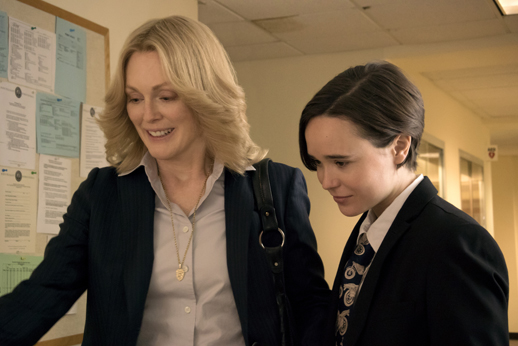 |
| Having made the brave decision to "out" herself and publicly acknowledge her relationship, Laurel (Jullianne Moore, left) happily completes and registers the paperwork so that she and Stacie (Ellen Page) can become official "domestic partners." |
It mattered in New Jersey in 2005
— one short decade ago — when the requested recipient was a “domestic partner.”
Freeheld, director Peter Sollett’s heartfelt
adaptation of those events, is anchored by compelling and deeply nuanced
performances from Julianne Moore and Ellen Page. Ron Nyswaner’s script deftly
compresses the key events, while focusing on the touching interpersonal dynamic
between the two principal characters.
The result is something in the
way of social commentary and advocacy cinema: a narrative model with which
Nyswaner is quite familiar, having been Oscar-nominated for his script to
1993’s AIDS drama, Philadelphia.
Moore, whose Hollywood career has
been impressively varied, stars as Laurel Hester, a well-respected veteran of
New Jersey’s Ocean County police force. She takes her job seriously, and —
thanks to Moore’s carefully shaded performance — we detect a slight chip on
Laurel’s shoulder, likely the hardened perseverance of a woman who has had to
work twice as hard as her male colleagues, probably for half as much
recognition.
It’s also clear that her private
life is very private, her sexual
preference having been concealed even from longtime partner Dane Wells (Michael
Shannon). But Laurel isn’t a hermit. Most recently, while participating in a
volleyball league across town, she meets the much younger Stacie Andree (Page),
who confidently acts on what she perceives as a possible shared attraction.
Stacie isn’t wrong; the spark is
genuine, even if Laurel takes awhile to lower a career’s worth of defenses. The
embryonic relationship is sweet, although not without setbacks; Laurel finds it
difficult to be as openly expressive as her new partner. That’d be the age
difference, at least in part; Stacie belongs to a generation that doesn’t feel
quite the same need to hide.

