Showing posts with label Ron Perlman. Show all posts

Friday, December 16, 2022

Guillermo del Toro's Pinocchio: A truly unique vision

Guillermo del Toro's Pinocchio (2022) • View trailer
Four stars (out of five). Rated PG, and much too generously, despite considerable violence, dark thematic elements, peril and rude humor
Available via: Netflix

Although there’s much to admire in this handsomely mounted, stop-motion version of Carlo Collodi’s oft-filmed 1883 children’s novel, I’m reluctant to recommend it … in great part, because the intended target audience is a mystery.
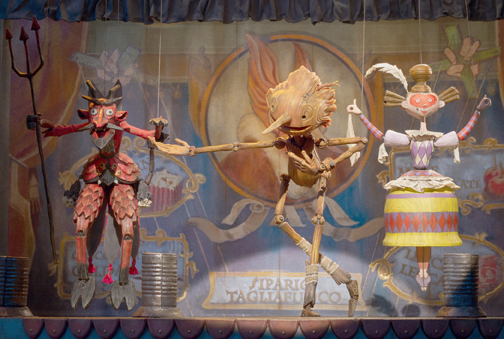
 

Having broken a promise to attend school, Pinocchio is delighted by the acclaim he
receives as the new star of Count Volpe's marionette show.


Del Toro’s relentlessly morbid and very loose adaptation definitely isn’t for children, who certainly won’t understand the updated shift to war-era Fascist Italy, and likely will be terrified by this setting. Nor can I picture mainstream adults wandering into what superficially appears to be a children’s film.

Unsuspecting parents who gather the kiddies for what they assume will be a family-friendly holiday flick, are apt to be horrified.


Even del Toro hedges this particular bet. “It’s not necessarily made for children,” he admitted, in a recent Los Angeles Times interview, “but children can watch it.”


Seriously?


I think not.


(Del Toro is fond of placing his dark fantasies against the backdrop of real-world horrors; both The Devil’s Backboneand Pan’s Labyrinth are set during the Spanish Civil War.)


Granted, the surrealistic writer/director has a legion of fans, and lovers of this painstaking animation style certainly will embrace this outré fantasy; perhaps, combined, they’ll be sufficient. And, in fairness, co-director Mark Gustafson’s stop-motion work is stunning; whatever else can be said about this film, it exhibits a true sense of wonder.


Pinocchio’s appearance here — rough-hewn, spindly, unfinished (missing one ear), a true marionette — is inspired by artist Gris Grimly’s illustrated 2002 edition of Collodi’s book.


And, backed by fine voice talent, del Toro and Gustafson elicit an impressive range of emotions from these characters.


But my goodness, this film is bleak. And macabre. And sad.


A lengthy prologue introduces wood-carver Geppetto (voiced by David Bradley) and his young son, Carlo (Alfie Tempest). The old man dotes on the boy, who — a model child — is equally devoted to his father: trustworthy, obedient, eager to learn. Alas, his life is cut short by a wartime tragedy.


Geppetto is heartbroken, overwhelmed by grief; his work suffers, leaving unfinished a large wooden effigy of Jesus in the local church, much to the chagrin of the village priest (Burn Gorman). Time passes; finally, in a fit of drunken rage one night, Geppetto makes a “replacement son” and then falls asleep.


A large, feather-winged, luminous blue wood sprite (Tilda Swinton) appears; taking pity on Geppetto, she grants life to the hastily carved little puppet. She then charges his “development” to the erudite and touchingly noble Sebastian J. Cricket (Ewan McGregor, who also narrates this tale).


Friday, December 17, 2021

Nightmare Alley: Not worth a visit

Nightmare Alley (2021) • View trailer
Three stars (out of five). Rated R, for strong, bloody violence, sexual content, nudity and profanity
Available via: Movie theaters
By Derrick Bang • Published in The Davis Enterprise, 12.17.21

Mid-20th century touring carnivals, by their very nature, seem … well … sordid.


Squalid. Uneasily unpleasant, as if something nasty is happening in the tent around the corner.


Although Molly (Rooney Mara) is instinctively wary around charismatic carnival newcomer
Stan (Bradley Cooper), his charm and aw-shucks persistence eventually wear her down.
Which isn't good news...


No surprise, such an environment proved alluring to director Guillermo del Toro.

Nightmare Alley began life as a 1946 novel by William Lindsay Gresham (who, rather disturbingly, in 1962 committed suicide — via sleeping pills — in the same hotel room where he had written the first draft). Dashing Hollywood star Tyrone Power, looking for something meatier than the romantic and adventure roles for which he had become famous, persuaded 20th Century Fox’s Darryl F. Zanuck to buy the rights for him.


The resulting film was rushed into production and hit theaters the following year; alas, nobody wanted to see Power play such a morally tainted character, and the movie also endured considerable bad publicity — and moral outrage — due to the story’s squalid elements (quite strong, for the time).


History has been much kinder; it’s now regarded as one of the era’s finest film noir entries … a reputation del Toro’s remake hasn’t a chance of attaining.


Granted, this new adaptation looks terrific; production designer Tamara Deverell and cinematographer Dan Lausten persuasively establish the late Depression era, down to the grime and foulness; and an atmosphere of impending dread hovers over the carnival setting like a shroud.


The performances are uniformly strong, and the characters are riveting, with most of them displaying various shades of corruption. It’s also nice to see del Toro and co-scripter Kim Morgan retain Gresham’s grim conclusion. (The 1947 version “softened” the ending, which is that film’s sole flaw.)


Alas, del Toro’s pacing is lethargic and ponderous to a degree that ruins everything.


The Los Angeles Times recently ran an article titled “Are movies too long?,” and this one’s a poster child for a resounding yes. The 1947 version knew when to get off the stage; it’s a just-right 111 minutes. Del Toro’s remake is a butt-numbing 150 minutes, with nothing to show for such expansion. Indeed, the additional length actually works against the story’s atmosphere and suspense.


That’s a shame, because all concerned otherwise do their best, and the classic elements are in place. Every true noirrequires a louse; a very, very, very bad gal; a second, usually trusting and naïve woman whose virtue will be compromised; and assorted sidebar characters of dubious moral quality.

Friday, July 12, 2013

Pacific Rim: Monster Mash

Pacific Rim (2013) • View trailer 
3.5 stars. Rating: PG-13, for intense sci-fi violence and brief profanity
By Derrick Bang • Originally published in The Davis Enterprise, 7.12.13


Guillermo del Toro must have loved Godzilla movies as a kid.

His newest action fantasy, Pacific Rim, is a valentine to the dozen or so romp ’em, stomp ’em features that starred “the big G” during del Toro’s formative years. (Quite a few more have been made since then.) This tip of the hat clearly is deliberate, since the director and fellow scripter Travis Beacham refer to their ginormous critters as kaiju, the Japanese term — literally “strange beast,” but more commonly “giant monster” — coined, back in the day, to describe Godzilla, Mothra, Rodan and their ilk.

Strapped into the high-tech body suits that make them "one" with the giant robot
warriors into which they've been placed, Raleigh (Charlie Hunnam) and Mako (Rinko
Kikuchi) prepare for a battle they already know is unwinnable, against a monstrous
beast with adaptive "enhancements" that have made it far stronger than their
mechanical avatar.
Throw in plenty of 21st century whiz-bang special effects, and the result is a high-tech thrill ride that blends big monsters, equally massive robot-like avatars, and the stubborn pluck of a puny human race unwilling to go quietly into that good night.

During a summer laden with end-of-the-world scenarios — zombie apocalypse and Kryptonian apocalypse, not to mention the biblical Book of Revelations — this one takes the prize for cheeky absurdity. At the same time, del Toro and Beacham pay careful attention to the human element, giving us would-be saviors who are inspiring for their fortitude, and endearing for their flaws.

Not to mention, it’s always nice when a screenplay takes the optimistic view, and shows world powers uniting in an effort to save the planet. Such all-for-one selflessness goes all the way back to H.G. Wells’ War of the Worlds, and the reminder is refreshing in this divisively cynical age.

Audacious fantasy has been del Toro’s stock-in-trade ever since 1997’s under-appreciated and genuinely creepy Mimic. He also was the perfect choice to adapt graphic novelist Mike Mignola’s lunatic Hellboy series, and — as an executive producer — del Toro has chaperoned riveting projects such as 2007’s wonderfully atmospheric The Orphanage.

And let us not forget his masterpiece: 2006’s Pan’s Labyrinth, the Oscar-winning horror film that brought adult sensibilities to a genre too frequently willing to settle for much less, and which demonstrated that human monsters can be much, much worse than anything cooked up by our vivid imaginations.

Pacific Rim doesn’t wade through such high-falutin' waters, though; this is simply del Toro’s first stab at a crowd-pleasing, mega-budget summer blockbuster, and he has done a commendable job.

The film, set in the not-too-distant future, opens with an extended flashback: An unseen narrator recalls the unexpected arrival of the first kaiju, an enormous — and quite savage — amphibious creature bent on death and destruction. It rises from the ocean depths and wreaks considerable havoc before being brought down by conventional military hardware.

Apparently passing this off as an isolated incident — perhaps a lone, Bradbury-esque behemoth, driven by curiosity to the surface world — mankind is similarly unprepared months later, when the next one arrives. And then another. And another, at noticeably shorter intervals. Scientists realize that they’re coming from some sort of dimensional portal deep in the Pacific Ocean.

Friday, August 19, 2011

Conan the Barbarian: Quite barbaric

Conan the Barbarian (2011) • View trailer for Conan the Barbarian
Two stars. Rating: R, for strong, bloody violence, gore, nudity and sensuality
By Derrick Bang


You sure didn't want to be a woman during the Hyborian Age.

Or a horse.
Conan (Jason Momoa, left) has just rescued Tamara (Rachel Nichols) from a
bad guy. Conan's now about to beat the stuffing out of said bad guy, while
Tamara cowers in terror. In fairness, Tamara soon will demonstrate quite a bit
more pluck: a good thing, because this gloomy flick needs all the personality
it can get.

The latter, apparently deemed of no value, routinely had their legs cut out from under them, in order to unseat the rider for easier dispatch on the ground.

The former, apparently deemed of minimal value, were enslaved or snatched as chattel, reflexively raped and passed among fellow mercenaries like biscuits at an afternoon tea. Which, from all appearances, seems not to have bothered these usually bare-breasted babes, who enthusiastically accepted their lustful lot in life. (I believe we call this a male-centric point of view.)

Exceptions existed, of course. Some women were lucky enough to train as sequestered monks; they lived a peaceful life until adversity forced them to demonstrate damn impressive fighting skills. (You never can tell about those monks!)

Alternatively, a growing young woman could become a witch, at which point she got to wear Freddy Krueger-style razored fingernails and summon sand demons. While remaining more or less fully clad, which I guess would have been a bonus.

These efforts at mocking levity represent the sole comedy relief you'll get from Conan the Barbarian, as humorless a thud-and-blunder bloodbath as I've seen in awhile. Yes, author Robert E. Howard's iconic warrior has been resurrected yet again: the most recent entry in a revival that began in the early 1970s, when Howard's 1930s Weird Tales novelettes were adapted into a popular Marvel Comics series, which in turn encouraged paperback reprints of the original stories and, a bit later, a 1982 film — and 1984 sequel — that boosted Arnold Schwarzenegger's nascent career.

While this new film's Jason Momoa certainly sports the necessary physique for all this hacking and slashing, he's at best only a marginally better actor than Schwarzenegger was. Young Leo Howard does a much better job as Conan's boyhood self, in this film's first act; for openers, he has a much better scowl.

Not that acting chops are of much significance. Momoa gets by on the sort of monosyllabic grunts and chopped-off sentences that Johnny Weissmuller made famous as the similarly heroic Tarzan, way back in the day. The so-called story here — stitched together by Thomas Dean Donnelly, Joshua Oppenheimer and Sean Hood — is long on battlefield fury and eyebrow-raising coincidence, and short on plot logic or common sense.

Thursday, July 10, 2008

Hellboy II: The Golden Army -- A bit tarnished

Hellboy II: The Golden Army (2008) • View trailer for Hellboy II: The Golden Army
Three stars (out of five). Rating: PG-13, for profanity and considerable action violence
By Derrick Bang • Originally published in The Davis Enterprise, 7.10.08
Buy DVD: Hellboy II: The Golden Army • Buy Blu-Ray: Hellboy II: The Golden Army [Blu-ray]


Back when he made 2004's Hellboy, Mexican director Guillermo del Toro was a star on the rise, known primarily in this country for an obscure (but quite imaginative) 1997 horror flick, Mimic, and 2002's stylish but otherwise forgettable second entry in Wesley Snipes' Blade series.
And you think you're having a bad day? Our misfit heroes — from left,
protoplasmic mystic Johann Krauss, aquatic empath Abe Sapien (Doug Jones),
reformed demon Hellboy (Ron Perlman) and pyrokinetic Liz Sherman (Selma
Blair) — reluctantly prepare for a last stand against 4,900 massive robot
warriors of death.

Arthouse patrons also had some exposure to del Toro, thanks to 2001's wonderfully moody ghosts-in-an-orphanage saga, The Devil's Backbone.

What a difference four years makes.

Today, deservedly riding the enormous success of Pan's Labyrinth, del Toro has used his enhanced prestige to rebound with — no, not another adult chiller in the mold of his Academy Award darling — a second crack at one of his favorite comic book characters.

Yep, Hellboy is back, in Hellboy II: The Golden Army ... but as far as del Toro's career is concerned, this sequel is a backwards step.

I don't fault the intent: Unlike too many stuffy Americans, del Toro is an unapologetic pop culture junkie, and that's commendable. (Del Toro's movie and comic book collection has grown so huge that he had to purchase a second house just to store it.)

And, like some of the more talented writers and artists toiling in the comic book medium these days, del Toro understands that these four-color adventures can be tailored for older audiences. I just wish del Toro had matched this new film's rich, imaginative and eye-popping visuals with a similarly strong and engaging script.

Granted, comic book writer/artist Mike Mignola's Hellboy — Mignola co-wrote this film's script with del Toro — remains a singularly fascinating protagonist.

Actually a demon spawned in hell and brought to Earth as an infant by WWII-era Nazis seeking any means to defeat the Allies — honestly, you gotta love this character's backstory — Hellboy was rescued by the good guys and raised to protect mankind from the occasional paranormal assault or underworld invasion.

His efforts remain under the radar, thanks to the belief by his government "handlers" that ordinary folks might have trouble getting cuddly with a horned red creature sporting a tail, a (literally) sledgehammer right hand and a snarky attitude ... even if he does adore kittens.

By necessity, then, Hellboy's good deed-doing has remained clandestine, as the head bad-ass for the top-top-secret Bureau for Paranormal Research and Defense, where he's joined by several other misfit agents. All are "chaperoned" by long-suffering government wonk Tom Manning (Jeffrey Tambor, always a hoot as a fussy bureaucrat).

Think Men in Black, but with a so-ugly-he's-cute hero instead of handsome fellas in three-piece suits.