Showing posts with label Maggie Smith. Show all posts

Friday, July 14, 2023

The Miracle Club: Faith isn't quite enough

The Miracle Club (2023) • View trailer
Three stars (out of five). Rated PG-13, and too harshly, for thematic elements and mild profanity
Available via: Netflix

Although director Thaddeus O’Sullivan’s gentle little dramedy has its moments, the best efforts of a powerhouse cast can’t quite overcome the issues left unresolved in the original story by Joshua D. Maurer, Timothy Prager and Jimmy Smallhorne.


Lily (Maggie Smith, right), Eileen (Kathy Bates, center) and Dolly (Agnes O'Casey) —
with her young son, Daniel (Eric D. Smith) — are delighted to learn that they've won
a trip to Lourdes, in France.


The year is 1967, the setting the (fictitious) hardscrabble Dublin suburb of Ballygar. One gets a sense — enhanced by the authentic locale and John Hand’s superb production design — that life hasn’t changed much during the past century. Pleasures are simple: boisterous family gatherings, a talent show at the local church.

Work is hard, money is scarce, family responsibilities — even under the most loving circumstances — leave no time for anything else. 


Travel? A vacation? Idle fantasy.


Of late, though, the daily struggle has been augmented by fresh worries for a couple of close friends. Eileen (Kathy Bates) is terrified that a lump on her breast might be cancer. Lily (Maggie Smith) is succumbing to the crushing guilt that has plagued her for years (the details of which emerge slowly). Both mourn the recent death of another friend, Maureen.


Dolly (Agnes O’Casey), a generation younger — and the sole Ballygar resident determined to bring a bit of London mod to the community — despairs over her silent young son, Daniel (Eric D. Smith, wide-eyed and adorable). She fears that the boy’s muteness, or unwillingness to talk, is somehow her fault. 


All three women — Eileen, Lily and Dolly — dream of making a pilgrimage to Lourdes, where millions travel each year, to bathe in the sacred waters and receive God’s grace. And, perhaps, a miracle.


Thanks to some clever maneuvering by the kindly parish priest, Father Byrne (Mark O’Halloran, note-perfect), a small miracle does occur … and, suddenly, all three get their wish: an all-expenses-paid trip to Lourdes. 


This includes something else they never expected: a brief bit of freedom. And independence.


Alas, the jubilant mood is dampened — for Eileen and Lily — by the unexpected appearance of Maureen’s daughter, Chrissie (Laura Linney), who fled to America 40 years ago, beset by scandal (the usual kind, given the time period). Dolly is too young to have any emotional response to Chrissie’s arrival, but it opens old wounds and long-unspoken betrayals involving Eileen and Lily.


Worse yet, Chrissie insists on joining the trip to Lourdes.

Wednesday, May 25, 2022

Downton Abbey: A New Era — A carefully calculated crowd-pleaser

Downton Abbey: A New Era (2022) • View trailer
Four stars (out of five). Rated PG, for no particular reason
Available via: Movie theaters

This certainly is the epitome of “comfort cinema.”


As this ensemble cast has expanded since the series 2010 debut, writer/creator Julian Fellowes has done an impressive job of granting every new character ample individuality, exposure and melodramatic plot points. We’ve lost only two major players, over time — Matthew and Sybil Crawley (Dan Stevens and Jessica Brown Findlay) — while adding several dozen more.


After sound engineer Stubbins (Alex McQueen, in headphones) orders total silence from
everybody else, Lady Mary (Michelle Dockery) tries hard to match her spoken dialogue
to the silent images being projected on a screen.


Goodness, it takes several minutes, during this sequel’s title credits montage, just to run through the entire cast list.

Not that this is any sort of problem. Fellowes knows his audience, just as all the players have grown comfortable with their roles. Spending another two hours with these characters is like enjoying an evening with beloved friends and relatives.


This film’s subtitle — “A New Era” — is both apt and a bit misleading. On the one hand, it does signify both a pop-culture shift (about which, more in a moment) and a change in fortune for both the Crawley family and a few of their “downstairs” servants. Yet the rise of such working-class individuals, and the accelerating decline of the aristocracy — which played such a key role in the TV series’ final season — is largely ignored here, even though we’ve moved forward another year, to 1928.


Indeed, this film concludes on a note that suggests nothing has changed in this respect, as if the real-world’s socio-political clock had ceased to move forward. Granted, that prompts a cheerful, audience-pleasing tableau, if this is to be our final glimpse of these characters — assuming Fellowes isn’t persuaded to do yet another film — but it’s a bit of a cheat.


Not that fans will care a whit.


The story begins as Tom Branson (Allen Leech), the Earl of Grantham’s widowed son-in-law, marries Lucy Smith (Tuppence Middleton): a celebration that makes good on the previous film’s swooningly romantic finale. This is the “upstairs” answer to the earlier, humbler but equally romantic wedding of adorably impertinent assistant cook Daisy (Sophie McShera) and footman Andy (Michael Fox), now living in the tenancy home of her father-in-law, Mr. Mason (Paul Copley).


Two unexpected events land simultaneously. The British Lion Film Studio expresses interest in shooting its next silent costume drama, The Gambler, at Downton Abbey — a notion that horrifies the Earl, Robert Crawley (Hugh Bonneville), and retired butler Mr. Carson (Jim Carter) — and the Dowager Countess Violet Crawley (Maggie Smith) learns that she has been bequeathed a villa in the south of France, in the will of the recently deceased Marquis de Montmirail. 


The latter prompts all manner of raised eyebrows, but Violet refuses to provide any explanation; she tartly refers only to her “mysterious past” (a line delivered with Smith’s typically arch smugness).

Saturday, September 21, 2019

Downton Abbey: A joyous reunion

Downton Abbey (2019) • View trailer 
Four stars. Rated PG, for no particular reason

By Derrick Bang

Goodness. What more could one desire?

Despite having settled everybody quite pleasingly, when Downton Abbey concluded its television run on Christmas Day 2015, creator/writer Julian Fellowes once again has worked his magic: ingeniously concocting fresh upstairs/downstairs dramas that unite the aristocratic Crawley family and its voluminous house staff.

When cascading events at Downton prove too overwhelming for the comparatively
untrained head butler, Lady Mary (Michelle Dockery, center) asks Mr. Carson (Jim Carter)
to return, much to the amusement of Mrs. Hughes (Phyllis Logan).
Mind you — as always was the case, during six enthralling television seasons — the Crawleys remain more progressive than most of their stuffy peers, and the staff manages far more impertinence and independent thinking, than ever would have been allowed, back in the day. Such is the shrewdness of Fellowes, who layers these one-century-removed escapades with enough modern attitude to reference contemporary issues, without damaging the period authenticity.

All the while making us smile, occasionally giggle and — yes, even this — shed a tear or two.

Very little has changed here, aside from the slight march of time. Fellowes managed to assemble just about the entire cast: a frankly stunning achievement, given that several of these talented actors have moved on with their individual careers. The only notable absence is Lily James’ Lady Rose MacClare, and I do miss the warmth of her sparkling smile; she always was a breath of effervescence, alongside the far more severe Lady Mary (Michelle Dockery) and Lady Edith (Laura Carmichael).

This big-screen adventure unfolds like an even better Christmas special; the enhanced budget’s only noticeable impact is a broader location backdrop for production designer Donal Woods to fill — which he does splendidly — and cinematographer Ben Smithard’s spectacular swooping shots of Downton and a few of its equally majestic neighbors.

Indeed, the film opens on an extremely clever sequence, as Smithard’s camera follows the posting of a Most Important Letter, while it crosses England by train and — finally — reaches its destination by individual carrier. That would be Downtown, of course, and our first glimpse of its familiar grounds is accompanied by the equally familiar swell of composer John Lunn’s iconic theme. 

Theater patrons breathed an audible sigh of happy satisfaction, at that moment.

The year is 1927. Some children have grown a bit older; a few new moppets have arrived. The aforementioned letter announces the impending arrival of their Majesties King George V and Queen Mary, who will stay at Downton for a full day, during a tour of Grantham and the surrounding countryside. This news naturally causes all manner of consternation, given the precise dictates of custom, tradition and regard. 

The Earl (Hugh Bonneville) and his wife, Cora (Elizabeth McGovern) — Mary and Edith’s parents — have all manner of details to coordinate, not the least of which is the royal parade scheduled for the same afternoon: an event eagerly anticipated by all the local townsfolk. Downstairs, Mrs. Hughes (Phyllis Logan), Mr. Bates (Brendan Coyle), Mrs. Patmore (Lesley Nicol) and all the other servants are just as excited about this opportunity to attend to the most prestigious guests in the land.

Friday, February 19, 2016

The Lady in the Van: Driven to delightful distraction

The Lady in the Van (2015) • View trailer 
Four stars. Rated PG-13, and too harshly, for a fleeting unsettling image

By Derrick Bang • Originally published in The Davis Enterprise, 2.19.16


Some plays make awkward films, the very nature of their enclosed stage universe rendered claustrophobic on the big screen.

When Alan (Alex Jennings) cautiously worries about his new "permanent interloper's"
ability to drive — let alone whether she even possesses a license — the feisty Miss
Shepherd (Maggie Smith) shrugs him off with one of her imperious displays of
dignified entitlement.
That absolutely isn’t the case with The Lady in the Van, which opens up quite cleverly under the guidance of director Nicholas Hytner and scripter Alan Bennett. The latter has adapted this charming little drama from his own play, which debuted in 1999 in London’s West End, and which in turn was based on actual events recorded in his exhaustive memoirs.

Maggie Smith starred in the stage production, and also played the same role in a BBC Radio adaptation. No surprise, then, that she delivers a crisp, saucy and richly memorable performance in this cinematic version.

She plays Mary Shepherd, an elderly homeless woman who lives in a dilapidated van that she has trundled about a bucolic North London street called Gloucester Crescent, a neighborhood which — in this late 1960s setting — hosts various British stage and literary luminaries. As introduced in Hytner’s film, we get the vague sense that “Miss Shepherd” has made a habit of parking in front of a given house until her sloppy ways prove too distressing, at which point she fires up the van and moves elsewhere along the lane.

Her eccentric behavior comes to the attention of playwright, screenwriter, actor and author Alan Bennett (Alex Jennings) when he moves into the neighborhood, taking the house at No. 23. She’s rather hard to miss — given the combination of street rubbish and feisty imprecations that trail in her wake — and Bennett’s new neighbors are only too happy to supply details and rumors.

They’ve all kinda/sorta tolerated Miss Shepherd, out of a sense of liberal guilt that prompts them into occasional deliveries of food, reading material and any other small items they assume she might find useful. Parents cluck when their children, passing too close to Miss Shepherd, wrinkle their noses and complain that “she smells bad.”

Here, too, Bennett’s descriptive prose paints marvelous word pictures, when (for example) his running commentary describes her aromatic miasma as an “odoriferous concerto ... with urine only a minor component.”

Friday, March 1, 2013

Quartet: A beautiful noise

Quartet (2012) • View trailer 
Four stars. Rating: PG-13, and quite stupidly, for fleeting profanity
By Derrick Bang • Originally published in The Davis Enterprise, 3.1.13


Music fills almost every frame of Quartet, whether created vicariously by this delightful story’s many talented characters, or delivered via Dario Marianelli’s evocative score, as a means to augment a reflective or dramatic moment.

Although Jean (Maggie Smith, right) initially refuses to become part of the musical
community at Beecham House, even she can't resist the kind, bubbly enthusiasm of
Cissy (Pauline Collins). But Jean also faces other issues, not the least of which is a
fellow resident who happens to be a long-estranged lover.
Dustin Hoffman’s thoroughly engaging directorial debut, working from Ronald Harwood’s adaptation of his own stage play, is another charming — if occasionally bittersweet — reminder that life need not end at 60, 70 or even 80. We’ve seen quite a few such films recently, and while it’s not true that Maggie Smith has been in all of them, she certainly dominates this one.

And that’s no small thing, given the cluster of scene-stealers with whom she shares the screen.

She stars as Jean Horton, a once-celebrated opera vocalist fallen on hard times, whose career is naught but a fading memory; she now must swallow her pride and accept government-supported lodging at Beecham House, a retirement home for musicians. But we don’t meet her right away; Harwood first introduces us to the celebratory warmth and magic of Beecham itself, which echoes morning to night with the rich sounds of pianos, strings, woodwinds and quite a few other orchestral instruments, along with plenty of singing.

Beecham’s residents are a bit more a-flutter than usual, because they’ll soon be performing in the retirement home’s annual fundraiser, timed to celebrate the birthday of famed opera composer Giuseppe Verdi. The event is being helmed by the imperious Cedric Livingston (Michael Gambon), a fussy, fusty martinet who lounges about in day robes and barks commands like a traffic cop.

He’s the only Beecham resident who doesn't make his own music, and thus exemplifies the punch line of that venerable saying: Those who can’t, direct. But nobody seems to mind; Cedric merely clings to the remnants of the career he knows best, as they all do.

Contrasting Cedric is Reginald (Tom Courtenay), a calm, quiet and emotionally withdrawn scholar who gives occasional lessons in opera history to local teenagers. Harwood grants us a glimpse of one such session, and it’s utterly enchanting; we expect poor Reggie to be overwhelmed by these kids, but in fact his gentle but authoritative delivery holds their attention — and ours — as he considers the intriguing similarities between opera and rap.

Friday, May 11, 2012

The Best Exotic Marigold Hotel: Make a reservation

The Best Exotic Marigold Hotel (2011) • View trailer
Four stars. Rating: PG-13, for sexual candor and fleeting profanity 
By Derrick Bang 


Change can be difficult — sometimes heartbreaking — even when embraced willingly.

It becomes considerably worse when change is forced upon us.

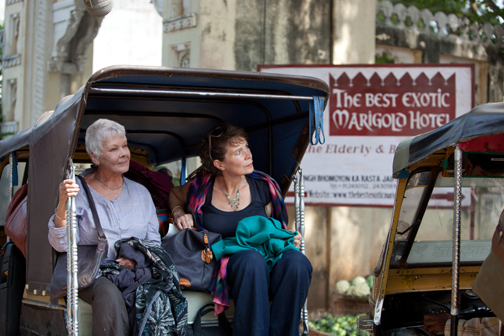
Evelyn (Judi Dench, left) and Madge (Celia Imrie) bravely embrace the hustle
and bustle of Jaipur, the city where they've elected to spend their "golden years."
Some of their companions, back at the self-professed Best Exotic Marigold
Hotel, lack this adventurous spirit ... which, obviously, is their loss.
During the prologue to director John Madden’s thoroughly charming The Best Exotic Marigold Hotel, we meet seven individuals who fear they’ve reached that point in their lives — “of a certain age,” as the fashionably polite suggest — when society deems them irrelevant. Worse yet, all these folks are further burdened by their own personal baggage, in some cases a soul-crushing weight that has dragged them down for decades.

Recently widowed Evelyn (Judi Dench) has just learned, to her humiliation, that her husband left her financially stranded and — by relegating her to the role of “companion” — unable to fend for herself. Graham (Tom Wilkinson), a High Court judge, finally has let cynicism overrule compassionate objectivity. Muriel (Maggie Smith), a fearful, reflexive xenophobe, needs hip replacement surgery.

Singletons Madge (Celia Imrie) and Norman (Ronald Pickup), refusing to gracefully accept their advanced years, continue to seek sexual thrills like thirtysomething sybarites. Tragically, marital bliss died long ago for Jean (Penelope Wilton) and Douglas (Bill Nighy); now she only snipes at him, while he patiently endures.

Fans of British cinema already realize they need read no further; with a cast like this, how could Madden’s adaptation of Deborah Moggach’s These Foolish Things — screenplay by Ol Parker — miss?

It doesn’t, of course. The Best Exotic Marigold Hotel is a gentle reminder that life doesn’t stop at 60; that new experiences are to be embraced, not avoided; that fate truly does reward the brave; and that it’s never too late to make new friends or find new lovers.

Through chance, serendipity and design — and, in Muriel’s case, medical necessity (no waiting time for her surgery) — all these retirees find themselves on the same plane to India, responding to the skillfully worded promise of colorful brochures and come-hither Internet sites extolling the luxurious accommodations of Jaipur’s Best Exotic Marigold Hotel.

Friday, February 11, 2011

Gnomeo and Juliet: All the garden's a stage

Gnomeo and Juliet (2011) • View trailer for Gnomeo and Juliet
3.5 stars (out of five). Rating: G, and suitable for all ages
By Derrick Bang


Shakespeare and garden gnomes?

Surely, you think, nothing good can come from such a combination.

Keep an open mind. Timeless stories endure no matter what form they take, and that includes this hilariously bent take on Romeo and Juliet. Director Kelly Asbury and a veritable army of writers – working from a screenplay by Rob Sprackling and John Smith – fine-tuned this droll animated fantasy until it purred. The result is clever, engaging and well integrated with a score that recycles a dozen Elton John tunes (in a few cases, with whimsically modified lyrics) and tosses in a few new ones.
When Gnomeo and Juliet consider ignoring their deepening feelings because of
the silly blue/red feud that has kept their respective clans apart for years, the
much wiser Featherstone, a yard flamingo in a neighboring garden, brings the
two lovebirds back together as only he can.

I’m all about little details, and Gnomeo and Juliet is laden with amusing touches. The film is introduced by a tiny “red goon gnome” who doesn’t get too far through a voluminous text scroll before being removed from the stage; the curtain then opens on two adjacent homes – one of a blue décor, the other red – on Verona Drive. Old lady Montague lives at 2B, while cranky Mr. Capulet’s identical address has been slashed out, Ghostbusters-style (in other words, “not 2B”).

Right away, I was charmed.

Aside from their ongoing squabbling feud of unknown origin, the human characters don’t really factor into this story, which instead concerns the ceramic fixtures in their respective gardens: mostly gnomes of all sizes and shapes, but also the occasional ornamental frog, fish and toadstool. Just like the assorted stars of Toy Story, these garden creatures come to life whenever they’re not being observed; when people unexpectedly arrive on the scene, the little figures freeze back into immobility ... no matter where they might be. That, by itself, leads to very amusing consequences at times.

The animation style – different yet again from anything done by Disney, Pixar, DreamWorks or Blue Sky (the Ice Age series) – is ingenious. All these figures have the worn, paint-faded, often slightly chipped appearances of weathered ceramic; they make contact with each other – whether gently or aggressively – with the easily recognized chink of porcelain bumping into porcelain. The 3-D cinematography gives them a rounded dimensionality, and we very quickly accept the notion that these figurines have their own clandestine societies.

They are limited by original design, however, and that’s also played for frequent laughs. A ceramic fish can neither float nor swim, and two gnomes who share a single ceramic base can’t ever “quit each other.”

And yes, that nod to the famous signature remark from Brokeback Mountain is typical of the occasional snarky one-liners. Although family-friendly and certain to appeal to youngsters, who’ll be enchanted by these colorful heroes and villains, the script frequently nudges and winks at adults who’ve been savvy enough to give this charmer a try.