Showing posts with label Kimberly Guerrero. Show all posts

Friday, May 27, 2022

Montana Story: An unhurried, thoughtful study of grief

Montana Story (2021) • View trailer
3.5 stars (out of five). Rated R, for profanity
Available via: Movie theaters

Trauma and disappointment drive us apart.


If we’re lucky, the nagging desire for closure might prompt a reunion.
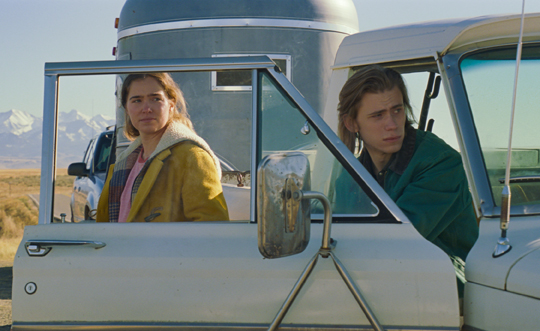
 

Cal (Owen Teague) thinks that bringing an elderly, arthritic horse to upstate New York
is a crazy idea, but his half-sister Erin (Haley Lu Richardson) is adamant: She wants
the horse to accompany her back home.

Writer/directors Scott McGehee and David Siegel — working from a story by Mike Spreter — must be intimately acquainted with emotional pain. This quietly contemplative character drama is an unhurried, thoughtful study of grief, regret and — at times — barely repressed rage.

The often wrenching angst is driven by nuanced performances from Owen Teague and Haley Lu Richardson, as estranged half-siblings brought together as morose, somewhat reluctant witnesses to a crucial passing. The tone is relentlessly somber, the pacing just this side of glacial (likely too slow, for some viewers.)


The story begins as twentysomething Cal (Teague) returns to the family home and ranch in the big-sky landscape of Montana’s Paradise Valley. He has been summoned by tragedy: A stroke has rendered his father comatose and dependent upon life support and the patient attention of a full-time caregiver (Gilbert Owuor, as Ace).


The homecoming is far from comfortable, and Cal never comes close to rushing to his father’s bedside; he’s perfect content to leave ministration in the hands of Ace, a Kenyan immigrant who — no doubt a veteran of such vigils — likely is familiar with prickly family dynamics. Ace isn’t the slightest bit judgmental; Owuor radiates kindness, sympathy and understanding.


Cal is easily distracted by the mountain of mortgage debt and creditors’ statements that have long been ignored (nor does this surprise him). There’s also the matter of Mr. T, an arthritic, 25-year-old black stallion kept in the barn and cared for by Native American housekeeper Valentina (Kimberly Guerrero) and her adult son Joey (Asivak Koostachin), once a childhood friend of Erin and Cal’s.


The multi-ethnic casting is deliberate. We get a sense that Cal’s father’s many sins — unspoken and mostly unacknowledged, until the third act — include racism, and that Cal may have inherited enough of this tendency to be instinctively uncomfortable in Ace and Valentina’s presence … while simultaneously struggling against such knee-jerk behavior, in an effort to be a better, fair-minded person.


All of this remains unspoken; we infer and deduce such details, and likely back-story, via Teague’s thoughtful, richly layered acting. This is one of those cases where viewers’ likely unfamiliarity with his previous work — some may recognize him from the recent TV miniseries adaptation of Stephen King’s The Stand — is an advantage, because it allows Teague to more easily become Cal. It’s not merely a performance; we recognize that this could be somebody living next door.

Thursday, October 1, 2020

The Glorias: A glorious life, inventively told

The Glorias (2020) • View trailer
Four stars. Rated R, for profanity

We’ve long been intrigued by the notion of our Older Self being able to step back in time, and personally reassure our Younger Self that everything will turn out just fine.


Gloria Steinem (Julianne Moore, left) and Bella Abzug (Bette Midler) chortle over some
of the reactions to a recent issue of Ms. Magazine.

(Or, alternatively, of Younger Self confronting Older Self with a narrow gaze, and demanding to know what the heck went wrong.)


Director/co-scripter Julie Taymor cleverly exploits this beguiling premise in The Glorias, her adaptation — alongside co-writer Sarah Ruhl — of Gloria Steinem’s 2015 memoir, My Life on the Road.


Love her or loathe her, one must acknowledge that Steinem carved out an impressively ambitious career, despite humble and disorientingly peripatetic origins. Taymor — an eclectic filmmaker known for her boldly unique approaches to varied projects such as FridaAcross the Universe and her gender-switching version of Shakespeare’s The Tempest — employs different actresses to depict four primary “pivot points” in Steinem’s life.


As her defiantly non-linear narrative bounces back and forth in time, these four selves occasionally meet and discuss what has transpired, or will transpire. Such encounters are filmed in dreamlike, soft-focus monochrome, always while traveling, and usually on a Greyhound bus whose windows look out upon a different time and place: an easy metaphor for the notion that life is a journey, with each stop far more important than the eventual destination.


Youngest Gloria (doe-eyed Ryan Kiera Armstrong) is enchanted by her irrepressible, irresponsible but flamboyantly theatrical father, Leo (Timothy Hutton), a huckster and charlatan forever keeping his family one step ahead of the previous town’s creditors. Despite the profoundly negative affect this has on his wife, Ruth (Enid Graham), Leo nonetheless inspires Gloria to recognize that travel is the best possible education.


Hutton is excellent: totally persuasive as a silver-tongued con artist who nonetheless knows, in his heart, that he’s destined to disappoint all the people he loves.


Twelve-year-old Gloria (Lulu Wilson), solemn beyond her years, is faced with the challenge of caring for her mentally fragile mother, after Leo abandons his family. With Ruth sliding ever deeper into chronic despair, Gloria soon understands how important it is for a woman to be able to make her own way in the world, without being beholden to a husband. We see the resolve in Wilson’s gaze.


There’s also a telling conversation, when Gloria discovers that her mother had once been a writer and reporter … forced to work behind a male byline. And we realize, from our contemporary remove, that Gloria would grow up to live her mother’s unlived life. (And how often, I wonder, does a child honor a parent in such an unspoken fashion?)