Showing posts with label Dennis Boutsikaris. Show all posts

Friday, April 7, 2023

Pinball: The Man Who Saved the Game — Terrific bumper action!

Pinbal: The Man Who Saved the Game (2023) • View trailer
Four stars (out of five). Not rated, with PG-level sexual banter and mild profanity
Available via: Amazon Prime and other streaming platforms

Who could have guessed that two fact-based films about gaming — Tetris and this one — would be released simultaneously?


Even less likely: Both are quite entertaining, in entirely different ways.


While Ellen (Crystal Reed) watches with delight, Roger (Mike Faist) gives her son,
Seth (Christopher Convery), some handy pinball tips.


Brothers Austin and Meredith Bragg — in an impressive writing/directing feature debut — have delivered a charming little film that’s practically its own category: equal parts docudrama, rom-com and (at times) mockumentary. 

However their film ultimately gets pigeon-holed, there’s no denying the gently whimsical touch that deftly balances established history, a charming romantic core, and droll meta touches that impishly poke fun at the making of this film, (supposedly) while it’s being made.


No less than New Yorker critic Richard Brody insists that “it’s better than all ten of the [2022] Best Picture nominees.”


I can’t go quite that far, but his enthusiasm is understandable.


The Brothers Bragg open their film as Roger C. Sharpe (Dennis Boutsikaris), circa today, is prepped in a studio chair, awaiting interview questions from unseen filmmakers. The topic: how he — Sharpe — literally “saved” pinball in New York City.


Sharpe demurs, insisting that he’s no more than a “footnote.” Yet he remains willing to tell the story, but only — sharp insistence, accompanied by Boutsikaris’ steely gaze — on his terms.


At which point we roll back to 1971, when a much younger Roger (now endearingly played by Mike Faist), while a student at the University of Wisconsin, has his first encounter with a true “pinball wizard.” Immediately intrigued by the possibility of prolonging a game for more than a quick couple of minutes, Roger becomes obsessed.


At which point the older Sharpe suddenly reappears, essentially looking over his younger self’s shoulder, in order to supply essential back-story. Boutsikaris continues to serve as on-camera narrator while the film continues: an initially disorienting device that quickly becomes an essential part of the story (thanks in no small part to Boutsikaris’ quiet sincerity).


Sharpe also occasionally interrupts on-screen events, insisting that the filmmakers are taking too much dramatic license in an effort to insert a “Hollywood touch.” Such objections noted, a given scene is re-staged to be more historically accurate.


(Wisely, the Brothers Bragg employ this gimmick sparingly.)


A few years pass. Roger graduates, moves to New York City, gets married, lands a job as an advertising copywriter, gets divorced — a lucky escape, given available evidence — loses his job, and loses most of his furnishings (such accoutrements having been supplied by his former wife’s family’s furniture store). Sleeping on a mattress on the floor, forced to improvise rough-and-ready plank bookshelves, Roger impulsively decides to become a journalist.

Friday, May 13, 2016

Money Monster: A beastly good time

Money Monster (2016) • View trailer 
4.5 stars. Rated R, for brief sexual content, violence and frequent profanity

By Derrick Bang • Originally published in The Davis Enterprise, 5.13.16

Between this new film, The Wolf of Wall Street, Margin Call and The Big Short, one gets the impression that people have become deeply concerned about corporate malfeasance and Wall Street shenanigans.

Gee, I can’t imagine why.

The calm before the storm: Unaware that this day is about to become anything but average,
TV financial advice guru Lee Gates (George Clooney) and his producer, Patty Fenn (Julia
Roberts), discuss the talking points for their upcoming live broadcast.
Director Jodie Foster’s Money Monster may not be as imaginatively brilliant as last year’s The Big Short, but it’s just as entertaining and pointedly audacious. Scripters Alan DiFiore, Jim Kouf and Jamie Linden set up a hair-trigger premise and then develop it with an unlikely — but quite successful — blend of suspenseful twists and scathing humor.

Along the way, they also skewer the 1 percent who’ve absolutely, completely — and without awareness or shame — abandoned any sense of comradeship with the rest of us ordinary mooks.

This is only Foster’s fourth big-screen feature as director, after having cut her teeth with 1991’s poignant Little Man Tate; she obviously chooses her projects carefully. “Money Monster” proves that the double Oscar-winning actress has matured into an equally capable shot-caller. This is the sort of endeavor that could have collapsed any number of times, in less skilled hands; she unerringly navigates the ship past all dangerous shoals.

With thoughtful, infuriating, hilarious and even unexpectedly poignant results.

George Clooney stars as high-profile financial TV guru Lee Gates, who has built a viewership on the strength of sideshow antics more befitting the local news clowns who used to dole out weather predictions while dressed in funny outfits. We get an extended view of Gates’ smirky, hyperactive — and insultingly patronizing — shtick as he begins one of his financial analysis/advice segments on an average day, under the much calmer guidance of longtime producer Patty Fenn (Julia Roberts).

It ain’t pretty.

It’s also a not very exaggerated jab at what a serious topic such as money management has become, in our cynical, bread-and-circuses era of cable/satellite infotainment. Any semblance of capably researched public service has been abandoned — goodness, that would be boring — in favor of keeping the gullible masses distracted. And hey: If Gates misstates, exaggerates or even lies today, he won’t even think about amending or retracting tomorrow; he’ll simply proceed with an all-new set of encouraging prevarications and half-truths.

Just like dozens of shrill, malicious and defiantly deceitful radio show hosts.

Friday, October 9, 2015

Freeheld: Sentiment over substance

Freeheld (2015) • View trailer 
3.5 stars. Rated PG-13, for dramatic intensity, mild profanity and discreet sensuality

By Derrick Bang


It seems such a reasonable request.

You work a job for 23 years, building up a respectable pension, and then — tragically — a health crisis strikes. Death now will come much sooner, as opposed to the “later” we all hope for. One therefore assumes that you’d be allowed to assign your pension funds to any loved one of choice: spouse, parent, child. Why should it matter?

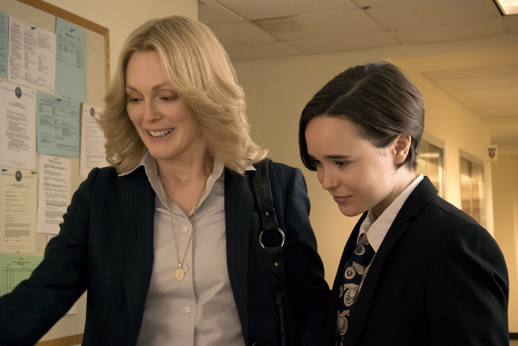
Having made the brave decision to "out" herself and publicly acknowledge her relationship,
Laurel (Jullianne Moore, left) happily completes and registers the paperwork so that she
and Stacie (Ellen Page) can become official "domestic partners."
It mattered in New Jersey in 2005 — one short decade ago — when the requested recipient was a “domestic partner.”

Freeheld, director Peter Sollett’s heartfelt adaptation of those events, is anchored by compelling and deeply nuanced performances from Julianne Moore and Ellen Page. Ron Nyswaner’s script deftly compresses the key events, while focusing on the touching interpersonal dynamic between the two principal characters.

The result is something in the way of social commentary and advocacy cinema: a narrative model with which Nyswaner is quite familiar, having been Oscar-nominated for his script to 1993’s AIDS drama, Philadelphia.

Moore, whose Hollywood career has been impressively varied, stars as Laurel Hester, a well-respected veteran of New Jersey’s Ocean County police force. She takes her job seriously, and — thanks to Moore’s carefully shaded performance — we detect a slight chip on Laurel’s shoulder, likely the hardened perseverance of a woman who has had to work twice as hard as her male colleagues, probably for half as much recognition.

It’s also clear that her private life is very private, her sexual preference having been concealed even from longtime partner Dane Wells (Michael Shannon). But Laurel isn’t a hermit. Most recently, while participating in a volleyball league across town, she meets the much younger Stacie Andree (Page), who confidently acts on what she perceives as a possible shared attraction.

Stacie isn’t wrong; the spark is genuine, even if Laurel takes awhile to lower a career’s worth of defenses. The embryonic relationship is sweet, although not without setbacks; Laurel finds it difficult to be as openly expressive as her new partner. That’d be the age difference, at least in part; Stacie belongs to a generation that doesn’t feel quite the same need to hide.