Friday, June 6, 2008

Kung Fu Panda: Panda-monium

Kung Fu Panda (2008) • View trailer for Kung Fu Panda
3.5 stars (out of five). Rating: PG, and quite pointlessly, for harmless martial-arts mayhem
By Derrick Bang • Originally published in The Davis Enterprise, 6.6.08
Buy DVD: Kung Fu Panda • Buy Blu-Ray: Kung Fu Panda (Two Disc Blu-ray/DVD Combo)

The concept is too silly for words, which is precisely the point.

You can't even glance at Po, the corpulent hero of Kung Fu Panda, without laughing.
Shifu (right), the kung fu master, can't imagine how he could ever transform the
corpulent Po into a martial-arts fighting machine ... until an epiphany strikes:
The oversized panda will do anything for food ... and that includes fighting
with impressive skill.

In lesser hands, this film might have gone no further than childish farce. But credit a stable of writers — Ethan Reiff, Cyrus Voris, Jonathan Aibel and Glenn Berger — for a script that cleverly blends ancient Chinese tradition with American geek culture, and credit directors John Stevenson and Mark Osborne for maintaining a snappy pace. (So nice to see a film that gets on the stage, tells its story in an economical 92 minutes, and then gets off.)

Mostly, though, this film owes its success to its gorgeous animation and sublime voice acting.

I mean, really: Dustin Hoffman as Shifu, an itty-bitty critter that happens to be a kung fu master?

The only thing funnier than that is the notion that Oogway, Shifu's master — and the apparent inventor of kung fu — is an ancient, slow-moving tortoise.

Hoffman is notorious for his adherence to "method"; I fondly recall Laurence Olivier's comment, during the filming of Marathon Man, when Hoffman prepared for a particular scene — one that called for his character to look whipped because he hadn't slept for days — by actually not sleeping for two days.

"My dear boy," Olivier is reported to have said, "why don't you just try acting?"

I can't imagine what Hoffman might have done to prepare for this role, but the effort clearly paid off. More crucially, the animators give Shifu's face a wealth of expressions that perfectly match Hoffman's palpable intensity. That all this should emerge in so diminutive a character ... well, that's just icing on the cake.

(Actually, trying to determine Shifu's species is surprisingly difficult in a film where all the other creatures are so easy to identify. He looks like a tiny cross between a possum and a raccoon. Hoffman has claimed, during interviews, that he's "a rare small red panda." Which I guess makes sense.)

The setting is ancient China, more or less, although the country is occupied not by people, but by animals. Ordinary citizens are the more vulnerable forest and barnyard creatures: bunnies, pigs and various birds. Po, the only panda in sight, sticks out like a sore thumb ... all the more because he seems to have been "adopted," at some point in the distant past, by his fussy father, a goose named Mr. Ping (James Hong).

Dad's sole hope in life is that his son will embrace the family calling and become a famous noodle chef.

Thursday, June 5, 2008

You Don't Mess with the Zohan: A true mess

You Don't Mess with the Zohan (2008) • View trailer for You Don't Mess with the Zohan
Zero stars (out of five). Rating: PG-13, which is a total crock, for nudity, profanity and unrelenting sexual vulgarity
By Derrick Bang • Originally published in The Davis Enterprise, 6.5.08
Buy DVD: You Don't Mess with the Zohan • Buy Blu-Ray: You Don't Mess With the Zohan (Unrated + BD Live) [Blu-ray]

Goodness, such a wealth of options...

In his race to the bottom, Adam Sandler has done what I wouldn't have believed conceivable: He has bested Eddie Murphy, Rob Schneider and Will Ferrell.
Having abandoned his career as an Israeli Mossad commando, Zohan Dvir (Adam
Sandler) winds up in New York, embracing his secret passion to become a hair
stylist. Needless to say, his past catches up with him.

Or...

Impossible as it sounds, Sandler actually has made the most wretched film of his career. It's almost as if he indulged in a contest with himself, to unleash something even more unspeakably dreadful than Little Nicky and Mr. Deeds.

Or...

I should have known that any movie with a substantial speaking appearance by Mariah Carey would be a dog.

Or...

You Don't Mess with the Zohan may not be the year's worst movie ... but it'll do until that one comes along.

Let's go with No. 4.

I have no pity for Sandler's fans, who at least know what to expect. But the notion of unwary mainstream patrons across these great United States — even one unsuspecting naïf — innocently paying good money with the expectation of enjoying some goofy slapstick, is enough to make me cringe.

Demanding their money back won't be sufficient compensation. Hell, they should get Columbia pictures to pay them ... and on a sliding scale: an exponentially larger payoff for every additional minute spent enduring this train wreck.

I'd like to think it could be possible to center a comedy around the Israeli/Palestinian conflict; humor has a way of bridging even the most entrenched cultural divide. But Zohan is so poisonously tasteless, so unrelentingly vulgar and racist, that I can see it becoming one of the bullet-points in the next peace talks. ("You execute Adam Sandler, and burn every copy of that Godforsaken movie, or we don't even come to the table!")

Its status as an unredeemable turkey aside, Zohan also has the distinction of proving, once and for all, that the idiots who work for the MPAA are just messing with us. I've long felt their ratings were arbitrary and temperamental, but this is ridiculous. They really do indulge big-studio productions while unfairly reserving their "real" scrutiny for indie pictures.

Granted, this tawdry flick doesn't contain any F-bombs or bare breasts — plenty of naked male butts, though — but otherwise it's the most mercilessly vulgar production I've seen in quite awhile ... and yes, I'm even comparing it to what the Farrelly brothers unleash. The notion that this crude trash could skate by with a PG-13 is simply insane. It's not just wincingly awful; it's lose-your-lunch awful.

Friday, May 30, 2008

Sex and the City: Cash and Carrie

Sex and the City (2008) • View trailer for Sex and the City
3.5 stars (out of five). Rating: R, for profanity, vulgarity, nudity and sexual content
By Derrick Bang • Originally published in The Davis Enterprise, 5.30.08
Buy DVD: Sex and the City • Buy Blu-Ray: Sex and the City: The Movie [Blu-ray]


Samantha no doubt would disagree, but I’m afraid there is such a thing as too much Sex.

Although longtime executive producer and Sex and the City series writer Michael Patrick King both wrote and directed this big-screen continuation of the hit HBO comedy/drama — and while I’ve no doubt this film will be the bee’s knees for legions of adoring fans — the long-awaited result is self-indulgent and somewhat irritating.
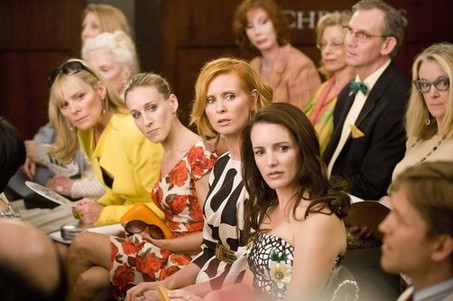
When Samantha (Kim Cattrall, far left) attends an auction with the intention of
purchasing one particular piece, she and her longtime gal pals — from left,
Carrie (Sarah Jessica Parker), Miranda (Cynthia Nixon) and Charlotte (Kristin
Davis) — are dismayed to see another person bidding quite aggressively for
the same item.

Self-indulgent because, at a thumping 145 minutes, this film is almost half a season’s worth of the half-hour TV episodes.

Somewhat irritating because, having left everybody — the show’s characters and us fans — in a happy place when the series rode off into the New York City sunset in February 2004, King rains on everybody’s parade by screwing up key relationships.

Yep, Carrie and Big are on the outs. Again.

And so are Miranda and Steve.

And so are Samantha and Smith.

Sigh.

The always witty and hilariously smutty dialogue aside, one expects better than tired, predictable melodrama from a franchise with such a smart pedigree. This movie feels driven more by studio greed than a need for further explore these characters.

I recall being similarly annoyed (on a much more superficial level) when, having brought Peter Parker and Mary Jane Watson into each other’s loving arms at the conclusion of Spider-Man 2, that series’ producers decided the only way they could obtain dramatic tension for the third film was to rip them apart again.

This is the tried-and-true tactic of afternoon soap operas, where plot developments emerge less from the logic of established characters and their distinctive behavior, and more because some idiot decides to throw a spanner into the gears.

While it’s genuinely delightful to see Carrie (Sarah Jessica Parker), Charlotte (Kristin Davis), Miranda (Cynthia Nixon) and Samantha (Kim Cattrall) once again strutting their Manhattan streets in search of labels, by rights — and by six seasons, and 94 episodes of the series — they should have gotten the other “L” (love) worked out by now.

Indeed, they did get it worked out. We saw it happen back in early 2004, when Carrie abandoned her ill-advised Parisian fantasy and allowed Big (Chris Noth) to sweep her back into his arms.

And when Miranda finally came to terms with her admittedly unusual but still emotionally satisfying relationship with Steve (David Eigenberg).

And particularly when Samantha came to terms with her cancer, and the debilitating effects of chemo, and watched in amazement as Smith (Jason Lewis) not only stood by her, but delivered quite possibly the most swooningly romantic “bouquet” in the history of such gestures.

Charlotte, for her part, had found true happiness a bit sooner than her friends, in the devoted arms of Harry (Evan Handler), her amazingly sweet and satisfying husband.

Thursday, May 29, 2008

Indiana Jones and the Kingdom of the Crystal Skull: Magic Kingdom

Indiana Jones and the Kingdom of the Crystal Skull (2008) • View trailer
Four stars (out of five). Rating: PG-13, for action violence and a few grody death scenes
By Derrick Bang • Originally published in The Davis Enterprise, 5.23.08
Buy DVD: Indiana Jones and the Kingdom of the Crystal Skull • Buy Blu-Ray: Indiana Jones and the Kingdom of the Crystal Skull [Blu-ray]

Two decades have passed since 1989's Indiana Jones and the Last Crusade, but if it really took this long for George Lucas, Steven Spielberg and Harrison Ford to be satisfied with the script for Indy's long-awaited fourth film adventure, the gestation time has been well-spent.
After breaking free from their captors, Mutt (Shia LaBeouf, left), Indy (Harrison
Ford) and Marion (Karen Allen) commandeer a truck and crash through the
Peruvian jungle, determined to catch up to the Soviet villains who've abducted
a friend and a priceless relic that supposedly has extraordinary powers.

David Koepp's screenplay is all things to all people: It properly respects the fans and acknowledges Indy's roots while examining — and gently spoofing — the character through an entirely fresh set of (youthful) eyes. That aside, one also must be impressed by a script that covers everything from atomic bomb test sites and the 1950s communist witch hunt to Area 51, Peru's Nazca lines and Erich von Däniken's "Chariots of the Gods."

Toss in a marvelously fiendish villain with an unstoppable man-mountain sidekick, and the result is a welcome return to the light-hearted, thrill-a-minute exploits found in Raiders of the Lost Ark and Indiana Jones and the Last Crusade ... absent the many mistakes that so badly compromised the original trilogy's middle entry, Indiana Jones and the Temple of Doom.

So, the heck with those who may have worried that Indy — and Harrison Ford — were past their prime; when Lucas and Spielberg are at the top of their game, as they are here, movie lovers are in great hands.

I suspect even today's jaded, "show me" teens will be impressed by several sequences.

After an eyeblink credits sequence that makes droll sport of the Paramount studio logo, the story kicks into gear as a kidnapped Indy (Ford) and new sidekick Mac (Ray Winstone) are dragged to a setting that can't help making fans smile: the never-officially titled "warehouse" where the Ark of the Covenant was placed for storage, at the conclusion of Raiders of the Lost Ark.

The year is 1957, and a new set of Soviet enemies — led by the icy-cold Irina Spalko (Cate Blanchett) — wants one carefully crated item from this massive storage facility.

At the end of Raiders, we only got a glimpse of this warehouse's labyrinthine interior. This time around, Koepp and Spielberg take us inside and stage the first action sequence within its walls.

What can I say? It's fan-geek heaven.

Although he survives this first skirmish, Indy isn't able to prevent Spalko from escaping with the coveted item. This creates problems back at Marshall College, where FBI agents — annoyed by the way Indy "helped" Soviet spies infiltrate a U.S. military base — question our hero's loyalty and order him removed from his teaching position. Longtime friend and colleague Charles Stanforth (Jim Broadbent) resigns in protest, but it does no good: Indy has lost his ability to teach, the one thing he loves best.

The only solution: to find Spalko, recover the missing whatzis and clear his name.

Mere child's play, for the whip-wielding hero who makes all his moves to John Williams' stirring orchestral fanfares.

Son of Rambow: This Son also rises

Son of Rambow (2007) • View trailer for Son of Rambow
3.5 stars (out of five). Rating: PG-13, for underage smoking and profanity, and youthful bad behavior
By Derrick Bang • Originally published in The Davis Enterprise, 5.29.08
Buy DVD: Son of Rambow • Buy Blu-Ray: Son of Rambow [Blu-ray]


I often wonder why some parents seem to have repressed the casual cruelties of childhood.

Why else would they stack the deck so badly against their own kids?
When one of their home-grown "special effects" — a dog statue fastened to a
massive kite — is carried off by a particularly strong gust of wind, it drags an
increasingly frantic Lee (Will Poulter, left) and Will (Bill Milner) along in its
wake.

Bad enough that 11-year-old Will Proudfoot (Bill Milner) has been saddled with such an impossible label by parents who clearly invented the surname as one of the tenets of their overly repressive, whacked-out approach to religion. But then Will's mother — his father having died unexpectedly, years earlier — sends him to public school with strict admonitions against being exposed to any sort of music or television, again due to the puritanical teachings of "The Brethren."

That means Will has to leave his classroom — and sit, isolated, in the hallway — every time the teacher shows an educational film.

Small wonder the boy has taken refuge in his imagination, and has meticulously scribbled flip-book images and other colorful drawings in the margins and every inch of white space of his massive Bible.

The setting is the depressed working-class England of 1982. Writer/director Garth Jennings deftly sketches this portrait of a lost and lonely little boy in the opening scenes of Son of Rambow, a movie whose goofy title — while absolutely appropriate — gives little indication of the bittersweet joys to be contained within.

Deliberately filmed with a low-tech style that mimics the story soon to be told, Jennings' charming, frequently hilarious and often heartbreaking coming-of-age saga bears strong echoes of other gleefully eccentric films that came out at roughly the time this story is set: 1981's Gregory's Girl and 1985's My Life As a Dog.

Will's home life is sepulchral: The house is quiet as a tomb, he shares his bedroom with an infirm grandmother, and his younger sister has naught but jigsaw puzzles for entertainment. All three of these women dress as if they live in an Amish community, and Will's mother (Jessica Stevenson) has an unhealthy willingness to take her marching orders from Joshua (Neil Dudgeon), a member of The Brethren who clearly wishes to become part of this fractured family.

Everything changes in a heartbeat for Will one day, when one of his enforced school hallway sojourns causes him to be noticed by the institution's rebellious tear- away, Lee Carter (Will Poulter).

Aggressively disliked by everybody and clearly proud of the mischief he creates, Lee sees Will as an easy mark for persecution ... but, oddly, that particular desire fades rather quickly in the larger, much more aggressive boy.

Will's too trusting, too easy a target. More to the point, Will's so delighted to have been noticed by anybody that he immediately regards "Lee Carter" — Will always uses the other boy's full name — as a friend, despite considerable evidence to the contrary.

And that, Lee quickly realizes, is far more valuable than a victim.

We soon discover that Lee's behavior is a product of similar loneliness: He lives with his contemptuous older brother, Lawrence (Ed Westwick), in the lavish back rooms of a massive estate mostly used as a home for the elderly. Lawrence has no time for Lee, just as their rich, jet-setting (and forever absent) parents have no time for either son.

Lee spends all his home time serving as cook, cleaner and general dogsbody for his brother, whom he worships ... a fact that doesn't seem to register with Lawrence, who delights solely in ordering the punk kid about.

Such orders include sneaking a bulky video camera (1982, remember) into a movie theater and bringing home an illegal bootleg copy of First Blood. But the movie inspires Lee in an entirely different direction; he decides to "borrow" the camera — Lawrence never pays attention anyway — and make his own homegrown adaptation.

Will, for his part, chances to see the entire film while visiting Lee's home for the first time. To say that it changes the boy's life would be an understatement; of all the flicks to serve as his entry to pop culture, this one doesn't just open his eyes. It sears his very brain, as if somebody had forced a branding iron into his head.

And he cheerfully agrees to be the star of Lee's fledgling movie ... which obviously means sneaking out of the house, ditching services with The Brethren and breathing not a word of such behavior to his mother.

These early sequences are hilarious, as Lee fabricates ever-more-dangerous stunts to inflict on Will, but always with available junk or machinery; the other boy, made fearless by his new awareness of the world, accepts all challenges. (My favorite occurs when Will lets himself get hurled backwards after taking the full, close-up force of a farm's industrial sprinkler blast to the chest.)

Much as this plotline drives Son of Rambow, Jennings' film has additional joys in its side-stories. As with Bill Forsyth's Gregory's Girl, a host of supporting school characters wander through this narrative, none more crucial than the French foreign-exchange students who arrive just as Lee and Will are becoming inseparable.

Most of these newcomers are quiet and uncertain, but one departs the bus with a flourish: the jaw-droppingly exotic Didier (Jules Sitruk), dressed with such deliberately aggressive ambiguity that it's difficult to determine that he's a boy.

But he's more than boy enough for all the upper-level girls in Lee and Will's school, who soon are standing in line for an opportunity to lock lips with this guy who seems to be from another planet ... a process stage-managed by Didier's new posse of adoring British lads.

Didier eventually learns of the movie being made, and circumstances allow him to believe that the amiable Will is the driving force, rather than the belligerent Lee. Suddenly wafted into a level of acceptance that makes him giddy, Will allows himself to be seduced by this new popularity ... a change of dynamic that does not go unnoticed by the increasingly abandoned Lee.

Although it seems I've spent a great deal of time on plot exposition, I've barely scratched the surface; what follows plays on the nature of friendship, family and the constant struggle to fit in. Jennings' script wanders a bit, and his focus strays; toward the middle, the film briefly loses its way as Didier's character becomes too prominent.

But for the most part, this tender saga is dead-on with respect to its depiction of that seminal moment when two little boys take their first step toward maturity.

The film's raw, realistic and kitchen-sink approach — which makes the story seem that much more real — is amplified by Jennings and producer Nick Goldsmith's decision to cast total unknowns as their leads. Neither Milner nor Poulter had acted before, and their fresh performances here are unerringly natural.

Poulter is every inch the combative little scamp, but he's also up for the tougher scenes, when Lee's true emotions finally come flooding out. Milner, for his part, wanders forlornly through the early scenes as though drugged: Then, watching his inner light begin to blaze — his eyes and mouth taking on new animation — is as magical as seeing a spring flower unfold.

Jennings and Goldsmith, collectively known as "Hammer & Tongs," have an interesting history. They've collaborated on countless British TV commercials and music videos, and they planned Son of Rambow as their feature film debut. But fate and a thumping big budget intervened, and they found themselves tagged to bring Douglas Adams' Hitchhiker's Guide to the Galaxy to the big screen.

Although not entirely successful with Adams' fans, Hitchhiker was a quite respectable entry to the movie biz, so Jennings and Goldsmith then returned to their original project. No doubt the Son of Rambow that has emerged now benefits from their greater experience, and Jennings certainly builds his story to a great payoff.

A couple of great payoffs, actually. The obvious one is a real tear-jerker, but the subtler one is much more satisfying: our unexpected realization that nerd-dom is only in the eye of the beholder, and that — as always — one man's trash is another man's treasure.

I'd love to think Son of Rambow will enjoy the slowly building momentum My Life As a Dog experienced two decades ago, but Paramount Vantage isn't throwing much money into the publicity campaign.

That leaves it up to us...

Thursday, May 22, 2008

The Visitor: Most welcome

The Visitor (2008) • View trailer for The Visitor
Four stars (out of five). Rating: PG-13, and much too harshly, for fleeting profanity
By Derrick Bang • Originally published in The Davis Enterprise, 5.22.08
Buy DVD: The Visitor • Buy Blu-Ray: The Visitor [Blu-ray]


Depression, at its most insidious, becomes a melancholy treadmill not even perceived as a problem.

We go through the motions — work, sleep, eat, keep all necessary appointments — but remain numb to life. The world ceases to be vibrant, as if all colors have drained not just from flowers and trees, but from every possession seen at the home or office.
Desperately wanting to learn more about drumming, but equally terrified of
appearing foolish — or, worse yet, being ridiculed by a young man he barely
knows — Walter (Richard Jenkins, left) slowly allows Tarek (Haaz Sleiman)
to teach him the basics of beat, and of feeling the rhythm, and (most
important) of not thinking, but simply diving into the experience.

Walter Vale (Richard Jenkins) endures; he does not live. A college professor by profession, he mechanically teaches his sole class, having presented the same material for so many years that he could recite the course work in his sleep. He justifies this minimal schedule by insisting, to anybody who asks, that he's devoting more time to his newest book.

At best, that's wishful thinking.

He rarely engages those who approach him; his eyes barely register their presence. If a conversation continues for too long, he cuts it off.

Writer/director Thomas McCarthy doesn't make many movies; his previous picture, The Station Agent, was a similar ensemble drama about lonely people trying to work through their problems. McCarthy's scripts are interesting, provocative and rich with potential; I see him becoming another John Sayles.

McCarthy also has a similarly strong casting sense. He made a star out of Peter Dinklage in The Station Agent, and now has given Jenkins — a longtime character actor with rich, expressive features — a lead role that should similarly boost his career.

Until now, Jenkins has been one of those stalwarts whose face you'll likely recognize from countless supporting roles, even if you're unlikely to remember (or even know) his name. The Visitor is his dream come true: a chance to truly demonstrate the acting chops that have waited for such an opportunity.

Walter works at a comfortable Connecticut university, but to say he "teaches" might be an overstatement; we get a sense that his students don't profit much from his class. At home, alone in a quiet house, he has gone through a series of piano teachers in an effort to learn how to play. We eventually learn that he's doing so as a means of re-connecting with his wife, a talented concert pianist whose death has led to Walter's shadowy, not-quite-existence.

We don't get specifics. Walter's wife might have died the previous week, or three years earlier. It doesn't really matter; the point is that he hasn't been able to move on.