Showing posts with label Martin Scorsese. Show all posts

Friday, May 29, 2026

The Mandalorian and Grogu: Solid sci-fi action

The Mandalorian and Grogu (2026) • View trailer
Four stars (out of five); rated PG-13, for sci-fi action and violence
Available via: Movie theaters
By Derrick Bang • Published in The Davis Enterprise, 5.31.26 

You simply cannot ask more of a Star Wars movie.


The Mandalorian has been — by far — the most popular streaming series set in the Star Wars universe, and considerable credit goes to writer/director/producer Jon Favreau, who created the show and shepherded it to greatness.


Having tracked the notorious crime lord Janu to his opulent lair on the planet Shakari,
the Mandalorian (Pedro Pascal) and little Grogu are about to confront an unpleasantly
vicious welcome.

(It must be remembered that Favreau also kick-started the Marvel Cinematic Universe franchise, by directing 2008’s Iron Man and its 2010 sequel. He firmly establishing the winning blend of action, peril, well-played characters by top-flight actors, and — most crucially — welcome dollops of wry humor ... all of which made subsequent MCU entries far more entertaining than their DC Universe cousins.)

Given that The Mandalorian is Favreau’s baby, it’s no surprise that he serves here as director, co-producer and co-writer, the latter alongside Dave Filoni and Noah Kloor.


The wildly entertaining result is as carefully structured as a Shakespeare play, with a thrilling prologue followed by two lengthy acts.


(By way of reminding folks who may have forgotten, all Mandalorian stories are set roughly five years after Return of the Jedi, in the optimistic New Republic era, and 25 years before things go awry again in The Force Awakens.)


This new adventure begins as the vile Commander Barro (Hemky Madera), an escaped Imperial warlord, terrorizes the serf-like clan leaders of a distant planet by demanding larger tributes in exchange for his “protection.” Madera capably establishes Barro’s credentials as A Thoroughly Nasty Fellow, but — happily — his despicable behavior is destined for a quick end.


Barro doesn’t realize that he’s one of many such Imperial loyalists identified in a card deck of notorious figures held by Col. Ward (Sigourney Weaver), leader of the New Republic Adelphi Rangers, and a former pilot for the Rebel Alliance. She, in turn, has hired veteran bounty hunter Din Djarin — better known as the Mandalorian (Pedro Pascal) — to deal with the guy.


Mando’s arrival is timely, his battle prowess impressively versatile. As always, he’s accompanied by his tiny companion, Grogu, a mute “Force-sensitive” creature belonging to the same rare and unspecified species as Jedi Master Yoda. Their unusual father/son dynamic has long been the heart of this franchise, transforming Mando — over time — from reluctant protector to proud and devoted surrogate parent.


Grogu’s Force powers notwithstanding, in many ways he’s still an innocent child, prone to getting into trouble ... as when he must be stopped from randomly punching buttons on the command deck of Mando’s spaceship. That aside, everything about Grogu is adorable, from his diminutive size and the way he waddles, to his unexpectedly expressive eyes, ears and the set of his head, which speak volumes even without words.


The blend of puppetry and CGI is seamless, and it’s easy to believe that Grogu is as “present” as Pascal’s Mando.

Tuesday, December 31, 2013

The Wolf of Wall Street: A howling disappointment

The Wolf of Wall Street (2013) • View trailer 
Two stars. Rating: R, for strong sexual content, graphic nudity, pervasive profanity and drug use, and some violence

By Derrick Bang • Originally published in The Davis Enterprise, 12.31.13


Boobs, blow and bad language.

That’s my takeaway, from the 180 minutes I wasted — nay, endured — while watching The Wolf of Wall Street.

This is where Jordan Belfort (Leonardo DiCaprio) feels the most comfortable, and the
most powerful: at the microphone in front of his troops at Stratton Oakmont, preparing
to deliver another do-or-die speech designed to encourage everybody to hit the
phones and fleece ever more working-class suckers out of their hard-earned savings.
Root-canal surgery would have been less painful.

Director Martin Scorsese and star Leonardo DiCaprio have made beautiful music on numerous occasions, but this symphony of wretched excess plays more like a botched rehearsal.

There isn’t more than 20 minutes’ worth of actual narrative in Terence Winter’s sloppy excuse for a screenplay. Indeed, this plays like the parody sketch Saturday Night Live might have made of a much better movie ... or, perhaps, the Mad Magazine take on far superior material.

Great, expansive chunks of this bewildering project could have come from the improvisational, goof-laden antics of a Seth Rogen/Judd Apatow farce. Pointless exchanges of inane, profanity-laden, frat boy “dialogue” go on and on and on and on. Our stars seem to make stuff up from one scene to the next, pretending that frenzied hysteria is some reasonable substitute for actual acting, with Scorsese apparently content to let the camera roll.

That sort of babbling slapstick nonsense wears thin very quickly ... and yet it continues for what seems an eternity.

I want those three hours of my life back.

Winter’s script is adapted from Jordan Belfort’s 2007 “memoir” of the same title, a book that can be called laughably unreliable at best, perniciously self-aggrandizing at worst. Belfort was yet another opportunistic Wall Street swindler who made the most of the high-flying 1990s, largely by defrauding investors with penny stocks via the “prestigious” brokerage firm front of Stratton Oakmont.

He was indicted for securities fraud and money laundering in 1998, investors having lost somewhere north of $200 million. Belfort served just shy of two years in federal prison, then re-invented himself as a “motivational speaker” and wrote the aforementioned book — and a sequel, Catching the Wolf of Wall Street — mostly to revel in the notoriously bad behavior he and his colleagues enjoyed while fleecing the unwary.

Actually, he’s the perfect egotistical show-off for the share-all Facebook generation.

Friday, November 25, 2011

Hugo: A true sense of wonder

Hugo (2011) • View trailer for Hugo
4.5 stars. Rating: PG, and too harshly, for mild peril and dramatic intensity
By Derrick Bang • Originally published in The Davis Enterprise, 11.25.11


This Thanksgiving weekend is impressively stuffed with family films, and the best is the one you’ve heard the least about.

Hugo isn’t merely a great film; it’s a spellbinding experience: one of the most loving, heartfelt valentines to the art of movie-making since 1988’s Cinema Paradiso.
After Hugo (Asa Butterfield, left) finally wins the grudging tolerance of the train
station toy shop owner (Ben Kingsley), the older man delights the boy with
sleight-of-hand card tricks. As Hugo soon is to discover, this gruff gentleman
possesses a wealth of hidden talent.

It’s also stunningly gorgeous, from cinematographer Robert Richardson’s first sweeping pan of France’s Gare Montparnasse train station — the story’s primary setting — to the luxurious vistas of a postcard-perfect Paris. It’s the sort of heightened-reality Paris that never really existed, except in the minds of those who adore the city ... and in on-screen fantasies such as An American in Paris, Amélie and this year’s Midnight in Paris.

Indeed, director Martin Scorsese’s sparkling approach here strongly evokes the playful, exquisite oeuvre of Jean-Pierre Jeunet, who has granted us access to his creatively whimsical dreams in films such as Amélie, City of Lost Children and Micmacs.

I hesitate to explain too much about Hugo, because much of its charm derives from not knowing where John Logan’s captivating screenplay will go next. Those familiar with Brian Selznick’s 2007 Caldecott Medal-winning children’s book, The Invention of Hugo Cabret — on which Logan based his script — will know, but everybody else deserves an opportunity to be swept along for a truly enthralling ride.

Hugo is one of those rare films that truly exploits the medium. This isn’t merely radio with pictures; you’ll want to savor every frame, every inch of production designer Dante Ferretti’s opulent sets. Too few movies deliver a true sense of wonder; this one does.

The year is 1931: a time of euphoria for those who believed that “the Great War” had put an end to conflict between nations. The year also is significant as the last gasp of silent filmmaking, before talkies would take over: a fact central to this story.

The Gare Montparnasse hustles and bustles with arrivals and departures, the waves of humanity tempted to linger at the little shops, stalls and cafés deposited, almost capriciously, within the cavernous building’s maze-like corners and hallways.

High overhead, unobserved by all those below, young Hugo (Asa Butterfield) tends the station’s many clocks, making his way along a concealed rabbit warren of tiny corridors, narrow stairways and dangerous ladders in order to oil, wind and repair — as necessary — all the magnificently detailed clockwork mechanisms that help travelers reach their destinations on time.

Hugo has the scruffy, ill-kempt appearance of a boy on his own: a life to which he has become accustomed, for reasons we’ll eventually learn. He has the station’s rhythm down to a science, and has become proficient at the art of snatching warm croissants and the occasional bottle of milk.

Thursday, February 25, 2010

Shutter Island: Cast adrift

Shutter Island (2010) • View trailer for Shutter Island
3.5 stars (out of five). Rating: R, for profanity, violence, nudity and dramatic intensity
By Derrick Bang • Originally published in The Davis Enterprise, 2.25.10
Buy DVD: Shutter Island • Buy Blu-Ray: Shutter Island [Blu-ray]


Shutter Island is a jittery, nerve-jangling riff on Alfred Hitchcock's Spellbound, by way of novelist Dennis Lehane's signature brand of menace and human depravity.

And when Lehane is involved — he also wrote the novels on which Mystic River and Gone Baby Gone were based — you can bet that children will be involved.
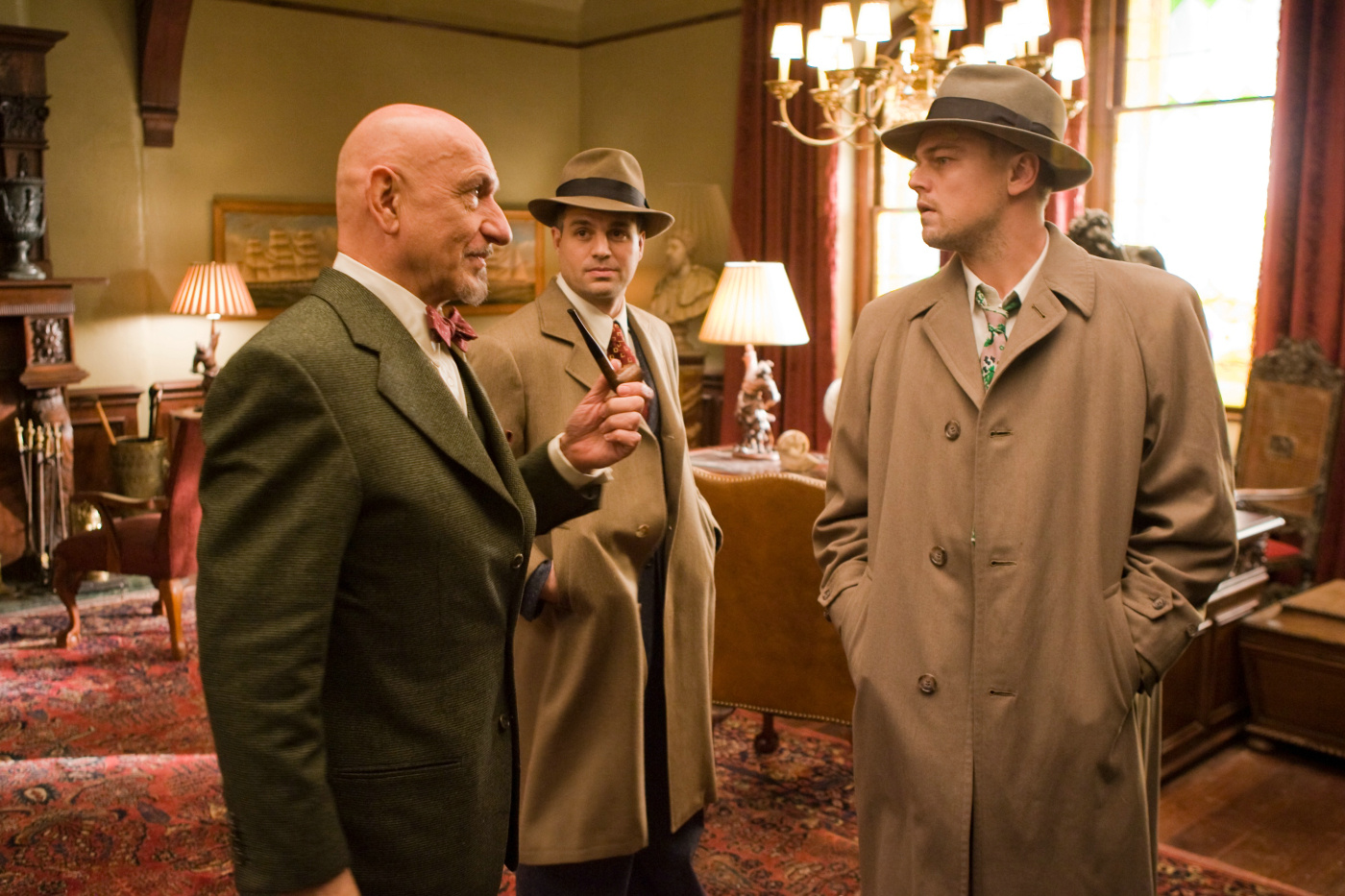
U.S. Marshal Teddy Daniels (Leonardo DiCaprio, right) and new partner
Chuck Aule (Mark Ruffalo, center) are immediately dissatisfied with the
information supplied by Dr. Cawley (Ben Kingsley); both detectives find the
psychiatrist too slick and much too condescending. The question, then,
revolves around what this unnaturally calm clinic head is hiding.

And not pleasantly.

Shutter Island is a period piece, set in 1954, and very much a product of its era. World War II remains a recent and highly disturbing memory, with reflexive suspicion directed toward German immigrants. Sen. Joseph McCarthy's red-baiting witch hunt and the House Un-American Activities Committee are uppermost on everybody's minds, as are fears about being vaporized by hydrogen bombs.

Against the paranoia of this Cold War backdrop, U.S. Marshal Teddy Daniels (Leonardo DiCaprio) and new partner Chuck Aule (Mark Ruffalo) are summoned to Ashecliffe Hospital, an isolated facility for the criminally insane located on Shutter Island, a rocky hiccup of land off the New England coast. (Filming actually took place on Peddocks Island, roughly 100 miles off Boston.)

The facility's directors, Dr. Cawley (Ben Kingsley) and Dr. Nauhring (Max von Sydow), have a disturbing problem: One of their patients — Rachel Solando (Emily Mortimer), a deranged woman who quietly drowned her three children, but even now believes that she and they are continuing their bucolic suburban lives — has disappeared from her cell. It's a classic locked room mystery: no way to get out, no way to get past several staffing and guard stations, and certainly no way to get off the island.

And yet she's gone.

Daniels, blessed with the sharpened awareness of a keen investigator, along with an intuitive ability to read people, senses hostility from the moment he and Chuck step off the only ferry that runs between Shutter Island and the mainland. The facility's armed guards are watchful and suspicious; the staff members, when gathered for interviews, are condescending and tolerantly amused.

Daniels knows they're lying to him, just as he knows that Rachel couldn't possibly have escaped ... at least, not without help.