Friday, March 15, 2013

The Incredible Burt Wonderstone: Hey, presto!

The Incredible Burt Wonderstone (2013) • View trailer 
3.5 stars. Rating: PG-13, for profanity, sexual candor, fleeting drug content and dangerous stunts
By Derrick Bang • Originally published in The Davis Enterprise, 3.15.13


Las Vegas magic acts — with their glitzy, overwrought buffoonery — are ripe for parody, and director Don Scardino attacks this subculture with verve, in The Incredible Burt Wonderstone.

Having discovered that his childhood idol is living in a retirement home, Burt
Wonderstone (Steve Carell, left) is delighted when Rance Holloway (Alan Arkin)
eventually consents to do a few tricks for the other residents.
Armed with a witty script that hits most of the right notes, Scardino demonstrates his own gift for prestidigitation, by shaping a gaggle of scene-stealing camera hogs into a well-balanced ensemble comedy troupe. That’s no small thing, when dealing with the likes of Steve Carell, Steve Buscemi and Jim Carrey, any one of whom could ruin a project by being too uninhibited ... and all have done so, in the past (in Carrey’s case, rather frequently).

Not this time. Scardino keeps his stars on point while also drawing deft supporting performances from Alan Arkin, James Gandolfini and Olivia Wilde. The latter, in particular, demonstrates an unexpected talent for comic timing that was nowhere to be seen in her token hottie roles in Tron: Legacy and Cowboys & Aliens. Given her work here, Wilde actually may have an acting career in her future.

The biggest miracle, though, is that this film’s script manages to stay reasonably well focused — and dead-on perceptive, as it skewers Vegas’ wretched excess — despite being a committee affair from four writers: Jonathan M. Goldstein, John Francis Daley, Chad Kultgen and Tyler Mitchell.

Gentlemen, my black top hat’s off to you.

Scardino clearly learned well from a long, Emmy Award-winning television career that has seen him helm shows as diverse as 30 Rock, Law & Order, Ed and even the wonderful Days and Nights of Molly Dodd. The common element: rich ensemble casts with characters we care about.

The story opens with a brief prologue in the early 1980s, as latchkey kid Burt (Mason Cook) celebrates a birthday by himself, forced by his working mother’s absence to bake his own cake (a droll and endearing touch that hints of great things to come). His one present: a celebrity magic set that will evoke strong memories from viewers who remember being a kid back in that era, when Marshall Brodien — as Wizzo the Wizard —hawked his “TV Magic Kit” of “mystifying tricks” on syndicated stations.

In this case, young Burt is awestruck by the kit’s videotape, wherein tuxedo-garbed Rance Holloway (Arkin) promises that magic can change one’s life. Burt, enchanted, starts pulling scarves out of thin air; his school time antics attract the attention of the similarly geeky — and bullied — Anton (Luke Vanek). The two become fast friends, energized by a desire to invent newer, fresher and ever more amazing tricks.

The Call: Better hang up!

The Call (2013) • View trailer 
Two stars. Rating: R, for violence, profanity and disturbing content
By Derrick Bang


This is a taut and tidy little thriller ... for awhile.

Unfortunately, the need to sustain the wafer-thin premise for 90 minutes prompts plot developments that are increasingly contrived, tawdry and — ultimately — downright stupid.

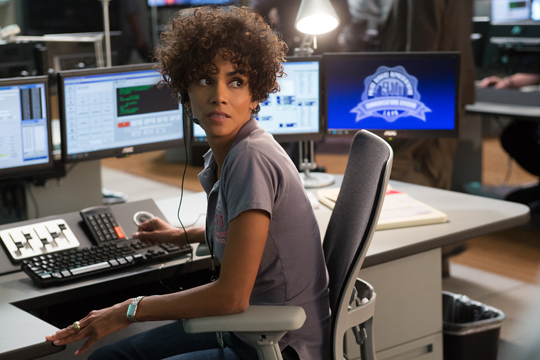
The calm before the storm: LAPD 911 operator Jordan Turner (Halle Berry) is good at
her job; indeed, she's one of the best. But all her training goes for naught when an
unknown nutjob goes on a serial kidnapping spree ... and worse. Alas, Jordan's
behavior will get pretty damn stupid by the time this numbnuts story concludes.
Not to mention exploitatively violent, with director Brad Anderson lingering almost lovingly on moments of gruesome death. By the time we hit the third act and its jaw-droppingly ludicrous conclusion, we’re firmly in the realm of exploitative trash.

Chalk up another dog on Halle Barry’s increasingly lamentable résumé. This woman has no taste or judgment whatsoever.

We also must wonder why anybody saw merit in Richard D’Ovidio’s brain-dead script, which feels like a one-sentence “What if” concept stretched far beyond its limits. I note that D’Ovidio had help from Nicole D’Ovidio and Jon Bokenkamp for the initial story, which staggers the imagination. It took three people to cobble together this laughable mess? The mind doth boggle.

That said, the first act is promising, as Anderson and cinematographer Tom Yatsko slowly swoop through the “hive” of the greater Los Angeles 911 call center, hovering over operators one by one, as they assess emergencies — and trivial nonsense — while logging details via an impressive computer interface. We finally come to rest on Jordan Turner (Berry), a crisp and efficient veteran who calmly handles everything that comes.

Including an inebriated “regular” who somehow seems to reach her whenever he desires. Which begs an obvious question — since I’m not aware that one has the option of requesting specific operators when dialing 911 — but hey, we’ll grant this rather odd detail for the sake of a quick smile.

The levity doesn’t linger, though, because Jordan’s next call comes from a terrified teenager who’s alone in her house as an intruder is breaking in. Jordan rises to the challenge, and one must credit Berry for navigating the escalating situation with a persuasive blend of calm and crisp efficiency; she does look and sound right for the part.

But it quickly becomes apparent — to us first, and then to Jordan and her increasingly concerned colleagues — that this is no mere burglary. This particular intruder’s intentions are far worse, and Jordan can only listen helplessly as the grim scenario unfolds.

A day or two later, the girl’s body is found.

Friday, March 8, 2013

Dead Man Down: The dish best served cold

Dead Man Down (2013) • View trailer 
3.5 stars. Rating: R, for profanity and considerable violence
By Derrick Bang


As I expected, David Fincher’s American remake of The Girl with the Dragon Tattoo completely eclipsed Danish director Niels Arden Oplev’s vastly superior 2009 version in this country ... and let me note, as well, that Noomi Rapace’s Lisbeth Salander blew Rooney Mara right off the screen.

Victor (Colin Farrell) thinks that the scarred Beatrice (Noomi Rapace) merely wishes to
go on a date, to forget — for an evening — the despair that has lingered in the wake
of the car accident that left her with such a crippled self-image. In fact, though, Beatrice
has chosen Victor for a very specific reason ... as he's about to learn.
Imagine my delight, then, to see that Oplev and Rapace have reunited for the former’s American film debut, with a riveting crime thriller that offers more of the intense, claustrophobic character interactions that marked their first collaboration.

Dead Man Down also owes much of its narrative snap to a slick script from J.H. Wyman, a writer/director/producer best known for a pair of engaging TV shows: Fringe and the woefully under-appreciated Keen Eddie. Wyman has a knack for provocative concepts, and he certainly delivers that — and more — in this new film.

The setting is contemporary, the locale the seedier underbelly of any American metropolis (filming took place in Philadelphia). Dead Man Down hits the ground running, with a gaggle of hoods summoned by their boss, Alphonse (Terrence Howard). Somebody is playing a nasty game with Alphonse, sending cryptic messages that arrive on the corpses of his men.

The newest oblique missive sends Alphonse and his gang to the lair of a local drug kingpin (Andrew Stewart-Jones, vividly compelling), which prompts a confrontation that doesn’t go at all well; indeed, Alphonse survives solely due to the timely intervention of Victor (Colin Farrell).

This clash doesn’t sit well with regional boss Lon Gordon (Armand Assante), who feels that Alphonse has gotten seriously out of line. A price will need to be paid. Alphonse scarcely registers this warning, obsessed instead with what these damned notes might mean.

Victor hasn’t much of a life outside his duties as protective gunsel, although he has bonded with fellow hood Darcy (Dominic Cooper), an ambitious fellow looking to work his way up the gangland ladder. After hours, Victor eats makeshift meals in a minimally furnished, upper-level apartment in a complex that might be one scant step up from slum projects. He occasionally spots an attractive young woman on the balcony of a similar apartment in the adjacent tower.

This time, however, their eyes lock. She tentatively wiggles her fingers in an almost-wave. After a lengthy pause, he does the same.

Oz, the Great and Powerful: Enchanting trip down the yellow brick road

Oz, the Great and Powerful (2013) • View trailer 
Four stars. Rating: PG, and rather generously, for considerable fantasy peril, scary scenes and brief profanity
By Derrick Bang • Originally published in The Davis Enterprise, 3.8.13


Disney got it right this time.

The Mouse House’s previous attempt to sequelize L. Frank Baum — a high-profile release in the summer of 1985 — was a dark and dreary affair, its rich Oz-ian landscape sabotaged by a grim atmosphere and a level of peril that bordered on child abuse. Opening Return to Oz with a sequence that finds little Dorothy sent to a primitive psychiatric ward, and nearly subject to electro-shock therapy? What the heck were the screenwriters thinking?

Having worked out a plan to steal the wicked witch's magic wand, thus removing her
ability to fight back, Oz (James Franco, right) and his two companions — Finley and
China Girl — wait for the proper moment to strike.
Oz, the Great and Powerful, in pleasant contrast, is a rich, imaginative and droll delight from start to finish. To be sure, its protagonists face their share of peril — the winged monkeys were the most terrifying part of 1939’s The Wizard of Oz, and that’s still true in this new film — but the tone is more appropriately adventure-scary, rather than psychologically twisted.

More to the point, scripters Mitchell Kapner and David Lindsay-Abaire — drawing from more of the rich material in Baum’s 1900 novel, The Wonderful Wizard of Oz — have fashioned a prequel that cleverly imitates the style and formula established by the beloved 1939 musical, while also laying the groundwork to anticipate key events in that earlier film’s storyline.

That’s no small accomplishment. Better still, director Sam Raimi and editor Bob Murawski pace their film perfectly, alternating essential character development with fantastical encounters both exhilarating and unnerving.

And — as was the case with Tim Burton’s recent re-boot of Alice in Wonderland, also for Disney — Raimi doesn’t slow the pace by pausing and calling attention to Oz’s myriad wonders; they’re simply present to be enjoyed, if even noticed the first time through. I predict hot home-video sales and plenty of repeat viewings, in order to spot and savor everything that production designer Robert Stromberg and visual effects supervisor Scott Stokdyk have packed into this film.

Heck, when a dozen or so “horses of a different color” graze quietly in a field — not even noticed by our main characters, let alone commented upon — you know that we’re in good hands.

The story, set in the early 20th century, begins roughly a generation before the events in the 1939 film. We’re once again in a small Kansas community — displayed in time-honored black-and-white, in a squarish, standard-frame image — this time in the shabby, sepia-toned “tent city” of a worn and seedy traveling carnival. Its various sideshow attractions include Oscar Diggs (James Franco), nicknamed Oz, a flashy stage magician and rake of dubious ethics who likely has a woman at every stop ... with an angry father or husband right behind her.

Friday, March 1, 2013

Quartet: A beautiful noise

Quartet (2012) • View trailer 
Four stars. Rating: PG-13, and quite stupidly, for fleeting profanity
By Derrick Bang • Originally published in The Davis Enterprise, 3.1.13


Music fills almost every frame of Quartet, whether created vicariously by this delightful story’s many talented characters, or delivered via Dario Marianelli’s evocative score, as a means to augment a reflective or dramatic moment.

Although Jean (Maggie Smith, right) initially refuses to become part of the musical
community at Beecham House, even she can't resist the kind, bubbly enthusiasm of
Cissy (Pauline Collins). But Jean also faces other issues, not the least of which is a
fellow resident who happens to be a long-estranged lover.
Dustin Hoffman’s thoroughly engaging directorial debut, working from Ronald Harwood’s adaptation of his own stage play, is another charming — if occasionally bittersweet — reminder that life need not end at 60, 70 or even 80. We’ve seen quite a few such films recently, and while it’s not true that Maggie Smith has been in all of them, she certainly dominates this one.

And that’s no small thing, given the cluster of scene-stealers with whom she shares the screen.

She stars as Jean Horton, a once-celebrated opera vocalist fallen on hard times, whose career is naught but a fading memory; she now must swallow her pride and accept government-supported lodging at Beecham House, a retirement home for musicians. But we don’t meet her right away; Harwood first introduces us to the celebratory warmth and magic of Beecham itself, which echoes morning to night with the rich sounds of pianos, strings, woodwinds and quite a few other orchestral instruments, along with plenty of singing.

Beecham’s residents are a bit more a-flutter than usual, because they’ll soon be performing in the retirement home’s annual fundraiser, timed to celebrate the birthday of famed opera composer Giuseppe Verdi. The event is being helmed by the imperious Cedric Livingston (Michael Gambon), a fussy, fusty martinet who lounges about in day robes and barks commands like a traffic cop.

He’s the only Beecham resident who doesn't make his own music, and thus exemplifies the punch line of that venerable saying: Those who can’t, direct. But nobody seems to mind; Cedric merely clings to the remnants of the career he knows best, as they all do.

Contrasting Cedric is Reginald (Tom Courtenay), a calm, quiet and emotionally withdrawn scholar who gives occasional lessons in opera history to local teenagers. Harwood grants us a glimpse of one such session, and it’s utterly enchanting; we expect poor Reggie to be overwhelmed by these kids, but in fact his gentle but authoritative delivery holds their attention — and ours — as he considers the intriguing similarities between opera and rap.

Jack the Giant Slayer: A massive disappointment

Jack the Giant Slayer (2013) • View trailer 
Three stars. Rating: PG-13, for intense fantasy action violence, frightening images and fleeting profanity
By Derrick Bang


We’ve recently had two rounds of Snow White, not to mention re-imagined takes on Red Riding Hood and Hansel and Gretel, and now Warner Bros. has taken a crack at Jack and his beanstalk.

What’s next ... Clever Hans? The Fox and the Geese?

After Jack (Nicholas Hoult, right) comes up with a clever plan to distract a giant that is
blocking their escape, the stalwart lad and his companions — Elmont (Ewan McGregor)
and Isabelle (Eleanor Tomlinson) wait to see if the scheme will work.
Hollywood’s current fascination with fairy tales seems a logical next step after spinning so much box-office gold from comic book superheroes, but one does wish for material that’s more mature, rather than less. Aside from its marvelous CGI giants — and one helluva weed — Jack the Giant Slayer is a curiously clumsy and vacuous affair.

The screenplay — a patchwork affair credited to Darren Lemke, David Dobkin, Christopher McQuarrie and Dan Studney — has no moral whatsoever, which seems an odd way to approach this venerable English folktale. The characters, both good and evil, are handled haphazardly, with little regard for satisfying plot structure. Good guys get dispatched hastily and pointlessly, not even granted a chance to perish in an act of noble self-sacrifice; villains also check out too quickly, at unsatisfying junctures in this protracted narrative.

The whole film feels like a committee affair, as if the four writers squabbled and then grudgingly allowed each contributor’s favorite bit to get stitched into the final result.

The first-act build-up isn’t bad, with farm lad Jack (Nicholas Hoult) chafing over his dull life, as he works the land outside the 12th century fortified English city of Cloister. He seeks escape in the books once read aloud by his father, now dead: particularly the grim legend about the massive creatures who exist in a fearsome realm hovering between Heaven and Earth.

Elsewhere in the kingdom, headstrong Princess Isabelle (Eleanor Tomlinson, perhaps remembered from 2010’s Alice in Wonderland) feels equally confined, thanks to an overly protective father — Ian McShane, as King Brahmwell — who refuses to let her mingle with the common folk. Worse yet, she has been betrothed to the smarmy Roderick (Stanley Tucci), whose frequent sneers suggest far less than a noble heart.

Roderick has come into possession of the magic beans that are capable of growing a massive beanstalk to Gantua, the giants’ realm of lore, these days regarded as little more than a myth. Roderick intends to control said giants and rule the land, but a guardian monk manages to steal back the beans, which in turn are passed along to Jack. He and Isabelle “meet cute” — the second time, actually — during a stormy night when, clandestinely out and about, and seeking shelter from the rain, she happens upon Jack’s rustic house. (Such a coincidence!)

Friday, February 22, 2013

Snitch: An engaging surprise

Snitch (2013) • View trailer 
3.5 stars. Rating: PG-13, for violence and drug content
By Derrick Bang • Originally published in The Davis Enterprise, 2.22.13


Despite what’s suggested by the publicity art, Snitch is not another shallow action flick, but instead a grim, thoughtful and quite tense drama about an honest man’s foolish and extremely dangerous descent into the forbidding world of narco-trafficking.


Having done his part, by exposing an exchange made by a mid-level drug dealer,
John (Dwayne Johnson, right) is surprised when this isn't enough for U.S. Attorney
Joanne Keeghan (Susan Sarandon). She's after bigger fish, even though DEA agent
Billy Cooper (Barry Pepper) insists this would put John in far too much danger.
It's also an impressive step forward for star Dwayne Johnson, mostly known until now for, well, shallow action flicks. Until this moment, his notion of “playing against type” meant silly comedies and family-friendly adventures along the lines of Tooth Fairy and Journey 2: The Mysterious Island. His work here is in another league entirely, demonstrating acting chops that few would have expected.


Don’t expect Johnson to bust heads and wreak havoc, the way he has done since TV wrestling shows granted access to the likes of The Scorpion King and the remake of Walking Tall. Writers Justin Haythe and Ric Roman Waugh go for credible drama here, and while the results certainly fall short of, say, Traffic, Waugh — also serving as director — ably delivers a believable cautionary tale along the lines of Midnight Express.


I’d like to believe that at least a few naïve and stupid teenagers might think twice about their own ill-advised activities, after watching this consequence-laden saga.


Life-changing disaster arrives in the blink of an eye, as this film begins, when 18-year-old Jason (Rafi Gavron) foolishly accepts delivery of a package, as a “favor” to a friend, knowing full well that the box is filled with illicit drugs. The thing is, Jason never quite agrees to this scheme, but he does sign for the package. And then he opens it, at which point he’s busted in a police sting.


The “friend” rolls over on him immediately, and suddenly Jason faces a mandatory minimum sentence of 10 years in a federal prison. His only avenue toward earlier release would involve deliberately setting up other friends and classmates, perhaps even fabricating evidence — against people he’s not even sure do drugs — and that’s an act of betrayal he’s not willing to commit.


(One cannot help hearing echoes of the post-WWII House Un-American Activities Committee trials, with their — often successful — attempts to persuade Hollywood directors, producers and writers to “rat out” fellow Communists, lest their own careers be destroyed. Breeding a culture of state-enforced snitches never produces a healthy social dynamic.)